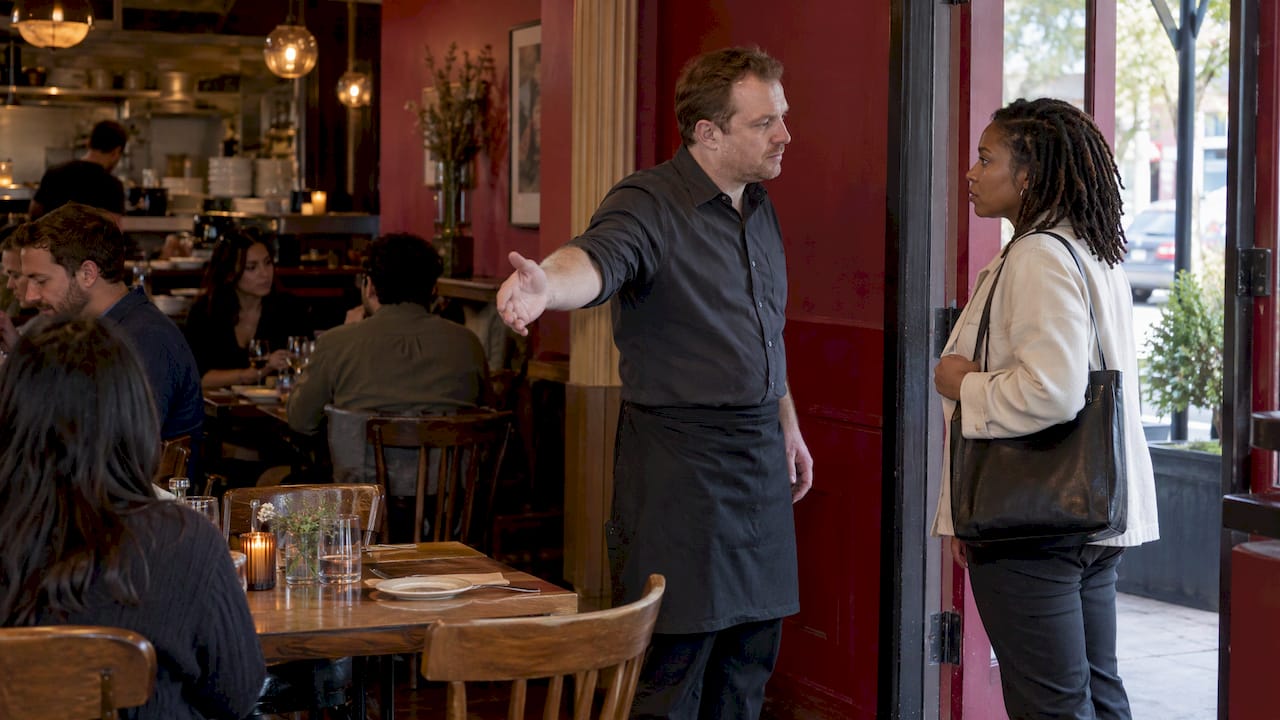
A customer who is refused service, seated apart, charged more or turned away at a restaurant, hotel or store because of race, religion, national origin or disability may bring a civil claim. The available remedy depends on the statute invoked. Federal law supports a lawsuit to stop the conduct, while several state statutes, California’s Unruh Civil Rights Act chief among them, also permit damages. The forum, the deadline and the evidence preserved in the first days frequently decide the outcome. Javitch Law Office represents clients in discrimination matters, and most such cases are handled on a contingency-fee basis, so the client pays nothing unless there is a recovery.
TL;DR
- Federal Title II of the Civil Rights Act of 1964 covers restaurants, hotels and certain other venues, and bars discrimination based on race, color, religion or national origin.
- A private plaintiff under Title II may seek a court order ending the discrimination, but not money damages. State laws, such as California’s Unruh Act, can add statutory damages and attorney’s fees.
- Administrative deadlines vary widely: 180 days in some states, 300 days in others, one year before the California Civil Rights Department.
- Receipts, photographs, messages and witness names collected immediately after the incident are the foundation of any claim.
- Most Javitch Law Office discrimination matters are handled on contingency, and the firm offers direct attorney contact and nationwide federal court admissions.
Table of Contents
- What the law covers: restaurants, hotels, stores and other public accommodations
- What discriminatory conduct looks like in practice
- Can a customer sue? Federal routes and their limits
- State law: where damages become available
- Deadlines: two clocks may run at once
- Evidence to preserve
- Filing: administrative complaint, lawsuit, or both
- What a recovery can include
- Related matters that arise in the same settings
- Perspective: why representation matters in these cases
- Speaking with Javitch Law Office
- FAQ
- Sources
What the law covers: restaurants, hotels, stores and other public accommodations
The legal term for a business open to the general public is a public accommodation. Under Title II of the Civil Rights Act of 1964 (42 U.S.C. § 2000a), all persons are entitled to full and equal enjoyment of the goods, services, facilities and privileges of covered establishments without discrimination on the ground of race, color, religion or national origin. The covered list includes hotels and motels lodging transient guests, restaurants and other facilities principally selling food for consumption on the premises, gasoline stations, and places of exhibition or entertainment, where their operations affect commerce.
The statute is narrower than many customers assume. The Justice Department’s Title II flyer states that the law does not reach every business open to the public: a retail store without public areas where customers buy and consume food is not covered. A store discrimination claim therefore frequently proceeds under a state statute, or under the disability provisions described below, rather than under Title II.
Disability
Disability is addressed separately. Under the ADA Title III regulations at 28 C.F.R. Part 36, no individual may be discriminated against on the basis of disability in the full and equal enjoyment of a public accommodation’s goods, services and facilities. Public accommodations must make reasonable modifications to policies, practices or procedures unless doing so would fundamentally alter the nature of the goods or services.
State law often reaches further
State statutes commonly add protected categories and cover more businesses. Wisconsin lists fitness centers, retail stores, taverns, restaurants, salons, hotels and movie theaters, and protects categories such as sex, ancestry, sexual orientation and disability. Missouri additionally prohibits retaliation for filing a complaint and protects against discrimination based on association. California’s Unruh Act, discussed below, is among the broadest.
What discriminatory conduct looks like in practice
The Indiana Civil Rights Commission describes recurring patterns: refusing to serve a person because of race or national origin, denying service because of disability, refusing entry because of religion, providing different services or seating, and charging higher prices because of a protected characteristic. The Pennsylvania Human Relations Commission gives the example of a restaurant refusing to serve a customer wearing religious headgear.
Not every refusal is unlawful. The Indiana commission notes that a business may decline service for non-discriminatory reasons, such as disruptive or unsafe behavior or violation of reasonable policies. A claim is strongest where the record shows that the stated reason does not account for the treatment, for instance where comparable customers outside the protected group were served without difficulty.
| Setting | Typical conduct | Principal sources of law |
|---|---|---|
| Restaurant | Refusal of service, segregated seating, higher prices, refusal to accommodate a service animal | Title II; ADA Title III; state public accommodation statutes |
| Hotel or motel | Denial of a room, different rates or terms, inaccessible rooms | Title II; ADA Title III; state statutes |
| Retail store | Profiling, refusal of service, inaccessible entrances | State statutes; ADA Title III; Title II only where the premises are covered |
| Entertainment venue | Denial of entry, discriminatory seating | Title II; ADA Title III; state statutes |
Can a customer sue? Federal routes and their limits
Yes. The Justice Department states that a customer who believes a public accommodation discriminated against them may bring a private lawsuit. The U.S. Commission on Civil Rights adds that a customer may file a complaint with the Civil Rights Division or the local U.S. attorney, or file suit in U.S. district court.
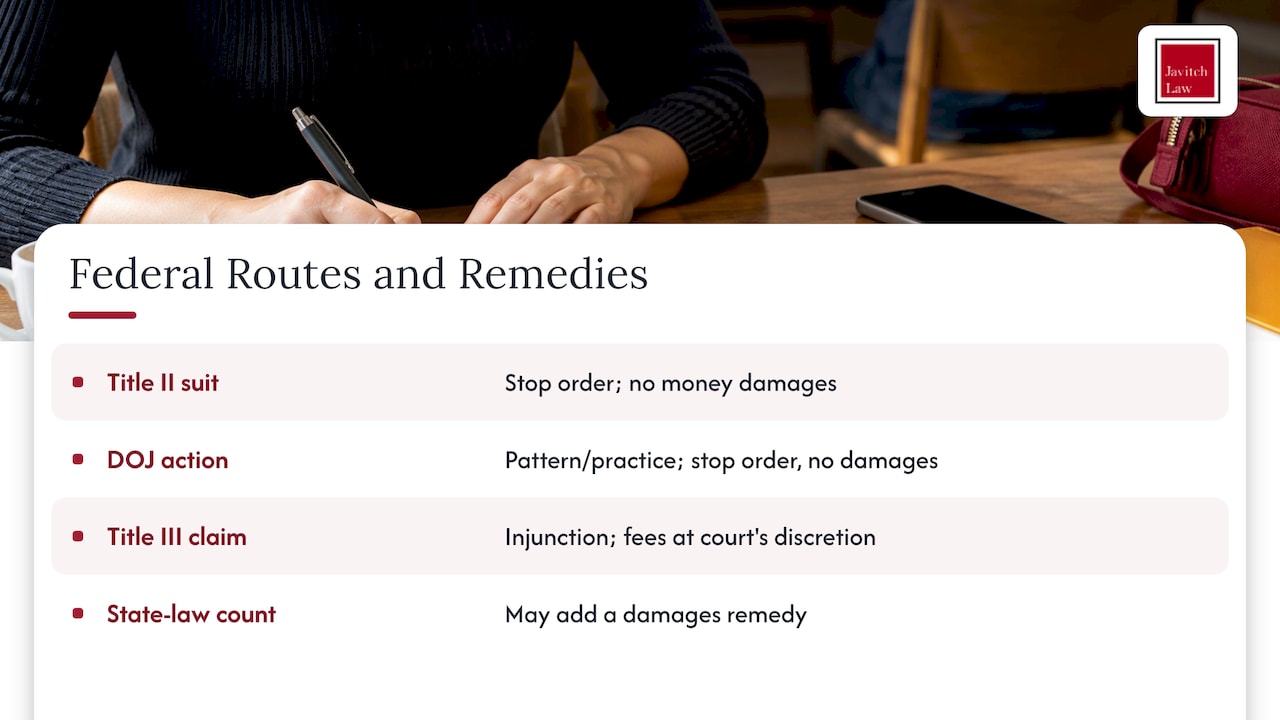
The remedy is the limiting feature. Under Title II, a private plaintiff may seek an order to stop the discrimination but cannot obtain money damages. The Justice Department’s own enforcement is similar: its info sheet explains that it generally acts on a “pattern or practice,” meaning more than one incident, such as a discriminatory policy or frequent incidents, and may seek an order requiring the business to stop, though not damages for victims. Reports can be submitted online at civilrights.justice.gov.
For disability claims, the Southwest ADA Center explains that a person may file a Title III complaint with the Justice Department or sue in federal court without first filing a complaint. The traditional private remedy is injunctive relief, such as an order to make a facility accessible, with attorney’s fees at the court’s discretion. Because Title III is silent on limitations periods, federal courts borrow the most analogous state period, which differs from state to state.
The practical consequence is that the strongest civil rights claims frequently combine a federal count with a state-law count carrying a damages remedy.
State law: where damages become available
California’s Unruh Civil Rights Act
The California Civil Rights Department explains that the Unruh Act protects customers of business establishments on the basis of race, ancestry, religion, age 40 or over, disability, sex or gender, sexual orientation, gender identity, medical condition, genetic information, marital status, military or veteran status, and primary language, citizenship or immigration status. Remedies include up to three times actual damages and no less than $4,000 per offense, out-of-pocket expenses, cease-and-desist orders, emotional-distress and punitive damages, and attorney’s fees and costs.
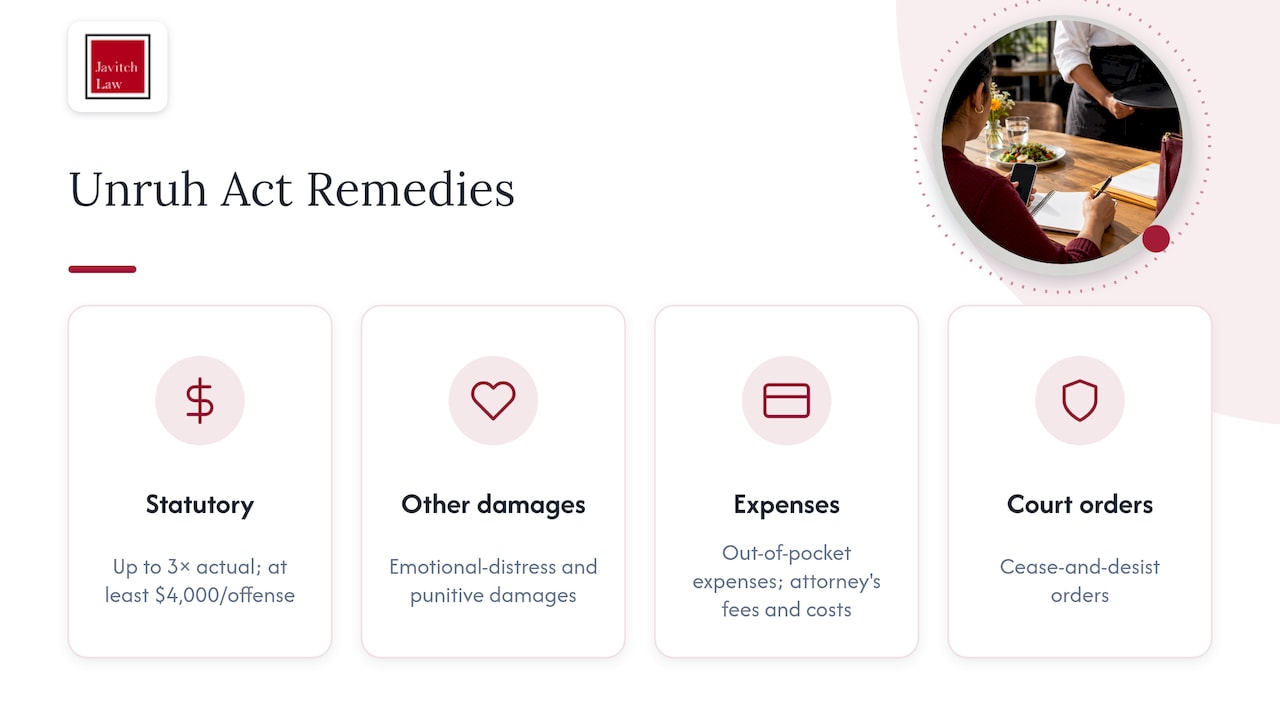
The statutory minimum matters because a customer need not prove a large financial loss to bring a viable claim, and the fee-shifting provision makes representation on contingency feasible. We discuss the minimum and how to preserve the claim in our article on the $4,000 Unruh Act minimum, and the wider framework in public accommodations discrimination in California.
The District of Columbia
D.C. Law 25-300, effective March 21, 2025, extended the deadline for filing a discrimination claim in court from one year to two years after the unlawful act or its discovery. It also allows withdrawal without prejudice of certain administrative complaints and clarifies that complainants may be entitled to compensatory damages and reasonable attorneys’ fees. Where a complaint is withdrawn before the investigation is complete, or dismissed on specified grounds, suit must be filed within 90 days after notice of the right to file or within the remaining limitations period, whichever is longer.
Other states
Remedies, protected categories and procedures differ in every state. Massachusetts, Maryland, New Jersey, Colorado, Delaware and Nebraska each have their own statutes and agencies, and Javitch Law Office practices in those jurisdictions as well as in California and the District of Columbia. A claim arising in another state is evaluated against that state’s law.
Deadlines: two clocks may run at once
Administrative and judicial deadlines frequently run in parallel, and they are shorter than most customers expect.
| Jurisdiction | Deadline stated by the official source |
|---|---|
| California | Unruh complaint to the Civil Rights Department within one year; private lawsuit generally within two years (some courts apply three, depending on the claim); the lawsuit deadline is paused while a Civil Rights Department complaint is pending (CRD) |
| Massachusetts | MCAD complaint within 300 days of the last discriminatory act (MOLA-MCAD guidebook, May 2025) |
| Wisconsin | 300 days to file a complaint (DWD) |
| Pennsylvania | 180 days to file with the PHRC (PHRC) |
| North Dakota | 180 days from the last date of harm (Department of Labor and Human Rights) |
| District of Columbia | Two years for a court claim, for acts after the March 2025 amendment (D.C. Law 25-300) |
The Massachusetts guidebook adds that investigations average 18 to 24 months, and that a person within 72 hours of the deadline should call (617) 994-6000 for emergency intake. Deadlines are applied strictly. A customer who is unsure which one governs should consult an attorney promptly, and the safest course is to count from the date of the incident, not the date the conduct was recognized as unlawful.
Evidence to preserve
The Pennsylvania commission advises preserving text messages, pictures and receipts that may support a complaint. The same principle extends to the other materials a discrimination claim ordinarily turns on:
- A written account made the same day. Record the date, time, location, the names or descriptions of staff, and the exact words used.
- Receipts, reservations and confirmations. These establish that the customer was present and what was ordered or booked.
- Photographs and video. Signage, seating arrangements, posted policies and inaccessible features.
- Witnesses. Names and contact details of companions and other patrons.
- Online material. Screenshots of reviews, social media replies, booking-page messages and the business’s stated policies.
- Comparators. Notes on how similarly situated customers outside the protected group were treated.
Retaliation is itself prohibited in states such as Pennsylvania and Missouri, so any later hostile response from the business should be recorded in the same manner. Our guide on how to document discrimination and preserve evidence sets out the process in greater detail, including why the first weeks matter.
Filing: administrative complaint, lawsuit, or both
A customer generally has three paths, which are not mutually exclusive:
- A federal complaint to the Civil Rights Division or the local U.S. attorney, which can lead to enforcement, chiefly where a pattern is present.
- A state agency complaint. Agencies such as MCAD accept complaints at no cost and without legal representation, but the process is investigative: the North Dakota department, for example, describes investigation, conciliation, a probable-cause determination and, if unresolved, an administrative hearing to set the remedy.
- A civil action in state or federal court, which is the route to damages where state law provides them.
The choice affects timing. In California, filing with the Civil Rights Department pauses the private-lawsuit deadline, while in some states an agency proceeding must be completed or a right-to-sue notice obtained first. A claim that combines a federal injunction request with a state damages claim is generally filed in court.
What a recovery can include
The categories of relief depend on the statute:
- Injunctive relief: an order requiring the business to cease the discriminatory practice, adopt a policy change or remedy an access barrier.
- Statutory damages: in California, no less than $4,000 per offense under the Unruh Act.
- Actual and emotional-distress damages: available under statutes such as the Unruh Act and, in the District of Columbia, compensatory damages.
- Punitive damages: available under the Unruh Act.
- Attorney’s fees and costs: provided by the Unruh Act and the District of Columbia statute, and discretionary in ADA Title III actions.
The amount in any particular case turns on the facts, the jurisdiction and the evidence, and no outcome can be promised in advance.
Related matters that arise in the same settings
Customers who experience bias at a business often face connected issues. Where the treatment was tied to national origin, see our overview of national origin discrimination. Where the conduct targeted a hairstyle associated with race, see California’s hair discrimination statutes. An employee, as opposed to a customer, should read about racial harassment at work, because workplace claims follow different agencies and deadlines.
Perspective: why representation matters in these cases
Customers who are mistreated at a restaurant, hotel or store often assume that the matter is too small to pursue. The statutes suggest otherwise. State laws such as the Unruh Act attach a statutory minimum and fee-shifting to a single discriminatory act precisely so that individuals can enforce them without bearing the cost alone.
Our approach is to take cases that larger firms avoid and to pursue claims that others have abandoned. Clients have direct contact with an attorney, our admissions to federal courts extend nationwide, and most discrimination matters are handled on a contingency-fee basis under which the client pays nothing unless there is a recovery.
The early record is where we can be of most use. A prompt evaluation identifies the governing statute, the applicable deadline and the combination of federal and state claims that preserves the broadest relief.
Mark
Speaking with Javitch Law Office
Javitch Law Office is a California-based civil rights firm with a nationwide reach, and its discrimination practice includes religious, racial and student discrimination, as well as discrimination in public accommodations. A personalized case evaluation addresses the facts of the incident, the evidence available and the deadlines that apply. Customers can review the firm’s discrimination practice area and request a free consultation.
The same firm handles consumer matters that sometimes accompany a bad experience with a business, such as junk fees and surprise subscription renewals, as well as TCPA claims for unwanted robocalls.
FAQ
Can a customer sue a restaurant for discrimination?
Yes. Title II of the Civil Rights Act permits a customer to bring a private lawsuit when a covered restaurant discriminates on the basis of race, color, religion or national origin. The federal remedy is a court order to stop the discrimination, and state laws may add damages and attorney’s fees.
Does the same law apply to hotels and stores?
Hotels and motels that lodge transient guests are expressly covered by Title II. Retail stores are covered by Title II only in limited circumstances, but state public accommodation statutes and the ADA frequently apply to them.
How long do I have to file?
The period depends on the forum and the state. Examples include 180 days in Pennsylvania and North Dakota, 300 days in Massachusetts and Wisconsin, and one year for a California Civil Rights Department complaint. Acting within weeks of the incident avoids any question.
Can I recover money damages?
Not under Title II, which provides for a court order only. Under California’s Unruh Act, remedies include no less than $4,000 per offense, together with actual, emotional-distress and punitive damages and attorney’s fees, and the District of Columbia statute allows compensatory damages and fees.
What should I do first after an incident?
Write down what happened the same day, keep receipts and confirmations, photograph relevant signage or conditions, and collect witness details. Then arrange an evaluation so the deadline that governs your claim can be identified.
Sources
- Title II of the Civil Rights Act, Civil Rights Division
- Title II flyer, U.S. Department of Justice
- Title II info sheet, U.S. Department of Justice
- 28 C.F.R. Part 36, eCFR
- Getting Uncle Sam to Enforce Your Civil Rights, U.S. Commission on Civil Rights
- Southwest ADA Center legal e-bulletin, June 2010
- Discrimination at Business Establishments, California Civil Rights Department
- D.C. Law 25-300
- Refusal of Service and Discrimination, Indiana Civil Rights Commission
- Discrimination in Public Places of Accommodation, Wisconsin DWD
- Discrimination in Places of Public Accommodations, Missouri Department of Labor
- Public Accommodation Protections, Pennsylvania Human Relations Commission
- Public Accommodation, North Dakota Department of Labor and Human Rights
- MOLA-MCAD guidebook, May 2025