
If you believe you’re being discriminated against at work, start a dated incident log on a personal device or in a notebook you keep at home tonight. Save or screenshot every relevant message. If you report anything to HR or a supervisor by phone or in person, follow up within hours with a dated email restating what you said. That single habit protects both your evidence and your legal deadlines.
TL;DR:
- Maintaining a detailed, incident-specific log with date, time, location, and exact words is essential for evidence, especially when supported by preserved emails and records.
- Store copies of all evidence on personal devices or cloud services rather than employer-controlled systems to prevent potential loss or deletion.
- Filing deadlines vary: 180 days for most EEOC claims, extended to 300 days in some states, with federal employees needing to report within weeks and specific agency windows.
- Comparative evidence showing more favorable treatment of coworkers outside protected classes strengthens a discrimination case, especially for disparate treatment claims.
- Organize and back up all communications and reports immediately, as delayed documentation introduces challenges and reduces case strength.
Table of Contents
- How do you document discrimination at work?
- Where should you keep discrimination evidence safe?
- Where do you report workplace discrimination?
- What are the deadlines for filing a discrimination claim?
- What do lawyers look for in discrimination evidence?
- What should you prioritize first when documenting discrimination?
- How can Javitch Law Office help you build your case?
- Where can you file a discrimination complaint?
- Sources
How do you document discrimination at work?
Document discrimination the way an investigator would want to see it: dated, specific, and free of guesswork. Each incident log entry should read like a short police report, not a diary entry.
For every incident, write down:
- The date, time, and exact location
- Who was present, including their job titles
- What was said or done, in as close to exact words as you can recall
- Any witnesses and how to reach them
- What happened immediately afterward (a warning, a demotion, silence)
Beyond the log itself, gather the paper trail your employer already generates. Performance reviews, write-ups, pay stubs, and shift schedules can reveal patterns, like a sudden drop in ratings right after you disclosed a disability or requested religious accommodation. Electronic records matter just as much: emails, Slack or Teams messages, text threads, calendar invites, and photos of anything physical, such as a discriminatory posting on a breakroom wall.
One category deserves special attention: comparative evidence. If a coworker outside your protected class committed a similar infraction and kept their job, or got the promotion you were denied, that comparison often becomes the backbone of a disparate treatment claim. Note names, dates, and outcomes for anyone in a similar role who was treated more favorably.

Where should you keep discrimination evidence safe?
Never store your evidence exclusively on a work laptop, company email account, or shared drive. Employers generally have the right to access and even wipe those systems, and a locked-out account can erase months of documentation overnight.
Keep copies on a personal phone, a personal cloud account, or an external drive at home. Print PDFs of key emails and reviews as a physical backup. Redundancy costs you ten minutes and can save a case.
A few cautions matter here too. Recording laws vary by state, and some require consent from everyone in the conversation, so check your state’s rules before hitting record on a conversation. Don’t access confidential personnel files or coworkers’ private data to build your case; that can create a counterclaim that undermines your credibility.
Pro Tip: After any verbal complaint to HR or a manager, send a same-day email that reads something like, “Following up on our conversation this afternoon about…” This creates a dated written record even when your employer never responds.
Where do you report workplace discrimination?
Reporting internally first usually strengthens your case. It creates an official record and can trigger retaliation protections if your employer punishes you afterward. Document the report itself: who you told, when, and what response you got.
From there, your external options depend on who you work for and what kind of discrimination you’re facing:
- EEOC: Most private and public employees start with the Equal Employment Opportunity Commission, which requires a charge before you can sue under most federal discrimination laws. Filing starts through its Public Portal.
- State FEPA: Many states run their own Fair Employment Practices Agency, which can dual-file your complaint with the EEOC automatically. USA.gov’s guide to reporting workplace discrimination walks through this option.
- OCR: Students facing discrimination in a school or university program generally file with the Department of Education’s Office for Civil Rights.
- DOL/CRC: If your claim involves a program receiving federal financial assistance, the Department of Labor’s Civil Rights Center may be the correct venue.
Before filing anywhere, organize your timeline, gather your documents, and consider talking to an attorney. Keep copies of every form you submit and every reply you get back.
What are the deadlines for filing a discrimination claim?
Deadlines are where good documentation pays off, because your incident log is often the only reliable way to pinpoint when the clock started.
For most EEOC charges, you generally have 180 days from the discriminatory act, extended to 300 days in states with their own fair employment agency. The Equal Pay Act works differently and doesn’t require an EEOC charge at all before suing.
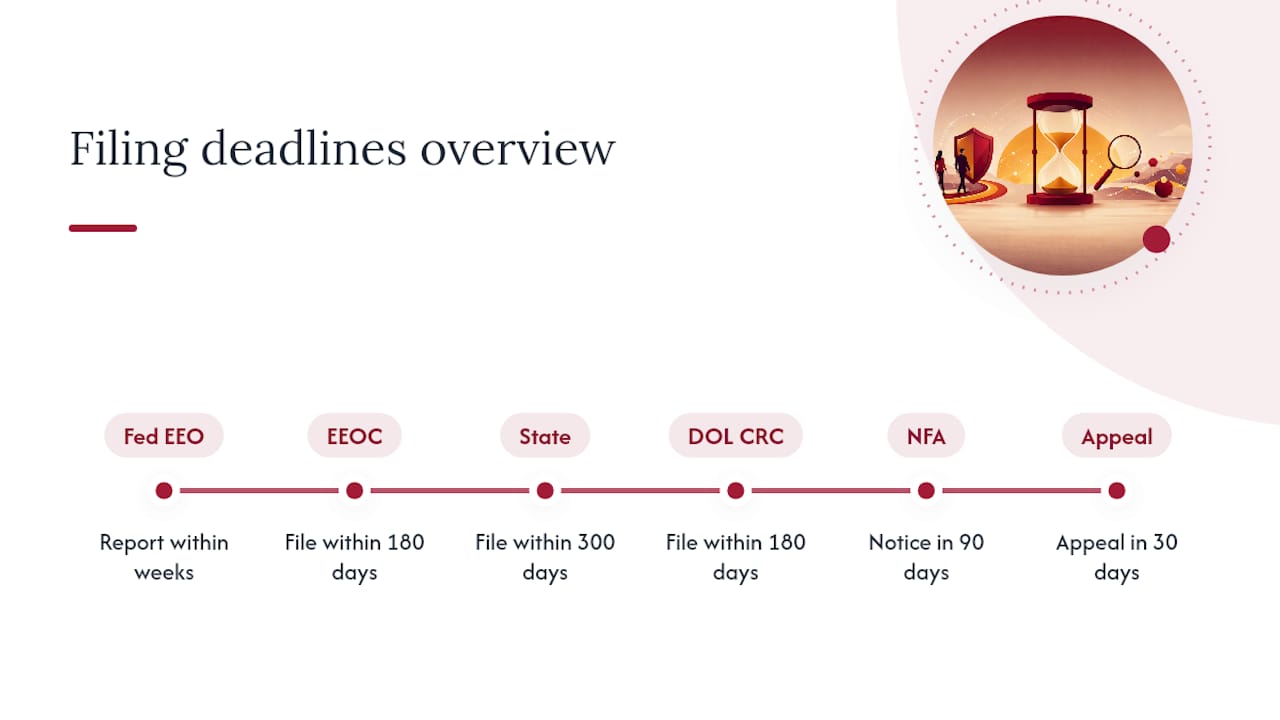
Federal employees must report discrimination to their agency’s EEO office within a relatively short deadline of several weeks. For complaints routed through the DOL Civil Rights Center, the filing window is typically 180 days, recipients must issue a Notice of Final Action within 90 days, and you generally have 30 days to appeal that decision to CRC.
What do lawyers look for in discrimination evidence?
Attorneys build cases around exactly the material described above: a contemporaneous incident log, preserved emails and messages, performance records, and comparator evidence showing how others were treated.
Timelines matter because they reveal patterns a single complaint can’t. A demotion that follows three weeks after you file an internal complaint looks very different from one that happens in isolation, and that sequence is often central to hostile work environment or retaliation theories.
Certain moments call for a consultation sooner rather than later:
- You’ve been threatened with termination or already received formal discipline
- Multiple states or federal agencies might have jurisdiction over your claim
- You suspect your employer might delete or alter records tied to your case
When you reach out to a firm like Javitch Law Office, bring your organized timeline, your saved communications, and the names of anyone who witnessed what happened. That combination tells an attorney within minutes whether you have a viable claim and what it might take to pursue it.
What should you prioritize first when documenting discrimination?
Secure your evidence before you do anything else. Get your incident log started, back up your communications somewhere your employer can’t touch, and document every internal report the same day you make it. Those three habits protect more claims than any single piece of legal knowledge.
The mistakes I see most often are avoidable. People wait weeks to write anything down, relying on memory that fades and gets challenged in court. They store everything on a company laptop that gets seized the day they’re terminated. And they write logs full of emotional conclusions like “my boss is racist” instead of specific, factual observations a judge or investigator can actually verify.
Fix those three habits and you’ve already done more than most people who walk into an attorney’s office with a discrimination claim.
— Mark
How can Javitch Law Office help you build your case?
Javitch Law Office handles workplace, student, and religious discrimination cases, along with antisemitic and racial discrimination claims, on a contingency basis, meaning you generally pay nothing unless the firm recovers on your behalf.
If you’ve been keeping a log, saving your messages, and following up verbal reports with dated emails, you already have the raw material a case gets built on. What you need next is someone who knows how to read that material and turn it into a legal strategy, whether that means a demand letter, an EEOC charge, or a lawsuit.
Bring your timeline, your saved documents, and the names of any witnesses to a free case review. Javitch Law Office’s workplace discrimination attorneys will tell you honestly whether your evidence supports a claim and what your realistic options look like from there.
Where can you file a discrimination complaint?
Start with the EEOC Public Portal for most workplace claims, the DOL Civil Rights Center for federally funded programs, or your state FEPA for dual-filing options.
This article is general information, not a substitute for advice from a qualified lawyer. Consult a qualified legal professional about your own circumstances before acting on anything here.
Sources
- Filing A Charge of Discrimination | U.S. Equal Employment Opportunity Commission
- How to File a Complaint | U.S. Department of Labor Civil Rights Center
- DOL CRC FAQs
- Usa