
Federal agencies must respond to a FOIA request within 20 working days of the date the office holding the records receives it. That’s the law, plain and simple. Agencies can tack on 10 more business days if they hit “unusual circumstances,” but they have to tell you when they do it.
Here’s the catch: that legal deadline and the real-world wait are often two different things. Complex requests routinely blow past both numbers, sometimes stretching into months or years.
If you’ve already filed a request and the silence is dragging on, do these three things now:
- Confirm you sent the request to the correct component office, not just the agency’s general mailbox
- Call or email the FOIA office and ask for your tracking number and current status
- Consider whether your situation qualifies for expedited processing
The 20/10 rule in short: 20 working days is the statutory clock. Add 10 business days if the agency invokes unusual circumstances. That’s 30 working days, maximum, under normal rules. Anything beyond that means either the agency is behind or something else is going on.
Key Takeaways
FOIA sets a 20 working-day response deadline with a possible 10-business-day extension, but GAO data shows most complex requests take far longer, making narrow drafting and early escalation the two moves that matter most.
| Point | Details |
|---|---|
| Know your legal deadline | Agencies must determine a response within 20 working days, plus up to 10 more for unusual circumstances. |
| Expect delays on complex requests | Only 14% of complex requests were processed within 20 days in fiscal year 2022, per GAO. |
| Draft narrow to move faster | Specific dates, record types, and named custodians route requests into faster processing tracks. |
| Escalate before you litigate | Administrative appeals and OGIS mediation resolve many delays without a lawsuit. |
| Get legal help for prolonged delays | Javitch Law Office handles FOIA litigation, Vaughn index challenges, and Glomar response disputes for stalled or denied requests. |
Table of Contents
- FOIA Response Time Rules: The 20-Day Clock, Extensions, and Expedited Processing
- Why FOIA Requests Take Longer Than the Law Promises
- Cutting Your FOIA Wait Time: What Actually Works
- What to Do When FOIA Responses Are Delayed or Denied
- When It’s Time to Call a FOIA Lawyer
- Editorial Take: What the Rules Actually Tell You to Do
- Get Help When Your FOIA Request Stalls
- Where to Verify FOIA Timelines and Get Agency Contacts
- Sources
FOIA Response Time Rules: The 20-Day Clock, Extensions, and Expedited Processing
The Freedom of Information Act, codified at 5 U.S.C. § 552, sets the baseline: agencies must determine whether to comply with a request and notify the requester within 20 working days of receipt by the office that actually holds the records. The Department of Homeland Security echoes this standard in its own FOIA processing guidance, noting that the 20-day window covers the determination, not necessarily the moment documents land in your inbox. Those are separate milestones, and agencies sometimes announce a decision well before they finish releasing everything.
Three things can stretch that timeline legally:
- The unusual circumstances extension. Agencies can add 10 business days when they need to search multiple field offices, sort through a large volume of records, or consult with another agency about the request. They’re required to notify you in writing when they invoke this.
- Fee tolling. If there’s a dispute over fees or the agency needs clarification about scope, the clock can pause, sometimes indefinitely, until that’s resolved.
- Track assignment. Foia explains that agencies generally process requests in the order received within a given track, and simple requests move through a faster lane than complex ones.
Expedited processing exists for two narrow situations: an imminent threat to life or physical safety, or an urgent need to inform the public about actual or alleged government activity, typically requested by someone whose primary occupation is disseminating information. Agencies generally decide on expedite requests within 10 calendar days. It’s not a general rush option, and agencies apply it sparingly.
Why FOIA Requests Take Longer Than the Law Promises
Ask anyone who’s filed a request for detailed records and they’ll tell you the same thing: the 20-day rule is aspirational for anything complicated. The numbers back that up. The Government Accountability Office found that in fiscal year 2022, only a small percentage of complex FOIA requests are processed within 20 days. Many complex requests take somewhere between 3 and 18 months, and some backlogs run past two years.
Why the gap between statute and reality?
- Multi-track processing splits requests by difficulty. Simple requests, ones with a narrow, easily located set of records, move through a faster lane. Complex requests, especially those requiring cross-office searches or large document volumes, get routed to a slower track where they wait behind similarly complex requests filed earlier.
- Search, review, and redaction take real time. Every request has to pass through a search for responsive records, a legal review against FOIA’s nine exemptions, and redaction of protected material. Foia confirms this multi-step process applies regardless of how simple the request sounds to the requester.
- Volume has outpaced staffing. A more detailed GAO report documents a government-wide rise in complex-request volume alongside declining timely-processing rates, and recommends agencies improve internal guidance and data tracking to catch up.
Agency variability matters too. A simple, well-scoped request to a smaller component might clear in two or three weeks. The same request routed to a high-volume component like an FBI field office or an ICE records unit can sit for months, simply because the backlog there is deeper.
Cutting Your FOIA Wait Time: What Actually Works
You can’t force an agency to move faster than its backlog allows, but you can avoid the mistakes that push a request into the slow lane in the first place. Requesters who get faster turnaround tend to do the same handful of things differently.
- Draft narrow, not broad. Specify exact date ranges, record types (emails, incident reports, memos), names, and preferred format. A request for “all records related to X” almost guarantees complex-track routing. A request for “emails between [name] and [name] from March 1 to March 15, 2025, regarding [specific topic]” gets processed faster because it’s easier to search and review.
- Send it to the right component. Large agencies have dozens of sub-offices. Use the agency’s FOIA Requester Service Center to confirm which component actually holds the records before you file, rather than guessing and waiting for a referral that eats weeks off your clock.
- Address fees upfront. State clearly whether you’ll pay processing fees up to a set amount, or explain why you qualify for a fee waiver (commonly, that disclosure serves the public interest and isn’t primarily commercial). Unresolved fee questions are one of the most common reasons the statutory clock gets paused.
- Build your expedited-processing case with evidence, not adjectives. If you’re claiming an imminent safety threat or an urgent public-interest need, say specifically why, and back it up. A one-line assertion that you need records “quickly” won’t qualify; a documented deadline tied to litigation, legislation, or a breaking public-safety issue might.
- Follow up on a schedule, and keep records of everything. Check in around day 15 to confirm status, then again if you pass day 20 with no determination. Save every email, tracking number, and phone log; you’ll need that trail if you end up appealing.
Pro Tip: Ask the FOIA officer directly which track your request landed on. If they say “complex” and you believe it shouldn’t be, ask what would need to change in the scope to move it to simple, then resubmit or amend accordingly.
What to Do When FOIA Responses Are Delayed or Denied
Once you’re past the statutory deadline with no determination, or you’ve received a denial you think is wrong, you have three realistic paths, each with a different time commitment.
- Administrative appeal. Every agency must offer an appeal process for denials, including partial denials and fee disputes. Appeal responses typically come within 20 to 30 working days, though this varies by agency, and a favorable appeal decision can resolve the issue without ever going to court.
- Contact OGIS. The Office of Government Information Services operates as an independent mediator between requesters and agencies specifically for disputes over timing, scope, and other processing snags. It’s free, and it often resolves stalled requests without formal litigation.
- Litigation. Once you’ve exhausted administrative remedies (or the agency has simply blown past its deadline with no valid extension), federal court is on the table. FOIA lawsuits move at wildly different speeds. Straightforward cases can resolve in around six months; contested cases involving disputed exemptions or large document sets can run one to three years. Before you file, make sure you’ve preserved every request email, agency notice, tracking number, and log of your follow-up attempts. That paper trail becomes evidence.
| Escalation step | Typical timeframe |
|---|---|
| Administrative appeal | 20 to 30 working days for agency response |
| OGIS mediation | Varies; often resolves faster than litigation |
| Federal FOIA litigation | One to three years depending on complexity |
When It’s Time to Call a FOIA Lawyer
Not every slow response needs a lawyer. But certain patterns are red flags worth taking seriously: an agency blowing past both the 20-day window and the 10-day extension with no explanation, a Glomar response refusing to confirm or deny records exist when you have reason to believe they do, or exemption claims that look like they’re shielding something other than legitimate national security or privacy interests.
Javitch Law Office handles FOIA litigation for requesters stuck in exactly these situations, including preparing Vaughn index challenges when an agency’s exemption claims don’t hold up, negotiating directly with agency counsel before filing suit, and evaluating whether a delay or denial supports a stronger legal claim tied to discrimination or First Amendment retaliation.
Before you reach out to any attorney, gather:
- Copies of your original request and every agency reply
- Tracking numbers and dates of every status check
- Notes on follow-up calls or emails, including who you spoke with
A request that sits unanswered for eight months isn’t just slow bureaucracy. Sometimes it’s a sign the records themselves are the problem, and that’s worth a second set of eyes.
Pro Tip: If an agency issues a Glomar response, don’t assume that’s the end of the road. Courts have pushed back on overly broad Glomar claims, and an experienced FOIA attorney can evaluate whether yours is one of them.
Editorial Take: What the Rules Actually Tell You to Do
Most FOIA guidance treats the 20-day rule like a promise. It’s not. It’s a floor, and the GAO’s own numbers show agencies routinely fall through it on complex requests. The conventional advice, “file your request and wait,” treats delay as an anomaly. It’s closer to the default for anything beyond a single, narrow record.
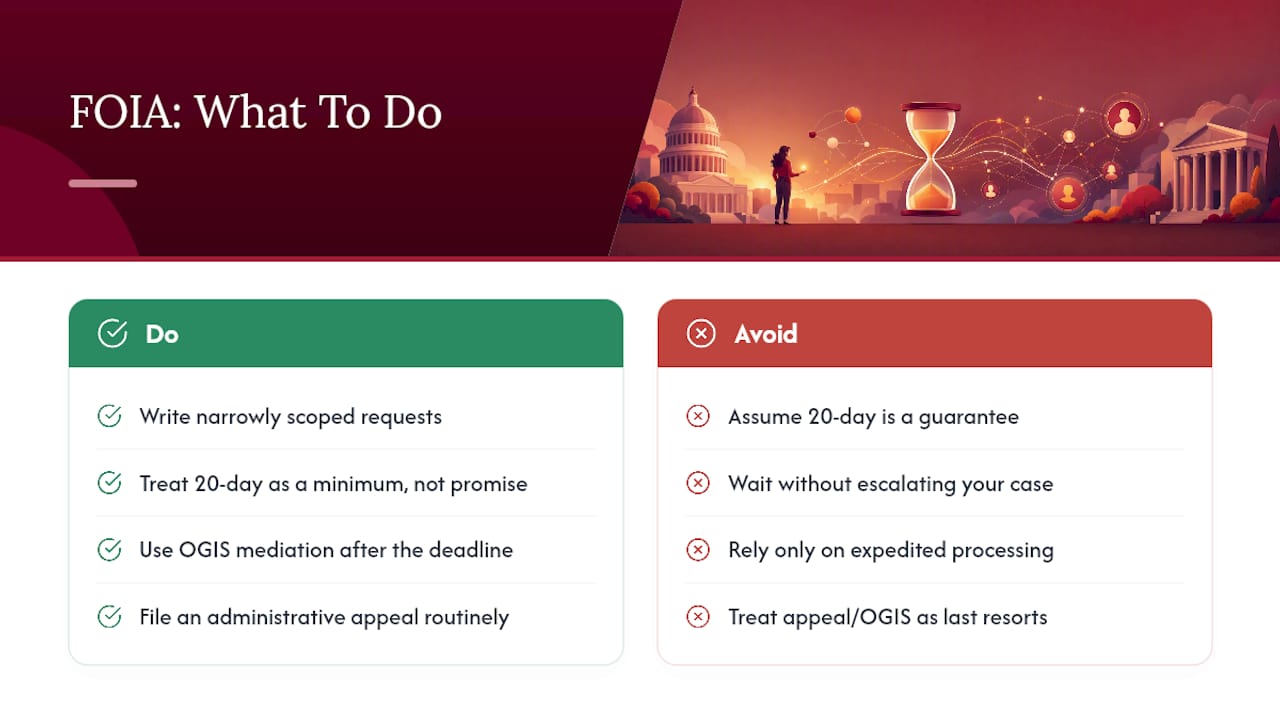
What gets underrated is scope discipline. Requesters obsess over expedited processing, which is genuinely hard to qualify for, while ignoring the much bigger lever: writing a request specific enough to land in the fast track in the first place. That’s not a legal trick. It’s just recognizing how agencies actually sort incoming mail.
The second miscalculation is waiting too long to escalate. OGIS mediation costs nothing and often unsticks a request that administrative silence never would. Treat the appeal and OGIS as routine steps, not last resorts, once you’re past the deadline. Save litigation for when the exemption claims themselves look wrong, not just when the wait feels long.
— Mark
Get Help When Your FOIA Request Stalls
Waiting on the government isn’t a strategy, and for readers facing an agency that’s ignored deadlines or leaned on a shaky exemption, Javitch Law Office is a direct path forward rather than another form to fill out and hope. The firm’s public records and FOIA litigation team works specifically on cases where agencies have blown past statutory timelines, issued questionable Glomar responses, or buried records behind exemptions that don’t hold up to scrutiny.
If your case also touches discrimination, First Amendment retaliation, or consumer harm uncovered through the records you’re seeking, that overlap often strengthens the underlying claim rather than complicating it. Start with a case evaluation: send over your request history, agency notices, and tracking numbers, and the firm can tell you within a consultation whether litigation or continued administrative pressure makes more sense for your situation.
Where to Verify FOIA Timelines and Get Agency Contacts
- Check request status and find agency FOIA offices at Foia
- Review GAO’s backlog findings in its full FOIA report
- Read DHS’s own processing guidance for agency-specific detail
- See how Javitch Law Office handles FOIA denials and litigation for public records
Sources
- DOL FOIA overview
- DOL FOIA guide
- GAO blog on FOIA backlogs
- Foia
- GAO-24-106535: Freedom of Information Act report