
A Glomar response is a government agency’s refusal to confirm or deny whether records responsive to your FOIA request even exist. Under 5 U.S.C. § 552, this “neither confirm nor deny” (NCND) posture is legally distinct from a standard denial: the agency is not saying it has records and is withholding them. It is saying the answer to that threshold question is itself protected. If you receive one, here is where to start:
- File an administrative appeal with the agency within the deadline stated in the response letter (typically 90 days).
- Narrow your request to specific timeframes, named programs, or document types to reduce the scope that triggers NCND treatment.
- Gather evidence of official acknowledgment — a documented, authorized government statement about the specific records you sought, not a news article or a leak.
- Consult the National Archives Office of Government Information Services (OGIS), which offers free mediation between requesters and agencies.
- Contact a FOIA attorney at Javitchlawoffice if the appeal fails or if litigation looks necessary.
Table of Contents
- What does a Glomar response mean, and where did the term come from?
- When is a Glomar response legally defensible under FOIA?
- How do agencies justify a Glomar response in practice?
- How do courts review Glomar claims, and when do they reject them?
- What are your options for challenging a Glomar response?
- How to draft FOIA requests that reduce the risk of a Glomar response
- What timelines and costs should you expect?
- Notable examples of Glomar responses in practice
- Key Takeaways
- Why Glomar responses deserve more scrutiny than they get
- Javitchlawoffice can help you fight a Glomar response
- Authoritative sources and further reading
What does a Glomar response mean, and where did the term come from?
The term traces directly to a 1970s CIA operation. The agency used a deep-sea mining vessel called the Hughes Glomar Explorer as cover to secretly recover a sunken Soviet submarine. When journalist Harriet Ann Phillippi filed a FOIA request for records about the ship, the CIA refused to confirm or deny that any responsive records existed. The resulting case, Phillippi v. CIA, 546 F.2d 1009 (D.C. Cir. 1976), established the legal doctrine. The ship’s name became the shorthand.
The distinction between a Glomar response and a standard FOIA denial matters practically.
| Feature | Glomar response (NCND) | Standard FOIA denial |
|---|---|---|
| What the agency says | Neither confirms nor denies records exist | Acknowledges records exist but withholds content |
| Search conducted? | Usually no | Yes |
| Vaughn index produced? | No | Yes (itemizes withheld records) |
| Requester’s challenge | Must prove official acknowledgment of existence | Can challenge each withholding |
| Governing authority | FOIA exemptions applied to existence itself | FOIA exemptions applied to content |
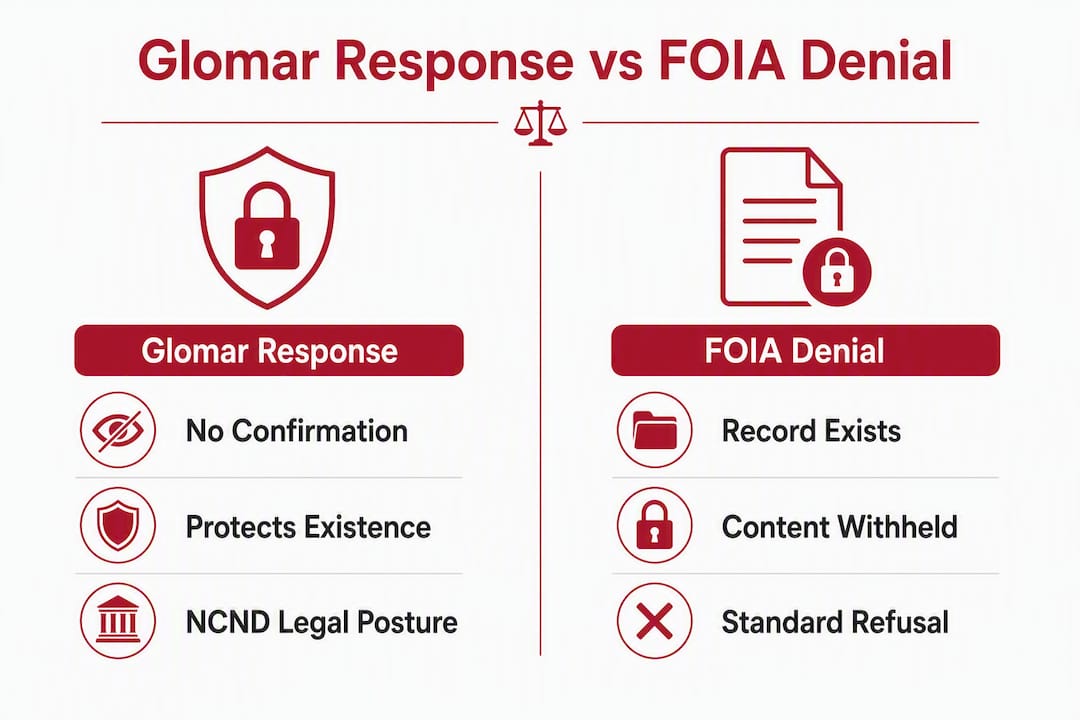
“Neither confirm nor deny” is the clearer public phrase. “Glomar” is the legal shorthand. Both describe the same posture, and knowing the difference tells you exactly why your challenge strategy has to be different from a standard appeal.
When is a Glomar response legally defensible under FOIA?
A Glomar response protects the existence or nonexistence of records, not their content. Agencies may issue one only when confirming that records exist would itself cause harm protected by a FOIA exemption. Courts require agencies to tether the NCND to at least one of FOIA’s nine exemptions, and four exemptions dominate Glomar claims:
- Exemption 1 (classified national security information): An agency cannot confirm it holds records about a covert operation without effectively revealing the operation exists. The CIA, NSA, and similar agencies invoke this most often.
- Exemption 3 (records protected by statute): Certain statutes, such as the National Security Act, independently prohibit disclosure. Confirming records exist can violate the statute even before any content is revealed.
- Exemption 6 (personal privacy): When a requester asks for records about a named private individual, confirming that law-enforcement or personnel files exist can itself constitute an unwarranted privacy invasion.
- Exemption 7© (law-enforcement privacy): Similar to Exemption 6 but applies specifically to law-enforcement records. Confirming an investigation file exists can stigmatize a person who was never charged.
When a request mixes sensitive and non-sensitive records, agencies often split the response: they process and release the non-sensitive portion while issuing an NCND for the rest. That bifurcation is actually good FOIA practice, and OGIS guidance encourages it to maximize disclosure.
How do agencies justify a Glomar response in practice?
Agencies support NCND claims with sworn affidavits or declarations from senior officials. The affidavit must explain, in as much detail as possible without revealing the secret, why confirming existence would harm a protected interest. Courts expect a logical, plausible explanation tethered to a specific exemption, not a boilerplate assertion that disclosure would be bad.

Because the agency typically does not search for records when issuing a Glomar response, it also does not produce a Vaughn index. That procedural shortcut changes the litigation dynamic significantly: you cannot see an itemized list of what is being withheld, so your challenge must attack the justification for the NCND itself rather than individual withholdings.
When you receive an agency Glomar letter, read it carefully for three things: the specific exemption cited, a factual explanation of the harm, and any indication that the agency considered splitting the request. A letter that cites only a vague national-security interest with no factual grounding is a weaker affidavit and a better litigation target.
Pro Tip: Request that the agency provide a “no records” response in the alternative — meaning, if it turns out no records exist, you want that stated explicitly. Some agencies will comply, which narrows the dispute considerably.
How do courts review Glomar claims, and when do they reject them?
Courts review Glomar claims under a deferential but not toothless standard. The agency must show a logical, plausible connection between confirming existence and the harm the exemption protects. Judges often accept agency judgments on national-security matters, but they do scrutinize the affidavit’s specificity and will conduct in camera review of classified materials when necessary.
Courts reject Glomar responses in several situations:
- Insufficient affidavit detail: A conclusory declaration that offers no factual basis for the harm fails the logical-plausibility test.
- Prior official acknowledgment: If an authorized government official has already publicly confirmed the existence of the records or the program at issue, the Glomar protection is waived.
- Overbroad application: Agencies sometimes issue NCND responses to avoid embarrassment rather than genuine harm. Courts have rejected Glomar claims where the agency could not credibly connect the existence of records to a protected interest.
- Circuit-split uncertainty: Scholarly analysis identifies disagreement among circuits over whether courts may consider disclosures from other agencies when evaluating a Glomar claim. Your litigation strategy should account for which circuit you are in.
The official-acknowledgment doctrine deserves special attention. A government failure to prevent leaks or media reporting does not constitute official acknowledgment. Courts look for an authorized, specific governmental admission about the same information you requested. A New York Times story, a congressional staffer’s comment, or an unofficial leak will not defeat a Glomar response. You need a documented statement from an authorized official about that specific program or record.
What are your options for challenging a Glomar response?
- File an administrative appeal — Submit a written appeal to the agency’s FOIA appeals office, citing the specific deficiency in the affidavit or arguing that official acknowledgment has already occurred. Include any evidence you have gathered.
Administrative appeals typically resolve within a few months. FOIA litigation can run one to three years depending on the court’s docket and the agency’s responsiveness.
How to draft FOIA requests that reduce the risk of a Glomar response
Precision in your initial request is the single most effective way to limit NCND exposure. Broad, open-ended requests give agencies more surface area to Glomarize.
- Specify timeframes. “Records from January 2018 through December 2020” is harder to Glomarize than “all records about Program X.”
- Name specific file systems or offices. Identifying the office or database you believe holds the records forces the agency to address that specific location rather than the program generally.
- Ask for segregable non-sensitive records explicitly. Language like “please process and release any non-exempt portions separately” signals that you expect a split response and makes it harder for the agency to Glomarize the entire request.
- Include privacy waivers or proof of death when seeking records about a named individual. Requesters can provide privacy waivers or proof of death to overcome Exemptions 6 and 7© and related NCND claims.
- Avoid framing that implies classified operations. Requests that explicitly reference covert programs or intelligence activities almost guarantee an Exemption 1 Glomar response.
- Document every communication. Keep copies of your request, the agency’s acknowledgment, any correspondence, and the final response. That paper trail is your evidence base for an appeal or lawsuit.
Pro Tip: If your FOIA request relates to a federal investigation, review the federal target letter guidance from Rubin Law to understand how investigative postures affect what agencies will and will not disclose.
What timelines and costs should you expect?
Administrative appeals at most agencies resolve within 20 business days by statute, though backlogs routinely push that to several months. OGIS mediation adds weeks to months but costs nothing. Federal district-court litigation is the long game: expect one to three years from filing to judgment, with no guarantee of full disclosure even if you win.
Cost considerations worth knowing before you commit:
- Attorney’s fees under FOIA: — Courts may award fees and costs to a substantially prevailing plaintiff. That fee-shifting provision makes contingency arrangements viable for strong cases.
Notable examples of Glomar responses in practice
-
Phillippi v. CIA (1976). The foundational case. The CIA refused to confirm or deny records about the Hughes Glomar Explorer’s role in recovering a Soviet submarine. The D.C. Circuit upheld the NCND, establishing that agencies may protect the existence of records when confirming existence would itself reveal classified information.
-
Classified intelligence operation (hypothetical). A journalist requests records about a named surveillance program. The NSA issues a Glomar response under Exemptions 1 and 3, supported by a senior official’s declaration. The journalist finds no authorized government admission about the program, so the NCND holds on appeal.
-
Law-enforcement investigation (hypothetical). A requester asks the FBI for records about a named private individual. The FBI issues an NCND under Exemption 7©, arguing that confirming an investigation file exists would stigmatize someone never charged. The requester provides a signed privacy waiver from the individual, which defeats the Exemption 7© basis and forces the agency to search.
-
Bifurcated response (hypothetical). A civil-rights organization requests records about both a public agency program and a named confidential informant. The agency releases the program records in full and issues a Glomar response only for the informant-related files. Agencies will sometimes split requests this way to preserve maximum disclosure, and requesters who draft for segmentation get more.
Key Takeaways
A Glomar response is a legally distinct FOIA posture that protects the existence of records, not their content, and defeating it requires either attacking the agency’s affidavit or proving official acknowledgment.
| Point | Details |
|---|---|
| What a Glomar response is | An agency refuses to confirm or deny records exist, invoking a FOIA exemption applied to existence itself. |
| Most common exemptions | Exemptions 1, 3, 6, and 7© cover national security, statutory bars, and personal privacy. |
| How to challenge it | File an administrative appeal, seek OGIS mediation, then litigate; official acknowledgment is the strongest counter-argument. |
| Drafting to reduce risk | Narrow requests by timeframe and file system; ask for segregable records explicitly to prompt a split response. |
| Javitchlawoffice | The firm handles FOIA administrative appeals and litigation, including Glomar challenges, for requesters nationwide. |
Why Glomar responses deserve more scrutiny than they get
The official-acknowledgment doctrine is where most Glomar challenges live or die, and it is also where the doctrine is most easily abused. Courts have set the bar for “official acknowledgment” high enough that agencies can sometimes maintain an NCND posture even after a program has been widely reported, debated in Congress, and acknowledged obliquely by senior officials. That gap between public knowledge and legal acknowledgment is real, and it matters.
What often gets missed is that the Glomar doctrine was designed for a narrow purpose: protecting genuinely sensitive existence-or-nonexistence questions, not shielding agencies from accountability for programs that are already functionally public. When an agency issues a Glomar response to avoid embarrassment rather than genuine harm, it is misusing a doctrine that courts have generally been reluctant to second-guess. The fix is not to abolish Glomar protection. It is to push harder on affidavit specificity and to document every authorized statement that comes close to official acknowledgment, because courts will not do that work for you.
The circuit split over external disclosures from non-responding agencies adds another layer of strategic complexity. In some circuits, a disclosure by Agency A about the same program may help defeat Agency B’s Glomar claim. In others, it will not. Knowing your circuit before you file an appeal or a lawsuit is not optional.
Javitchlawoffice can help you fight a Glomar response
Receiving a “neither confirm nor deny” letter is not the end of the road. Javitchlawoffice represents FOIA requesters in administrative appeals, OGIS mediations, and federal-court litigation, including cases where agencies have issued Glomar responses to block access to civil-rights, discrimination, and First Amendment records. The firm’s public records and FOIA practice is built around holding agencies accountable when they use procedural shields to avoid transparency.

Before your consultation, gather these materials:
- A copy of your original FOIA request and the agency’s Glomar response letter.
- A timeline of all communications with the agency, including acknowledgment letters and any interim responses.
- Any evidence of official acknowledgment: congressional testimony, declassified documents, or authorized agency statements about the records or program at issue.
- Notes on the specific exemption the agency cited and whether it offered any factual explanation.
If your records request connects to a discrimination, civil-rights, or First Amendment matter, Javitchlawoffice can evaluate both the FOIA challenge and any underlying civil claim in a single consultation. Reach out through the firm’s public records practice page to get started.
This article is general legal information, not legal advice. FOIA rules, deadlines, and agency procedures vary. Confirm current requirements with OGIS, the relevant agency, or a qualified FOIA attorney before acting.
Authoritative sources and further reading
- National Archives OGIS: NCND/Glomar guidance — the primary agency-facing explanation of when and how Glomar responses should be used, with FOIA Advisory Committee recommendations.
- National Archives FOIA Blog: What the FOIA Is — Glomar — plain-language explanation of the official-acknowledgment doctrine and why leaks do not defeat NCND claims.
- FOIA.Wiki: Glomar — practitioner-focused summary of the evidentiary standard for agency affidavits and the requester’s burden to prove official acknowledgment.
- Fordham Law Review: The Glomar of It All — the most thorough academic treatment of the circuit split over external disclosures and its strategic implications for requesters.
- Wikipedia: Glomar response — accessible background on the Hughes Glomar Explorer origin and Phillippi v. CIA.
- Javitchlawoffice: FOIA requests guide — practical guide to filing federal and California FOIA requests, including how agencies respond to appeals.
- Javitchlawoffice: How to sue for public records — step-by-step litigation guide for requesters considering federal court after a failed appeal.
Recommended
- FOIA Requests: Accessing Government Records in California and Federal Agencies | Javitch Law Office
- FOIA Lawyer: How to Fight Government Denials of Your Records Requests | Javitch Law Office
- FOIA Lawyer | Fight Government Denials & Get Public Records
- Public Records & FOIA Attorneys | California & Federal