
National origin discrimination is illegal under Title VII of the Civil Rights Act of 1964. Employers cannot treat you unfavorably because of your birthplace, ancestry, ethnicity, accent, or the country your family comes from — and it makes no difference whether you’re a U.S. citizen, a green card holder, or working under a visa.
The Equal Employment Opportunity Commission (EEOC) protects both applicants and employees, regardless of who is doing the discriminating or where they’re from themselves. Three federal agencies handle enforcement, each with a different lane:
- EEOC investigates workplace discrimination charges and can pursue mediation, settlements, or litigation.
- Department of Justice (Civil Rights Division) handles pattern-or-practice cases and visa-related civil rights violations.
- Department of Labor (DOL) covers civil rights issues tied to federal contractors and certain wage-related complaints.
Remedies can include back pay, reinstatement, promotion, and court orders forcing an employer to change its practices. The Department of Justice notes that national origin discrimination remains widely underreported, partly because victims don’t realize the conduct is illegal or fear retaliation for speaking up.
Key Takeaways
National origin discrimination is illegal under Title VII regardless of citizenship status, and claims succeed or fail based on documentation quality and how quickly you act.
| Point | Details |
|---|---|
| Protection is universal | Title VII covers citizens and non-citizens alike based on birthplace, ancestry, accent, or perceived origin. |
| English-only rules need justification | Blanket policies are presumed unlawful; narrow ones require proven business necessity and clear notice. |
| Harassment must be severe or pervasive | Isolated jokes rarely qualify, but persistent slurs or mockery that alter working conditions do. |
| Deadlines are strict | EEOC charges are due in 180 days, or 300 days where state agencies also enforce protections. |
| Documentation beats memory | Javitch Law Office recommends logging incidents with dates and witnesses immediately, then consulting an attorney for retaliation or multi-agency cases. |
Table of Contents
- What Counts as National Origin Discrimination Under Federal Law
- Hiring, Pay, and English-Only Rules: Where Employers Cross the Line
- When Jokes and Comments Become Illegal Harassment
- Citizenship, Visas, and Where Immigration Law Steps In
- How to File a Complaint and What You Can Recover
- Deadlines You Cannot Afford to Miss
- Building Your Case: What to Document Before You File
- What Most Guidance on This Topic Gets Wrong
- When It’s Time to Bring in an Employment Discrimination Lawyer
- Where to Verify These Protections Yourself
- Sources
What Counts as National Origin Discrimination Under Federal Law
Title VII defines national origin broadly. It covers your place of birth, your ancestry, your ethnic background, your culture, your language, and your accent, according to the EEOC. You’re also protected if an employer simply perceives you as being from a certain country or ethnic group, even if that perception is wrong.
The law recognizes two distinct legal theories:
- Disparate treatment — an employer intentionally treats someone worse because of their national origin (a manager passing over qualified candidates with “foreign-sounding” names).
- Disparate impact — a policy that looks neutral on its face but disproportionately harms people of a certain national origin, and isn’t justified by business necessity.
Association-based claims count too. If you’re penalized because your spouse, friend, or family member is of a particular national origin, that’s covered under the same framework. There’s also meaningful overlap with race and religion. A Sikh worker facing hostility over a turban, or a Latino employee mocked for speaking Spanish, may have claims that touch multiple protected categories at once. Courts routinely let these claims proceed together rather than forcing a plaintiff to pick just one label.
Hiring, Pay, and English-Only Rules: Where Employers Cross the Line
Discrimination shows up most often in decisions that feel routine on the surface. Here’s where it typically surfaces:
- Job postings with citizenship or visa preferences. An ad stating “U.S. citizens only” or favoring one visa category over another, absent a genuine legal requirement, is a red flag.
- Interview questions about accent or birthplace. Asking where someone is “really from” or steering candidates away based on how they sound.
- Pay and assignment disparities. Paying immigrant workers less for the same role or routing them to less visible, lower-paying tasks.
- Promotion ceilings. Passing over qualified employees repeatedly because leadership assumes clients prefer a certain look or accent.
- English-only policies applied around the clock. A blanket rule barring any other language, even during breaks or private conversations.
That last one deserves its own explanation. The EEOC treats English-only rules applied at all times as presumptively unlawful. A narrower rule can survive only if the employer can show a genuine business necessity, such as safety communication during a specific task, and gives clear advance notice of when the rule applies. A blanket ban with no carve-out for lunch breaks rarely holds up.
Pro Tip: If your employer enforces an English-only rule, ask for the written policy and the stated business justification. If neither exists, or if the rule applies to casual conversation with no safety link, you likely have a strong challenge. Read our breakdown of English-only policy law for the full legal test.
When Jokes and Comments Become Illegal Harassment
Not every insensitive comment is illegal. The legal standard requires conduct that is “severe or pervasive” enough to create a hostile work environment or lead to a firing, demotion, or other tangible harm, per EEOC guidance. A single awkward joke usually doesn’t clear that bar. A pattern of slurs, mocking someone’s accent in meetings, or repeated “go back to your country” comments usually does.
Conduct that typically crosses the line includes:
- Ethnic slurs or derogatory nicknames tied to national origin
- Persistent mimicking or ridicule of someone’s accent
- Offensive jokes or stereotypes repeated after complaints
- Exclusion from meetings, projects, or social events based on origin
Employers face liability not just for a supervisor’s conduct but for coworkers, and even customers or vendors, if management knew or should have known and failed to act. EEOC regulations require employers to take immediate, appropriate corrective action once they’re on notice. Many of the strongest harassment cases involve intersectional claims, where national origin harassment overlaps with religious or racial bias, like an employee facing both accent mockery and comments about their faith.
Citizenship, Visas, and Where Immigration Law Steps In
Title VII protects you regardless of your citizenship or immigration status. An employer can’t use your visa type as cover for treating you worse because of where you’re from. That said, immigration law can lawfully limit certain hiring decisions, mainly around verifying someone’s authorization to work in the United States.
The line matters. A company can require valid work authorization for everyone. What it cannot do is:
- Refuse to consider otherwise qualified candidates because they hold one visa type over another when both are legally authorized
- Demand more or different documentation from workers based on their apparent national origin
- Use “visa complications” as a pretext for pushing out employees the company simply doesn’t want because of their background
According to EEOC enforcement guidance, agencies coordinate when a case touches both discrimination and immigration law. If you suspect visa-related discrimination, both the EEOC and the DOJ Civil Rights Division accept complaints, and wage-related visa violations can also go to the DOL.
How to File a Complaint and What You Can Recover
Reporting national origin discrimination starts with picking the right agency. Employment-based claims generally go to the EEOC. Visa-related civil rights violations and pattern-or-practice cases go to the DOJ Civil Rights Division. Wage disputes tied to federal contractors often route through the DOL. Housing-related national origin discrimination falls under HUD, separate from the employment agencies above.
Here’s the general process:
- Document the conduct before you file anything (more on that below).
- Consider internal reporting first, through HR or a formal complaint process, if you believe the employer might correct the issue and retaliation risk is low.
- File an external charge with the EEOC if internal reporting fails or isn’t safe. This step is required before you can sue under Title VII.
- Participate in mediation if the EEOC offers it. Many cases resolve here without a drawn-out investigation.
- Cooperate with the investigation. The agency may request documents, interview witnesses, and issue a determination.
Remedies vary by case but commonly include:
- Back pay and lost benefits
- Reinstatement or promotion
- Injunctive relief forcing policy changes
- Compensatory and, in some cases, punitive damages
The DOJ has flagged national origin discrimination as chronically underreported, in part because people don’t realize retaliation for filing a complaint is itself illegal.
Deadlines You Cannot Afford to Miss
Federal discrimination claims run on a strict clock. You typically have 180 days from the discriminatory act to file an EEOC charge. That window extends to 300 days if your state or locality has its own fair employment agency enforcing similar protections, which most states do.
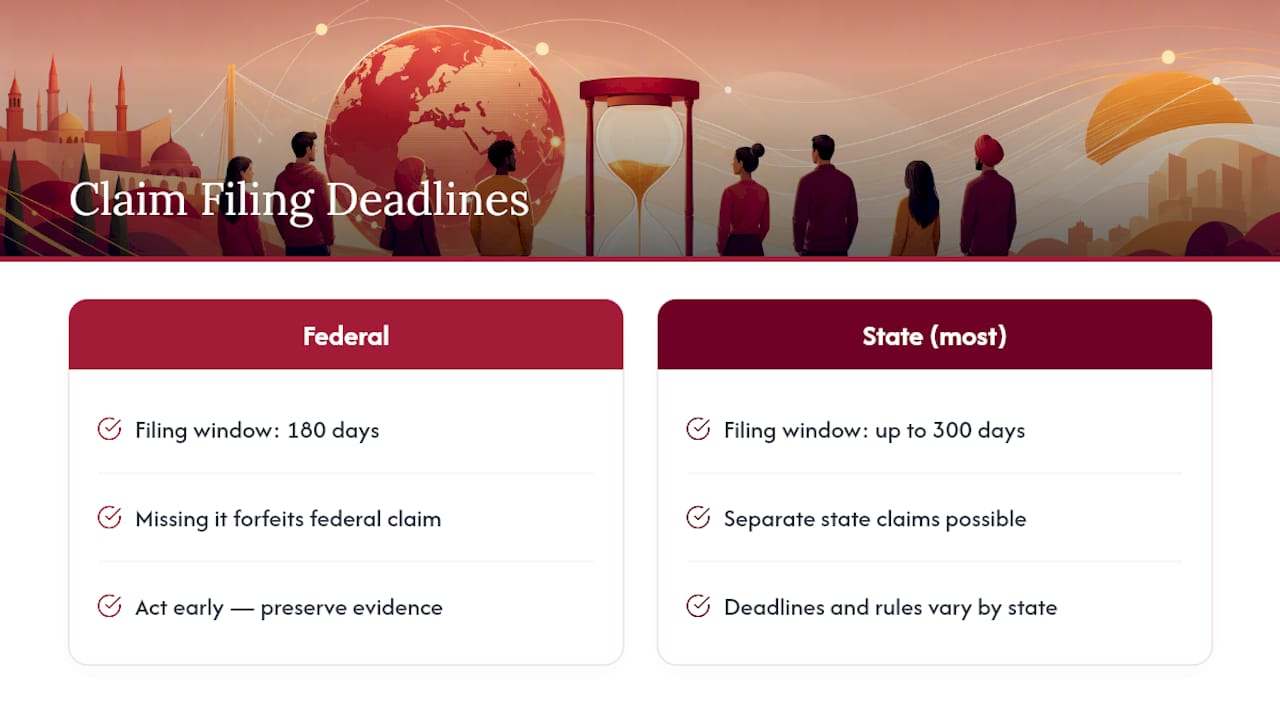
Miss the deadline and you generally lose your right to pursue the federal claim entirely, regardless of how strong the evidence is. Some states also allow separate claims under their own civil rights statutes, sometimes with different or longer deadlines, so it’s worth checking your state’s specific rules alongside the federal timeline.
Delay hurts your case even before the deadline arrives. Witnesses forget details, security footage gets overwritten, and coworkers change jobs. The sooner you act, the more evidence survives intact.
Building Your Case: What to Document Before You File
Strong discrimination claims are built on paper trails, not memory. Start collecting now, even if you haven’t decided whether to file a complaint.
- Save every relevant document — job postings, offer letters, emails, performance reviews, and pay stubs showing disparities.
- Log incidents as they happen, noting dates, times, exact words used, and who was present.
- Preserve digital evidence immediately, including texts, Slack messages, and voicemails, since these can be deleted or overwritten.
- Identify witnesses by name while the events are fresh in everyone’s memory.
- Request your personnel file in writing before any dispute becomes public.
In cases involving public employers or contractors, public records requests can surface hiring data or internal communications that reveal a broader pattern, evidence an individual complaint alone might never uncover.
Pro Tip: Keep a personal log outside of work systems, a notebook or personal email, since employer-owned devices and accounts can be wiped or restricted the moment a dispute becomes formal.

What Most Guidance on This Topic Gets Wrong
Most explainers on national origin discrimination stop at defining the law and listing your rights. That’s useful, but it undersells the single biggest factor in whether a claim actually succeeds: documentation quality, not documentation existence.
I’ve seen the pattern play out the same way across countless cases. People know they were mistreated. They can describe it vividly. But when it comes time to prove it, they have vague memories instead of dated records, and secondhand accounts instead of named witnesses. The law doesn’t reward how wronged you felt. It rewards what you can show.
The conventional advice, “keep records,” is technically correct and practically useless without specifics. Dates matter more than descriptions. A witness’s name matters more than your certainty they’ll remember. And starting your log the day something happens beats trying to reconstruct it three months later when you finally decide to act.
If you take one thing from this article, let it be this: treat the first uncomfortable comment as evidence day one, not as something to tolerate until it gets “bad enough” to matter. By the time it feels undeniable, you may have already lost the paper trail that would have proven it.
— Mark
When It’s Time to Bring in an Employment Discrimination Lawyer
Some situations call for a lawyer before you file anything with the EEOC. If you’ve reported discrimination and now face retaliation, if the conduct fits a broader pattern across your department, or if your case touches multiple agencies at once (visa issues plus harassment, for instance), you’re past the point where a DIY complaint is your best move.
A workplace discrimination attorney evaluates the strength of your evidence, files or amends your EEOC charge, negotiates directly with the employer, and litigates if a fair settlement isn’t on the table. Javitch Law Office handles exactly this kind of case from its California base, with a nationwide reach into employment, housing, and public accommodations discrimination.
The firm’s background in antisemitic and racial discrimination cases means it regularly works claims that overlap national origin with religion or race, exactly the intersectional pattern discussed above. Its experience with public records and FOIA requests also matters when a case might involve a broader institutional pattern rather than a single bad manager. If your situation involves discrimination based on national origin tangled up with other civil rights violations, that combined experience is worth having on your side.
Start with a free case evaluation. Bring your documentation, even if it’s incomplete, and let an attorney tell you whether you have a viable claim before your filing window closes.
Where to Verify These Protections Yourself
These agencies enforce the protections covered in this article and publish free guidance for workers and applicants:
- EEOC: National Origin Discrimination
- DOJ Civil Rights Division: Federal Protections Against National Origin Discrimination
- DOL: National Origin Discrimination
- 29 C.F.R. § 1606.8 (Harassment Regulation)
This article is general information, not a substitute for advice from a qualified lawyer. Consult a qualified legal professional about your own circumstances before acting on anything here.
Sources
- National Origin Discrimination | U.S. Equal Employment Opportunity Commission
- Federal Protections Against National Origin Discrimination | U.S. Department of Justice
- National Origin Discrimination | U.S. Department of Labor
- Law