
A blanket English-only policy that applies at all times in the workplace is presumptively unlawful under federal law. 29 C.F.R. § 1606.7 makes that clear: requiring employees to speak only English at all times is a burdensome term and condition of employment that is presumed to violate Title VII of the Civil Rights Act of 1964. A narrowly tailored rule tied to a genuine business necessity — safety, direct supervision, communication with English-only customers — can survive legal scrutiny, but only if the employer documents the justification and gives employees proper advance notice.
If you are an employee facing a language restriction at work, your first step is to document the policy and any enforcement incidents, then file a charge with the EEOC or consult a workplace discrimination attorney. Employers who want to implement a language rule should consult counsel before rolling it out, because proving business necessity in court is harder than it looks.
Key Takeaways
Blanket English-only policies are presumptively unlawful under 29 C.F.R. § 1606.7 and Title VII, and only narrowly tailored rules tied to documented business necessity can survive legal scrutiny.
| Point | Details |
|---|---|
| Blanket rules are presumptively unlawful | Any rule requiring English at all times violates the presumption under 29 C.F.R. § 1606.7 and Title VII. |
| Business necessity must be narrow and documented | Safety, direct supervision, and English-only customer interactions are the recognized examples; preference or convenience is not enough. |
| Employers must give advance notice | The rule must specify exactly when English is required and what the consequences are; vague policies undermine the employer’s defense. |
| Employees have a 180/300-day EEOC filing deadline | File a charge within 180 days of the discriminatory act (300 days in states with their own agencies) or lose the federal claim. |
| Javitchlawoffice handles these claims nationwide | The firm offers free case evaluations for workplace language discrimination and works on contingency for qualifying cases. |
Table of Contents
- What is an English-only policy in the workplace?
- What does federal law say about English-only policies?
- When can an English-only rule actually be lawful?
- What employers must do for a language rule to hold up legally
- What employees can do if an English-only rule affects them
- How state laws on official English differ from workplace rules
- Alternatives to broad English-only rules that reduce legal risk
- How to document an English-only policy dispute from day one
- Why these cases deserve more attention than they get
- Javitchlawoffice can evaluate your English-only policy claim
- Sources
What is an English-only policy in the workplace?
An English-only rule is any employer directive that restricts employees from speaking languages other than English while at work. The scope matters enormously for legal analysis.
All-times rules require English during every working moment: at the desk, on the floor, in the break room, even during lunch. These are the rules courts and regulators find most problematic. Limited-time rules apply only in defined circumstances, such as when speaking directly with a customer or during a recorded safety briefing. The narrower the scope, the stronger the employer’s legal footing.
Common forms these rules take in real workplaces:
- A posted sign or employee handbook section stating “English must be spoken at all times on the premises.”
- A supervisor’s verbal instruction to “speak English when I’m around so I can understand what’s being said.”
- A meeting policy requiring English during formal team calls or client-facing presentations.
- A customer-service rule requiring English when assisting English-speaking customers at a register or help desk.
- A safety protocol requiring English during emergency announcements or equipment operation.
The legal analysis turns on when and where the rule applies. A cashier required to speak English while serving a customer is in a different legal position than a warehouse worker told to speak English while eating lunch with coworkers. The first scenario has a plausible business rationale; the second almost certainly does not.
What does federal law say about English-only policies?
Title VII of the Civil Rights Act of 1964 prohibits employment discrimination based on national origin. The EEOC has long interpreted language-based workplace rules as a form of national-origin discrimination, because a person’s primary language is closely tied to their national origin. Restricting that language can therefore disadvantage employees from particular countries or ethnic backgrounds, creating either disparate treatment or disparate impact.
The controlling federal regulation is 29 C.F.R. § 1606.7, which sets out a two-tier framework:
- All-times rules are presumptively discriminatory. The employer bears the burden of rebutting that presumption.
- Limited rules may be lawful if the employer can demonstrate business necessity and narrow tailoring.
The EEOC’s position: EEOC guidance states that speak-English-only rules applied at all times are presumptively unlawful, and that limited rules are permissible only when justified by business necessity — such as safety, effective supervision, or communication with English-only customers or coworkers.
The U.S. Department of Labor aligns with the EEOC: employees’ communications in languages other than English should generally not be restricted, and any limited rule must be narrowly tailored, nondiscriminatory in intent, and accompanied by effective notice to affected employees.
Courts have wrestled with these standards. In Garcia v. Spun Steak Co., the Ninth Circuit held that an English-only rule did not necessarily constitute discrimination under Title VII, but that ruling was specific to the facts and the court’s interpretation of disparate impact — it did not give employers a green light for blanket rules. The U.S. Commission on Civil Rights has documented that English-only workplace policies can cause disproportionate adverse impacts on employees of particular national origins and recommends careful evaluation of business justifications and available alternatives.
On the burden side: to establish business necessity under Title VII, an employer must show that the English-only requirement is essential to safe and efficient job performance, not merely convenient or preferred. Discomfort, managerial preference, or customer bias does not meet that standard.
When can an English-only rule actually be lawful?
A rule can be lawful only when it is narrowly tied to a genuine business necessity. “Narrow” is the operative word. The rule must apply to specific situations, not the entire workday.
Scenarios courts and regulators have recognized as potentially sufficient:
- Safety-critical communications: Workers operating heavy machinery, handling hazardous chemicals, or responding to emergencies may be required to communicate in a shared language to prevent accidents.
- Direct supervision: A supervisor who speaks only English may need to monitor and direct employees in English during specific tasks where real-time oversight is required.
- Customer-facing interactions: When serving customers who speak only English, requiring English during those specific transactions has a defensible rationale.
- Recorded or documented meetings: Formal proceedings where a verbatim record is required may justify an English requirement for that session.
- Cooperative assignments with English-only coworkers: Where a team must coordinate closely and a coworker cannot communicate in another language, a targeted rule for that assignment may hold up.
What does not qualify: a rule that singles out one particular foreign language while permitting others, a rule that applies during breaks or meal periods, or a rule motivated by customer or coworker discomfort with hearing another language. Courts have consistently found those rationales insufficient.
The Garcia v. Spun Steak case is instructive here. The employer’s rule applied during work hours but not breaks, and the court found the plaintiffs had not shown the rule caused a material disadvantage. Even so, the case turned on specific facts and the Ninth Circuit’s reading of disparate impact — it did not establish that similar rules are automatically lawful elsewhere. Employers who read Garcia as a blanket permission slip are misreading it.
What employers must do for a language rule to hold up legally
Documentation, narrow scope, objective justification, and advance notice are the four pillars. Miss any one of them and a defensible rule can become evidence of discrimination.
Notice is not optional. Under 29 C.F.R. § 1606.7, employers must inform employees of the precise circumstances when English is required and of the consequences for violations. A vague “speak English at work” memo does not satisfy this requirement. The notice must specify: which situations trigger the rule, which employees are covered, and what happens if the rule is violated.
Documentation should precede implementation. Before rolling out any language rule, employers should create a written record that answers: What is the business necessity? Why is this the least restrictive means of achieving it? Were alternatives considered and rejected? That record is what counsel will rely on if a charge is filed.
Scope must be as narrow as possible. A rule covering the entire workday, all locations, and all employees is almost impossible to justify. A rule covering one department during specific customer-service hours is far more defensible.
Consistent application matters too. Enforcing the rule against Spanish-speaking employees but not against French-speaking employees, or applying it selectively based on who the supervisor dislikes, converts a facially neutral policy into evidence of discriminatory intent.
A minimal, legally defensible policy statement might read: “Employees in the customer service department are required to communicate in English when directly assisting customers during scheduled service hours. This requirement does not apply during breaks, meal periods, or non-customer-facing communications.”
Pro Tip: Before finalizing any language rule, test whether the underlying business need can be met by a less restrictive alternative. Translation apps, bilingual supervisory staff, multilingual signage, or documented communication protocols may achieve the same safety or efficiency goal without restricting speech. If a less discriminatory alternative exists, the English-only rule likely cannot survive a business-necessity challenge.
Bloomberg Law reporting confirms that employers who implement English-only rules without robust, documented justification remain exposed to discrimination suits even when regulatory positions shift. Proving narrow business necessity is legally difficult in practice.
What employees can do if an English-only rule affects them
Document first, then act. The sequence matters because evidence gathered immediately after an incident is far more credible than reconstructed timelines.
Step-by-step process:
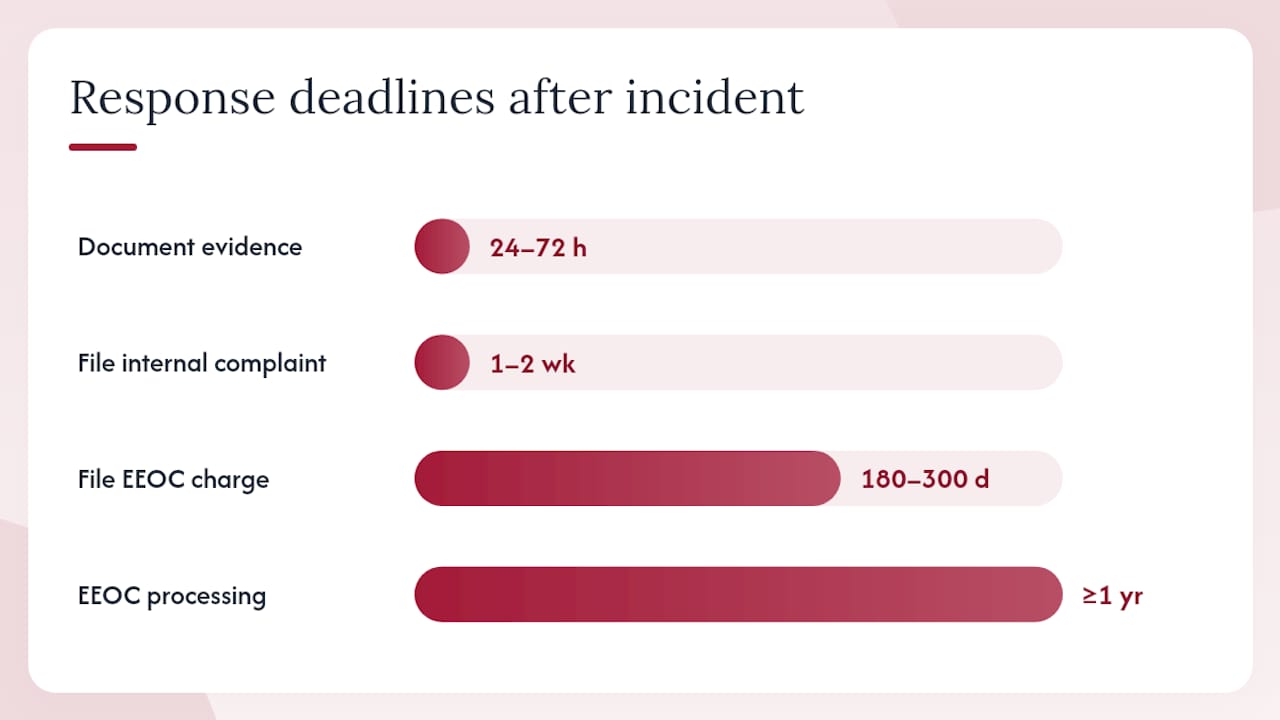
- Within 24–72 hours of the incident: Write down exactly what happened. Include the date, time, location, who said what, and the names of any witnesses. If a written policy exists, get a copy.
- Within one to two weeks: File an internal complaint with HR or your union representative. Put it in writing and keep a copy. This creates a paper trail and may trigger the employer’s internal investigation process.
- Within 180 days (300 days in states with their own anti-discrimination agencies): File a charge with the EEOC. The deadline runs from the date of the discriminatory act, not from when you learned about your rights. Missing this deadline can bar your federal claim.
- After EEOC charge: The EEOC will investigate, attempt mediation, and either issue a “right to sue” letter or pursue the case itself. After receiving a right-to-sue letter, there is a limited time to file a private lawsuit according to legal procedures.
- Attorney consultation: You can consult a workplace discrimination attorney at any stage. Many discrimination attorneys work on contingency for strong cases, meaning no upfront cost.
Remedies available include injunctive relief (stopping the policy), back pay for lost wages, reinstatement if you were terminated, compensatory damages for emotional distress, and in cases of intentional discrimination, punitive damages. EEOC processing times vary; charges can take a year or more to resolve, which is one reason consulting an attorney early helps you understand your options and timeline.
The ACLU of Northern California notes that language discrimination can also occur when employers treat workers differently because of accent or primary language, and that English proficiency requirements are unlawful unless justified by business necessity for the specific position. That means a blanket “must be fluent in English” job requirement for a role where English fluency is not actually needed is itself a potential violation.
For more on recognizing when an attorney’s involvement is warranted, the firm’s guide on when to hire a racial discrimination lawyer walks through the key signals and what evidence improves a case.
How state laws on official English differ from workplace rules
State “official English” statutes and employer workplace policies are legally distinct, and conflating them is a common mistake.
Most state official-language laws govern how state government agencies conduct their operations: which language is used in official documents, public meetings, or government websites. They do not grant private employers the authority to restrict what language employees speak among themselves. The English-only movement is a political and legislative initiative focused on government operations, not a grant of employer authority over workplace speech.
Executive Order 14224, signed March 1, 2025, designates English as the official language of the United States at the executive branch level. It does not authorize private employers to impose English-only workplace rules, and it does not override Title VII or the EEOC’s regulatory framework.
California is the clearest example of a state with stronger worker protections than the federal floor. Under 2 C.C.R. § 11028, California makes it unlawful to adopt or enforce any language restriction in the workplace unless three conditions are met: the restriction is justified by business necessity, it is narrowly tailored, and the employer effectively notifies employees. California regulations explicitly prohibit English-only rules during non-work time. Critically, California rejects business convenience or customer preference as sufficient justification. The employer must show an overriding legitimate business purpose and demonstrate that no less discriminatory alternative exists.
Other states with robust anti-discrimination frameworks may provide similar or additional protections. Federal Title VII protections apply nationwide regardless of state law, and state law can only add to those protections, not subtract from them.
Alternatives to broad English-only rules that reduce legal risk
Adopt narrowly targeted rules and alternatives rather than blanket bans. That is the practical bottom line for any employer trying to balance operational needs against legal exposure.
Actionable alternatives:
- Require English only during specific customer-service interactions with English-only customers, not during the entire shift.
- Use bilingual signage and written safety instructions rather than verbal-only English requirements.
- Hire or designate bilingual supervisors for teams with multilingual employees, so oversight does not depend on a single language.
- Implement translation technology for internal communications, safety briefings, and HR documents.
- Create documented supervisory monitoring protocols that specify how supervisors will communicate with employees in multilingual settings.
- Provide cross-linguistic communication training for managers.
For employers with international or multilingual teams, multilingual legal communication resources offer practical frameworks for managing language diversity without restricting speech.
When writing job descriptions, request the actual proficiency level the role requires rather than a blanket “English required” statement. For example: “Must be able to communicate in English with English-speaking customers during service interactions” is defensible. “English fluency required” applied to a back-of-house role with no customer contact is not.
| Approach | Pros | Cons |
|---|---|---|
| Blanket English-only rule | Simple to administer | Presumptively unlawful; high litigation risk; damages morale |
| Targeted English requirement (specific tasks/times) | Defensible if documented; meets business need | Requires careful drafting and consistent enforcement |
| Bilingual supervisory staff | Eliminates language barrier entirely; no speech restriction | Staffing cost; not always feasible for small employers |
| Translation technology | Low cost; reduces communication gaps | May not work in real-time safety situations |
| Bilingual signage and written protocols | Accessible to all employees; no speech restriction | Requires upfront investment in translation |
How to document an English-only policy dispute from day one
Thorough contemporaneous documentation is the single most important asset in any English-policy dispute. Cases that look strong at intake often weaken because the employee waited too long to write things down, and cases that looked marginal have succeeded because the client kept meticulous records.
What to gather in the first 24–72 hours:
- Write a detailed account of the incident: exact date, time, location, what was said, by whom, and in what context.
- Identify all witnesses present and note their names and roles.
- Obtain or photograph any posted policy, written memo, or handbook section containing the language rule.
- Screenshot any digital communications (email, Slack, text) referencing the rule or its enforcement.
- Note any disciplinary action taken: verbal warning, written warning, suspension, termination.
Within two weeks:
- File a written internal complaint with HR and keep a copy of everything submitted and received.
- Document any retaliation or change in treatment following the complaint.
- Gather pay stubs or employment records that establish your tenure, role, and compensation.
Long-term records to maintain:
- All HR correspondence and responses.
- Performance reviews before and after the incident.
- Records of how the rule was applied to other employees (was it enforced selectively?).
- Any EEOC charge filing confirmation and subsequent correspondence.
The U.S. Commission on Civil Rights has noted that employees frequently fail to preserve evidence, and that contemporaneous notes and policy copies materially improve case outcomes.
When you consult an attorney, bring:
- Your written account of events.
- Copies of the policy and any enforcement notices.
- Your witness list.
- Any HR complaint and the employer’s response.
- Your employment contract or offer letter.
- Questions about the EEOC timeline, potential remedies, and what the attorney needs to evaluate your claim.
The firm’s resource on fighting discrimination in the workplace covers documentation strategies and what to expect when engaging counsel for employment discrimination claims.
Why these cases deserve more attention than they get
Language discrimination sits at an uncomfortable intersection of civil rights law and cultural politics, which means it often gets underestimated by both employers and employees. Employers assume a posted policy is enough protection. Employees assume the rule is just “how things are” and don’t realize they have a federal claim.
The legal reality is sharper than most people expect. A blanket English-only rule is not a gray area. It is presumptively unlawful under a federal regulation that has been on the books for decades. The fact that regulatory enforcement priorities shift with administrations does not change the underlying statute or the litigation risk. Courts still apply Title VII. Juries still hear discrimination claims. And as Bloomberg Law has reported, employers who implement these rules without documented justification remain exposed even when the EEOC’s enforcement posture changes.
What gets overlooked is the human cost. Language is not just a communication tool. It is how people think, express urgency, build trust with coworkers, and process stress. Forcing someone to operate in a second language for eight hours straight, including during breaks when they are supposed to decompress, is not a neutral administrative decision. The Cambridge Handbook of Language Policy frames this well: institutional attempts to force monolingualism often overlook identity factors and increase workplace conflict rather than reducing it.
The firms and supervisors who handle this well are not the ones with the most restrictive policies. They are the ones who invest in bilingual supervision, clear written protocols, and genuine communication infrastructure. That is both the legally safer path and the operationally smarter one.
Javitchlawoffice can evaluate your English-only policy claim
If an English-only rule has cost you a job, a promotion, or a fair working environment, you have concrete legal options under federal and state law.
Javitchlawoffice is a California-based civil rights firm with nationwide reach that handles workplace discrimination claims including language-based discrimination under Title VII. The firm offers personalized case evaluations, works on contingency for qualifying discrimination cases, and brings the same documentation discipline to intake that this article describes. When you reach out, you can expect a direct conversation about the facts, a clear explanation of your legal options, and an honest assessment of your claim’s strength.
Contact Javitchlawoffice for a free case evaluation at Javitchlawoffice. Bring your documentation, your timeline, and your questions. The consultation is the first step toward understanding whether you have a claim worth pursuing.
This article is general legal information, not personalized legal advice. Laws and agency guidance can change. Consult a qualified employment attorney or contact the EEOC directly to evaluate your specific situation.
Sources
The sources below are the primary legal and regulatory texts underlying this article. Each is publicly available.
Regulatory sources (binding law and regulations):
- 29 CFR § 1606.7 - Speak-English-only rules. | Electronic Code of Federal Regulations (e-CFR) | US Law | LII / Legal Information Institute
- EEOC fact sheet on immigrants’ employment rights under federal anti-discrimination laws
- What do I need to know about… English-Only Rules | U.S. Department of Labor
- English_Only_Policies_Report-July-2011.pdf | U.S. Commission on Civil Rights
Agency guidance (interpretive, not binding law):
Policy and scholarly reports:
This article is general information, not a substitute for advice from a qualified lawyer. Consult a qualified legal professional about your own circumstances before acting on anything here.
Recommended
- Fighting Antisemitic and Racial Discrimination in the Workplace | Javitch Law Office
- When to Hire a Racial Discrimination Lawyer: Protecting Your Workplace Rights | Javitch Law Office
- Javitch Law Office | Civil Rights & Consumer Protection Attorneys
- First Amendment Violations: When Free Speech Leads to Retaliation | Javitch Law Office