
Yes, racial discrimination in hiring still happens across the U.S. economy, and the evidence for it is not subtle. Field experiments sending out tens of thousands of matched resumes keep finding the same gap, and Title VII of the Civil Rights Act of 1964 has banned it since 1964. Federal protection exists, but it does not enforce itself.
If you suspect you were passed over because of race, three moves matter right now:
- Document everything while your memory is fresh: dates, names, job postings, and every email.
- Preserve evidence before it disappears, including screenshots of listings that might get edited or taken down.
- File a charge with the EEOC or your state fair employment agency, or talk to an employment attorney if the pattern looks systemic.
The evidence that actually holds up in a charge or lawsuit tends to be mundane:
- Timestamps on applications and rejections
- Names and titles of everyone involved in the decision
- Callback rates if you applied to multiple similar roles
- The exact job posting language, saved before it changes
Key Takeaways
Racial discrimination in hiring persists at measurable, documented rates across the U.S. labor market, and Title VII gives affected workers a clear legal path to challenge it.
| Point | Details |
|---|---|
| Discrimination is well documented | Field experiments show a 36% callback gap favoring white applicants over Black applicants, unchanged over 25 years. |
| Bias concentrates at specific firms | A small share of employers account for nearly half of lost contacts to Black applicants in large correspondence studies. |
| Two legal theories apply | Title VII covers both intentional disparate treatment and neutral policies with disparate impact. |
| Documentation wins cases | Timestamps, job postings, comparator evidence, and callback logs make or break an EEOC charge or lawsuit. |
| Javitch Law Office handles patterns, not just incidents | The firm evaluates hiring discrimination claims, coordinates with the EEOC and state agencies, and pursues litigation when harm is systemic. |
Table of Contents
- How Common Is Racial Discrimination in Hiring?
- What Federal and State Laws Cover Hiring Bias?
- What Hiring Practices Create Racial Disparities?
- What Evidence Should You Collect if You Suspect Bias?
- How Do You File a Discrimination Claim and What Happens Next?
- What Should Employers Do to Prevent Hiring Bias?
- What Recent Enforcement Actions Show About Hiring Discrimination
- When Should You Talk to an Employment Lawyer?
- A Practitioner’s View on What Actually Moves These Cases
- How Javitch Law Office Can Help With a Hiring Discrimination Claim
- Where to Learn More About Hiring Discrimination
- Frequently Asked Questions
- Sources
How Common Is Racial Discrimination in Hiring?
The data on racial bias in hiring is remarkably consistent for something people assume has faded with time. A meta-analysis of 24 field experiments involving more than 54,000 job applications found that white applicants received on average 36% more callbacks than Black applicants and 24% more than Latino applicants. The same analysis found no meaningful decline in discrimination against Black applicants over the prior 25 years.
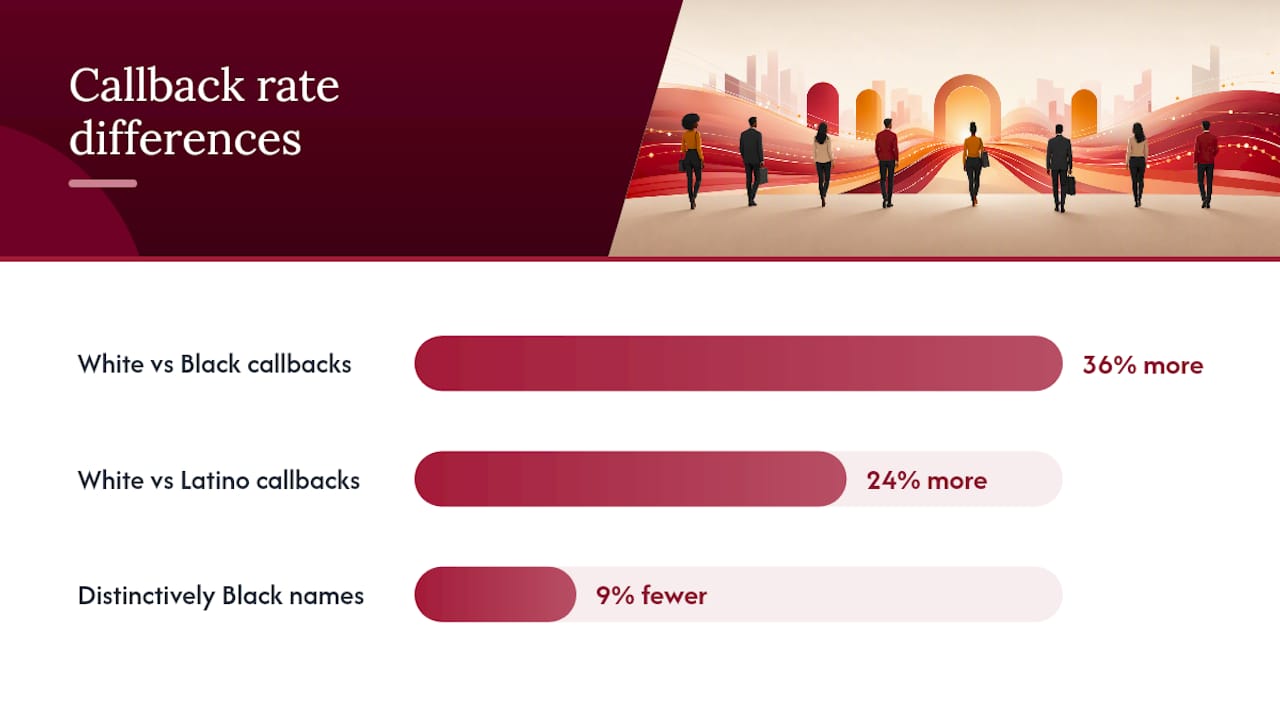
Statistic to sit with: in a nationwide correspondence experiment covering a very large number of fictitious applications, resumes with distinctively Black names generated about 2.1 percentage points fewer employer contacts, roughly 9% of the baseline Black contact rate. That gap was not spread evenly. A small share of firms, concentrated in the top quintile of discriminators, accounted for nearly half of all lost contacts to Black applicants.
Northwestern researchers reviewing field-experiment data covering more than 174,000 applications reached a similar conclusion: hiring discrimination remains persistent across multiple racial and ethnic groups, not just one.
Where does the bias actually surface?
- Resume-name signals, where identical qualifications get different callback rates based on how “White-sounding” or “Black-sounding” a name reads
- Timing gaps, where minority applicants wait longer for a response even when they eventually get one
- Differential interview requests for otherwise matched candidates
- Screening software that quietly filters out patterns tied to race without anyone intending it to
What Federal and State Laws Cover Hiring Bias?
Title VII of the Civil Rights Act of 1964 makes it illegal for employers with 15 or more employees to discriminate based on race or color in hiring, firing, pay, promotion, or benefits. That size threshold matters: a five-person startup is not covered by Title VII, though many states set their own, often lower, thresholds under their own fair employment laws.
Courts recognize two distinct theories of race discrimination hiring claims. Disparate treatment means someone was treated differently on purpose, like a hiring manager who admits (or is caught on record) rejecting a candidate because of race. Disparate impact means a policy that looks neutral on its face ends up excluding a protected group at a much higher rate, and the employer can’t show it’s genuinely job-related.
Neutral-sounding policies, like blanket criminal-background exclusions or residency requirements, can violate federal law even without a shred of intentional bias, if they disproportionately screen out a protected group and aren’t justified by business necessity.
Enforcement runs through several channels:
- The EEOC investigates individual and pattern charges and can pursue conciliation or litigation.
- State Fair Employment Practices Agencies (FEPAs) often have parallel authority and sometimes broader protections.
- The DOJ Civil Rights Division steps in for systemic or high-impact cases.
- Private lawsuits proceed once you have a right-to-sue letter.
Proving these claims usually requires comparator evidence (someone less qualified who got the job) or statistical patterns showing the disparity is not random chance.
What Hiring Practices Create Racial Disparities?
Some of the most damaging practices are not overtly racist. They just produce racist outcomes.
Resume-name bias is the best-documented example. Audit studies from Chicago Booth Review and others repeatedly show resumes with racially distinctive names getting fewer callbacks than identical resumes with white-sounding names.
Other common patterns:
- Referral-only hiring, which reproduces whatever racial makeup a company’s existing staff already has, since people tend to refer people who look like them.
- Blanket criminal-record exclusions, which disproportionately screen out Black and Latino applicants given disparities in the criminal justice system, and which a criminal-history exclusion can trigger a disparate-impact claim if it’s not tied to actual job duties.
- Residency requirements and inflated education demands that screen out qualified candidates for reasons unrelated to the job.
- Algorithmic screening tools, which Stanford researchers warn can create an “algorithmic monoculture”, rejecting the same candidate profile across many employers using the same vendor software.
What Evidence Should You Collect if You Suspect Bias?
Discrimination rarely announces itself. It shows up as silence, a callback that never comes, or a rejection with vague, shifting reasons. Building a record turns a feeling into a case.
Start collecting:
- The original job posting, saved or screenshotted before it can be edited
- Every timestamp: when you applied, when you heard back (or didn’t)
- Names and titles of recruiters, interviewers, and hiring managers
- Any notes from interviews, including exact language used in feedback
- How many similar jobs you applied for and your callback rate across them
Track the pattern, not just the incident. If you applied to ten similar roles and got interviews for the ones where you used a different, less “ethnic-sounding” name variant, or a friend with weaker qualifications got a callback where you didn’t, that comparison is powerful.
Pro Tip: Keep a simple dated log, even a plain text file, noting every application, contact, and rejection. A messy memory six months later loses cases that a clean two-line entry per event would have won.
Back up digital evidence somewhere outside your work email, since access can vanish the moment you’re no longer employed there.
How Do You File a Discrimination Claim and What Happens Next?
You have real options, and they are not mutually exclusive at the start.
- File an EEOC charge. This is usually the required first step before a Title VII lawsuit. You typically have 180 days from the discriminatory act, extended to 300 days in states with their own fair employment agency.
- File with your state FEPA if your state offers stronger protections or a longer filing window.
- Wait for EEOC intake and investigation. The agency may attempt conciliation between you and the employer.
- Get a right-to-sue letter if the EEOC closes its investigation without resolution, which lets you file a private lawsuit.
- Consider a class or collective action if the pattern reaches beyond you.
What relief looks like in practice:
- Back pay for wages you lost
- Front pay if reinstatement isn’t practical
- Hiring or reinstatement orders
- Injunctive relief forcing policy changes
- Punitive damages in cases of intentional, malicious conduct
Individual EEOC cases can take months to over a year before resolution; litigation, especially class litigation, often runs longer but can force company-wide changes an individual charge never would.
What Should Employers Do to Prevent Hiring Bias?
The EEOC’s own guidance points to specific, checkable steps. Employers should validate that selection criteria are actually job-related, avoid blanket exclusions like automatic criminal-background bans, and diversify recruiting sources instead of relying on employee referrals alone.
Look for signs an employer takes this seriously: a posted EEO policy, documented and consistent job requirements, structured interviews with the same questions for every candidate, and periodic audits of hiring outcomes by role and department, not just company-wide averages that can hide real disparities.
Any employer using algorithmic screening tools should be auditing vendor software for adverse impact, not trusting the vendor’s word for it.
What Recent Enforcement Actions Show About Hiring Discrimination
Enforcement outcomes reveal what regulators actually prioritize. Recent settlements typically require:
- Back pay and monetary relief for affected workers
- Mandatory training and revised hiring procedures
- Ongoing monitoring or reporting to the agency
The DOJ Civil Rights Division’s settlement with OpenAI, totaling $3.2 million, addressed discriminatory PERM recruitment practices that disadvantaged U.S. workers, a reminder that federal enforcement extends well beyond obvious cases.
When Should You Talk to an Employment Lawyer?
Some situations call for counsel early, not as a last resort. Consider talking to a lawyer if you’re seeing a pattern across multiple applications, facing retaliation after raising concerns, dealing with high-value back pay, a potential class of affected workers, or approaching a filing deadline you can’t afford to miss.
A racial discrimination lawyer will typically assess your case, coordinate with the EEOC or state agency, and plan discovery or litigation strategy if conciliation fails.
Bring to your first consultation: your documented timeline, copies of job postings and communications, names of potential witnesses, and any prior filings you’ve already made.
A Practitioner’s View on What Actually Moves These Cases
Discrimination in hiring rarely looks like a smoking gun. More often it’s concentrated at a handful of employers, dressed up in vague language like “not a great fit,” or buried inside a vendor’s screening algorithm nobody at the company fully understands. Cases built on a clean, dated record move faster and settle for more than cases built on memory alone. Individual charges resolve in months; systemic patterns take longer but change more. If what you’re seeing looks bigger than one rejection, preserve everything now and get a second opinion sooner rather than later.
How Javitch Law Office Can Help With a Hiring Discrimination Claim
There’s no shortage of ways to pursue a discrimination claim on your own, from filing directly with the EEOC to researching your state’s fair employment agency. But going in without a clear strategy for evidence and remedies often means leaving money and leverage on the table. Javitch Law Office is built specifically for these cases: race and hiring discrimination claims where the pattern, not just a single incident, is the real issue.
The firm evaluates your case, coordinates directly with the EEOC or your state’s fair employment agency, and handles litigation or class-action strategy when the harm reaches beyond one applicant. A free consultation starts with your documented timeline: job postings, emails, interview notes, and anything showing a comparator who got the callback you didn’t.
If you believe you were passed over because of your race, visit the discrimination practice page or explore workplace discrimination representation to schedule a case evaluation today.
Where to Learn More About Hiring Discrimination
- EEOC guidance pages for filing procedures and protected-class definitions, straight from the enforcement agency itself.
- NBER and academic field experiments for the empirical backbone behind callback-gap statistics.
- BLS employment tables for macro labor-market data on racial disparities in employment.
- DOJ press releases for the latest enforcement actions and settlement terms.
Frequently Asked Questions
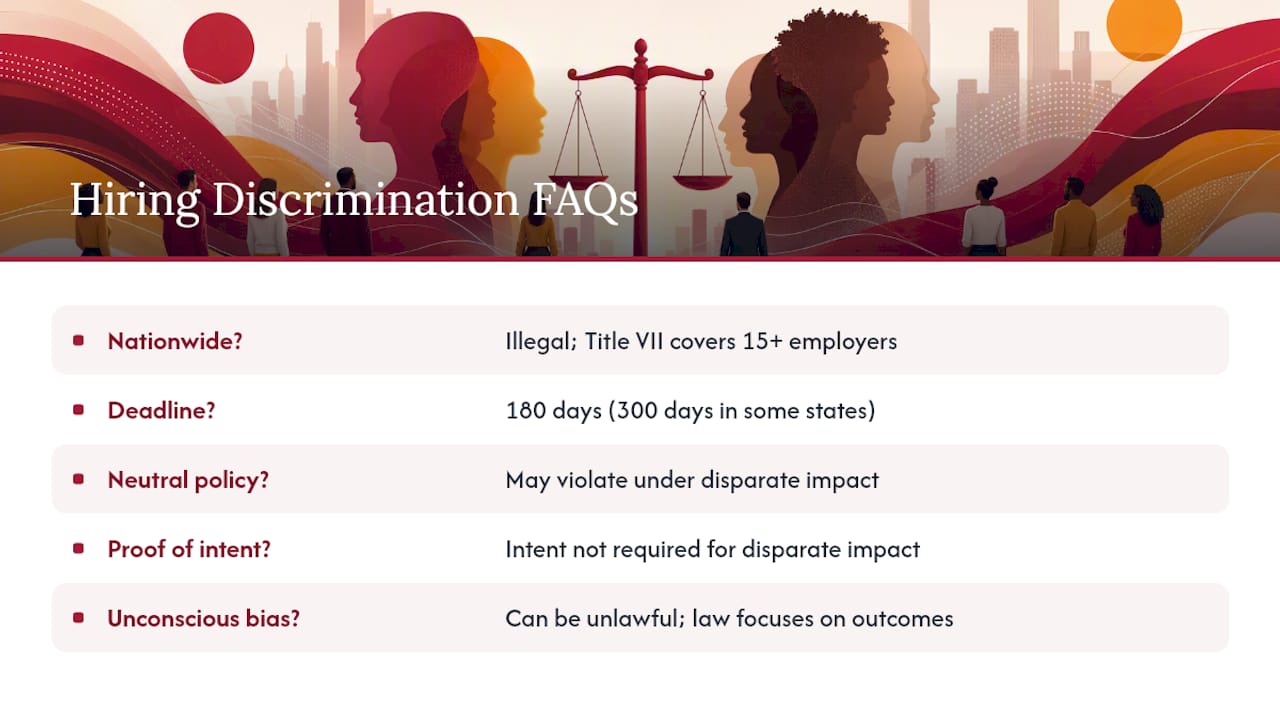
Is racial discrimination in hiring illegal in every state? Yes. Title VII applies nationwide to employers with 15 or more employees, and most states add their own fair employment laws, sometimes covering smaller employers or offering longer filing windows.
How long do I have to file an EEOC charge? Generally 180 days from the discriminatory act, extended to 300 days if your state has its own fair employment agency with overlapping jurisdiction.
Can a neutral hiring policy still be considered racial discrimination? Yes, under the disparate impact theory. A policy like a blanket criminal-background ban can violate federal law if it disproportionately excludes a protected group and isn’t tied to genuine job requirements.
What if I can’t prove intent to discriminate? You don’t need to for a disparate impact claim. Statistical patterns and comparator evidence often carry more weight than proving what was in someone’s head.
Does unconscious bias count as illegal discrimination? It can. The law generally focuses on outcomes and patterns rather than requiring proof that a decision maker consciously intended to discriminate.
This article is general information, not a substitute for advice from a qualified lawyer. Consult a qualified legal professional about your own circumstances before acting on anything here.
Sources
- Questions and Answers about Race and Color Discrimination in Employment | U.S. Equal Employment Opportunity Commission
- Civil Rights Division secures settlement with OpenAI
- Prohibited Employment Policies/Practices | U.S. Equal Employment Opportunity Commission
- Racial Bias in Hiring | Chicago Booth Review