
Racial harassment at work is unlawful under Title VII of the Civil Rights Act of 1964 when it is severe or pervasive enough to alter your working conditions, or when it results in an adverse employment action. You do not have to endure a months-long pattern before you have a legal claim. A single, extremely offensive incident — a racial slur from a supervisor, a noose left at your workstation — can be enough. Here is what to do right now:
- Document everything. Write down dates, times, locations, what was said or done, and who witnessed it. Do this the same day it happens.
- Report internally. Notify HR or a supervisor in writing. Keep a copy of every complaint you submit.
- Preserve evidence. Screenshot messages, save emails to a personal account, and photograph any physical items.
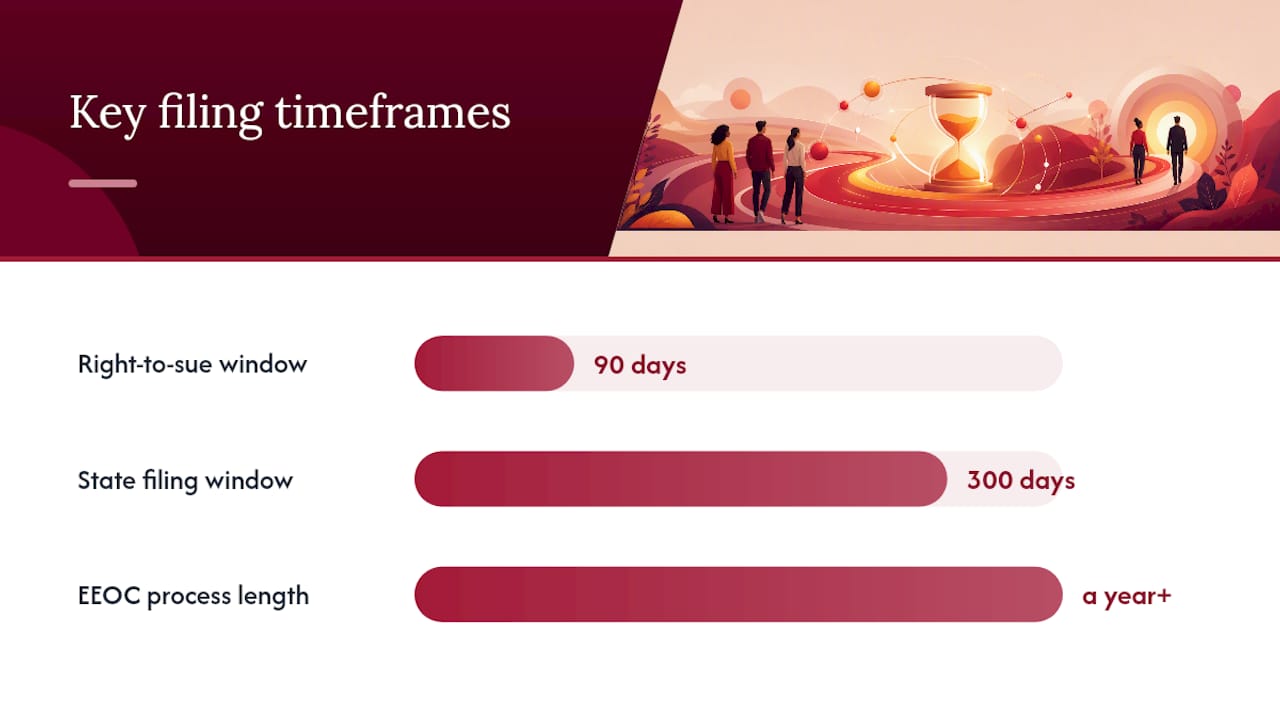
- Know your deadline. You generally have 180 days to file a charge with the U.S. Equal Employment Opportunity Commission (EEOC), extended to 300 days in most states that have their own anti-discrimination laws.
- Consider legal counsel. Javitchlawoffice offers free case evaluations for racial harassment claims and handles cases on a contingency basis.
Missing the filing deadline can permanently bar your federal claim. Act quickly.
Key Takeaways
Racial harassment at work is unlawful under Title VII when conduct is severe or pervasive, and missing the EEOC filing deadline can permanently bar your federal claim.
| Point | Details |
|---|---|
| Legal threshold | Harassment must be severe or pervasive, or result in an adverse employment action, to violate Title VII. |
| Filing deadlines | You have 180 days to file an EEOC charge, extended to 300 days in most states with their own anti-discrimination laws. |
| Single incident rule | One extremely offensive incident — a racial slur from a supervisor or a threatening symbol — can be enough to state a claim. |
| Retaliation protection | Reporting harassment protects you from retaliation; a retaliation claim is legally independent and can succeed even if the harassment claim does not. |
| Javitchlawoffice | The firm offers free consultations and contingency representation for racial harassment and hostile work environment claims nationwide. |
Table of Contents
- What counts as racial harassment at work?
- When does conduct become unlawful harassment?
- What are employers required to do, and when are they liable?
- How do you report racial harassment internally and to the EEOC?
- Are you protected from retaliation after reporting?
- Concrete steps to take today
- When should you contact an employment lawyer?
- How Javitchlawoffice evaluates racial harassment cases
- What most people get wrong about racial harassment claims
- Javitchlawoffice handles racial harassment claims nationwide
- Authoritative resources for reporting and filing
- Sources
What counts as racial harassment at work?
Federal law defines racial harassment as unwelcome conduct based on race or color that either creates a hostile work environment or leads to a tangible employment action such as termination or demotion. The conduct must be based on race — not just general workplace rudeness.
Common examples that can cross the legal line:
- Racial slurs, epithets, or derogatory nicknames
- Racist jokes, mockery, or stereotyping comments
- Offensive images, symbols, or graffiti (nooses, swastikas, caricatures)
- Differential discipline applied more harshly to employees of one race
- Exclusion from meetings, assignments, or opportunities based on race
- Physical threats or intimidation tied to race
Conduct that probably does not rise to the level of unlawful harassment includes a single offhand remark that is not severe, generalized workplace friction with no racial component, or a personality conflict that has nothing to do with race. Courts look at the full picture, not isolated moments in a vacuum.
The protected class under Title VII covers race and color, which means harassment based on skin tone within the same racial group is also covered. A Black employee harassed by another Black employee because of lighter skin tone, for example, can still have a valid claim.
When does conduct become unlawful harassment?
Two legal theories govern most racial harassment claims: hostile work environment and quid pro quo.
A hostile work environment exists when the conduct is unwelcome, based on race, and sufficiently severe or pervasive to alter the terms and conditions of employment from both the victim’s perspective and a reasonable person’s perspective. Courts weigh several factors under EEOC guidance:
- Frequency: How often did the conduct occur?
- Severity: Was it physically threatening, humiliating, or merely offensive?
- Physical threat: Did it involve bodily intimidation?
- Work interference: Did it actually disrupt the victim’s ability to do their job?
No single factor is decisive. A highly severe incident can satisfy the standard even without repetition.
Quid pro quo harassment occurs when a supervisor conditions a job benefit — a raise, a promotion, keeping your position — on tolerating race-based treatment. This is rarer in racial harassment cases than in sexual harassment cases, but it does happen.
The single-severe-incident rule is worth understanding clearly. Recent appellate decisions have confirmed that one use of a racial epithet by a supervisor can be sufficient to state a hostile work environment claim, depending on context. A physical artifact like a noose placed at an employee’s workstation has been found actionable on its own. Courts analyze context, not just incident counts.
The key takeaway: do not assume your situation is “not bad enough.” Let a lawyer assess the facts.
What are employers required to do, and when are they liable?
Employers have affirmative duties under federal law. They must maintain a written anti-harassment policy, provide a clear complaint procedure, investigate complaints promptly, and take corrective action proportionate to the conduct. Failing any one of these steps can significantly increase their legal exposure.
Liability rules differ based on who did the harassing:
- Supervisor with tangible employment action: If a supervisor fires, demotes, or reassigns you because of race-based harassment, the employer is automatically liable. No defense is available.
- Supervisor without tangible action: The employer may raise an affirmative defense if it had a reasonable anti-harassment policy and the employee unreasonably failed to use it.
- Coworker harassment: The employer is liable if it knew or should have known about the harassment and failed to take prompt corrective action.
- Non-employees (customers, clients, contractors): The employer can still be liable under EEOC standards if it controlled the work environment and did nothing after receiving notice.
The EEOC’s enforcement action against Tesla illustrates what inadequate response looks like in practice. According to the EEOC’s complaint, management’s failure to investigate or discipline after repeated complaints effectively signaled tolerance of the conduct, which the agency treated as evidence of employer liability.
Pro Tip: If you report harassment and your employer’s response is to do nothing, document that inaction in writing. Send a follow-up email to HR confirming your complaint and asking for a status update. That paper trail matters enormously if you later file an EEOC charge.

How do you report racial harassment internally and to the EEOC?
Internal reporting first
Before filing with any agency, report the harassment through your employer’s internal process. This matters legally: skipping internal reporting can give your employer an affirmative defense.
- Identify the right person. Go to HR or, if HR is implicated, to a senior manager or your employer’s EEO officer.
- Put it in writing. An email or written complaint creates a timestamp. Verbal complaints are harder to prove.
- Be specific. Include dates, what was said or done, who did it, who witnessed it, and how it affected your work.
A sample complaint opening you can adapt: “I am writing to formally report racial harassment I have experienced at work. On [date], [name/title] said/did [specific conduct] in the presence of [witnesses]. This conduct has created a hostile work environment and I am requesting a prompt investigation.”
Filing with the EEOC or a state agency
If internal reporting fails or you want to preserve your federal rights, file a charge with the EEOC through the EEOC public portal. You can also contact a state Fair Employment Practice Agency (FEPA); many states have their own civil rights agencies that enforce parallel state laws, sometimes with broader protections.
Usa explains that you can file with either the EEOC or your state agency, and the agencies often share charges with each other automatically.
Filing deadlines are the most critical detail in this entire process. Under EEOC time-limit rules:
- 180 days from the last discriminatory act if your state does not have a law covering the same conduct.
- 300 days if your state or local agency enforces a law that covers the same type of discrimination.
Most employees in states with active civil rights agencies get the 300-day window, but you should verify which applies to your state. Missing either deadline typically bars your federal lawsuit entirely.
Are you protected from retaliation after reporting?
Yes, and that protection is legally independent of your underlying harassment claim. Under Title VII, your employer cannot take adverse action against you because you opposed harassment, filed a complaint, or participated in an EEOC investigation. Even if the employer ultimately wins the harassment claim, a retaliation claim can still succeed on its own.
Retaliation can look like:
- Termination or constructive discharge shortly after a complaint
- Demotion, pay cuts, or reduced hours
- Negative performance reviews that did not exist before you reported
- Exclusion from projects, meetings, or social events
- Undesirable transfers or schedule changes
- Ostracism or a sudden change in how colleagues treat you
The timing matters. If adverse actions cluster around your complaint date, that sequence is evidence. Document every negative change with dates and compare it against your complaint timeline.
If retaliation occurs, report it separately to HR and to the EEOC. A workplace retaliation claim is filed the same way as a harassment charge and carries the same deadlines.
Concrete steps to take today
The strongest cases are built on records created close to the time of the incident. Here is a prioritized checklist:
- Write contemporaneous notes. Record the date, time, location, exact words or conduct, and any witnesses. Do this within 24 hours while memory is fresh.
- Save all electronic evidence. Screenshot text messages, Slack messages, and emails. Forward relevant emails to a personal account before your employer can restrict access.
- Photograph physical evidence. If a symbol, image, or object was involved, photograph it with your phone before it is removed.
- Identify witnesses. Write down the names of anyone who saw or heard the conduct, even if they did not react.
- Secure copies off-site. Store everything on a personal device or cloud account, not a company-issued one.
- Submit a written internal complaint. Use the sample language above and keep a copy.
- Track all employer responses. Note who responded, when, and what they said or did. If nothing happened, note that too.
Pro Tip: Never use your work computer or work email to store evidence or communicate with a lawyer. Your employer can access those systems. Use personal devices and personal accounts for everything related to your claim.
When should you contact an employment lawyer?
You do not need to wait until you have been fired. Consult a lawyer if any of these apply:
- A single severe incident occurred (a slur from a supervisor, a threatening symbol)
- Your employer has not responded to your internal complaint within a reasonable time
- You are experiencing retaliation after reporting
- Your filing deadline is approaching and you have not yet filed
- You are unsure whether your state’s 300-day window applies
The EEOC process in brief: You file a charge, the EEOC notifies your employer and begins an investigation. The agency may attempt conciliation (a negotiated settlement). If conciliation fails, the EEOC either files suit on your behalf or issues a right-to-sue letter, giving you 90 days to file a civil lawsuit. The full process can take a year or more, which is why having counsel early matters.
Possible remedies in a successful case include back pay, reinstatement, compensatory damages for emotional distress, punitive damages against employers who acted with malice or reckless indifference, and injunctive relief requiring the employer to change its practices. Most employment discrimination attorneys, including Javitchlawoffice, work on contingency for these cases, meaning you pay nothing unless you recover. For more on when to hire a racial discrimination lawyer, the firm’s blog covers state versus federal claim strategy in detail.
How Javitchlawoffice evaluates racial harassment cases
When you contact Javitchlawoffice, the intake process focuses on building a clear factual picture before any legal strategy is discussed. The firm typically asks for:
- A chronological timeline of incidents, including dates and descriptions
- Copies of any internal complaints you filed and employer responses
- Electronic communications (emails, texts, screenshots)
- Names and contact information for witnesses
- Any documentation of employer inaction or retaliation
Case-strength factors the firm weighs include the severity of the conduct, whether a supervisor was involved, whether there is a pattern or a single extreme incident, the quality of documentary evidence, and whether you reported promptly. Supervisor involvement and documented employer inaction are two of the strongest signals.
The firm handles racial and antisemitic discrimination cases on a contingency basis, so the financial barrier to getting legal help is low. If you have evidence of a hostile work environment and a timely filing window, there is no reason to delay a consultation.
What most people get wrong about racial harassment claims
The most common mistake is waiting. Employees often spend months hoping the situation will resolve itself, or they worry that reporting will make things worse. By the time they consult a lawyer, the 180-day or 300-day window is closing, key witnesses have left the company, and electronic evidence has been overwritten.
The second mistake is underestimating a single incident. Courts have moved away from requiring a long pattern of conduct. A supervisor using a racial slur once, in front of witnesses, in a context that signals contempt rather than accident, can be enough. The legal question is not “how many times” but “how bad and in what context.” Employees who dismiss their own experience because it only happened once may be walking away from a valid claim.
There is also a persistent misconception that you must exhaust every internal remedy before the EEOC clock starts. That is wrong. The deadline runs from the date of the discriminatory act, not from the date your employer finishes its internal investigation. Filing internally does not pause the EEOC clock.
Javitchlawoffice handles racial harassment claims nationwide
Racial harassment cases require a lawyer who understands both the federal framework and the state-specific rules that can expand your rights and your deadline. Javitchlawoffice is a civil rights firm with nationwide reach, built specifically for cases like these.
The firm offers free, confidential case evaluations for employees facing racial harassment, hostile work environments, and retaliation. You bring your timeline, your evidence, and your questions. The firm assesses whether you have a viable claim, explains your options under federal and state law, and, where appropriate, takes the case on contingency, meaning no upfront fees. To get started, visit the firm’s workplace discrimination attorney page or the racial and antisemitic discrimination practice page to schedule your consultation today.
Authoritative resources for reporting and filing
Use these sources to file a charge, find your state agency, or report criminal conduct:
- EEOC Public Portal: File a charge of discrimination online. The portal guides you through the intake process and connects you with your regional EEOC office.
- EEOC Time Limits Guidance: Confirms whether your state’s 180-day or 300-day window applies before you file.
- EEOC Race/Color Discrimination: The agency’s primary guidance on what constitutes unlawful racial harassment and how to pursue a charge.
- Usa: Plain-language overview of your rights, how to file with the EEOC or a state FEPA, and links to legal aid resources.
- DOJ Civil Rights Division: For civil rights violations beyond employment, including housing and public accommodations, the DOJ Civil Rights Division accepts complaints and provides referrals.
- DOJ Report a Hate Crime: If the conduct is criminal and motivated by race — threats, physical assault, vandalism — contact local police and follow up with the DOJ’s hate crime reporting portal. Employment claims and hate crime reports are separate processes; you can pursue both simultaneously.
This article provides general legal information, not legal advice. Laws vary by state and individual circumstances differ. Consult a qualified employment attorney and verify current rules with the EEOC or your state civil rights agency before taking action.
This article is general information, not a substitute for advice from a qualified lawyer. Consult a qualified legal professional about your own circumstances before acting on anything here.
Sources
- Race/Color Discrimination | U.S. Equal Employment Opportunity Commission
- Single Use of Racial Slur Can Create Hostile Work Environment
- Time limits for filing a charge | U.S. Equal Employment Opportunity Commission
- Discrimination, harassment, and retaliation | USAGov
- Report a Hate Crime | U.S. Department of Justice
Recommended
- When to Hire a Racial Discrimination Lawyer: Protecting Your Workplace Rights | Javitch Law Office
- Jewish Discrimination in the Workplace: Know Your Rights and Legal Options | Javitch Law Office
- Fighting Antisemitic and Racial Discrimination in the Workplace | Javitch Law Office
- Workplace Discrimination Attorney | California & Nationwide