
Yes. California outlaws discrimination based on natural hair texture and protective hairstyles under SB-188, the CROWN Act, and its 2024 amendment, AB-1815, which folds those protections into the Fair Employment and Housing Act, the Unruh Civil Rights Act, and the Education Code. That covers workplaces, schools, and public accommodations statewide. If it happened to you, the first stop for a formal complaint is California’s civil rights enforcement agency, and a discrimination attorney can help you figure out the fastest path from there.
TL;DR:
- Vague dress codes that use terms like “neat” or “professional” can lead to strong disparate impact claims if they disproportionately target natural Black hairstyles.
- Discrimination claims in employment involve filing with California’s civil rights agency if the employer has at least five employees, while schools and businesses have their own specific complaint processes.
- Facial hairstyle discrimination policies explicitly banning protective styles are easier to prove, whereas neutral policies causing disproportionate harm require statistical evidence to establish impact.
- Remedies include damages, policy changes, and injunctive relief, but defenses like safety requirements or true occupational qualifications can limit liability.
- Documenting incidents, preserving evidence, and consulting an attorney promptly are essential steps to strengthen a hairstyle discrimination case in California.
Table of Contents
- What the CROWN Act and AB-1815 Actually Cover
- Who’s Protected, and Where Do You File?
- Facial Discrimination vs. Disparate Impact: The Legal Test
- What to Do if You Think You Were Discriminated Against
- What Remedies Look Like, and Where the Law Draws Lines
- How Javitch Law Office Evaluates Hairstyle Discrimination Cases
- Get a Case Evaluation for Hair-Based Discrimination
- Sources
- FAQ
What the CROWN Act and AB-1815 Actually Cover
California’s statute does something federal law never quite managed: it names hair. The CROWN Act, which Governor Gavin Newsom signed on July 3, 2019, redefines “race” under state law to include traits historically associated with race, including hair texture and protective hairstyles. The law took effect January 1, 2020, making California the first state in the nation to pass this kind of protection.
The statute lists specific examples, and the list matters because vague language is exactly what let employers get away with grooming bias for decades. Protected styles include:
- Afros
- Braids and cornrows
- Twists
- Locs
- Bantu knots and similar protective styles
AB-1815, chaptered in September 2024, closed a gap that had crept into interpretation: it clarified that “traits associated with race” apply consistently across FEHA, the Unruh Act, and the Education Code, so there’s no argument that one statute covers hair texture while another doesn’t.
The change wasn’t cosmetic. A 2019 report from JOY Collective and Cal State LA documented that Black women frequently faced pressure to alter their natural hair to keep a job, and were sent home from work over their hairstyle at disproportionate rates. That pattern is exactly what lawmakers built the statute to stop.
Who’s Protected, and Where Do You File?
Where the discrimination happened determines which law and which agency applies. California’s protections aren’t limited to a single setting.
- Employment: FEHA covers private employers with five or more employees, plus most public employers, through California’s civil rights enforcement agency.
- Public schools: The Education Code extends CROWN Act protections to K-12 and higher education, covering dress codes, dance team and athletic grooming rules, and disciplinary policies.
- Business and public accommodations: The Unruh Civil Rights Act bars discrimination in stores, restaurants, hotels, and other public-facing businesses.
- Housing: Landlords and property managers can’t apply grooming-based exclusions that function as racial discrimination either.
Private-sector employees and most public employees file employment claims with the state’s civil rights agency. Education-related complaints typically start with the school district’s own grievance process before escalating. Business and housing discrimination generally routes through the same civil rights agency handling Unruh Act claims. If you’re not sure which lane applies to your situation, a discrimination attorney can sort that out in a single conversation.
Facial Discrimination vs. Disparate Impact: The Legal Test
Not every hairstyle policy gets challenged the same way, and understanding which category yours falls into changes how much you need to prove.
- Facially discriminatory policies name or directly target protected styles. A grooming policy that says “no braids, locs, or twists in customer-facing roles” is facially discriminatory. You don’t need statistics or comparative data here. The rule itself is the violation.
- Disparate impact policies look neutral on paper but land disproportionately on one group. A “professional appearance” rule that bans “extreme” or “unnatural” hairstyles can function as a proxy for banning natural Black hairstyles, even without naming them.
Before California’s CROWN Act, federal courts often treated hairstyle as a mutable, changeable trait outside race discrimination law, which let employers argue grooming policies weren’t really about race at all. California’s statute erased that argument by defining hair texture and protective styles as race traits by law, not by inference.
Pro Tip: If your employer’s dress code uses vague language like “professional” or “neat” appearance without defining it, ask for the written policy in full. Vague standards enforced unevenly are often where disparate-impact claims are strongest.
What to Do if You Think You Were Discriminated Against
Move fast, but move carefully. Evidence fades and memories blur within weeks, not months.
- Document everything as it happens. Write down dates, names of everyone involved, exact words used, and any witnesses present.
- Preserve physical evidence. Save emails, text messages, written warnings, dress code policies, and photos of your hairstyle before and after any incident.
- Use internal channels, but don’t rely on them alone. File a written complaint with HR or, for students, the school’s designated compliance officer, and keep a copy.
- Start an intake with California’s civil rights enforcement agency. Employment and housing claims generally must be filed within three years of the incident under current state law, though earlier filing always strengthens your position.
- Consult an attorney before or alongside filing. Bring your documentation, any written policies, and a timeline of events to that first conversation.
A few habits make a real difference in how a complaint holds up later:
- Keep a private log outside of work email or school accounts, since employer-owned systems can be revoked or monitored.
- Ask witnesses to write down what they saw while it’s fresh, rather than waiting to see if you’ll need it.
- Note any pattern. One incident is a complaint. A pattern affecting multiple people is often a stronger case.
What Remedies Look Like, and Where the Law Draws Lines
California law offers real remedies, but they come with limits worth understanding before you file.
- Monetary damages for lost wages, emotional distress, and in some cases punitive damages under FEHA.
- Injunctive relief requiring an employer or school to rewrite or abandon a discriminatory policy.
- Policy changes mandated as part of a settlement or court order, often with compliance monitoring.
Employers do retain narrow defenses. A bona fide occupational qualification defense applies only in rare circumstances tied directly to job function, not general “brand image” preferences. Safety and hygiene rules can survive if they’re narrowly tailored, applied consistently across racial groups, and actually necessary, not just convenient. A blanket ban on “unnatural” hair colors in a food service job might survive scrutiny; a ban on locs in the same job almost certainly wouldn’t.
Administrative complaints through the state agency are typically less expensive and faster than a civil lawsuit, but civil claims can pursue larger damages when the agency process doesn’t resolve things.
How Javitch Law Office Evaluates Hairstyle Discrimination Cases
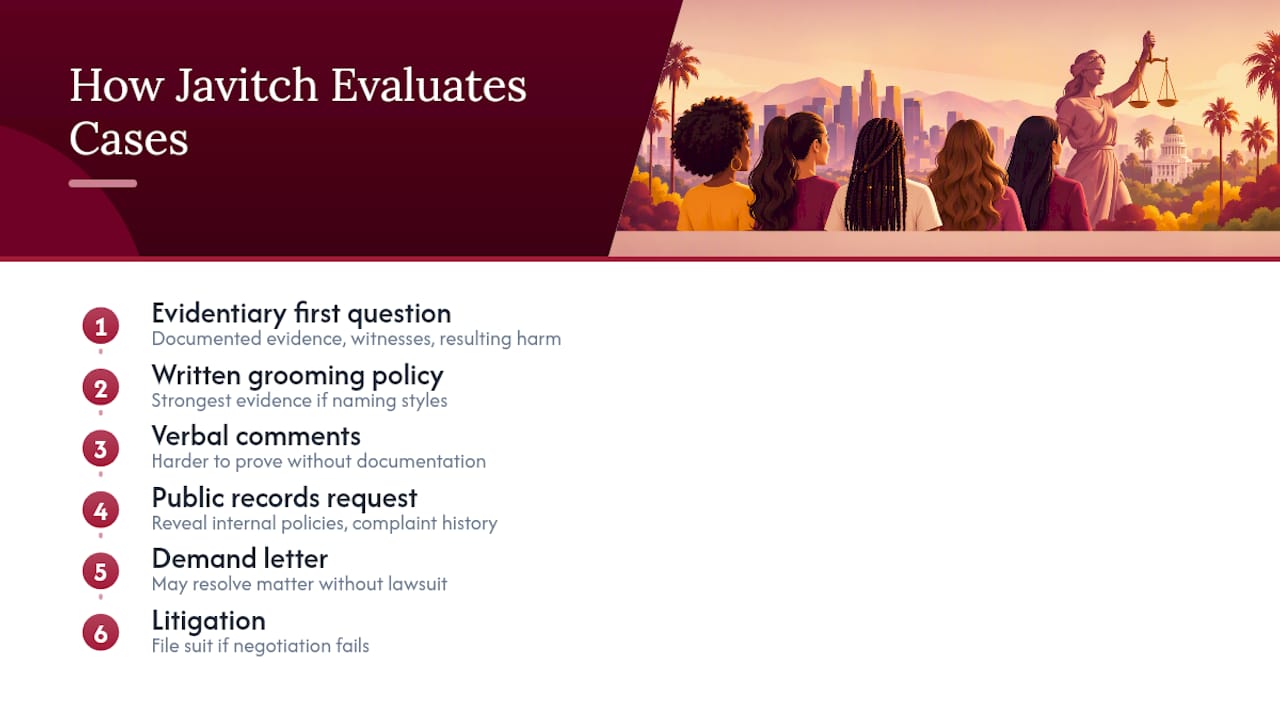
When we review a potential CROWN Act matter, the first question is always evidentiary: what’s documented, who witnessed it, and what harm followed. A written grooming policy that names protective styles is one of the strongest pieces of evidence a client can bring us. Verbal comments without documentation are harder, though not impossible, to build a case around.
Our approach often starts before litigation. Public records requests can surface internal policies or complaint histories that strengthen a claim, and a demand letter sometimes resolves a matter without a lawsuit at all. When negotiation doesn’t work, we’re prepared to litigate through our discrimination practice.
— Mark
Get a Case Evaluation for Hair-Based Discrimination
Javitch Law Office is the alternative to guessing whether your situation qualifies. Some employees and students don’t know which statute applies to their case, and that uncertainty is exactly what stops people from filing before the clock runs out.
An initial case evaluation with a legal team costs you nothing to start, and many discrimination cases are handled on a contingency basis, meaning you don’t pay unless there is a recovery. Bring whatever documentation you have, even if it feels incomplete: dates, names, dress code policies, texts, emails, disciplinary notices. If your case involves a school rather than a workplace, our student discrimination team handles those claims separately. If a public agency’s records could support your case, our FOIA and public records attorneys can help pull them.
Start with our workplace discrimination attorneys page and request a case evaluation directly. The sooner you document what happened, the stronger your position when you’re ready to act.
Sources
- SB-188 Discrimination: hairstyles. — California Legislative Information
- AB 1815 (Weber) analysis — California Senate Judiciary Committee (analysis PDF)
- A Hairy Situation: Fighting Hair Bias in the Workplace — JOY Collective / Cal State LA (report)
This article is general information, not a substitute for advice from a qualified lawyer. Consult a qualified legal professional about your own circumstances before acting on anything here.
FAQ
Is Hair Discrimination the Same as Race Discrimination?
Under California law, yes. The CROWN Act specifically redefines “race” to include hair texture and protective hairstyles, so discrimination based on natural hair is legally treated as racial discrimination, not a separate category.
Is It Illegal to Discriminate Based on Hair Color?
Hair color alone, like dyeing your hair blue or blonde, generally isn’t a protected trait under the CROWN Act. The law protects texture and protective styles like braids, locs, and afros because those traits are tied to race, not color choices made for personal style.
Can You Sue for Hair Discrimination in California?
Yes. After filing with California’s civil rights enforcement agency, you can pursue a civil lawsuit seeking damages, and many cases resolve through settlement before trial. A workplace discrimination attorney can evaluate whether your documentation supports a strong claim before you file.
What Is the 80% Rule in Discrimination Cases?
The “80% rule,” more accurately called the four-fifths rule, is a federal guideline used to evaluate disparate impact by comparing selection or treatment rates between groups. It’s a tool sometimes used in broader employment discrimination analysis, but California’s CROWN Act claims involving facially discriminatory hair policies don’t require this statistical showing at all.
Does a School Dress Code Violate the CROWN Act?
A school policy banning specific protective hairstyles, or grooming standards that disproportionately affect Black students, can violate the Education Code’s CROWN Act provisions. Complaints typically start with the district’s compliance process before any outside filing.