
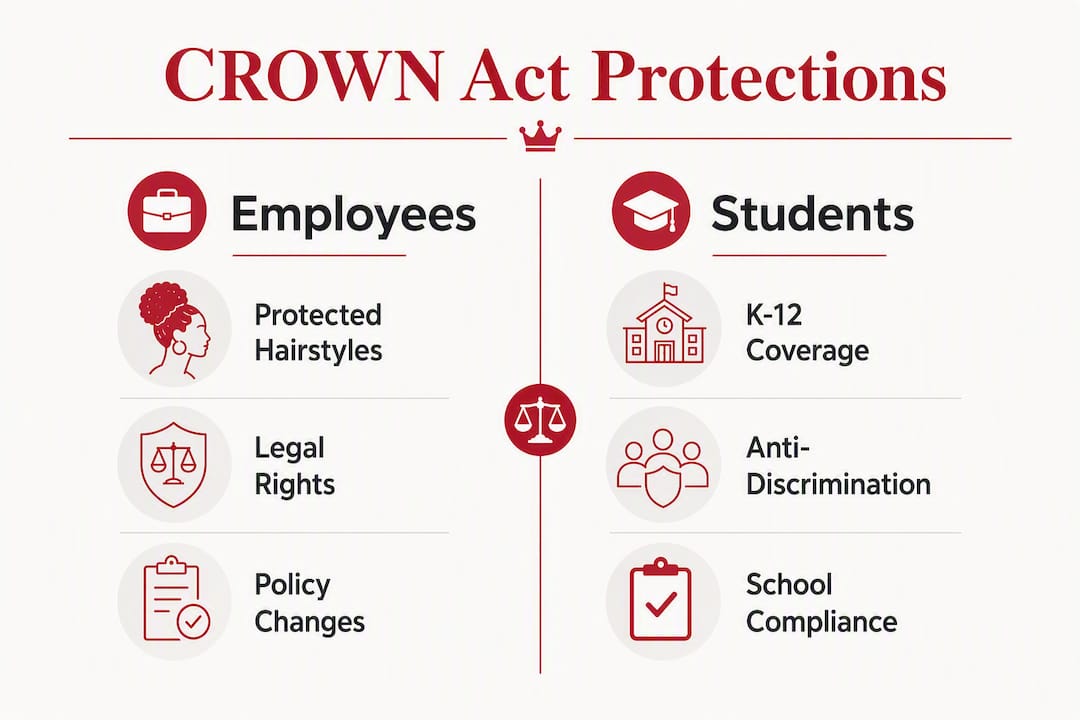
California’s CROWN Act (SB 188) makes hair texture and protective hairstyles legally protected traits under state anti-discrimination law, effective January 1, 2020. The law amends the Fair Employment and Housing Act (FEHA) and the California Education Code so that an employer, school, or licensing body cannot penalize someone for wearing braids, locs, twists, knots, or natural hair textures. Governor Newsom signed SB 188 on July 3, 2019, making California the first state in the nation to enact this protection. If you have faced discipline, termination, or school suspension tied to your hairstyle, you have a viable legal claim. File with the California Civil Rights Department (CRD) within three years of the most recent act, and you can pursue federal EEOC options at the same time. The CROWN Coalition and California Legislative Information are the primary public resources for the bill text and advocacy background.
This article provides general legal information, not legal advice. Consult a qualified attorney or the CRD to evaluate your specific situation.
Table of Contents
- What does the CROWN Act change in California law?
- Who does the California hairstyle law actually cover?
- What hairstyles and traits are protected under California law?
- What employers and schools must do to comply
- How to enforce your rights under the CROWN Act
- What to document: building a strong record
- Recent developments: AB-1815 and what comes next
- When to contact a lawyer and how Javitchlawoffice can help
- Key Takeaways
- Why the CROWN Act matters more than most people realize
- Javitchlawoffice: get a case evaluation for your CROWN Act claim
- Authoritative sources and further reading
What does the CROWN Act change in California law?
SB 188 did one precise thing: it redefined “race” in California’s civil rights statutes to include traits historically associated with race. The key provision sits at Government Code § 12926(w), which now reads that “race” encompasses “traits historically associated with race, including, but not limited to, hair texture and protective hairstyles.”
That language matters for a specific legal reason: before SB 188, a plaintiff challenging a grooming policy had to prove the employer intended to discriminate by race. By classifying hair texture and protective hairstyles as racial traits, the statute removes that burden. A policy that disproportionately burdens natural Black hair textures is now facially discriminatory, not just circumstantially suspicious.
The Education Code received a parallel amendment, extending the same definitional change to K–12 public and charter schools.
| Statute | Code Section | What It Does |
|---|---|---|
| SB 188 (CROWN Act) | Gov. Code § 12926(w) | Adds hair texture and protective hairstyles to FEHA’s definition of “race” |
| SB 188 (CROWN Act) | Education Code | Extends the same definition to K–12 public and charter schools |
| AB-1815 (2024) | Civil Code § 51 (Unruh Act) | Expands the same hair-texture definition to public accommodations and Unruh Act coverage |
The statutory list of protected styles is illustrative. The phrase “including but not limited to” means courts and agency investigators apply the same protection to any presentation historically or culturally associated with race, even if the style is not named in the text.
Who does the California hairstyle law actually cover?
The law covers more people and settings than most readers initially assume.

In employment, FEHA applies to employers with five or more employees. Protection extends to current employees, job applicants, contractors where FEHA reaches, and participants in apprenticeship or vocational training programs. Every stage of the employment relationship is covered: hiring decisions, compensation, promotion, discipline, and termination. An employer who rejects a candidate at the interview stage because of locs has violated the statute just as clearly as one who fires a long-tenured employee for the same reason.
In schools, the Education Code amendment covers K–12 public schools and charter schools. A student sent home or suspended for wearing braids or twists has a claim under the Education Code. School discipline records, dress-code policies, and any written communication about the student’s appearance are all relevant evidence.
Licensing and apprenticeship programs fall within FEHA’s reach when they function as gatekeepers to employment. A cosmetology board or trade apprenticeship that imposes grooming standards as a condition of entry cannot require applicants to alter natural hair textures or abandon protective styles.
Federal law overlap. Title VII of the Civil Rights Act also prohibits race discrimination in employment, and a CROWN Act claimant can file with both the CRD and the EEOC simultaneously. California’s standard is more protective: Title VII courts have historically required plaintiffs to show that a grooming policy was tied to an “immutable” characteristic, a hurdle SB 188 eliminates at the state level. Filing both tracks preserves maximum options without waiving either.
A few quick scenarios: A Black woman arrives at a job interview with box braids and is told the company has a “neat appearance” policy that prohibits them. That is a FEHA violation at the hiring stage. A middle-school student is disciplined for wearing locs under a dress code that permits other students to wear their hair down. That is an Education Code violation. A union apprenticeship program requires all trainees to cut their hair to a uniform length, effectively forcing Black trainees to cut locs or twists. That triggers FEHA scrutiny.
What hairstyles and traits are protected under California law?
The statute explicitly names four categories of protective hairstyles:
- Braids (including box braids, cornrows, and similar plaited styles)
- Locs (sometimes spelled “locks” or “dreadlocks,” though the latter term is contested)
- Twists (two-strand twists, flat twists, and related styles)
- Knots (including Bantu knots and similar gathered styles)
Beyond those four, the law covers natural hair texture itself, meaning the unaltered texture of hair as it grows. Afros, coils, and tightly curled natural styles fall within this protection even though the statute does not name them individually. The “including but not limited to” construction means any style historically or culturally associated with race is covered once a claimant can show that association.
When a neutral policy still violates the law. A grooming rule does not have to say “no braids” to be discriminatory. A policy requiring all employees to wear hair “off the collar” or “no longer than two inches” may be facially neutral but operate to burden natural Black hair textures in a way it does not burden straight or wavy hair. Courts and agency investigators look at disparate impact: who, in practice, is disciplined under this rule? If the answer is disproportionately Black employees wearing protective styles, the policy is suspect regardless of its wording.
Selective enforcement is often the clearest proof. If a white employee wears a messy bun and receives no comment, while a Black colleague wearing a similarly sized style is disciplined, that comparator evidence goes directly to discriminatory application.
Pro Tip: Document comparator evidence from the start. Note the names, positions, and hairstyles of colleagues who are not disciplined under the same policy. A single well-documented comparator can be more persuasive than a stack of general statistics.
What employers and schools must do to comply
Compliance is not complicated, but it requires deliberate policy review and consistent enforcement.

The legal standard. An employer or school cannot maintain a grooming rule that explicitly prohibits protective hairstyles or natural hair textures. Beyond that, any facially neutral rule that disproportionately burdens those traits must be justified by a genuine operational or safety need, and even then, the employer must offer the least restrictive accommodation available.
Common policy fixes. Most violations stem from legacy dress codes drafted before 2020 that use vague terms like “professional appearance,” “neat and tidy,” or “no extreme hairstyles.” Those phrases need to go, or at minimum be accompanied by explicit language confirming that protective hairstyles and natural textures are permitted. A compliant policy might read:
Safety exceptions. The statute permits genuinely race-neutral safety rules, such as requiring hair to be secured near moving machinery or covered in food-preparation environments. The key constraint: an employer cannot require cutting or chemical alteration as the only compliance method. A hair net, covering, or tie-back is almost always a less restrictive alternative. Courts apply heightened scrutiny when a safety rule disproportionately burdens natural Black hair textures, so the employer’s justification must be specific and documented, not generic.
For HR leaders reviewing appearance and photo policies, corporate photo policy best practices offer a practical framework for balancing non-discrimination requirements with legitimate operational standards.
Pro Tip: When a safety-based exception applies, document the specific hazard and the specific reason a hair covering was not sufficient before requiring any further restriction. A one-sentence written justification at the time of the decision is far stronger than a post-hoc explanation in litigation.
Training matters as much as policy text. Supervisors who have never read the updated policy will apply old assumptions. Annual training that names the CROWN Act, explains protected styles, and walks through the comparator-evidence standard is the single most effective compliance investment.
How to enforce your rights under the CROWN Act
You can file a CROWN Act complaint with the California Civil Rights Department (CRD) within three years of the most recent discriminatory act, and you can pursue EEOC federal options at the same time without waiving either track.
Step-by-step enforcement process:
- Document the incident. Write down what happened, when, who was present, and what was said or written. Do this within 24 hours while details are fresh.
- File an internal complaint (when practical). Report the incident to HR or a school administrator in writing. Legal advocates recommend this step when it is safe to do so, but it is not a prerequisite to agency filing.
- File with the CRD. Submit an intake form through the CRD’s online portal or by phone. The CRD will investigate, attempt mediation, and issue a right-to-sue notice if the case does not resolve.
- File with the EEOC (optional but recommended). Federal and state filings can run concurrently. The EEOC’s deadline for Title VII claims is 300 days from the discriminatory act in California (a deferral state).
- Receive a right-to-sue notice. Once the CRD or EEOC issues this notice, you have a limited window to file a civil lawsuit. An attorney should be involved before this stage.
- Litigation. If the agency process does not resolve the claim, a civil lawsuit in California Superior Court or federal district court is the next step.
Available remedies under FEHA include:
- Back pay (lost wages from the date of the discriminatory act)
- Front pay (projected future lost earnings)
- Emotional distress damages (uncapped under California law)
- Injunctive relief (court order requiring the employer to change its policy)
- Attorney’s fees and costs
- Punitive damages in cases of malice, oppression, or fraud
The combination of uncapped emotional distress damages and attorney’s fees makes California one of the strongest jurisdictions in the country for hair discrimination claims.
What to document: building a strong record
Failing to preserve documentation is the most common reason strong claims become weak ones. Start collecting evidence the moment you suspect discrimination.
Evidence checklist:
- Written grooming or dress-code policies (request a copy in writing)
- All disciplinary records, warnings, and performance reviews
- Emails, texts, or messages referencing your hairstyle or appearance
- Photographs of your hairstyle at the relevant time
- Names and contact information of witnesses
- Notes on comparator employees (who wore what, who was or was not disciplined)
- Interview notes or rejection letters if the claim involves hiring
- Any HR communications about the incident
Sample email requesting your employer’s grooming policy:
Sample email reporting an incident:
Pro Tip: Forward all relevant emails to a personal account immediately after saving them. Metadata (sent timestamps, headers) can be critical in litigation. Keep a running contemporaneous log with dates, times, and exact quotes — a handwritten journal entry made the same day carries significant evidentiary weight.
Comparator evidence deserves special attention. Selective enforcement is often the strongest proof of disparate treatment, and it requires you to know what your colleagues are wearing and how they are treated. Note this information as it happens, not months later.
Recent developments: AB-1815 and what comes next
California’s hairstyle protection law has not stood still since 2019. The statutory environment is actively evolving, and the changes matter for both claimants and employers.
- Assembly Bill 1815 (Chapter 619, Statutes of 2024): AB-1815 was signed into law on September 26, 2024, amending Civil Code § 51 (the Unruh Civil Rights Act) and other code sections to include hair texture and protective hairstyles within the definition of “race” for public accommodations. Before AB-1815, the CROWN Act’s explicit protections applied primarily to employment and K–12 schools. The Unruh Act extension means businesses open to the public, including hotels, restaurants, retail stores, and service providers, now face the same legal standard. A salon that refuses to serve a customer with locs, or a gym that bars a member for wearing twists, is now squarely within the statute’s reach.
- Expanded enforcement signals. The CRD has incorporated CROWN Act violations into its standard intake process, and practitioners report that agency investigators treat comparator evidence and policy text as the two most critical early factors in case assessment.
- Federal momentum. The federal CROWN Act has passed the U.S. House of Representatives in prior sessions but has not yet cleared the Senate. California claimants do not need federal legislation to pursue state claims, but federal passage would extend protections to states that have not yet enacted their own laws.
Staying current with California and federal statutes is practical for both claimants and employers, given how quickly the statutory framework is expanding.
When to contact a lawyer and how Javitchlawoffice can help
Some situations require immediate legal counsel rather than a wait-and-see approach,
You should speak with an attorney if you have experienced repeated discipline tied to your hairstyle, been passed over for promotion while less-qualified colleagues were advanced, been constructively discharged (conditions made so intolerable you felt forced to resign), or if your child has been suspended or excluded from school activities because of a protective style. These patterns suggest a systemic policy problem, not a one-time misunderstanding, and they tend to produce the strongest claims.
Javitchlawoffice handles racial and hair-based discrimination claims across California, with experience in FEHA litigation, agency filings, and civil rights cases involving employment and school settings. The firm evaluates cases at intake for the strength of comparator evidence, the clarity of the policy violation, and the damages picture, including emotional distress and back pay. For school-related claims, the firm’s school discrimination practice covers both Education Code violations and situations where a student’s discipline record has downstream consequences for college admissions or extracurricular eligibility.
What to bring to a consultation:
- A copy of the employer’s or school’s written grooming policy
- All disciplinary records, warnings, or suspension notices
- A written timeline of events with dates and names
- Any communications (emails, texts) referencing your hairstyle
- Names of witnesses or comparator employees
Pro Tip: Before your first call, write a one-page timeline: date of incident, what was said or written, who was present, and what happened next. Attorneys can assess a case in minutes when the facts are organized. It also helps you remember details that fade quickly.
Understanding when to hire a racial discrimination lawyer is itself a strategic decision. The three-year CRD filing window sounds generous, but evidence degrades, witnesses move on, and employers sometimes destroy records. Earlier consultation almost always produces a stronger case.
Key Takeaways
California’s CROWN Act (SB 188) gives employees and students concrete, enforceable rights against hair discrimination, backed by uncapped emotional distress damages and a three-year filing window with the CRD.
| Point | Details |
|---|---|
| SB 188 protects hair as race | Hair texture and protective hairstyles are legally defined racial traits under FEHA and the Education Code. |
| Workplaces and schools both covered | Protection applies at every employment stage and to K–12 public and charter school discipline. |
| Three-year filing deadline | File with the California Civil Rights Department within three years of the most recent discriminatory act. |
| Safety rules have limits | Employers may enforce genuine safety rules but cannot require cutting or chemical alteration as the only solution. |
| Javitchlawoffice evaluates claims | The firm handles FEHA and Education Code hair discrimination cases across California, from intake through litigation. |
Why the CROWN Act matters more than most people realize
The conventional framing of the CROWN Act treats it as a narrow grooming-policy fix. That undersells what the statute actually did. Before SB 188, a Black employee challenging a “no locs” policy had to prove the employer’s intent to discriminate by race, a nearly impossible standard when the policy was written in neutral language. The law’s real innovation was definitional: by classifying hair texture and protective hairstyles as racial traits, California shifted the burden. A policy that burdens those traits is now presumptively discriminatory, full stop.
What that means in practice is that the weakest cases under the old framework, the ones where an employer could point to a facially neutral policy and claim ignorance, are now the clearest violations. The employer who says “we treat everyone the same” while enforcing a rule that only burdens natural Black hair has no defense left.
AB-1815 extended that logic to public accommodations in 2024, which is the more consequential expansion. Employment discrimination claims require a five-employee threshold and an administrative exhaustion process. The Unruh Act has no such threshold and allows direct civil suits with statutory damages. A single discriminatory interaction at a business open to the public is now actionable without going through the CRD first.
The gap between what the law says and what most employers and schools actually know remains wide. Grooming policies written in 2015 are still in use. Supervisors who have never heard of SB 188 are still making discipline decisions. That gap is where most claims originate, and it is also where early legal consultation makes the biggest difference.
Javitchlawoffice: get a case evaluation for your CROWN Act claim
Hair discrimination claims have real teeth in California, and the window to act is finite. Javitchlawoffice offers workplace discrimination representation for employees and student discrimination representation for families navigating school-based claims, with a focus on civil rights cases where the evidence supports litigation.
The initial consultation covers document review, timeline assessment, and a frank evaluation of your damages picture, including back pay, emotional distress, and whether punitive damages are in play. Many discrimination cases are handled on a contingency basis, meaning no attorney fees unless the case resolves in your favor. All consultations are confidential. Bring your grooming policy, disciplinary records, and a written timeline of events, and the firm will tell you plainly where your claim stands. Contact Javitchlawoffice through the firm’s online intake or by phone to schedule your evaluation.
Authoritative sources and further reading
Primary law and official resources:
- The CROWN Act — California (CROWN Coalition) — advocacy organization that led the campaign; background and coalition materials.
Guidance and commentary:
| Source | Type | Best Use |
|---|---|---|
| California Legislative Information (SB 188) | Primary law | Verify exact statutory language |
| California Legislative Information (AB-1815) | Primary law | Confirm 2024 Unruh Act expansion |
| Governor’s Press Release | Official executive record | Confirm signing date and stated purpose |
| CROWN Coalition | Advocacy / background | Coalition history and campaign context |
| LawHelpCA | Advocacy guidance | Documentation and complaint process |
Recommended
- California Public Records Act Lawyer: Enforcing Your Right to Government Transparency | Javitch Law Office
- FOIA Requests: Accessing Government Records in California and Federal Agencies | Javitch Law Office
- California’s 90 Day Price Rule: Fighting Deceptive Pricing Practices | Javitch Law Office
- Civil Rights Lawyers for Students: Defending Your Child’s Constitutional Rights | Javitch Law Office