
Yes, discrimination in public accommodations is illegal under federal law in most settings, and many states go further. If it happens to you, write down what happened while it’s fresh, note the date, time, and names of anyone involved, and check filing deadlines immediately. Federal statutes like Title II of the Civil Rights Act and the ADA, enforced by agencies including the DOJ Civil Rights Division, the DOL Civil Rights Center, and the EEOC, set the floor. Legal professionals can help you figure out which one applies to your case.
TL;DR:
- Federal laws protect against discrimination in most public accommodations, but protections and filing deadlines vary significantly by state.
- Many states expand protections to include traits like sexual orientation, gender identity, and source of income, beyond federal classifications.
- Document incidents thoroughly with dates, names, and evidence immediately, as missing deadlines or evidence loss can jeopardize claims.
- Filing with the correct agency depends on who discriminated against you; agencies include the DOJ Civil Rights Division, DOL Civil Rights Center, state agencies, and the EEOC.
- Discriminatory behaviors include outright denial of service, segregation, harassment, refusal to accommodate disabilities, and retaliatory conduct.
Table of Contents
- What Counts as a Public Accommodation Under Federal Law?
- What Federal Laws Protect You From Discrimination?
- Do State Laws Offer More Protection Than Federal Law?
- How Do You Document an Incident and Meet Filing Deadlines?
- Where Do You File a Public Accommodations Discrimination Complaint?
- What Remedies and Protections Exist After You Report Discrimination?
- When Should You Contact an Attorney for a Discrimination Claim?
- What Behaviors Count as Discriminatory in Practice?
- Can You Resolve a Discrimination Claim Without Going to Court?
- What Court Cases Have Shaped Public Accommodations Law?
- How Do Disability and Other Protected Traits Overlap?
- An Editorial Take: Where This Area of Law Actually Trips People Up
- Get Legal Help From Javitch Law Office
- Sources
- FAQ
What Counts as a Public Accommodation Under Federal Law?
A public accommodation is any private business that opens its doors to the general public and whose operations touch interstate commerce. That second part trips people up, but it’s broader than most assume. A diner in a small town qualifies if it serves interstate travelers or sells food shipped across state lines, which covers nearly every restaurant in the country.
Places typically covered include:
- Hotels, motels, and other lodging (with a narrow exception for owner-occupied properties with five or fewer rooms)
- Restaurants, bars, and food-service venues
- Movie theaters, concert halls, and stadiums
- Retail stores, grocery stores, and banks
- Doctors’ offices, clinics, gyms, and schools
The ADA extends coverage even further than Title II of the Civil Rights Act, reaching categories like professional offices and recreational facilities that Title II doesn’t touch. If you’re unsure whether the business you dealt with counts, ask whether it sells goods, serves customers who crossed state lines, or operates as part of a regional or national chain. Any of those usually settles the question.
What Federal Laws Protect You From Discrimination?
Two statutes do most of the heavy lifting, and they don’t cover the same ground.
Title II of the Civil Rights Act of 1964, codified at 42 U.S.C. §2000a, bans discrimination based on race, color, religion, or national origin in hotels, restaurants, theaters, and similar establishments. It applies once a business’s operations affect interstate commerce, a test the Department of Justice established using evidence as simple as receipts for goods that moved across state lines or records showing a hotel books guests from other states.
ADA Title III, at 42 U.S.C. §12182, prohibits disability discrimination and requires businesses to:
- Make reasonable modifications to policies and procedures
- Remove architectural and communication barriers when doing so is readily achievable
- Provide auxiliary aids and services, like sign-language interpreters or Braille menus
The gap that matters: Title II lists five protected traits and a defined set of establishments. ADA Title III covers disability discrimination across a much wider range of businesses, from grocery stores to gyms to medical offices. That’s why disability-based claims and race- or religion-based claims often route through different legal tracks even when the underlying incident looks identical.
Both statutes can apply to the same incident. A wheelchair user turned away from a restaurant for being Muslim, for instance, might have claims under both laws simultaneously.
Do State Laws Offer More Protection Than Federal Law?
Often, yes, and the gap can be significant. Federal law sets a floor, not a ceiling, and states are free to build on top of it.
Many states add protected characteristics that federal law omits entirely, including sexual orientation, gender identity, marital status, and source of income (meaning landlords or businesses can’t discriminate against someone using a housing voucher). Some states also expand the list of covered establishments well beyond what Title II names.
The Justia 50-state survey documents just how uneven this patchwork is. A few practical consequences follow:
- Filing deadlines under state law can be shorter or longer than the federal 180-day window
- State agencies may offer remedies, like punitive damages, that federal statutes don’t
- The same incident might be actionable in one state and not another, depending on which traits that state protects
Before you file anything, check your state civil-rights agency’s website. It usually takes ten minutes and can change your entire strategy.
How Do You Document an Incident and Meet Filing Deadlines?
The clock starts running the moment the incident happens, and missing a deadline can end your claim before it starts. Move fast.
- Write down what happened while your memory is sharp: date, time, location, exact words used, and names of everyone involved.
- Collect physical evidence: receipts, photos, screenshots of texts or emails, and any signage or written policy involved.
- Get contact information for witnesses before they scatter.
- Note whether the business is a chain, and if so, get its corporate name and address.
- Calendar the deadline immediately. The DOL Civil Rights Center sets a 180-day window for complaints filed directly with the agency, and recipients of federal funds generally must issue a Notice of Final Action within 90 days, with a 30-day window to appeal after that.
Pro Tip: Save your contemporaneous notes as a dated document, even a simple email to yourself, sent the same day. A note with a timestamp carries more weight than a memory reconstructed six months later during an investigation.
If your situation overlaps with employment, such as a manager discriminating against you as both a customer and a former employee, the EEOC’s separate deadlines may also apply, and those clocks run independently.
Where Do You File a Public Accommodations Discrimination Complaint?
Which agency you contact depends on who discriminated against you and how.
- DOJ Civil Rights Division: handles Title II claims and pattern-or-practice cases involving systemic discrimination across multiple locations or repeated conduct by the same business.
- DOL Civil Rights Center: takes complaints against recipients of federal financial assistance, such as programs receiving Department of Labor funding.
- State civil-rights agencies: handle claims under state public-accommodation laws, including the expanded protected categories many states recognize.
- EEOC: steps in when the discrimination overlaps with an employment relationship rather than a pure customer interaction.
A written complaint typically needs your contact information, the business’s name and address, a detailed narrative of what happened, and your signature. Filing methods vary by agency and include online portals, mail, and fax, per DOL guidance.
One catch worth knowing: submitting a report through the DOJ’s Civil Rights Division portal is not the same as filing a formal complaint. The portal collects information; it doesn’t start an official investigation the way a direct complaint to the right enforcement agency does. After filing, expect an investigation period, then a Notice of Final Action, with appeal or referral options depending on the outcome.
What Remedies and Protections Exist After You Report Discrimination?
Outcomes vary by statute and forum, but a few paths show up consistently. The DOJ can pursue civil actions and seek injunctions ordering a business to change its practices. Administrative processes can result in corrective action requirements for agencies or recipients found in violation. Some state laws allow monetary damages that federal statutes don’t offer for the same conduct.
Retaliation protections matter just as much as the underlying discrimination claim. It’s illegal for a business or agency to punish you, through harassment, service refusal, or other retaliatory conduct, because you filed a complaint or participated in an investigation. If that happens, document it separately; it can become its own claim.
Whether administrative remedies are your only option or a private lawsuit is also available depends on the statute and, often, on exhausting administrative steps first. This is exactly where legal advice pays off, since guessing wrong here can cost you your case.
When Should You Contact an Attorney for a Discrimination Claim?
Certain situations almost always benefit from counsel: unclear interstate-commerce jurisdiction, claims that touch both federal and state law, a deadline closing in fast, or any hint of retaliation or a repeated pattern by the same business. These are exactly the fact patterns where a wrong guess about which agency to file with can cost you your claim entirely.
An attorney typically preserves evidence properly, identifies the strongest agency or court path, prepares and files complaints correctly, and can seek emergency injunctive relief when a business’s conduct is ongoing. Javitch Law Office handles antisemitic, racial, and religious discrimination cases nationwide and offers case evaluations to help you understand your options before deadlines close.
What Behaviors Count as Discriminatory in Practice?
Discrimination in public accommodations takes several recognizable forms, and knowing the categories helps you name what happened to you.
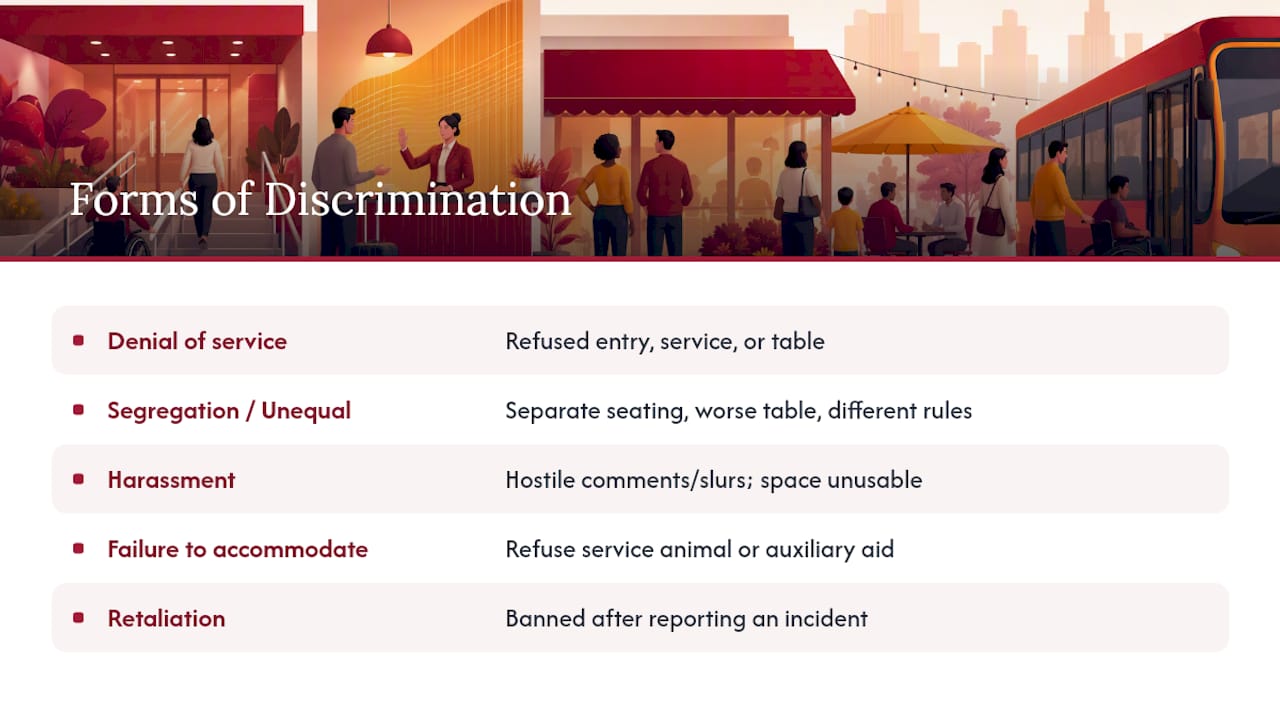
Outright denial of service is the most obvious: being refused entry, service, or a table because of your race, religion, national origin, or disability. It’s also the easiest to prove, especially if a staff member says the reason out loud.
Segregation and unequal treatment are subtler but equally illegal. This includes being seated in a separate section, served after everyone else, given a worse table, or subjected to different rules than other customers, like being asked to leave a deposit others weren’t asked for.
Harassment covers a pattern of hostile comments, slurs, or conduct severe enough to make the space unwelcome or unusable, even if you’re technically still being “served.”
Failure to accommodate disability is its own category under ADA Title III: refusing to let a service animal enter, failing to provide a requested auxiliary aid, or declining a reasonable policy modification when doing so wouldn’t fundamentally alter the business or create an undue burden.
Retaliatory conduct after a complaint, like being banned from a business for reporting an incident, can also violate anti-discrimination laws separately from the original act.
The common thread across all five is that the business treated you differently, or worse, because of a protected trait rather than your conduct as a customer.
Can You Resolve a Discrimination Claim Without Going to Court?
Litigation isn’t always the fastest or most practical route, and alternative dispute resolution deserves serious consideration before you commit to a courtroom fight.
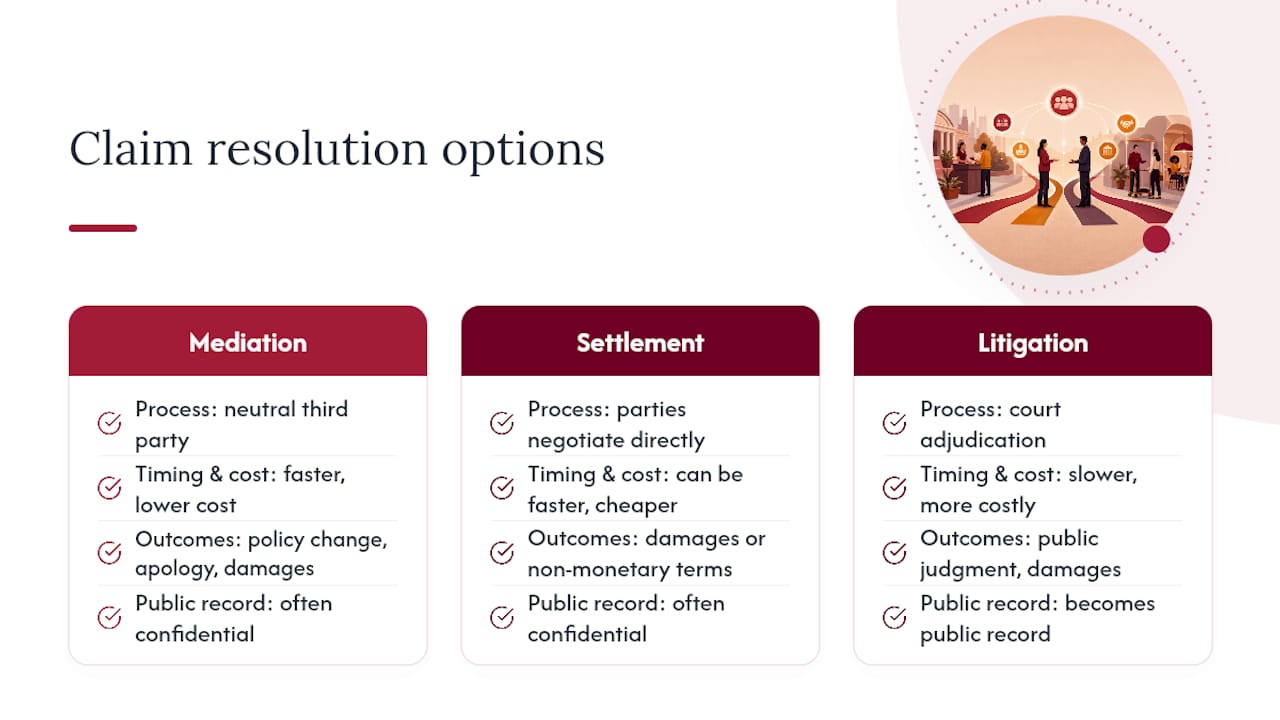
Mediation puts you and the business in front of a neutral third party who helps negotiate a resolution, whether that’s a policy change, an apology, training requirements, or a monetary settlement. Some state civil-rights agencies build mediation directly into their complaint process, offering it before or during a formal investigation. It tends to move faster than litigation and costs less, though it depends on the business being willing to participate in good faith.
Settlement negotiations can happen at almost any stage, before filing, during an agency investigation, or after a lawsuit is filed. A settlement might include damages, but it can also include non-monetary terms like staff training, accessibility upgrades, or a written policy change. Businesses often prefer settling because public discrimination litigation carries reputational risk beyond the legal cost.
The tradeoff worth understanding upfront: mediated or settled cases usually come with confidentiality terms, meaning the outcome doesn’t become public record the way a court judgment does. If part of your goal is holding a business publicly accountable, that’s worth weighing against the speed and certainty ADR offers. An attorney can help you decide whether to pursue mediation, hold out for a stronger settlement, or take the case to court, based on the strength of your evidence and what outcome actually matters to you.
What Court Cases Have Shaped Public Accommodations Law?
The foundation of modern public accommodations law traces back to Heart of Atlanta Motel v. United States (1964), where the Supreme Court upheld Title II’s constitutionality just months after the Civil Rights Act passed, confirming Congress could regulate discrimination in public accommodations under its power over interstate commerce. That ruling is why the commerce test still matters today: it’s not a technicality, it’s the legal foundation the entire statute rests on.
On the disability side, ADA Title III litigation has repeatedly tested what “readily achievable” barrier removal actually requires. Courts have generally held that the standard is fact-specific, weighing a business’s size and resources against the cost and difficulty of a given modification, rather than applying a fixed rule. That case-by-case approach is why two businesses with similar layouts can reach different legal outcomes over the same type of barrier.
More recent disputes have centered on digital accessibility, arguing that websites and mobile apps function as extensions of a physical public accommodation and must be accessible under ADA Title III. Courts remain split on exactly how far that theory extends, which makes this one of the more unsettled corners of accommodation law right now. If your discrimination involves a business’s app or website rather than its physical location, that unsettled status is itself worth flagging to counsel early.
How Do Disability and Other Protected Traits Overlap?
Real discrimination rarely fits neatly into one legal category, and the law hasn’t fully caught up to that reality.
Consider a Black woman with a mobility disability who’s denied entry to a restaurant. Was it her race, her disability, or both? The honest answer is often “both, tangled together,” and proving that can be harder than proving either form of discrimination alone. Courts and agencies increasingly recognize intersectional claims, but the legal framework still largely evolved to handle one protected trait at a time.
This matters practically because different statutes protect different traits, and a single incident might require filing under both Title II and ADA Title III simultaneously, sometimes with different agencies, different deadlines, and different evidentiary standards. A person facing religious discrimination who also uses a wheelchair may need to document both the religious hostility and the accessibility failure as distinct, provable events, even if they happened in the same five minutes.
The practical takeaway: don’t let one obvious form of discrimination overshadow a second, less visible one. If you were denied service and the denial involved both a slur and a refusal to accommodate a disability, document both elements separately, with separate details, even though they occurred in a single incident.
An Editorial Take: Where This Area of Law Actually Trips People Up
Most guidance on public accommodations discrimination focuses on the wrong thing first. It leads with statutory definitions and covered categories, as if the hardest part is figuring out whether you were legally discriminated against. In practice, that part is usually obvious. The hard part is procedural, and procedure is where valid claims die.
The 180-day window isn’t generous once you factor in real life: gathering documents, tracking down witnesses, deciding which agency has jurisdiction, and figuring out whether state law offers a better path than federal law. I’d argue the single most underrated piece of advice in this entire area is the simplest: write it down today, not this week. Memory degrades fast, and discrimination cases often turn on small details, exact wording, tone, who else was present, that vanish within days.
The other place conventional advice falls short is treating the DOJ’s reporting portal as equivalent to filing a complaint. It isn’t, and that confusion has almost certainly cost people valid claims. If you take one thing from this article, let it be that reporting and filing are two different acts, and only one of them starts the legal clock running in your favor.
— Mark
Get Legal Help From Javitch Law Office
Some firms take discrimination cases that larger firms often turn down, and give clients direct access to the attorney handling their case rather than a rotating cast of paralegals. If you’re dealing with a denial of service, harassment, or an accessibility failure at a hotel, restaurant, retailer, or other public-facing business, the firm’s discrimination attorneys can evaluate whether your case fits under Title II, ADA Title III, or your state’s broader protections, and identify the fastest path to a remedy.
Before your consultation, gather your written account of the incident, any receipts or photos, witness contact information, and the exact date it happened, since that date determines which deadlines are already running. Many discrimination cases proceed on a contingency-fee basis, meaning you owe nothing unless there’s a recovery. If retaliation followed your complaint, or if employment overlapped with the incident, the firm’s workplace discrimination team can evaluate that angle too. Request a case evaluation through the discrimination practice page to find out where your claim stands before any deadline closes.
This article is general information, not a substitute for advice from a qualified lawyer. Consult a qualified legal professional about your own circumstances before acting on anything here.
Sources
- Title II Of The Civil Rights Act (Public Accommodations) — U.S. Department of Justice
- ADA Title III overview — ADA.gov (archive)
- How to file a discrimination complaint — U.S. Department of Labor Civil Rights Center
- Civilrights
- 42 U.S. Code § 12182 — Prohibition of discrimination by public accommodations
FAQ
What Is Discrimination in Public Accommodations?
It’s unequal treatment, denial of service, segregation, or harassment, based on a protected trait like race, religion, national origin, or disability, in a business open to the public. Federal law addresses it through Title II of the Civil Rights Act and ADA Title III, with many states adding further protections.
What Are the Categories of Public Accommodations?
Federal law defines specific categories, including hotels and lodging, restaurants and bars, and places of entertainment like theaters and stadiums. The ADA extends coverage further to retail stores, banks, medical offices, schools, and gyms, among other business types, as outlined in ADA Title III.
What States Do Not Have Public Accommodation Laws?
Every state operates under the federal floor set by Title II and the ADA, but the scope of additional state-level protections varies widely. The Justia 50-state survey is the clearest way to check exactly what your state adds or omits beyond federal law.
Did the 1964 Civil Rights Act Ban Discrimination in Public Accommodations?
Yes. Title II of the Civil Rights Act of 1964, found at 42 U.S.C. §2000a, banned discrimination based on race, color, religion, and national origin in covered establishments whose operations affect interstate commerce.
How Do I Report Public Accommodations Discrimination?
Document the incident immediately, then file with the appropriate agency, DOJ, the DOL Civil Rights Center, your state civil-rights agency, or the EEOC if employment is involved, before your deadline runs out. If you’re unsure which agency applies or a deadline is close, a discrimination attorney can help you file correctly the first time.