
Housing discrimination is illegal in California under the Fair Employment and Housing Act (FEHA) and the federal Fair Housing Act, both of which cover far more than landlords refusing an application. If you’ve been denied housing, quoted different terms, or turned away because of a housing voucher, disability, or family status, you likely have a valid claim. Start now: write down dates, save every message, and file with the California Civil Rights Department (CRD) or talk to an attorney, since CRD’s filing window runs longer than the federal one at HUD.
TL;DR:
- Housing discrimination in California includes refusing to rent or sell based on protected characteristics, charging different terms, and denying accommodations for disabilities.
- State law extends protections to source of income, gender identity, sexual orientation, age, and more, with a strong emphasis on accepting rental vouchers.
- Most violations involve subtle patterns like delayed responses, shifting requirements, or unreasonably denying vouchers, rather than overt outright refusals.
- Documentation of interactions, including written requests and testing, is crucial for proving discrimination and building a strong case.
- Filing with CRD offers more time (up to three years) and broader protections than federal agencies, but legal help is advisable for complex or repeated violations.
Table of Contents
- What Counts as Housing Discrimination in California?
- Who Does California’s Fair Housing Law Protect?
- What Types of Housing and Providers Does the Law Cover?
- How Do Reasonable Accommodations and Modifications Work?
- How Do You Document and Prove Housing Discrimination?
- Where Should You File: CRD, HUD, or Court?
- What Remedies Are Available if You Win?
- What Happens After You File a Complaint With CRD?
- When Should You Talk to an Attorney?
- Recent Housing Discrimination Cases in California
- What Landlords and Tenants Are Each Responsible For
- How Can Landlords and Tenants Prevent Discrimination Disputes?
- Author Perspective: Enforcement Trends and Practical Takeaways
- How Javitch Law Office Can Help You Pursue a Claim
- Sources
What Counts as Housing Discrimination in California?
Housing discrimination covers a wider range of conduct than most people assume. It’s not just an outright “no.” It includes charging a higher deposit, inventing a bogus qualification standard, or ignoring an application altogether while accepting others.
Some of the most common patterns California enforcement agencies see:
- Refusing to rent or sell to someone based on a protected characteristic
- Quoting different rent, deposit amounts, or lease terms depending on who’s asking
- Steering applicants toward or away from certain buildings or neighborhoods
- Refusing to accept Section 8 vouchers or other rental assistance
- Denying a reasonable accommodation or modification request tied to a disability
- Advertising language that excludes families with children or other protected groups
A neutral-sounding policy can still be illegal if it lands harder on a protected group. This is called disparate impact. A blanket “no felons” screening rule, for example, can disproportionately exclude certain racial groups even when race is never mentioned, and courts have treated that as unlawful under the same framework as intentional bias.
Recent testing conducted by CRD in Los Angeles and Ventura counties found source-of-income discrimination in 54% of tested interactions, alongside documented bias tied to familial status, race, and disability. If you’ve been turned away with a vague excuse right after mentioning a voucher or a child, that timing itself is evidence.
Who Does California’s Fair Housing Law Protect?
FEHA’s list of protected characteristics runs noticeably longer than the federal Fair Housing Act’s. Federal law covers race, color, national origin, religion, sex, familial status, and disability. California adds several categories that matter in everyday rental disputes.
State law also protects against discrimination based on:
- Source of income, including Section 8 vouchers and other rental subsidies
- Immigration status and primary language
- Gender identity and gender expression
- Sexual orientation
- Marital status
- Ancestry
- Genetic information
- Age
Source-of-income protection is one of the biggest gaps between state and federal law. The federal Fair Housing Act does not require landlords to accept vouchers; California’s does. That single distinction explains why so many voucher-holders who get refused have a case in California but might not if the same refusal happened elsewhere.
Protection also extends to people who are perceived to have a characteristic, even incorrectly, and to people associated with someone in a protected class, like a caregiver or family member of a person with a disability.
What Types of Housing and Providers Does the Law Cover?
Fair housing law reaches almost every corner of the housing market, not just apartment leasing. It applies to rentals, home sales, mortgage lending, and most shared or supportive housing arrangements.
Covered housing includes:
- Apartments, single-family rentals, condos, and co-ops
- Home sales and real estate transactions
- Mortgage lending and loan terms
- Shelters and transitional or supportive housing
- Homeowners associations (HOAs) and their rules or fee structures
- Short-term rentals when they function as someone’s primary housing
The obligation to comply doesn’t rest on the property owner alone. Landlords, property management companies, real estate brokers, mortgage lenders, tenant-screening companies, HOA boards, and public housing authorities all fall under fair housing law. A property manager who screens out voucher-holders is just as liable as the owner who told them to do it.
One edge case trips people up constantly: owner-occupied buildings with a small number of units and certain religious or private club exemptions have limited carve-outs under federal law, but California’s protections are often broader, so an exemption at the federal level doesn’t automatically mean the same conduct is legal under FEHA.
How Do Reasonable Accommodations and Modifications Work?
Disability rights in housing come down to two related but distinct obligations. A reasonable accommodation is a change to a rule or policy, like allowing a service animal despite a no-pet policy or assigning an accessible parking spot. A reasonable modification is a physical change to the unit or common area, like installing grab bars or a ramp, which a tenant typically pays for themselves unless the housing is federally subsidized.
CRD guidance is direct on this point: denying either request can itself be an independent act of unlawful discrimination, separate from any other bias in the transaction.
For service animals and emotional support animals, three rules come up constantly:
- Landlords cannot charge pet fees or deposits for a service or support animal.
- Breed, size, and weight restrictions generally don’t apply to these animals.
- Providers can request documentation supporting the need for the animal, but they cannot demand details about the specific diagnosis.
Response time matters. An unreasonable delay in responding to an accommodation request can amount to a denial, even if the landlord never says the word “no.”
Pro Tip: Put every accommodation request in writing, even if you first ask in person. A text or email creates a timestamp that becomes critical if the request gets ignored.
How Do You Document and Prove Housing Discrimination?
Discrimination cases usually turn on details, not dramatic confrontations. What you save in the moment often decides whether a complaint succeeds.
Keep a running record that includes:
- Dates and times of every call, showing, and conversation
- Full names and titles of everyone you dealt with
- Screenshots of listings, texts, emails, and application portals
- Copies of your application, lease terms offered, and any denial letters
- Names and contact information of witnesses, including anyone with you at a showing
- Any inspection, police, or code enforcement reports tied to the property
Paired testing is one of the most persuasive tools in fair housing enforcement. Two testers with matching financial profiles, one from a protected group and one not, apply for the same unit under similar conditions. When the outcomes differ, the gap becomes hard evidence of bias. It’s exactly this method that produced the 54% source-of-income discrimination finding in Southern California testing, and nonprofit fair housing groups like the Housing Rights Center have used the same approach for years to expose voucher and disability discrimination.
Write down what happened the same day it occurs. Memory fades fast, and a contemporaneous note carries more weight than a recollection built months later.
Where Should You File: CRD, HUD, or Court?
You have three realistic paths, and they’re not mutually exclusive. Each carries a different deadline, so the clock matters as much as the choice.
- File with the California Civil Rights Department. CRD accepts complaints for a broad range of housing-related discrimination and generally allows a three-year window to file, giving you significantly more runway than the federal process.
- File with HUD. The federal Fair Housing Act complaint process through HUD’s Office of Fair Housing and Equal Opportunity typically requires filing within one year of the discriminatory act, a much tighter window than CRD’s.
- File a civil lawsuit. You can sue directly under FEHA or the federal Fair Housing Act, and an agency complaint doesn’t always have to come first, though pursuing one can strengthen your record.
Most Californians start with CRD, and for good reason: the state agency covers more protected categories, gives you more time to act, and doesn’t require you to choose between agency relief and a later lawsuit in most circumstances. You don’t need to be the leaseholder or even have signed anything. Prospective tenants, applicants, and even people who never got as far as an application can have standing to file if they were denied a fair shot at housing.
What Remedies Are Available if You Win?
Outcomes vary widely depending on the severity of the conduct, whether it’s a single incident or a pattern, and how well the claim is documented. Available remedies under FEHA and federal law include:
- Injunctive relief ordering the housing provider to stop the practice
- Actual access to the housing that was wrongfully denied
- Compensation for out-of-pocket losses, like moving costs or higher rent paid elsewhere
- Emotional distress damages
- Civil penalties against the housing provider
- Required policy changes or staff training
- Attorney’s fees and litigation costs
A single missed accommodation request might resolve through a policy correction and modest compensation. A documented pattern of voucher refusals across multiple applicants tends to produce larger settlements and can trigger civil penalties on top of individual damages.
What Happens After You File a Complaint With CRD?
Filing is just the start. CRD’s process moves through several distinct stages, and understanding them keeps you from feeling stuck when weeks pass without an update.
CRD’s process generally works like this:
- Intake screening checks that your complaint falls within CRD’s jurisdiction and filing deadline.
- An intake interview lets you walk an investigator through what happened and what evidence you have.
- Investigation follows, where CRD gathers records, interviews witnesses, and may contact the housing provider directly.
- Conciliation attempts to resolve the matter without a formal finding, often through a negotiated agreement.
- A probable-cause determination decides whether the case moves toward further legal action if conciliation fails.
The full complaint process is outlined by CRD with more detail on each phase. Timelines vary based on caseload and complexity, and cases involving multiple respondents or conflicting evidence tend to move slower. Having an attorney involved from the intake interview onward often keeps the investigation focused on the strongest facts instead of getting bogged down in disputed details.
When Should You Talk to an Attorney?
Some situations call for legal help immediately rather than waiting to see how an agency complaint plays out. Consider consulting an attorney when you’re facing:
- A flat denial of a reasonable accommodation or modification request
- Repeated voucher or source-of-income refusals
- Evidence suggesting a pattern across multiple tenants, not just your situation
- Serious financial or emotional harm from the discrimination
- Multiple respondents or conflicting evidence that complicates a straightforward complaint
An attorney typically preserves evidence properly, files complaints with the right agency, negotiates a settlement where possible, and litigates when a provider won’t budge. Javitch Law Office’s discrimination practice handles housing bias cases alongside employment and public accommodations discrimination matters across California.
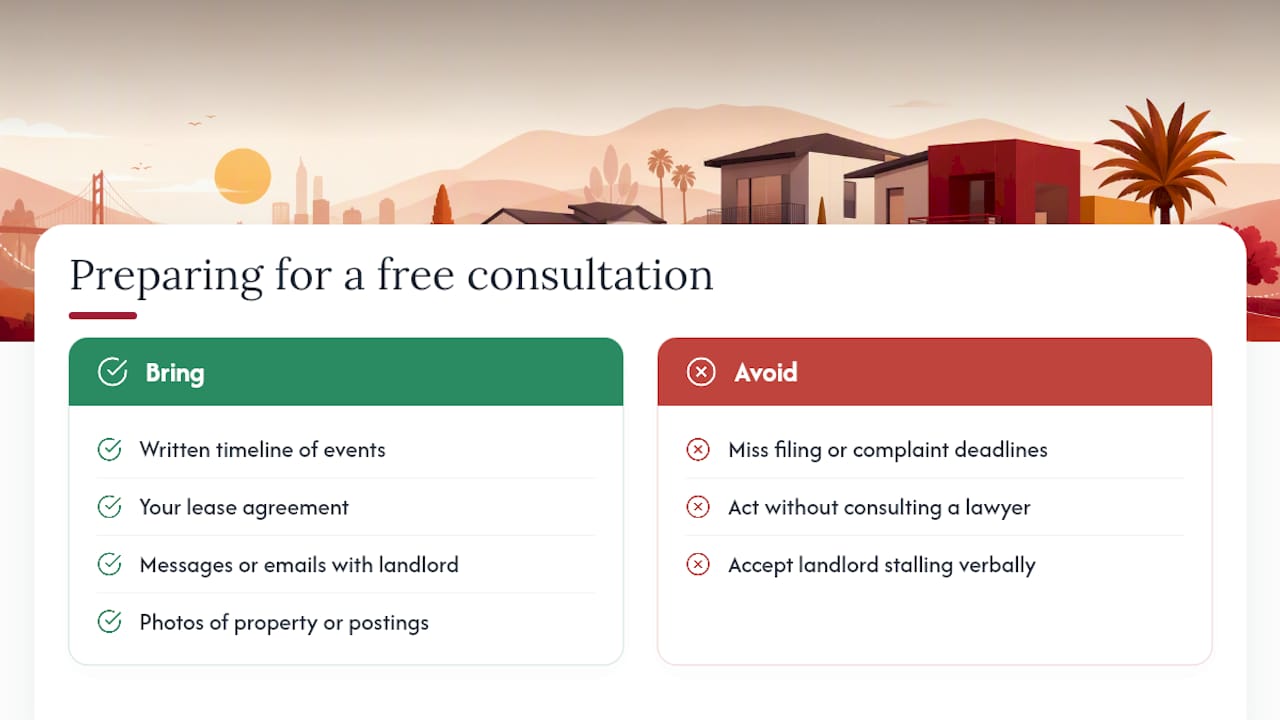
Pro Tip: Bring a timeline, your lease, all written communications, and photos of the property to your first consultation. It cuts the intake time roughly in half.
Recent Housing Discrimination Cases in California
California’s enforcement record shows discrimination claims moving well beyond isolated landlord disputes into large-scale patterns affecting entire portfolios of rental properties. Cases brought by CRD and private litigants in recent years have targeted source-of-income refusals at scale, where property management companies applied blanket no-voucher policies across dozens of units rather than screening individual applicants.
Familial status cases have also featured prominently, often involving occupancy limits set so low that they effectively exclude families with children, or “adults only” language buried in listings that never gets removed despite complaints. Disability-related cases frequently center on accommodation denials, particularly around assistance animals and requests for accessible parking or unit modifications that property managers ignored or delayed for months.
A recurring thread across these matters: the discrimination rarely announced itself outright. Instead, it showed up in delayed responses, sudden unavailability after a caller mentioned a voucher, or requirements that shifted only for certain applicants. That pattern is exactly what CRD’s testing data captured in recent Southern California sweeps, and it’s why documentation matters so much. A single denial can look like a scheduling conflict. A pattern across ten applicants looks like a policy.
Settlements in these cases have ranged from individual compensation and unit access to broader injunctive terms requiring policy rewrites, staff retraining, and ongoing compliance monitoring. The trend line points toward agencies and courts treating systemic screening policies as high-priority targets, not just one-off landlord disputes.
What Landlords and Tenants Are Each Responsible For
Anti-discrimination law places real obligations on both sides of a lease, even though tenants are usually the ones filing complaints. Landlords must apply screening criteria consistently, respond to accommodation requests within a reasonable timeframe, and avoid advertising language that signals a preference for or against any protected group. That includes training leasing staff who handle phone inquiries, since a single employee’s verbal comment about “not wanting kids running around” can create liability for the entire company.
Property managers and landlords also have an affirmative duty to accept valid rental assistance, including Section 8 vouchers, under California’s source-of-income protections. Refusing to even consider a voucher application, before evaluating the applicant’s actual qualifications, is itself the violation.
Tenants carry responsibilities too, mainly around providing accurate information and reasonable documentation when requesting an accommodation. A tenant who requests a modification isn’t entitled to demand a specific brand of ramp or fixture, only a reasonable one that addresses the need. Tenants also need to respond to legitimate screening questions truthfully; a fair housing claim doesn’t excuse fraud on an application.
Both sides benefit from putting requests and responses in writing. Verbal promises and verbal denials are the hardest disputes to resolve later, because they come down to conflicting memories rather than a record either party can point to.
How Can Landlords and Tenants Prevent Discrimination Disputes?
Prevention is far cheaper than litigation, and most disputes trace back to avoidable gaps rather than deliberate malice. Landlords reduce risk substantially by writing screening criteria down in advance and applying them the same way to every applicant, rather than making case-by-case judgment calls that can look arbitrary or biased after the fact.
Training matters more than most property owners realize. A leasing agent who doesn’t know that refusing vouchers is illegal in California, or who doesn’t understand the difference between a reasonable accommodation and a special favor, creates liability the owner may not even know exists until a complaint arrives.
For advertising, the safest approach avoids any language describing an “ideal” tenant type, family structure, or lifestyle. Even phrases that sound neutral, like “perfect for young professionals,” can suggest a preference against families with children.
Tenants protect themselves by documenting every interaction from the start of the application process, not just after something goes wrong. Save the listing, the confirmation of your application, and any communication about approval status or denial reasons. If an accommodation is needed, request it in writing early rather than waiting until move-in day creates time pressure.
Both landlords and tenants benefit from knowing where to find California’s tenant guide from the Department of Real Estate, which lays out rights and responsibilities in plain language and recommends contacting legal aid or an attorney when a dispute can’t be resolved directly.
Author Perspective: Enforcement Trends and Practical Takeaways
The data from recent CRD testing tells a story that surprises a lot of people: source-of-income refusals aren’t a relic of the past, they’re one of the most commonly documented violations happening right now. Familial status and disability denials show up right alongside them, often disguised as scheduling issues or vague unavailability.
What strikes me most is how much speed matters. Evidence disappears fast. Listings get taken down, staff turn over, and memories blur within weeks. If you think something happened to you, write it down today, not after you’ve decided whether it’s “worth it.”
Use the official CRD and HUD resources to understand your options, and don’t assume a complicated case is something you have to sort out alone.
— Mark
How Javitch Law Office Can Help You Pursue a Claim
If you’re struggling to resolve a housing discrimination issue on your own, especially when a landlord or property manager keeps stalling instead of giving you a straight answer, legal help can be a direct option. The firm’s discrimination practice handles housing bias cases involving source-of-income refusals, disability accommodation denials, and familial status discrimination, alongside related claims like source-of-income discrimination and national origin discrimination that often overlap with housing disputes.

A free consultation starts with a review of what happened and whether the timeline still allows for a CRD or HUD complaint, or a direct lawsuit. Bring a written timeline of events, your lease agreement, any messages or emails with the landlord or property manager, photos of the property or relevant postings, and the names of any witnesses. If your case also involves being pushed out of a unit through neglect or harassment, the firm’s work on constructive eviction claims may be relevant too.
If you’re dealing with a denied accommodation, a voucher refusal, or a pattern of unequal treatment, request a consultation with Javitch Law Office’s discrimination team to find out where you stand and what deadlines are still open.
This article is general information, not a substitute for advice from a qualified lawyer. Consult a qualified legal professional about your own circumstances before acting on anything here.
Sources
- Housing | CRD - Civil Rights Department - CA.gov
- HUD Fair Housing and Equal Opportunity (FHEO)
- California Tenants - A Guide to Residential Tenants’ and Landlords’ Rights and Responsibilities - 2025 Edition