
Yes. California law forbids landlords from punishing tenants for exercising their legal rights, and if your landlord raises the rent, cuts services, or tries to evict you within 180 days of you filing a complaint, Cal. Civ. Code § 1942.5 presumes it was retaliation. The federal Fair Housing Act backs this up when the retaliation touches on discrimination, disability, or another protected class. That presumption flips the burden onto your landlord: they have to prove they had a legitimate, non-retaliatory reason for what they did, not the other way around.
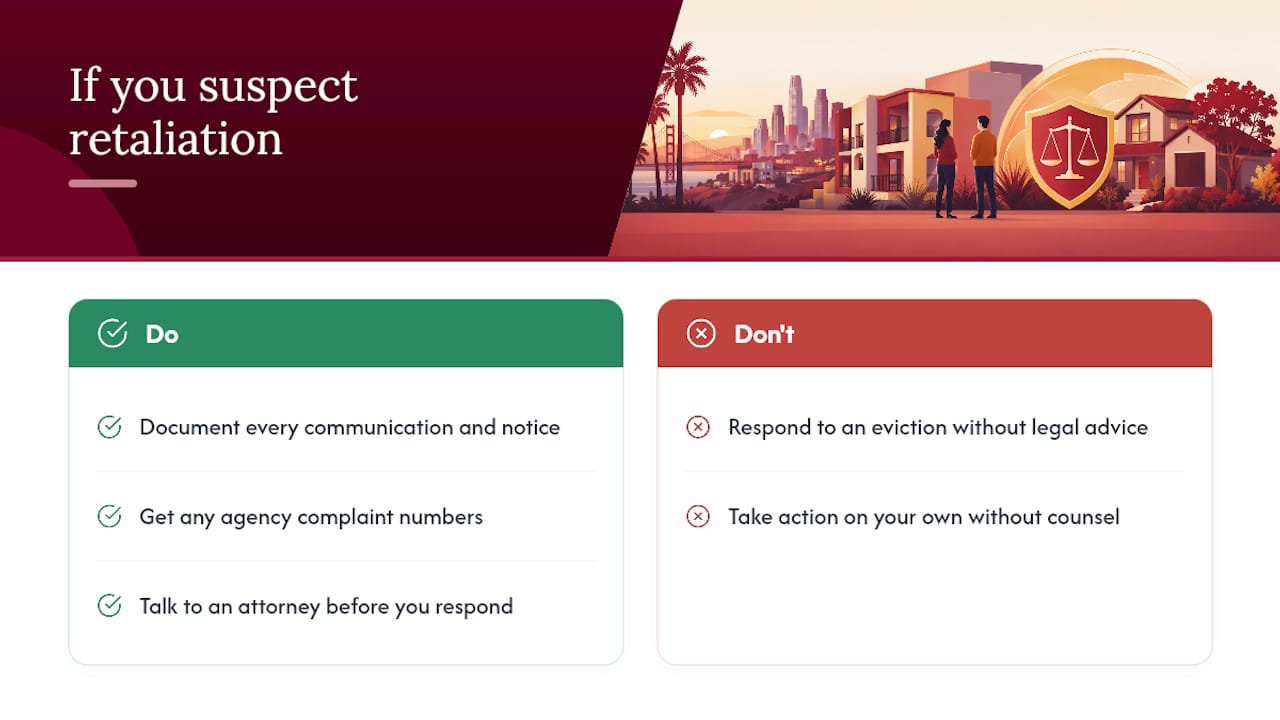
If you think you’re facing landlord retaliation in California right now, do three things immediately:
- Document everything. Save texts, emails, notices, and photos with dates attached.
- Contact the right agency. File with local code enforcement, the California Department of Justice, or HUD if discrimination is involved.
- Get legal advice before you act. A quick call to an attorney, such as Javitch Law Office, can help you preserve your defense before a deadline passes.
Table of Contents
- What Counts as Landlord Retaliation in California?
- What Does California Civil Code § 1942.5 Actually Say?
- How Do You Prove Landlord Retaliation?
- What Can You Actually Win From a Retaliation Claim?
- What Should You Do First if You Suspect Retaliation?
- Does the 180-Day Window Ever Run Out?
- How Javitch Law Office Helps With Retaliation Claims
- What This Guide Gets Right That Others Miss
- Get a Case Evaluation From Javitch Law Office
- Frequently Asked Questions
- Sources
What Counts as Landlord Retaliation in California?
Retaliation isn’t limited to a landlord screaming “get out” the day after you complain. It shows up in quieter, more calculated forms, and California courts look at both the action and the timing.
Adverse acts that commonly qualify include:
- Serving an eviction notice or refusing to renew a lease shortly after a complaint.
- Raising the rent outside the normal schedule.
- Cutting off services like hot water, parking, or storage access.
- Threatening to report a tenant to immigration authorities.
- Changing the locks or attempting a self-help eviction.
- Increasing surveillance, unannounced inspections, or selective harassment.
These retaliatory acts almost always follow a protected activity. Common triggers include:
- Requesting repairs for a habitability issue like mold, a broken heater, or pest infestation.
- Reporting code violations to a local building or health department.
- Lawfully withholding rent to force repairs.
- Organizing with other tenants over building conditions.
- Filing a fair housing complaint over disability accommodations or discrimination.
A landlord who issues a rent increase two weeks after a code enforcement inspection looks very different from one who raises rent on the same annual schedule they’ve used for five years. Pattern and timing are what separate ordinary landlord conduct from retaliatory eviction in the eyes of a judge.
What Does California Civil Code § 1942.5 Actually Say?
Section 1942.5 is the backbone of tenant protection against retaliation in California, and it’s worth understanding in plain terms rather than legalese.
If a landlord takes an adverse action, such as eviction, a rent hike, or a service cutback, within 180 days of a tenant’s protected activity, the law presumes that action was retaliatory. The burden then shifts to the landlord to prove a legitimate, non-retaliatory reason.
That single mechanic changes the entire posture of a dispute. Instead of a tenant scrambling to prove intent, the landlord has to justify their timing. The statute also carries real teeth: tenants can recover actual damages, punitive damages between $100 and $2,000 per act when fraud, oppression, or malice is shown, plus attorney’s fees for the prevailing party.
Subdivisions © and (d) go further. They explicitly bar landlords from threatening to report a tenant or their guests to immigration authorities as a retaliatory tactic, and they protect tenants who organize with neighbors over habitability or rent issues. One limit worth knowing: a tenant generally can’t invoke the 180-day presumption more than once in a 12-month period, so timing your protected activity and any complaint matters.
On the federal side, HUD enforces Fair Housing Act retaliation protections when the underlying complaint involves discrimination. HUD’s civil penalty schedule allows penalties up to $26,262 for a first violation, climbing to $131,308 for landlords with multiple violations within seven years. That’s a meaningful deterrent for property owners who might otherwise treat a fine as a cost of doing business.
How Do You Prove Landlord Retaliation?

Proving retaliation usually comes down to a three-step pattern: you engaged in a protected activity, the landlord took an adverse action within 180 days, and the landlord knew about your protected activity when they acted. Courts and agencies lean heavily on timing because motive is hard to prove directly, but a tight timeline does a lot of the work for you.
Build your evidence file before you need it:
- Dated emails, texts, and letters between you and the landlord.
- Case or reference numbers from any code enforcement or agency complaint.
- Photos and videos of the conditions you reported, timestamped where possible.
- Written statements from neighbors or witnesses who saw the landlord’s response.
- A rent payment ledger showing your history was current and unremarkable.
- Contemporaneous notes you wrote the same day something happened.
Landlords typically fight back with a pretext defense, claiming the eviction or rent hike was planned all along or driven by a legitimate business reason. You undercut that by comparing how other tenants in similar units were treated, documenting whether the landlord followed their usual notice procedures, and requesting a written explanation for the action. If a landlord raised rent on your unit only, right after your complaint, while leaving comparable units untouched, that gap is exactly what attorneys look for when they build a pretext argument.
Pro Tip: Ask your landlord in writing why they’re taking the action against you. A vague or evasive answer, or no answer at all, becomes evidence in your favor later.
What Can You Actually Win From a Retaliation Claim?
Retaliation isn’t just a defense that delays an eviction. Pled correctly in an unlawful detainer case, it can defeat the eviction outright, since a judge who finds the underlying motive was retaliatory generally won’t grant the landlord possession of the unit.
Beyond stopping an eviction, tenants who prove retaliation can recover:
- Actual damages covering financial losses tied to the retaliatory act, like moving costs or a rent overpayment.
- Punitive damages of $100 to $2,000 per act under § 1942.5 when the landlord acted with fraud, oppression, or malice.
- Attorney’s fees for the prevailing tenant, which removes much of the financial risk of pursuing a claim.
- Federal civil penalties through HUD, ranging up to $26,262 for a first Fair Housing Act violation and much higher for repeat offenders.
- Injunctive relief, forcing the landlord to restore services or stop a pattern of harassment.
The attorney’s fee provision changes the calculation for a lot of tenants who might otherwise assume a lawsuit isn’t worth the cost.
What Should You Do First if You Suspect Retaliation?
Move fast, but move in the right order. Evidence gets harder to gather the longer you wait, and some defenses have to be raised at a specific point in the eviction process.
- Build a dated chronology of every complaint you made and every response the landlord gave, starting from the first repair request or agency report.
- Copy every notice the landlord serves, including rent increase notices, termination notices, and any written warnings.
- Photograph the property and save receipts for any repairs or losses tied to the dispute.
- Get your complaint number whenever you file with code enforcement, HUD, or the California Civil Rights Department, since that number anchors your timeline.
- Raise retaliation as a defense if you’re served an eviction. In California, this is typically done through your answer to the unlawful detainer complaint, using the Judicial Council’s Form UD-105 as the standard vehicle for asserting affirmative defenses.
- File a federal or state complaint with HUD or the state civil rights agency if discrimination is part of the story.
- Consult an attorney before responding to any eviction notice, and bring your chronology, copies of notices, and any agency case numbers to that first conversation.
Pro Tip: Never respond to a lockout or utility shutoff by breaking back in or retaliating yourself. Document it and call an attorney or the police instead. Self-help responses can undercut an otherwise strong case.
Does the 180-Day Window Ever Run Out?
The 180-day presumption is powerful, but it’s not the only path to proving retaliation, and it comes with a real limit.
- The presumption applies once per 12-month period. A second retaliation claim inside that window doesn’t get the same automatic burden shift.
- Retaliation that happened more than 180 days after your protected activity can still be proven with direct evidence, like a threatening email or a documented pattern of targeted treatment, but the proof burden falls back on you.
- Local rent control and just-cause eviction ordinances in cities like Los Angeles, Oakland, and San Francisco often add separate protections that stack on top of § 1942.5.
If you’re past the 180-day mark, don’t assume you’re out of options. Talk to an attorney about what direct evidence you have.
How Javitch Law Office Helps With Retaliation Claims
Javitch Law Office represents California tenants facing retaliation, alongside broader work in discrimination and First Amendment cases where housing disputes overlap with civil rights violations. The firm’s approach starts with a straightforward case evaluation, not a sales pitch.
Expect the firm to ask for:
- Your chronology of complaints and landlord responses.
- Copies of notices, texts, emails, and any agency complaint numbers.
- Photos or records tied to the habitability issue or protected activity.
From there, cases typically move down one of three paths: an eviction defense if you’ve been served an unlawful detainer, a civil suit for damages under § 1942.5, or an administrative complaint through HUD or the state civil rights agency when discrimination is involved.
Pro Tip: Bring your documents to the first consultation, even if they feel incomplete. An attorney can often tell within minutes whether your timeline supports the 180-day presumption.

| Point | Details |
|---|---|
| Know the statute | Cal. Civ. Code § 1942.5 presumes retaliation for adverse acts within 180 days of a protected activity. |
| Document immediately | Save dated notices, texts, photos, and agency complaint numbers before memories fade. |
| Watch for pretext | Compare how other tenants were treated to expose a landlord’s false justification. |
| Know your recovery | Damages, $100 to $2,000 per act in punitive damages, and attorney’s fees are all on the table. |
| Get help early | Javitch Law Office evaluates retaliation cases and guides tenants through eviction defense or a civil claim. |
What This Guide Gets Right That Others Miss
Most tenant rights content treats the 180-day presumption like a magic shield. It isn’t. It’s a burden-shifting tool, and plenty of landlords still win by producing a halfway credible non-retaliatory reason, especially when tenants haven’t documented anything before the notice arrives.
The bigger mistake I see is tenants treating retaliation claims as a last resort, something you raise only after you’re already served with eviction papers. By then, you’re reconstructing a timeline from memory instead of a paper trail. The tenants who win are the ones who started keeping records the day they made their first complaint, not the day the landlord retaliated.
I’d also push back on the idea that the 180-day window is the whole story. Plenty of strong retaliation cases involve conduct outside that window, built on a landlord’s pattern of selective enforcement rather than one clean trigger event. If your case doesn’t fit neatly into 180 days, that’s a reason to call an attorney, not a reason to give up.
Get a Case Evaluation From Javitch Law Office
If you’re dealing with a landlord who raised your rent, cut services, or served an eviction notice right after you complained, Javitch Law Office evaluates California retaliation cases directly, without routing you through a call center or a generic intake form. The firm’s retaliation practice focuses on the same pattern this guide covers: protected activity, adverse action, and the timeline connecting them, whether that shows up in housing, employment, or free speech disputes.
Where retaliation overlaps with discrimination based on religion, race, or another protected class, the firm’s discrimination practice handles the federal Fair Housing Act side of a claim alongside the state law issues. If your situation touches on speech or organizing that led to landlord blowback, the First Amendment practice covers that angle too.
Start by requesting a case evaluation through Javitch Law Office and bring your chronology, notices, and any agency complaint numbers. That first conversation will tell you whether your timeline supports a strong retaliation claim, and what path, eviction defense, civil suit, or administrative complaint, fits your situation best.
Frequently Asked Questions
What is landlord retaliation in California? It’s when a landlord punishes a tenant for exercising a legal right, such as reporting a habitability issue, by evicting them, raising rent, cutting services, or harassing them. State and federal law both prohibit it.
How do I prove retaliation against my landlord? Show that you engaged in a protected activity, like a repair complaint or agency report, and that the landlord took an adverse action within 180 days. Timing, documentation, and comparisons to how other tenants were treated all matter.
Can my landlord evict me for complaining about repairs? Not lawfully. If an eviction notice follows a repair complaint within 180 days, § 1942.5 presumes it’s retaliatory, and the landlord has to prove a legitimate reason unrelated to your complaint.
What should I do if I think I’m facing landlord retaliation? Document every communication and notice, get any agency complaint numbers, and talk to an attorney before you respond to the eviction or take any action on your own.
Does the 180-day rule mean I have no case after six months? No. You can still prove retaliation with direct evidence or a documented pattern after 180 days, though the burden of proof shifts back to you rather than the landlord.
This article is general information, not a substitute for advice from a qualified lawyer. Consult a qualified legal professional about your own circumstances before acting on anything here.
Sources
- California Civil Code § 1942.5
- Landlord‑Tenant Issues - California Department of Justice
- Retaliation by your Landlord: Know Your Housing Rights — Disability Rights California