
A FOIA lawsuit is a federal civil action forcing a federal agency to release records it wrongly withheld. Before you sue, you generally need to appeal the denial or wait out the agency’s statutory deadline. Once that deadline passes, watch the two key windows: 90 days to appeal, then 20 working days for the agency to decide. Missing either can cost you your case, so most requesters get an experienced FOIA attorney involved early.
TL;DR:
- Missing the 90-day appeal deadline or failing to document delays thoroughly can result in losing the right to sue or weaken your case.
- Proper venue selection, such as filing where records are located or your residence, can speed up the case and influence judge familiarity with FOIA issues.
- A FOIA complaint must include detailed records requests, agency responses, and legal arguments; small omissions can cause significant delays.
- Most FOIA lawsuits are resolved through motions for summary judgment based on the agency’s Vaughn index, not jury trials, making legal precision critical.
- Fee recovery depends on substantial success and public benefit, so documenting how your disclosure advances the public interest boosts your chances of winning attorney fees.
Table of Contents
- Before You Sue: Exhaustion, Constructive Exhaustion, and Building Your Appeal
- Where to File and Who You Can Sue
- Drafting and Filing the Complaint
- How a FOIA Case Actually Plays Out in Court
- What You Can Win: Remedies and Attorney Fees
- The Deadlines That Actually Decide Your Case
- Practical Lessons From FOIA Litigation
- A Note on Working With Counsel
- Get Help With Your FOIA Lawsuit
- Where to Verify Deadlines and Case Data
- Sources
- FAQ
Before You Sue: Exhaustion, Constructive Exhaustion, and Building Your Appeal
Courts won’t hear a FOIA case until you’ve exhausted your administrative options, meaning you appealed the denial and got a final answer, or the agency blew its deadline and you get to skip straight to litigation. That second path is called constructive exhaustion, and it kicks in when an agency fails to respond within its statutory window. There’s a catch: if the agency finally responds after you’ve technically qualified for constructive exhaustion but before you’ve filed suit, a court may still require you to exhaust administrative remedies, according to OIP guidance on exhaustion. Document the delay the moment it happens.
A strong administrative appeal isn’t a formality. It’s your best shot at winning without ever seeing a courtroom. Include:
- The original request date and any tracking or reference numbers
- Copies of every agency letter, denial, or partial-release notice
- A section-by-section rebuttal of each claimed exemption
- Specific legal or policy arguments, not just “please reconsider”
Agencies must give requesters at least 90 calendar days to file an appeal, and they generally have 20 working days to decide it absent unusual circumstances. Building a paper trail now saves your lawyer weeks later. For a deeper walkthrough of what arguments actually move agencies, see this guide on filing a FOIA appeal.
Where to File and Who You Can Sue
FOIA lawsuits belong in federal district court under 5 U.S.C. § 552, never state court. You have real choices about venue, and picking the right one can affect how fast your case moves and how a judge views agency excuses.
Proper venues include:
- The district where you reside
- The district where your principal place of business sits (for organizations)
- The district where the requested records are physically located
- The District of Columbia, almost always available as a fallback
The only proper defendant is the federal agency itself, not the individual FOIA officer who signed your denial letter and not the agency head personally. Naming the wrong party is a common, avoidable mistake that can delay a case by months.
Some districts, particularly D.C., have deep FOIA case law and judges familiar with agency Vaughn indices and search-adequacy disputes. Filing where records are located can sometimes force a more responsive agency component to the table. An attorney who litigates FOIA regularly can tell you which venue actually helps your specific case rather than just which one is convenient.
Drafting and Filing the Complaint
A FOIA complaint has a fairly standard structure, but small omissions create big delays. Your complaint needs to identify who’s requesting the records, describe exactly what was requested, cite the agency’s tracking number, lay out the facts showing exhaustion or constructive exhaustion, state your legal claims under FOIA, and specify the relief you want, usually an order compelling disclosure and a Vaughn index.
Steps for filing:
- Attach your original request and every agency response as labeled exhibits.
- Reference each exhibit directly in the body of the complaint rather than just dumping them at the end.
- File through the court’s CM/ECF electronic system; out-of-district attorneys typically need to file for pro hac vice admission first.
- Serve the complaint on the U.S. Attorney for that district, the U.S. Attorney General, and the named agency.
- File a Proof of Service once all three are completed, since federal rules give the government 60 days to answer, longer than the standard 21.
Pro Tip: Keep a running log of every request, denial letter, and phone call with dates attached. When your attorney drafts the complaint, that log turns a multi-day research task into an afternoon. If your denial involved a refusal to even confirm records exist, review how Glomar responses get challenged in court, since they follow a different pleading approach.
How a FOIA Case Actually Plays Out in Court
Once the agency answers your complaint, the case rarely goes to trial. FOIA disputes are usually legal questions, whether an exemption applies, whether the search was adequate, not factual disputes a jury would resolve. That’s why the vast majority of FOIA suits get decided on motions for summary judgment.
The centerpiece of that briefing is usually the Vaughn index, a document-by-document log where the agency justifies every withheld page under a specific exemption. Plaintiffs attack these indices on two fronts:
- Search adequacy — did the agency actually look everywhere responsive records could exist?
- Segregability — did the agency release everything it could after redacting only the exempt portions?
Discovery in FOIA cases is narrow compared to ordinary civil litigation. Judges rarely allow depositions or broad document requests, since the question is usually whether the existing record justifies withholding, not new facts. More than 18,700 FOIA lawsuits have been tracked as of early 2026, and the overwhelming pattern in that dataset is exactly this: complaint, Vaughn index, summary judgment, resolution.
What You Can Win: Remedies and Attorney Fees
Courts can order an agency to produce records, review disputed material in camera, or grant partial relief on specific documents while denying it on others. FOIA doesn’t authorize money damages, so financial recovery comes almost entirely through attorney fees, not compensation for the withholding itself.
Getting fees paid requires two separate showings. First, eligibility: did you substantially prevail? Second, entitlement: should the court actually award fees? Courts weigh four factors from the OPEN Government Act framework:
- Public benefit from the disclosure
- Any commercial benefit to you personally
- Your interest in the records
- Whether the agency’s withholding was reasonable
Fee awards stay discretionary even after you win, as the Ninth Circuit’s Schoenberg v. FBI decision illustrates. Pro Tip: Document the public interest angle from day one, journalists, researchers, and watchdog groups who prevail on eligibility routinely lose entitlement when they can’t show broader public benefit.
The Deadlines That Actually Decide Your Case
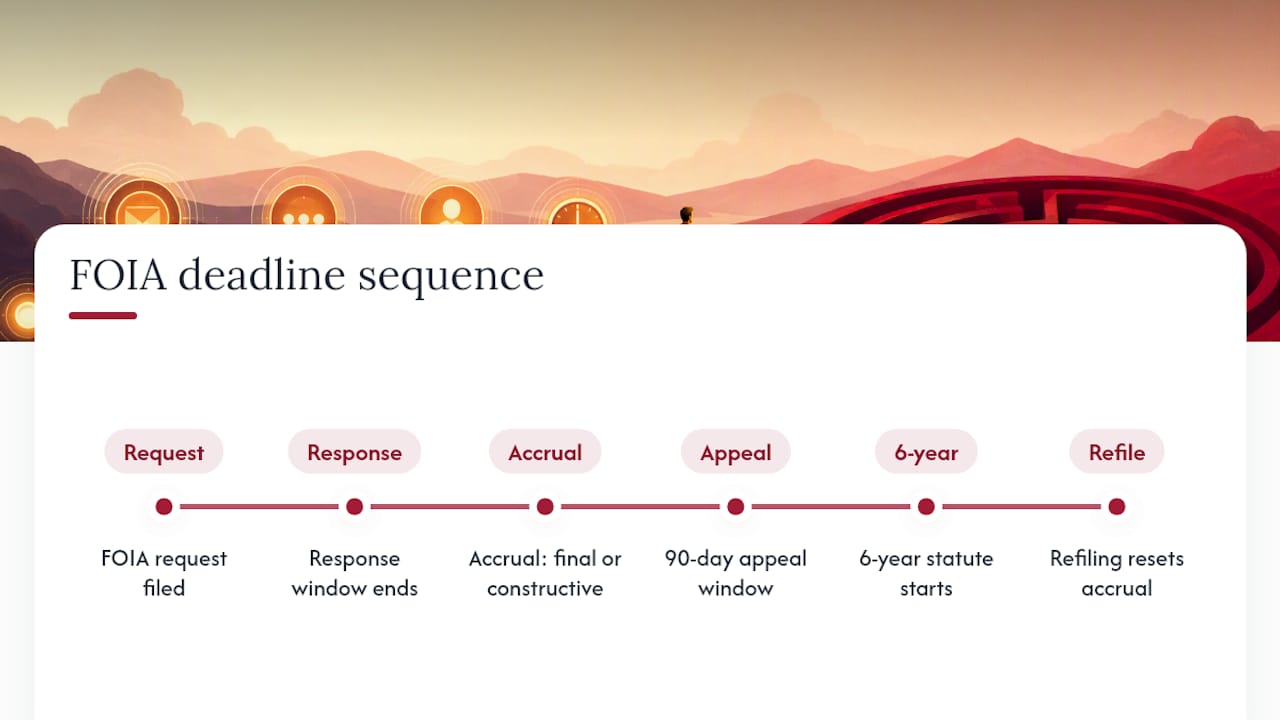
The six-year statute of limitations starts running the moment your cause of action accrues, typically the final denial or the date the statutory response window expired. If that clock is getting close and your case isn’t ready, filing a fresh FOIA request for the same records resets the accrual date and buys you a new administrative cycle. Track every date in writing; a missed 90-day appeal window is one of the few mistakes in FOIA litigation that usually can’t be fixed later.
Practical Lessons From FOIA Litigation
Non-attorney advocates, journalists, researchers, and community organizers often shape the strongest FOIA arguments because they know exactly which records matter and why. Litigators who work with these experts consistently build sharper administrative appeals, since practitioner experience shows outcomes hinge on search adequacy and submission specificity, not just legal theory.
The most common mistakes:
- Missing the 90-day appeal deadline entirely
- Submitting vague requests that give agencies room to claim an inadequate search
- Never pushing for interim or partial releases while an appeal sits pending
Pro Tip: If an agency offers a partial release during your appeal, take it and keep pressing for the rest, don’t wait for an all-or-nothing final answer. Litigation makes sense once you’ve exhausted or hit constructive exhaustion; narrowing the request often resolves things faster than filing suit.
A Note on Working With Counsel
The strongest FOIA cases I’ve studied all share one trait: the requester documented everything and stayed engaged with counsel from the first denial letter forward. Tailored appeals built on specific dates and tracking numbers consistently outperform generic ones. If your request hits delays, vague exemptions, or genuinely sensitive records, loop in an attorney before your appeal window closes, not after.
— Mark
Get Help With Your FOIA Lawsuit
Experienced FOIA attorneys can assist with case evaluation, administrative appeals, complaint drafting, agency negotiation, and full litigation when an agency won’t budge, often handling matters on a contingency basis where clients pay nothing unless there is a recovery.
Bring your original request letters, every agency response you’ve received, and any tracking or reference numbers to your consultation. That paper trail is exactly what turns a vague complaint into one that survives a motion to dismiss. If your case involves employment or housing bias alongside a records dispute, the firm’s workplace discrimination team can evaluate overlapping claims too. Start with the FOIA & Public Records practice page and get a straight answer on whether your case is ready to file.
Where to Verify Deadlines and Case Data
Check the DOJ/OIP appeals guidance, the FOIA Project’s litigation data, and your target agency’s own FOIA regulations before filing.
This article is general information, not a substitute for advice from a qualified lawyer. Consult a qualified legal professional about your own circumstances before acting on anything here.
FAQ
How Do You Sue Under FOIA?
You generally must exhaust administrative remedies first, either by appealing a denial and receiving a final decision, or by invoking constructive exhaustion after the agency misses its statutory deadline. Once that’s satisfied, you file a federal civil complaint in the proper district court naming the agency as defendant.
How Long Does a FOIA Appeal Take?
Agencies must give you at least 90 calendar days to file an appeal, and they generally have 20 working days to decide it absent unusual circumstances. If the agency blows that deadline, you may qualify for constructive exhaustion and can potentially skip straight to court.
What Is a FOIA Lawsuit?
A FOIA lawsuit is a federal civil action asking a district court to order an agency to disclose records it improperly withheld or failed to process on time. More than 18,700 FOIA lawsuits have been tracked as of early 2026, and most resolve through summary judgment rather than trial.
How Much Does a FOIA Request Cost?
Filing the initial FOIA request itself is typically free or low cost, though agencies can charge search and duplication fees depending on requester category. Litigation costs vary by firm and case complexity; Javitch Law Office handles most FOIA matters on a contingency basis, so consult the FOIA practice page for current details.
Can You Recover Attorney Fees in a FOIA Case?
Fee recovery requires proving both eligibility (you substantially prevailed) and entitlement, based on a four-factor test covering public benefit, commercial benefit, your personal interest, and the reasonableness of the agency’s withholding. Courts retain broad discretion even when both prongs are met.