
Yes, federal law lets you file an administrative appeal of almost any adverse FOIA determination, from a full denial to a partial redaction. You typically have at least 90 days from the date of the denial letter to file, and the agency should rule on your appeal within 20 working days absent unusual circumstances. Filing costs nothing. Keep every letter, tracking number, and email tied to your original request.
TL;DR:
- Filing a FOIA appeal must be done within at least 90 days from the denial letter, and agencies should decide within 20 working days unless delays occur.
- Appeals should specifically challenge the agency’s rationale, include precise details, and identify the exact records or exemptions in dispute for better success.
- You must follow the agency’s specified appeal method and address, avoiding reliance on generic deadlines and ensuring all correspondence is properly documented.
- If an agency delays past its response deadline, you may skip appeal and go directly to court, but only if the delay is deemed exhaustion or procedural grounds.
- Legal assistance becomes valuable when exemptions are complex, records are large, or agencies repeatedly stall, to build targeted arguments and preserve your case rights.
Table of Contents
- What Is a FOIA Administrative Appeal, and When Does It Apply?
- When Do You Need to File a FOIA Appeal?
- How to File a FOIA Appeal: Step by Step
- What Should Your Appeal Arguments Actually Say?
- What Happens After You File: Timeline and Follow-Up
- If the Appeal Fails: Mediation and Judicial Review
- When a FOIA Attorney Makes Sense, and How Javitch Law Office Helps
- A Practitioner’s Take on What Actually Moves the Needle
- Javitch Law Office: Help When Your Appeal Needs More Than a Letter
- Where to Confirm Your Agency’s Exact Appeal Procedures
- Sources
What Is a FOIA Administrative Appeal, and When Does It Apply?
An administrative appeal is exactly what it sounds like: a fresh set of eyes on your case. The Department of Justice’s Office of Information Policy describes it as a “second, fresh look” at the agency’s decision, handled by different personnel than the ones who reviewed your original request, per OIP guidance on adjudicating appeals. That separation matters. It means the appeals officer isn’t defending a colleague’s call, and appeals sometimes lead to more documents being released without ever going to court.
You can appeal almost any decision that doesn’t give you the full, unredacted records you asked for. That includes:
- Full or partial denials, including heavy redactions under a claimed exemption
- A “no responsive records” response you believe is wrong
- Denial of a fee waiver or expedited processing request
- A Glomar response, where the agency refuses to confirm or deny records exist
- Rejection of your request on procedural grounds
Procedural disputes count just as much as substantive withholding fights, according to OIP’s guidance. If an agency claims it searched thoroughly and found nothing, you can appeal that too.
When Do You Need to File a FOIA Appeal?
Check your denial letter first. The FOIA Improvement Act of 2016 sets a floor: agencies must give you at least 90 days from an adverse determination to file an appeal, according to OIP’s summary of the law. Some agencies extend that window further, but none can shrink it below 90 days.
There’s a wrinkle worth knowing. If an agency blows past its statutory response deadline without ruling on your request, you may be able to treat that as “constructive exhaustion” and go straight to federal court, skipping the appeal step entirely. This gets complicated fast, and getting the timing wrong can cost you your case before it starts.
Before you file anything, run through this:
- Confirm the exact appeal deadline stated in your denial letter
- Locate the required mailing address, fax number, or email listed for appeals
- Check whether the agency requires “FOIA Appeal” in the subject line or on the envelope
Pro Tip: Missing a specific agency deadline can forfeit your right to appeal administratively. Don’t rely on a general 90-day rule of thumb. Pull the actual number from your denial letter or the agency’s own FOIA regulations every single time.
How to File a FOIA Appeal: Step by Step
Filing an appeal is more paperwork than mystery, but the details matter. Here’s the order that works:
- Confirm appealability. Make sure your denial letter actually gives you appeal rights (nearly all do).
- Gather your documents. Pull the original request, the denial letter, and any tracking or request number the agency assigned.
- Find the appeal address. It’s usually on the denial letter or the agency’s FOIA page. FOIA.gov also lists agency contacts and confirms there’s no fee to file an appeal.
- Pick your submission method. Email, mail, or fax, depending on what the agency accepts. Follow their format instructions exactly.
- Keep copies of everything you send and receive, including delivery confirmations.
FOIA.gov also recommends reaching out to the agency’s FOIA Public Liaison before you file, since a liaison can sometimes clear up a misunderstanding or trigger a supplemental release without a formal appeal.
A solid appeal letter follows a predictable structure:
- A clear statement of appeal stating you’re appealing under FOIA and naming the request number
- Background details, including the original request date, the denial date, and any correspondence in between
- Specific identification of which records or redactions you’re challenging
- Focused legal and policy arguments explaining why the exemption or search was flawed
- A request for segregable release of any nonexempt portions mixed in with withheld material
- Your contact information and signature
Several agencies publish sample letters worth studying for formatting, including the FTC’s sample FOIA appeal letter. The Department of State and the Centers for Medicare & Medicaid Services publish similar templates on their FOIA pages. None of them are one size fits all. Adapt the structure, not the wording, to your specific denial. And for background on how the underlying request process works before you ever reach an appeal, see this guide to filing FOIA requests.
What Should Your Appeal Arguments Actually Say?
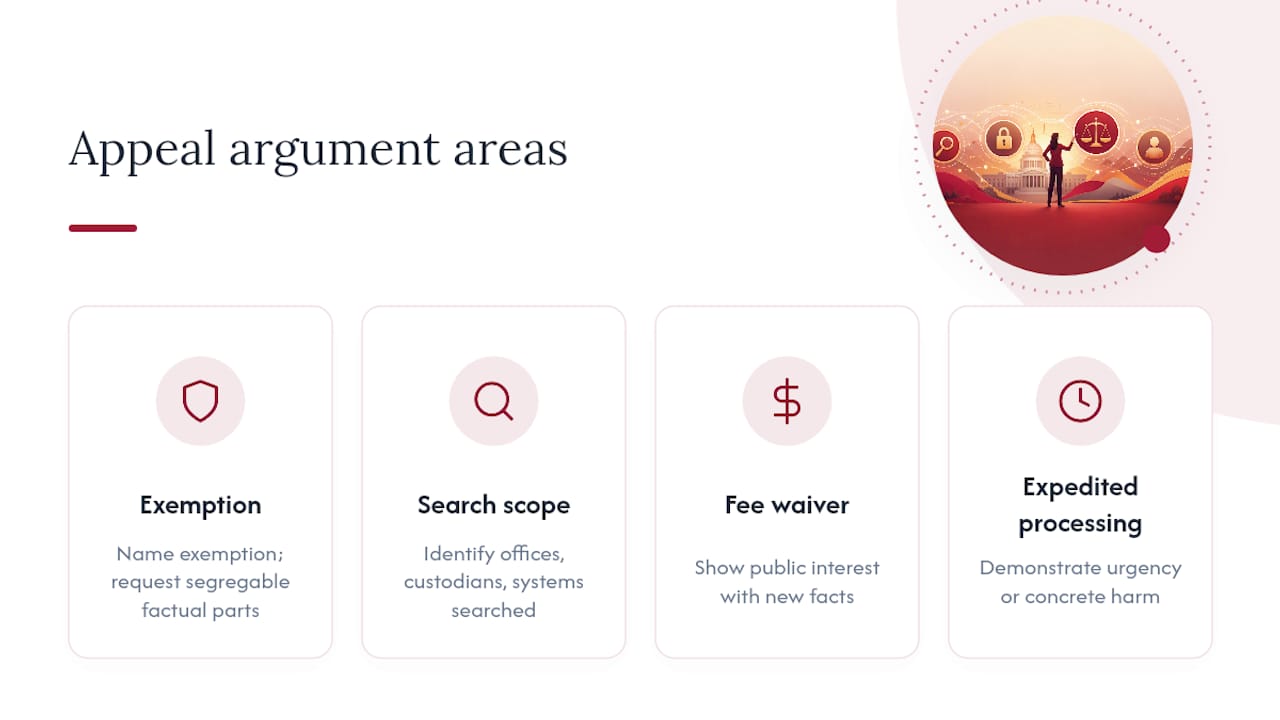
Vague disagreement doesn’t move an appeals officer. Specificity does. HHS’s own guidance notes that appeals succeed more often when they directly challenge the agency’s rationale and point to segregable portions or new facts, rather than simply restating that you want the records.
If the agency claims an exemption, name it and explain why it doesn’t fit your facts. Exemption 5, for instance, protects certain deliberative process material, but not purely factual information mixed into that material. Ask explicitly for any segregable, nonexempt portions to be released even if the exemption itself holds up.
If the agency says it found “no responsive records,” get specific about where those records should live. Name the office, the custodian, or the file type you expect to exist. Ask the agency to identify its search terms and which systems it searched. A search limited to one email account when three employees worked the issue is exactly the kind of gap an appeal should expose.
Fee waiver and expedited processing denials deserve the same treatment. Restate the public interest or urgency with concrete new facts, not just a repeated request. A firm handling expedited processing requests will tell you the same thing: specificity about harm or urgency is what actually moves these decisions.
What Happens After You File: Timeline and Follow-Up
Most agencies send an acknowledgment letter and assign a new appeal number, separate from your original request number. Reference both when you follow up.
Absent unusual circumstances, agencies should decide your appeal within 20 working days, per OIP guidance and confirmed by agencies like HHS in their own procedures. That clock can stretch for a few reasons:
- The agency needs to consult another office or a third party before deciding
- The volume of records involved is genuinely large
- Multiple related requests are being processed together
Some agencies release records in rolling batches rather than all at once. If weeks pass with no word, call or email referencing your appeal number. When a decision finally arrives, it should state whether the agency is upholding, reversing, or partially reversing the original denial, and it should notify you of your right to seek judicial review. For more on how agency timelines work generally, see this breakdown of FOIA response times.
If the Appeal Fails: Mediation and Judicial Review
Losing an appeal isn’t the end of the road. The Office of Government Information Services, part of the National Archives, offers free, voluntary mediation between requesters and agencies, and its FOIA Public Liaisons can often resolve disputes without any litigation at all, according to OGIS’s own description of the liaison role.
If mediation doesn’t work or isn’t the right fit, you can file suit in federal court once you’ve exhausted your administrative remedies, meaning you filed the appeal and received (or should have received) a final decision. Filing before exhausting that appeal is one of the most common ways cases get dismissed early.
A few situations point toward calling an attorney instead of going it alone:
- The agency’s exemption claims turn on unsettled or unclear legal questions
- Your case involves a strong public interest angle that needs to be argued persuasively
- The agency has repeatedly delayed or stonewalled with no clear resolution in sight
A FOIA lawyer can spot which of these apply to your situation faster than most requesters can on their own.
When a FOIA Attorney Makes Sense, and How Javitch Law Office Helps
Filing the appeal yourself costs nothing, and plenty of requesters succeed without a lawyer. But once a case turns on complex exemption law, a genuinely large release, or an agency that keeps stalling past its own deadlines, legal representation changes the equation. An attorney can build arguments tailored to the specific exemption cited, preserve a clean administrative record for eventual court review, and file suit if the agency won’t budge.
That’s the kind of work a public records practice does regularly:
- Drafting appeal arguments that target the agency’s specific legal theory, not generic objections
- Handling the procedural steps needed to preserve your right to sue later
- Litigating FOIA denials in federal court when administrative remedies run out
Appeals themselves are always free to file. Attorney fee arrangements vary by case, so if your matter involves contested exemptions or looks headed for litigation, a consultation is worth the conversation.
A Practitioner’s Take on What Actually Moves the Needle
Most requesters skip the FOIA Public Liaison and go straight to a formal appeal. That’s a mistake. A short conversation before filing sometimes resolves a misunderstanding or prompts a supplemental search, saving weeks. When you do appeal, be specific: name the exemption, name the missing custodian, name the search term you think they skipped. Vague appeals get vague denials. Save every letter and tracking number from day one; you’ll need them later even if the case looks simple now. Clear, focused appeals genuinely do produce more releases than boilerplate ones.
— Mark
Javitch Law Office: Help When Your Appeal Needs More Than a Letter
Javitch Law Office handles public records disputes that go beyond a standard appeal letter, including cases where agencies withhold records improperly, drag out timelines, or misuse exemptions to avoid disclosure.
Where a template letter falls short is exactly where a public-records practice earns its keep: spotting a weak exemption claim, documenting a search that never happened, and knowing when constructive exhaustion lets you skip straight to court. That’s the gap between a denied appeal and a released record. If your FOIA appeal involves contested exemptions, a stalled timeline, or an agency that seems intent on stonewalling, reach out through the firm’s Public Records & FOIA practice page to set up a consultation and find out where your case actually stands.
Where to Confirm Your Agency’s Exact Appeal Procedures
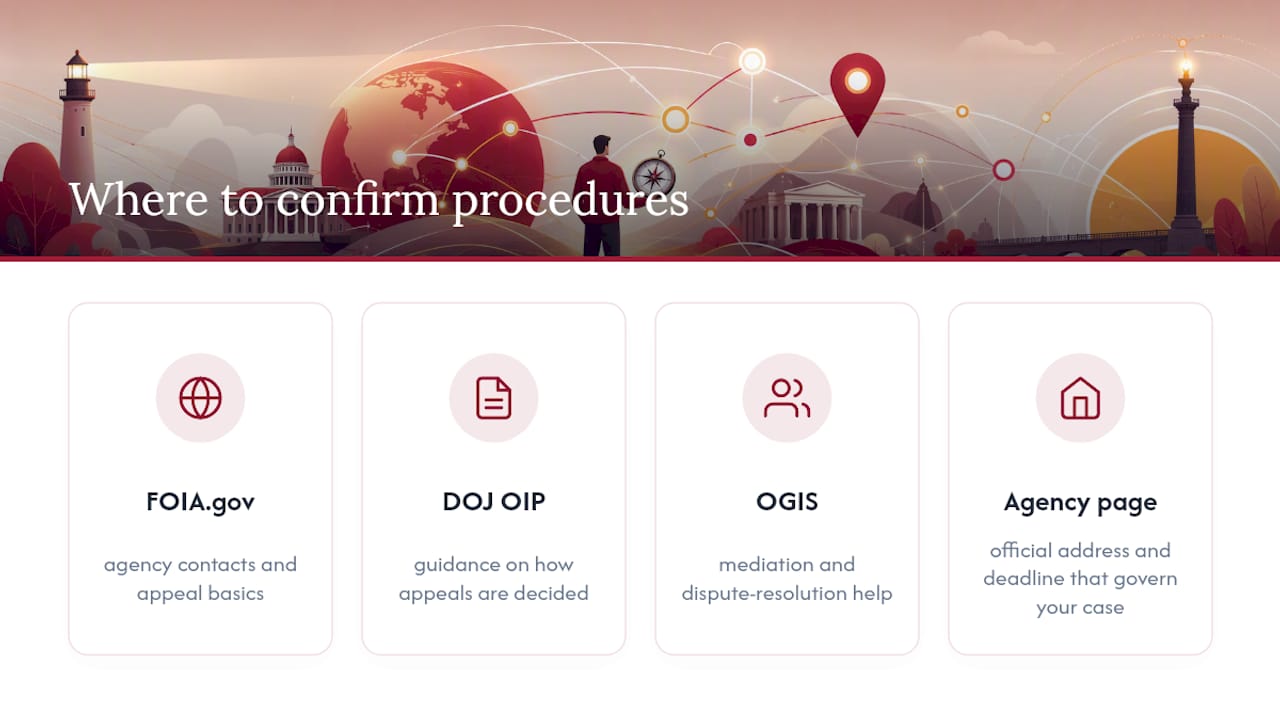
Always verify appeal instructions against primary sources, not general guides. Start with FOIA.gov for agency contacts and appeal basics, DOJ’s OIP guidance for how appeals get decided, OGIS for mediation help, and your specific agency’s FOIA appeals page, such as HHS’s appeals procedures, for the address and deadline that actually govern your case.
This article is general information, not a substitute for advice from a qualified lawyer. Consult a qualified legal professional about your own circumstances before acting on anything here.
Sources
- OIP Guidance: Adjudicating Administrative Appeals Under the FOIA
- Foia
- HHS FOIA appeals
- What’s a FOIA public liaison? (OGIS/NARA blog)