
You qualify for expedited FOIA processing if you can show an imminent threat to someone’s life or physical safety, or if you’re primarily in the business of disseminating information and there’s an urgent need to inform the public about government activity. Once you file a proper request, the agency has a limited time period to decide as required by law. Approved requests jump the line and move forward “as soon as practicable,” but you need a detailed, certified statement to get there, and you can appeal if the agency says no.
TL;DR:
- Eligible requests for expedited FOIA processing are limited to life or safety threats or urgent public dissemination of government information, both requiring strong documentation.
- Agencies determine approval within 10 days, but even approved requests depend on backlog and request complexity, often delaying final response.
- Narrowing the request, involving FOIA liaisons, or using the Office of Government Information Services can often produce faster results than relying solely on formal expedited processing.
- Denied expedited requests can be appealed, but success relies on detailed, certified statements with deadlines and supporting evidence, not persuasive language.
- Seeking legal help is advisable if requests are denied or delayed, as attorneys can assist with appeals, rephrasing requests, and potential litigation.
Table of Contents
- What Qualifies as FOIA Expedited Processing
- How to Ask for Expedited FOIA Processing
- How Long Agencies Take to Decide on Expedited Requests
- Faster Alternatives to Formal Expedited Processing
- What to Do When Expedited Processing Is Denied
- What Practitioners See Go Wrong With Expedition Requests
- Why the Expedition Process Rewards Precision Over Passion
- Get Help With a Denied or Delayed FOIA Request
- Where to Verify the Rules Yourself
- Sources
What Qualifies as FOIA Expedited Processing
Federal law recognizes exactly two grounds for expedited treatment, and both are narrower than most people assume. The first is a circumstance where failure to obtain the records quickly could reasonably pose an imminent threat to someone’s life or physical safety. That’s a high bar. It covers things like a pending safety recall, an active environmental hazard, or records tied to an imminent enforcement action against a specific person. The second ground applies to a person “primarily engaged in disseminating information” who can show an urgency to inform the public about actual or alleged federal government activity, according to Foia.
Neither prong exists to reward general curiosity or professional convenience. The Department of Justice’s Office of Information Policy has been explicit that “compelling need” is applied narrowly, and agencies routinely reject requests that do not meet the narrow criteria for compelling need. Being a journalist doesn’t automatically clear the bar either. The National Archives’ Office of Government Information Services notes that requesters must show a “particular urgency” beyond the general public interest in the topic, not just their occupation.
A few things worth knowing before you file:
- Agencies can, and often do, add their own criteria in their FOIA regulations, so a standard that works at one department might not apply at another.
- Non-media requesters carry a heavier burden and typically need to prove both urgency and a lack of alternative sources for the information.
- “Urgent to inform the public” usually means the story has a shelf life. Once the news cycle passes, so does the justification.
Before filing, check the specific agency’s FOIA regulation, usually published in the Code of Federal Regulations under that agency’s title.
How to Ask for Expedited FOIA Processing
You can request expedited processing at the same time you file your FOIA request, or afterward if circumstances change and urgency develops later. Either way, the request has to do real work. A vague plea for speed gets denied fast, often without much explanation.
Here’s what a solid request needs:
- A factual narrative. Lay out specifically why the information is urgent now, tied to a real deadline, event, or safety risk, not a general sense of importance.
- A certification statement. Federal regulations require you to certify that your statement is “true and correct to the best of my knowledge and belief,” per 1 CFR § 304.5.
- Proof of dissemination activity, if you’re not a government employee claiming a life/safety threat. Show that informing the public is a primary part of what you do, and that this particular request serves a specific urgency, not just general interest.
- Supporting documents. Attach anything that backs the timeline: a court deadline, a publication date, a medical statement, a press schedule.
Sample certification language looks like this: “I certify that the foregoing statement is true and correct to the best of my knowledge and belief.” Keep the surrounding explanation concrete. Name the date something happens, not just that something is happening “soon.”
Pro Tip: File the expedition request as its own labeled section at the top of your FOIA letter, not buried in the middle. Agency FOIA officers process hundreds of requests; make the urgency the first thing they see.
How Long Agencies Take to Decide on Expedited Requests
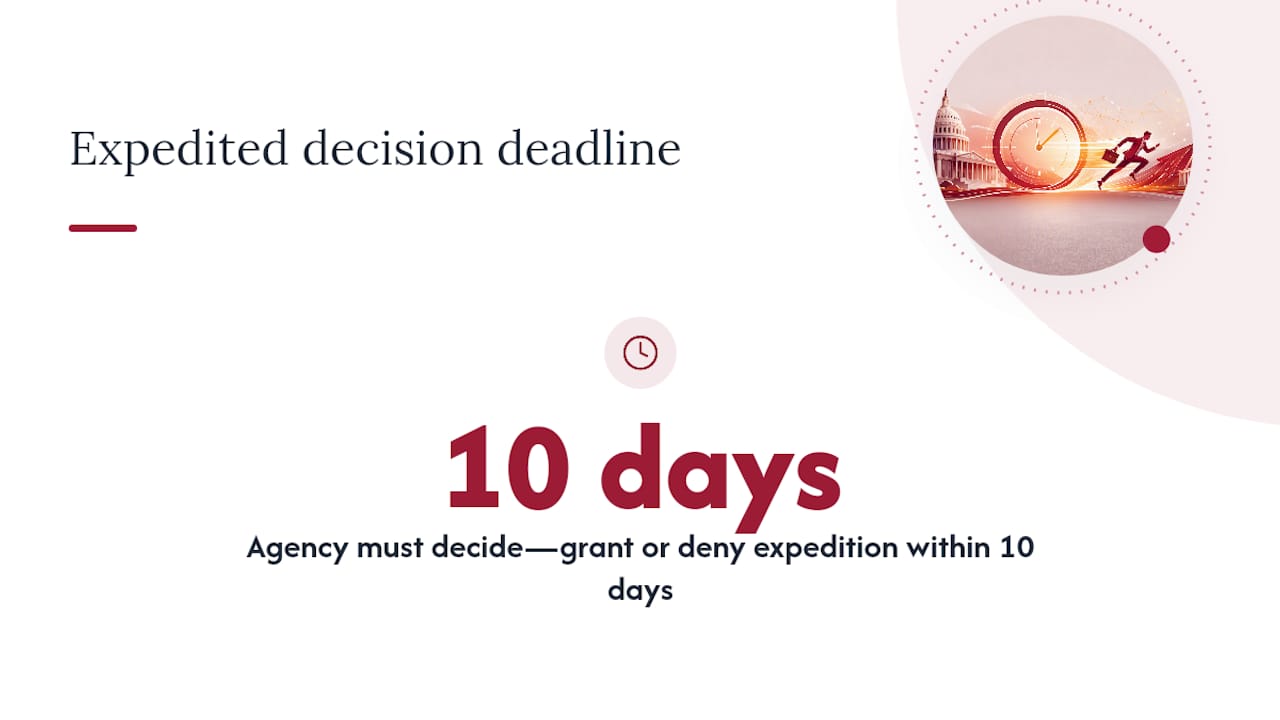
Agencies must determine whether to grant or deny expedited processing within 10 calendar days of receiving your request, a requirement written into 1 CFR § 304.5 and echoed across individual agency regulations. Components like the Defense Finance and Accounting Service restate the same 10 day clock in their own FOIA guidance, which tells you this rule isn’t optional or agency-specific. It’s baked into the statute.
Getting approved for expedition doesn’t mean you get your documents in 10 days. It means your request moves to the front of the processing queue and gets worked “as soon as practicable,” a phrase that depends heavily on the agency’s backlog and how complex the request is.
Processing times for expedited requests vary widely among agencies, depending on backlog and request complexity. Agencies report statistics on processing times in their Annual FOIA Reports.
If you want a sense of how bad the delay can get before expedition even matters, Javitchlawoffice’s breakdown of FOIA response times walks through why backlogs form in the first place.
Faster Alternatives to Formal Expedited Processing
Formal expedition isn’t always your best shot at speed. A tightly scoped request often beats a granted expedition buried in agency backlog.
- Narrow the request before you file it. Limit the date range, name specific custodians, and specify record types instead of asking for “all records related to.” Agencies process requests in the order received, and a request classified as simple moves through a shorter track than one classified as complex, per FOIA.gov’s request guidance.
- Call the agency’s FOIA Public Liaison. Every agency has one. Liaisons can clarify scope, resolve processing disputes, and sometimes reclassify a stuck request.
- Loop in the Office of Government Information Services (OGIS) for mediation if the liaison doesn’t move things along. OGIS operates as a neutral resource specifically built to unstick FOIA disputes without litigation.
Pro Tip: If your real goal is a handful of specific documents, don’t ask for the universe and then fight for expedition. Ask for the five documents you actually need. You’ll often get them faster than a broad request would clear even with expedited status.
Javitchlawoffice’s guide to accessing government records covers scoping strategy in more depth if you’re building your first request.
What to Do When Expedited Processing Is Denied
You have the right to appeal a denial of expedited processing, and agencies are obligated to act on that appeal expeditiously rather than let it sit in a general appeals queue, according to DOI OIG’s FOIA appeals guidance. If the appeal stalls, contacting the agency’s FOIA Public Liaison after roughly 21 business days without movement is a reasonable next step before considering OGIS mediation or federal court.
Litigation is available, but timing matters more than most requesters realize. If an agency releases all responsive records before a judge rules on your expedited-processing claim, the court can lose jurisdiction over that specific claim, according to Foia.
Before you escalate, preserve:
- Every email exchange with the FOIA office, timestamped.
- Copies of your original request and certification statement.
- The agency’s written denial and any stated reasoning.
Javitchlawoffice’s guide to fighting agency denials walks through what that escalation path looks like in practice.
What Practitioners See Go Wrong With Expedition Requests
Most denied expedition requests fail for the same three reasons: vague urgency language, treating personal convenience as a compelling need, and a weak or missing certification statement. “Urgent” without a date attached to it reads as opinion, not evidence.
The requests that get approved read like a timeline, not a plea. Name the deadline. Name the harm. Attach the document that proves both exist. Agencies aren’t looking for passion, they’re looking for a fact pattern that matches one of two narrow legal categories.
Javitchlawoffice handles FOIA litigation and public-records disputes across discrimination, consumer protection, and transparency cases, and has seen firsthand how a poorly drafted expedition request gets tossed in the same pile as requests that never should have qualified in the first place. The Vaughn Index guide is worth a look if you’re heading toward litigation and need to understand how agencies justify withholding records once a case is filed.
Why the Expedition Process Rewards Precision Over Passion
The biggest misconception about expedited FOIA processing is that urgency is a feeling you can argue your way into. It isn’t. It’s a legal standard with exactly two doors, and both require documentation, not persuasion. Most rejected requests aren’t rejected because the requester’s cause wasn’t important. They’re rejected because the statement read like advocacy instead of evidence.
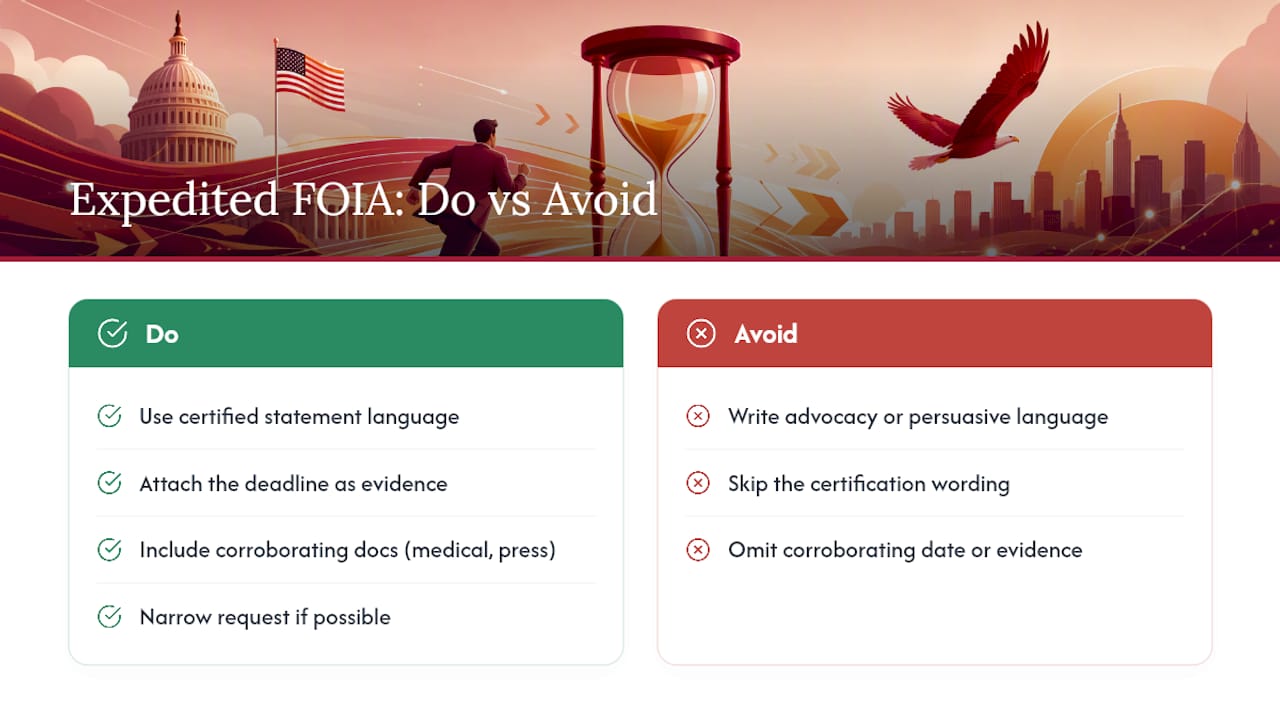
The conventional advice, “explain why you need it fast,” undersells how mechanical this process actually is. Agencies aren’t weighing your urgency against your sincerity. They’re checking your statement against a narrow statutory checklist and a certification requirement. Skip the certification language or leave out a corroborating date, and the strongest cause in the world won’t save the request.
If there’s one thing readers should prioritize first, it’s this: draft the certified statement like you’re building evidence for a case file, not writing a persuasive letter. Attach the deadline. Attach the medical note or press schedule. Then, separately, ask whether a narrower request would get you the same records faster without needing expedition at all. Often it will.
— Mark
Get Help With a Denied or Delayed FOIA Request
If your expedited FOIA request was denied, or your agency has gone silent past the deadlines the law requires, you don’t have to sort out the appeal process alone. Javitchlawoffice is the option for requesters who need a firm that actually litigates public-records disputes, not just files paperwork and waits.

Legal firms can review denied and delayed FOIA requests, draft and refile expedition statements with the certification language agencies expect, and represent clients through administrative appeals and, when necessary, federal litigation. FOIA practice may be backed by courtroom experience along with letter writing.
If you’re stuck in an agency backlog or you’ve already been denied expedited treatment, reach out to Javitchlawoffice’s public records and FOIA attorneys for a case evaluation. The firm can review your documentation, tell you honestly whether an appeal or lawsuit makes sense, and outline realistic timelines before you commit to anything.
Where to Verify the Rules Yourself
- Foia for how to file and how expedited processing works agency-wide.
- DOJ Office of Information Policy guidance on interpreting “compelling need.”
- 1 CFR § 304.5 for the regulatory text on timing and certification.
- Your target agency’s own FOIA regulation and Annual FOIA Report for processing statistics specific to that office.
This article is general information, not a substitute for advice from a qualified lawyer. Consult a qualified legal professional about your own circumstances before acting on anything here.
Sources
- Foia
- OIP Guidance: When to Expedite FOIA Requests - U.S. Department of Justice, Office of Information Policy
- 1 CFR § 304.5 — Timing of responses to requests (Expedited processing) - LII / Cornell Law
- Processing a FOIA Request - Inspector General (DOI OIG)