
A Vaughn Index is a court-ordered, document-by-document justification that a federal agency must produce in FOIA litigation to explain, record by record, why specific documents or redactions are withheld under 5 U.S.C. § 552. Courts typically require it at the summary-judgment stage, and it is a litigation tool, not something requesters are entitled to during administrative processing. The National Archives/OGIS guidance makes that distinction explicit: administrative lists agencies provide during processing are not Vaughn Indices and receive no judicial scrutiny.
Key Takeaways
A Vaughn Index is a litigation tool, not an administrative entitlement; specificity and segregability analysis in each entry determine whether an agency’s withholdings survive judicial review.
| Point | Details |
|---|---|
| Litigation tool only | Courts order a Vaughn Index at the MSJ stage; agencies owe nothing comparable during administrative processing. |
| Three required elements | Each entry must include a detailed description, the specific exemption invoked, and a non-conclusory factual justification. |
| Segregability is non-optional | Every entry must address whether nonexempt material was released or explain why segregation is not reasonably possible. |
| Format follows volume | Document-by-document, grouped, or coded formats are all acceptable; choose based on production size and court expectations. |
| Javitchlawoffice | The firm integrates early records mapping and Vaughn Index strategy into FOIA and civil-rights litigation from the outset. |
Table of Contents
- Where does the Vaughn Index requirement come from?
- What must every Vaughn Index entry include?
- What formats can a Vaughn Index take?
- How do courts evaluate a Vaughn Index, and what goes wrong?
- Practical tactics when an index is adequate or inadequate
- What practitioners often get wrong about Vaughn Indices
- Javitchlawoffice can help with your FOIA litigation
- Authoritative sources for citation and further research
Where does the Vaughn Index requirement come from?
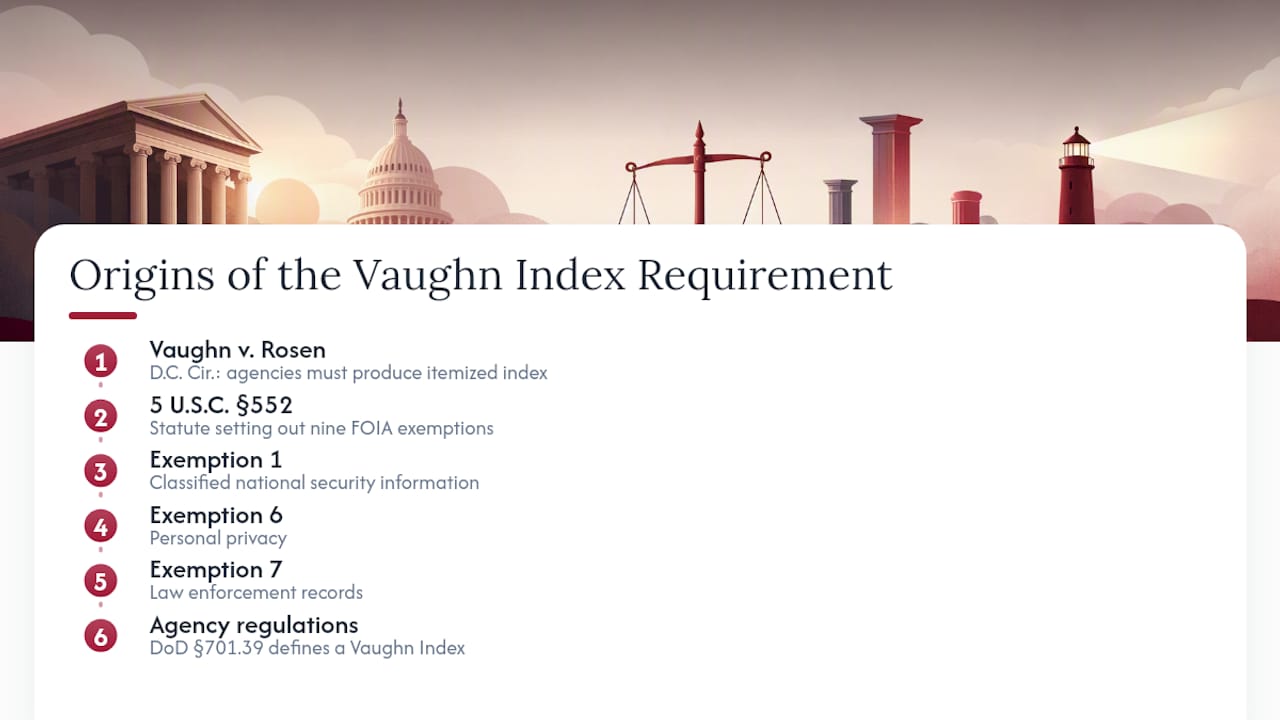
The requirement traces directly to Vaughn v. Rosen, 484 F.2d 820 (D.C. Cir. 1973). The D.C. Circuit held that vague government assertions made meaningful judicial review impossible, so agencies had to produce an itemized index correlating each withheld document with the exemption claimed and the factual basis for nondisclosure. That holding remains binding precedent in FOIA litigation nationwide.
The statutory backbone is 5 U.S.C. § 552, which sets out the nine FOIA exemptions. An agency invoking any of those exemptions in litigation must justify each invocation in the index. Exemptions 1 through 9 cover everything from classified national security information (Exemption 1) to personal privacy (Exemption 6) to law enforcement records (Exemption 7). The index is the mechanism that connects a withheld document to the specific statutory harm disclosure would cause.
Some agencies have codified the requirement in their own regulations. DoD § 701.39 explicitly defines a Vaughn Index as an itemized index correlating withheld documents with claimed exemptions and nondisclosure justifications. That regulatory recognition matters: it signals that the index is not a judicial invention courts can waive but a structured accountability mechanism embedded in agency practice.
What must every Vaughn Index entry include?
IRS guidance on FOIA litigation distills the standard that courts apply across agencies. Each entry must contain three core elements, and missing any one of them invites a motion to compel or an order for an amended index.
- Non-conclusory factual justification: explain concretely how disclosure of this specific document would cause the harm the exemption protects against. “Internal memorandum, Exemption 5” is not enough; the entry must enable a reasoned judicial judgment without the court reading the withheld material.
For electronic records, metadata carries extra weight. Email headers, timestamps, distribution lists, and thread context materially increase an entry’s usefulness to the court and often determine whether the index survives scrutiny.
What formats can a Vaughn Index take?
There is no single required form; format should match the volume and complexity of the production. The DOJ Office of Information Policy recognizes three primary formats, each with distinct tradeoffs.
| Format | Best used when | Strength | Risk |
|---|---|---|---|
| Document-by-document | Small productions or when court demands granularity | Maximum specificity; hardest to challenge | Burdensome for large productions |
| Grouped/categorical | Many documents share the same exemption rationale | Manageable volume; efficient | Court may demand individual entries if categories are vague |
| Coded with cross-reference | Large-volume cases with recurring exemption patterns | Reduces repetition; scalable | Each coded category must still be explained with enough specificity for judicial review |
| Declaration-only | Narrow disputes where a sworn narrative suffices | Flexible; attorney-controlled framing | Courts may reject it and order a formal index |
The grouped format works only when the category description is genuinely specific. Grouping “all emails discussing the investigation” under Exemption 7(A) without explaining the concrete harm from disclosure will not hold up.
How do courts evaluate a Vaughn Index, and what goes wrong?
Courts focus on two questions: Does the entry give enough factual detail to evaluate the exemption claim? Does the agency address segregability? Failure on either front is the most common reason agencies end up with an order to redo the index.
DOJ OIP’s archived court decisions show a consistent pattern of deficiencies. Boilerplate language is the leading problem: entries that repeat the statutory text without linking it to the specific document’s content. Conclusory entries (“disclosure would harm national security”) with no factual predicate are treated the same way. Agencies also frequently fail to address segregability at all, which courts read as an admission that releasable portions exist.
Judicial remedies escalate with the severity of the deficiency. A first-time inadequate index typically draws an order for a supplemental or amended index. Persistent failures or apparent bad faith can lead to in camera review of the withheld documents, denial of the agency’s summary-judgment motion, or heightened scrutiny of every future withholding in the case. Courts treat a weak index as a signal of sloppy process, and that skepticism tends to carry forward.
Practical tactics when an index is adequate or inadequate
For requesters challenging a weak index:
- File a targeted motion to compel a more detailed index, citing specific entries that are conclusory or lack segregability analysis.
- Use a meet-and-confer to identify whether the agency will voluntarily supplement before motion practice.
- Request in camera review for entries where the justification is implausible on its face.
- Deploy metadata arguments: if the agency’s index omits email headers or timestamps for electronic records, argue the entry is facially insufficient.
For agencies defending or shoring up an index:
- Supplement with sworn declarations that expand factual detail without disclosing protected content.
- Propose narrow in camera review of disputed documents rather than wholesale disclosure.
- Explain segregability decisions document by document; a blanket “no segregable material” statement across dozens of entries will not survive scrutiny.
On cost and timing: if an agency’s index is so deficient that it required multiple rounds of supplementation, requesters should evaluate whether fee-shifting under 5 U.S.C. § 552(a)(4)(E) is available. Phased disclosure or sampling agreements can also reduce burden when productions involve hundreds of documents, and courts are generally receptive to those arrangements when both sides propose them in good faith. For guidance on fighting government denials after receiving an inadequate index, the procedural steps matter as much as the substantive arguments.
What practitioners often get wrong about Vaughn Indices
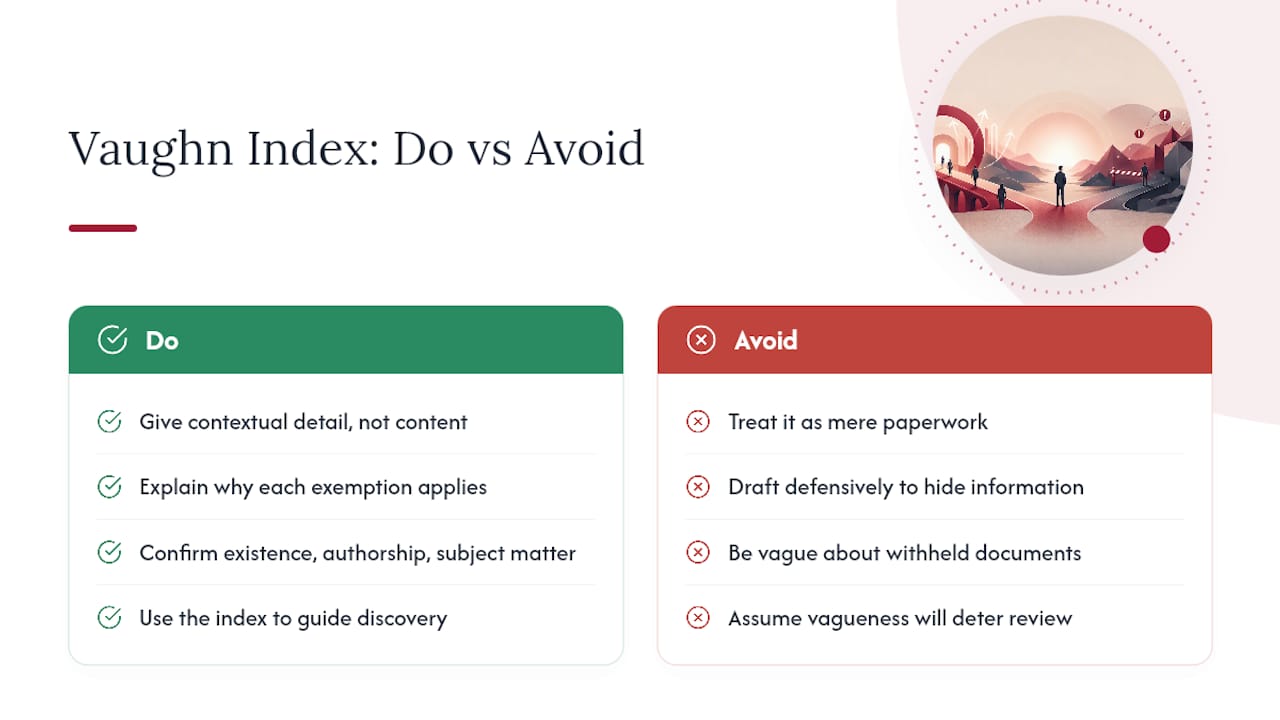
The conventional wisdom treats a Vaughn Index as a paperwork exercise. It is not. It is the agency’s one structured opportunity to justify secrecy to a federal judge, and courts read it that way. The entries that fail are almost never the ones where the agency had a weak exemption claim; they are the ones where a legitimate claim was explained so badly that the court could not evaluate it.
The deeper issue is that agencies often draft indices defensively, as if the goal is to reveal as little as possible about the withheld documents. That instinct backfires. A court that cannot understand why a document is withheld from the index alone will look harder at it, not less. The more contextual detail an agency provides without revealing protected content, the more likely the withholding holds. Requesters understand this, which is why the sharpest challenges target vagueness, not the exemption itself.
For civil rights practitioners, the Vaughn Index is also an investigative tool. An index that describes documents with enough specificity to confirm their existence, authorship, and subject matter often tells you more about an agency’s conduct than the documents themselves would. That intelligence shapes discovery strategy, settlement posture, and the narrative at trial.
Javitchlawoffice can help with your FOIA litigation
When FOIA litigation requires preparing or challenging a Vaughn Index, the stakes are higher than most requesters expect; understanding how to respond to a Federal Target Letter: What It Means and What to Do can be critical in navigating the litigation process. A single deficient entry can unravel an agency’s entire summary-judgment motion, and a single overlooked segregability argument can cost a requester documents they are entitled to.

Javitchlawoffice handles FOIA litigation and public records matters for clients across the country, including cases where government transparency intersects with First Amendment claims or civil rights investigations. The firm’s approach starts before litigation: early records mapping, close coordination with declarants, and index strategy built around the specific exemptions an agency is likely to invoke. If you are facing a FOIA denial or need to challenge an inadequate index, request a case evaluation to discuss your options.
Authoritative sources for citation and further research
| Source | Citation | Best used for |
|---|---|---|
| FOIA statute | 5 U.S.C. § 552 | Statutory basis for exemptions and fee-shifting provisions |
| National Archives/OGIS | FOIA Resources | Administrative posture; confirms index is a litigation tool only |
| DOJ OIP court decisions | Archived Vaughn Index decisions | Judicial standards; specificity and segregability case law |
| DOJ OIP handouts | Index examples and formats | Sample formats; document-by-document, grouped, and coded approaches |
| DoD § 701.39 | 32 C.F.R. § 701.39 | Regulatory recognition of the index; cite for agency-practice arguments |
| IRS Internal Revenue Manual | IRS guidance on FOIA litigation | Agency preparation procedures; useful for timing and declaration coordination |
| FOIA.Wiki | Vaughn Indices | Format flexibility; practitioner reference for hybrid approaches |
This article provides general legal information, not legal advice. Consult a qualified FOIA attorney or review the primary sources above to confirm current standards for your specific matter.