
If your employer passed you over for a promotion because of your race, that decision can violate Title VII of the Civil Rights Act of 1964. The first move isn’t confrontation. It’s preservation: save the job posting, your performance reviews, and any emails about the decision, and write down dates and names while they’re fresh. The EEOC and firms like Javitch Law Office exist specifically to help you turn those details into a valid claim.
TL;DR:
- Nearly all promotion discrimination claims should be supported by consistent documentation of unfair patterns, including shifting explanations and exclusion from key projects.
- Comparator analysis is crucial, focusing on how similarly qualified employees of different races were treated, especially when statistical evidence shows systemic promotion gaps.
- Filing deadlines are strict, with 180 days in most states and up to 300 days in states like California; early action is essential to preserve legal rights.
- Evidence of discrimination can include biased remarks, inconsistent criteria, and underrepresentation of people of color at higher ranks, with systemic patterns often stronger than isolated incidents.
- Discrimination claims can involve either intentional bias (disparate treatment) or policies with disproportionate racial effects (disparate impact), requiring different types of proof.
Table of Contents
- Signs of Promotion Discrimination Based on Race
- Disparate Treatment, Disparate Impact, and the Prima Facie Case
- Building Your Case: Evidence, Comparators, and Filing Deadlines
- Your Next Steps: Internal Complaints, EEOC Charges, and Retaliation
- How Employers Defend Promotion Decisions
- What a Successful Claim Can Actually Recover
- How Javitch Law Office Can Help
- When Race Discrimination Overlaps With Other Protected Traits
- Preventing Racial Bias in Promotion Decisions
- The Real Cost of Promotion Discrimination
- A Brief Note From the Author
- Talk to Javitch Law Office About Your Case
- Sources
- FAQ
Signs of Promotion Discrimination Based on Race
Ordinary unfairness and illegal discrimination can look similar on the surface. The difference usually shows up in the pattern, not the single decision.
Watch for these red flags:
- Shifting explanations. HR says you lacked “leadership experience,” then later says the issue was “cultural fit,” then something else entirely.
- Inconsistent criteria. The job posting listed five years of experience, but the person promoted had three, and they’re a different race than you.
- Biased remarks. Comments about “not fitting the team” or coded language about communication style, tone, or “polish.”
- Exclusion from stretch assignments. You never got the visible projects, mentoring, or leadership training that typically precede a promotion.
- Underrepresentation at the top. Your department promotes white employees at a visibly higher rate than employees of color with comparable tenure and reviews.
Comparator analysis matters here. Look at who applied, who got the job, and how their qualifications actually stacked up against yours. The pattern often tells the real story.
By the Numbers: One study of the U.S. Patent Office found Black examiners were 30% less likely to be promoted on time than similarly qualified White examiners, and took 13% longer to reach the top pay grade. That’s not an isolated anecdote. It’s the kind of systemic gap courts and the EEOC take seriously.
Disparate Treatment, Disparate Impact, and the Prima Facie Case
Two distinct legal theories cover promotion discrimination, and knowing which one fits your situation shapes everything that follows.
Disparate treatment means you were treated differently because of your race, intentionally. A manager who tells a Black employee “you’re just not ready” while promoting a less-qualified white colleague with identical reviews is a disparate treatment scenario.
Disparate impact doesn’t require proof of intent. It targets neutral-looking policies that disproportionately exclude a racial group. A promotion exam that consistently produces lower pass rates for one race, with no clear connection to actual job performance, can trigger a disparate-impact claim.
To build a failure-to-promote case under Title VII, you generally need to establish four elements, known as the prima facie case:
- You belong to a protected class (race, in this context).
- You were qualified for the promotion.
- You suffered an adverse action, meaning you were denied the promotion.
- The circumstances suggest race played a role in the decision.
Once you clear that bar, the burden shifts to your employer to offer a legitimate, nondiscriminatory reason. From there, it shifts back to you to show that reason is a pretext. Title VII covers both flavors of discrimination, but disparate-impact claims typically require statistical evidence showing a measurable gap in promotion rates, not just your own experience.
Building Your Case: Evidence, Comparators, and Filing Deadlines
Strong claims are built on paper, not memory. Start collecting now, even if you’re not sure yet whether you’ll file a charge.
Preserve these records immediately:
- Every performance review you’ve received, going back as far as you can.
- Emails, texts, or Slack messages referencing the promotion decision or your qualifications.
- The original job posting and any stated promotion criteria.
- Calendar entries showing project assignments, meetings, or training you were excluded from.
- Names of coworkers who witnessed relevant conversations or who were passed over similarly.
Once you have documents, build a comparator analysis: who else applied, what were their qualifications, and how did the outcome compare to yours? If you can, look at broader numbers, selection rates by race, representation at each job level, how long people of different races typically wait between promotions. The EEOC Compliance Manual specifically identifies pattern-or-practice statistics and inconsistent application of standards as key evidence types.
Statistic to know: Filing deadlines are unforgiving. You generally have 180 days from the discriminatory act to file an EEOC charge, extended to 300 days in states with their own fair employment agency, which includes California.
Pro Tip: Don’t wait for a “clean” case before contacting the EEOC or an attorney. Filing preserves your rights even while you keep gathering evidence, and missing the deadline can end a valid claim before it starts.
Your Next Steps: Internal Complaints, EEOC Charges, and Retaliation
Most successful claims follow a predictable sequence, and skipping steps rarely helps.
- Document everything as it happens, not from memory weeks later.
- Raise the issue internally, in writing, through HR or a formal complaint channel. This creates a paper trail and sometimes triggers a faster resolution.
- Preserve evidence independently. Don’t rely on your employer to keep records that might not favor them later.
- File an EEOC charge if internal channels don’t resolve the issue within a reasonable window, and always before your deadline expires.
Retaliation is a separate, serious risk once you complain. Sudden negative reviews, exclusion from meetings, schedule changes, or a abrupt shift in tone from your manager after you raise concerns can all count as retaliation under EEOC-enforced laws. Document retaliatory acts the same way you document the original discrimination, with dates, screenshots, and witnesses.
Pro Tip: If your case involves statistical patterns across a department, multiple witnesses, or retaliation, that’s usually the point to bring in a racial discrimination lawyer rather than handling the EEOC charge alone. Pattern cases require discovery and data analysis that most employees can’t manage solo.
How Employers Defend Promotion Decisions
Employers rarely admit bias outright. They lean on a small set of standard defenses, and knowing them helps you spot the weak spots.
- Legitimate nondiscriminatory reason. “We promoted the more qualified candidate.” This only works if the reasoning holds up under scrutiny.
- Seniority systems. Employers may point to a bona fide seniority structure as the deciding factor.
- Validated testing. If a promotion exam exists, employers may argue it’s job-related and consistent with business necessity.
Ricci v. DeStefano adds an important wrinkle here. The Supreme Court held that an employer cannot discard promotion test results just because the outcome created a racial disparity, unless there’s a strong basis in evidence that certifying those results would itself violate disparate-impact law. Employees can rebut employer defenses by pointing to shifting explanations, thin documentation, or promotion patterns that contradict the employer’s stated criteria.
What a Successful Claim Can Actually Recover
Relief under Title VII typically includes back pay for the wages you lost, front pay or the promotion itself, injunctive relief requiring policy changes, and compensatory or punitive damages in appropriate cases. Most claims settle before trial, often faster and with more certainty, though trial can yield larger awards when the evidence is strong. Expect months, not weeks, and factor in confidentiality clauses that often come with settlements before you decide which path fits your situation.
How Javitch Law Office Can Help
Javitch Law Office handles workplace discrimination cases nationwide, including case review, EEOC charge support, and litigation. Early counsel matters most when deadlines, retaliation, or statistical proof are involved.
When Race Discrimination Overlaps With Other Protected Traits
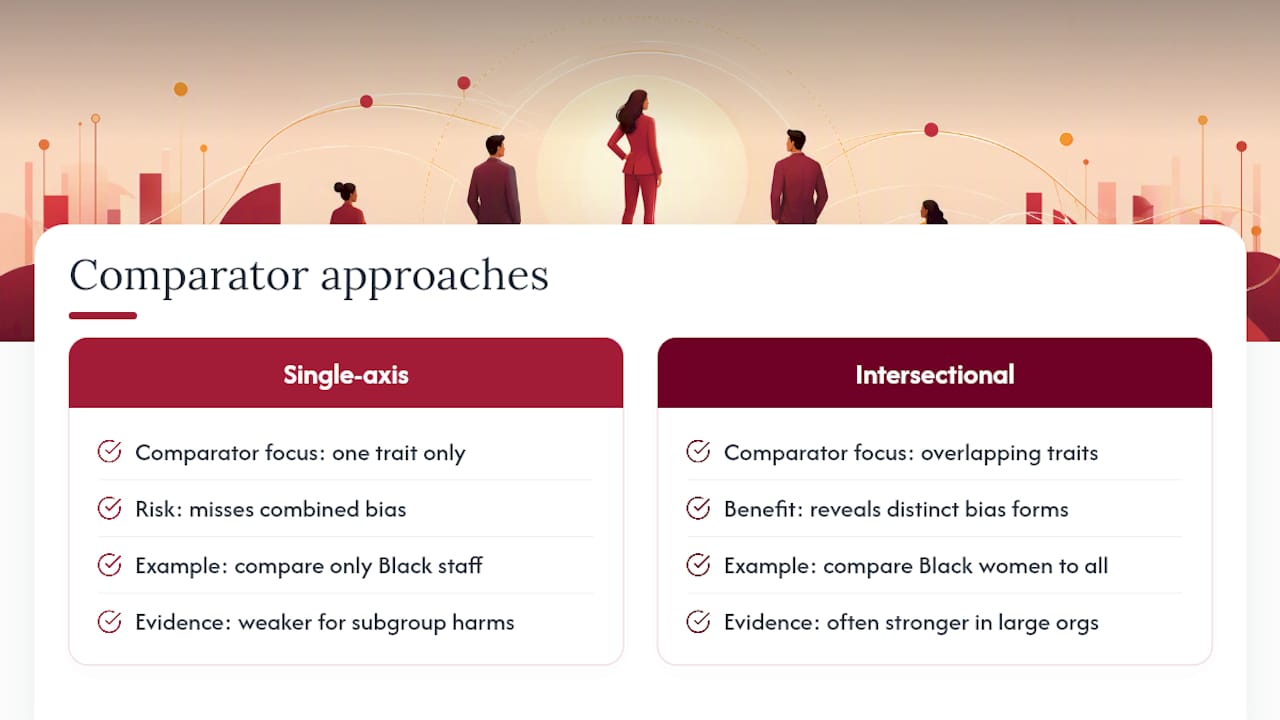
Promotion discrimination rarely travels alone. A Black woman passed over for a leadership role may face bias tied to both her race and her gender simultaneously, a dynamic often called intersectionality. The discrimination isn’t necessarily “race plus gender” as two separate problems; it’s frequently a distinct form of bias that neither category fully captures on its own.
This matters practically because a comparator analysis built only around race can miss the real pattern. If you’re comparing yourself only to other Black employees, or only to other women, you might overlook the actual gap: how Black women specifically fare against everyone else in the promotion pipeline. The same logic applies to combinations involving age, disability, national origin, or religion.
Older Black employees facing promotion denials, for example, may confront age bias and racial bias working together, sometimes producing effects that show up nowhere in aggregate hiring statistics. Immigrant employees of color often face additional bias tied to accent or perceived “cultural fit,” language that frequently masks both racial and national-origin discrimination at once.
When building your case, note every protected trait that could plausibly be in play, not just race. A lawyer evaluating your claim will want the full picture, because a claim built on overlapping traits sometimes has stronger comparator data than a single-axis claim, particularly in larger organizations where subgroup statistics are easier to pull.
Preventing Racial Bias in Promotion Decisions
Companies serious about equality in workplace promotions tend to build structure into a process that’s otherwise vulnerable to unconscious bias.
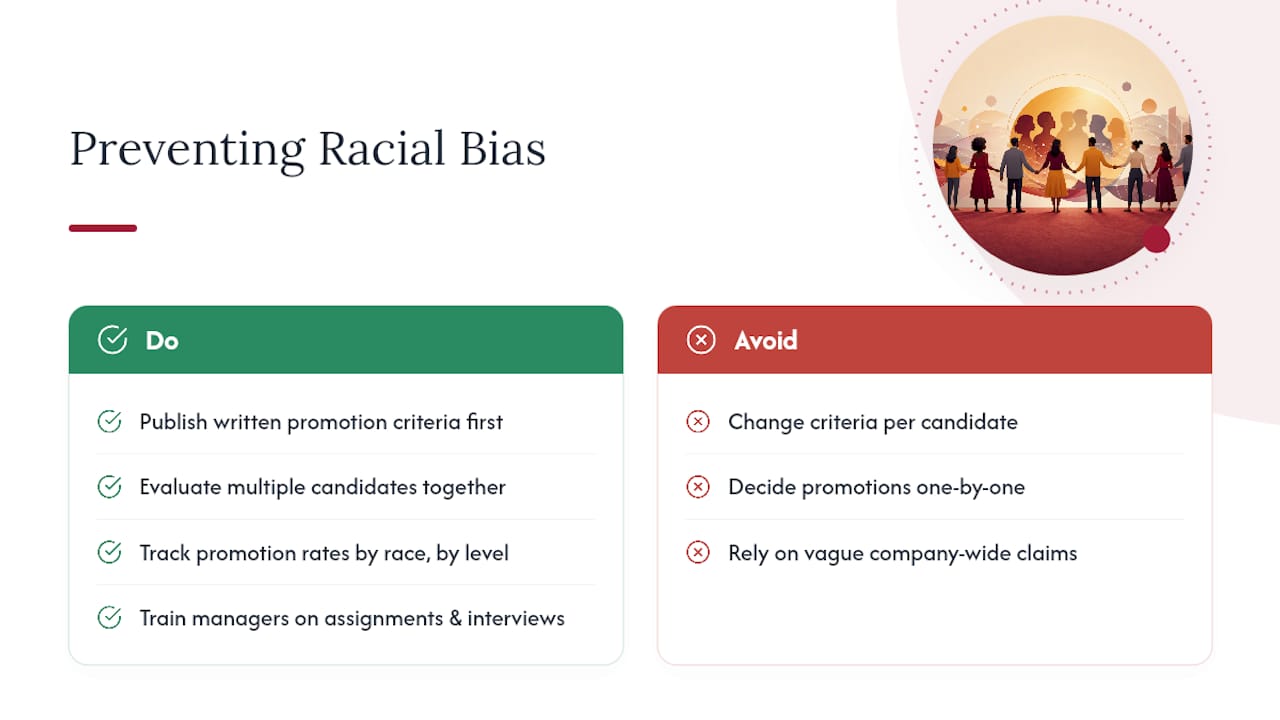
Standardized, written promotion criteria published before candidates apply removes much of the room for after-the-fact justification. When criteria shift depending on who’s being considered, that inconsistency becomes evidence, not just an internal headache.
Evaluating multiple candidates together, rather than one at a time, is one of the more effective structural fixes available. Research on promotion and tenure decisions found that joint evaluation reduced negative votes against underrepresented candidates and increased their odds of promotion, compared to evaluating candidates separately. Sequential decisions let bias creep in through comparison to whoever came right before; simultaneous review forces evaluators to weigh everyone against the same fixed standard at once.
Beyond process design, companies benefit from tracking promotion rates by race across every level of the organization, not just at hiring. A gap that appears only at the senior-manager transition, for instance, points to a specific breakdown point worth investigating rather than a vague, company-wide culture problem. Regular manager training on stretch-assignment allocation, mentoring access, and interview standardization rounds out a program that actually holds up if challenged later.
The Real Cost of Promotion Discrimination
Racial disparities in advancement don’t just cost the employee who was passed over. They corrode morale across an entire team, often in ways that don’t show up in an engagement survey until much later.
Employees who watch colleagues with weaker qualifications get promoted ahead of them tend to disengage quietly. Some start looking for other jobs immediately. Others stay but stop volunteering for the extra projects that used to define their work, because the unspoken lesson is that effort doesn’t translate into advancement anyway.
The career-progression cost compounds over time. A promotion delayed by even two or three years, at the rate the patent-office research documented, means lower lifetime earnings, less retirement savings, and a resume that looks thinner than it should for someone with that tenure. That gap rarely closes on its own once a person’s career trajectory falls behind their actual peers.
There’s also a quieter effect on coworkers who aren’t directly affected. When a workplace’s promotion pattern is visibly skewed, other employees of color read it correctly as a signal about their own ceiling there, regardless of what leadership says in official communications. That perception shapes who applies for the next opening, who stays past their second year, and who starts building an exit plan before anything has even happened to them personally.
A Brief Note From the Author
Documentation wins cases before lawyers ever get involved. The employees who come out ahead are the ones who started saving emails and writing down dates the week something felt off, not the month before a filing deadline.
— Mark
Talk to Javitch Law Office About Your Case
Some law firms take on promotion discrimination cases that larger firms pass on, offering direct attorney contact and handling many cases on a contingency-fee basis, meaning clients often pay nothing unless there is a recovery.
If you’ve documented shifting explanations, biased remarks, or a promotion pattern that doesn’t add up, the firm’s workplace discrimination team can review what you’ve gathered and tell you honestly whether it’s strong enough to move forward. The firm also handles related claims, including retaliation that surfaces after an employee raises a discrimination complaint. Start with a free case evaluation before your filing window closes.
This article is general information, not a substitute for advice from a qualified lawyer. Consult a qualified legal professional about your own circumstances before acting on anything here.
Sources
- Facts about race/color discrimination (EEOC fact sheet)
- Race, Glass Ceilings, and Lower Pay for Equal Work (research summary)
FAQ
Can a White Person Be Discriminated Against in a Promotion?
Yes. Title VII protects everyone from race-based discrimination, including white employees, and courts have allowed reverse-discrimination claims under the same prima facie framework used for any other race. The employee still has to show the same four elements: protected class, qualification, adverse action, and circumstances suggesting race was a factor.
Does DEI Discriminate Against White Men?
Diversity programs themselves aren’t illegal, but a specific promotion decision that denies a qualified candidate solely because of race, regardless of the program’s stated goals, can still violate Title VII. The legal question always comes back to whether race was used as a deciding factor in that individual decision, not whether a diversity initiative exists in general.
What Is Promotion Discrimination?
Promotion discrimination happens when an employer denies someone a promotion based on a protected trait like race, rather than qualifications or performance. It can involve outright bias, like biased remarks or inconsistent criteria applied only to certain candidates, or neutral-looking policies that produce a documented disparate impact on one racial group.
What Are Examples of Race Discrimination in Promotions?
Common examples include passing over a qualified candidate while promoting a less-qualified colleague of a different race, using promotion criteria inconsistently across candidates, or excluding certain employees from the mentoring and stretch assignments that typically lead to advancement. A workplace with visible racial gaps in promotion rates at senior levels, especially when statistics show a pattern rather than an isolated case, strengthens a discrimination claim considerably.
How Long Do I Have to File an EEOC Charge?
You typically have 180 days from the discriminatory act to file, extended to 300 days in states with their own fair employment agency, including California. Filing late generally forfeits your right to pursue that specific claim, so starting the process early, even before you have every document, protects your options.