
If a landlord, property manager, lender or seller in California treated you differently because of who you are, you may have a claim under both state and federal law, and an attorney can take that claim forward in the right forum while you keep living your life. Javitch Law Office is a California civil rights firm that represents clients in discrimination matters, and most of its discrimination and class cases are handled on a contingency-fee basis, meaning the client pays nothing unless there is a recovery. This article explains what the law covers, what to preserve, which deadlines and agencies matter, and what a lawyer adds.
The focus here is housing. If your concern is a robocall, a wrong-number call, an AI-voice call, a subscription charge or a false-pricing practice, those are separate consumer matters with their own pages on our site, and nothing below addresses them.
TL;DR
- California’s Fair Employment and Housing Act (FEHA) and the federal Fair Housing Act both prohibit housing discrimination, and California’s list of protected characteristics is longer than the federal one.
- Write down what happened, when, and who was involved, and keep every message, listing, application and notice.
- A federal complaint to HUD must be filed within one year of the last act of discrimination, so act promptly.
- Discrimination agencies do not handle ordinary repair, deposit or eviction disputes unless discrimination is part of the facts.
- Most of our discrimination matters are taken on contingency, and the first conversation is a case evaluation.
Table of Contents
- What counts as housing discrimination in California
- A recent change that affects voucher holders
- What to document after possible discrimination
- Where complaints go and how long you have
- What a housing discrimination lawyer does
- Examples of fact patterns worth an evaluation
- Promo: speaking with Javitch Law Office
- Perspective
- FAQ
- Sources
What counts as housing discrimination in California
Two bodies of law apply at once. The federal Fair Housing Act, as HUD describes it, protects against discrimination based on race, color, national origin, religion, sex, familial status and disability, and applies to nearly all housing. It reaches renting or buying a home, obtaining a mortgage, seeking housing assistance and other housing-related activity.
California adds to that. The state Civil Rights Department (CRD) explains that FEHA prohibits housing discrimination and harassment by most housing providers, covering rentals, sales, lending, insurance, shelters, advertising and land-use decisions. Government Code section 12955, the statute itself, separately bars discriminatory housing advertisements, discriminatory financing and real-estate transactions, and discriminatory public or private land-use practices.
Protected characteristics under California law
Per the CRD, California protects the following:
- race, color, ancestry and national origin
- citizenship, immigration status and primary language
- religion
- disability
- sex, gender, gender identity and gender expression, and sexual orientation
- genetic information
- marital status and familial status
- source of income
- military or veteran status
- age
The protection follows the housing type as well. According to the CRD, covered housing includes apartments, single-family and multifamily homes, short-term rentals, shelters, dormitories, mobile homes and subsidized housing. Qualifying senior housing is an exception to some of the familial-status rules.
What it looks like in practice
The CRD gives examples that match what tenants and applicants typically report:
- telling an applicant a unit is unavailable when it is not
- applying a different screening standard to one applicant than to others
- imposing family rules, such as restrictions on where children may play, that are not applied evenly
- refusing a housing voucher
- denying a reasonable accommodation for a disability
Several of these have their own detailed pages on our site. If children were the issue, see our guide to familial status violations in California. If a landlord refused a voucher or other lawful income, read about source of income discrimination. If an assistance animal or accessibility request was refused, see service animals and housing in California. For a broader view of how bias against vouchers shows up in the state’s rental market, see our article on housing discrimination in California.
A recent change that affects voucher holders
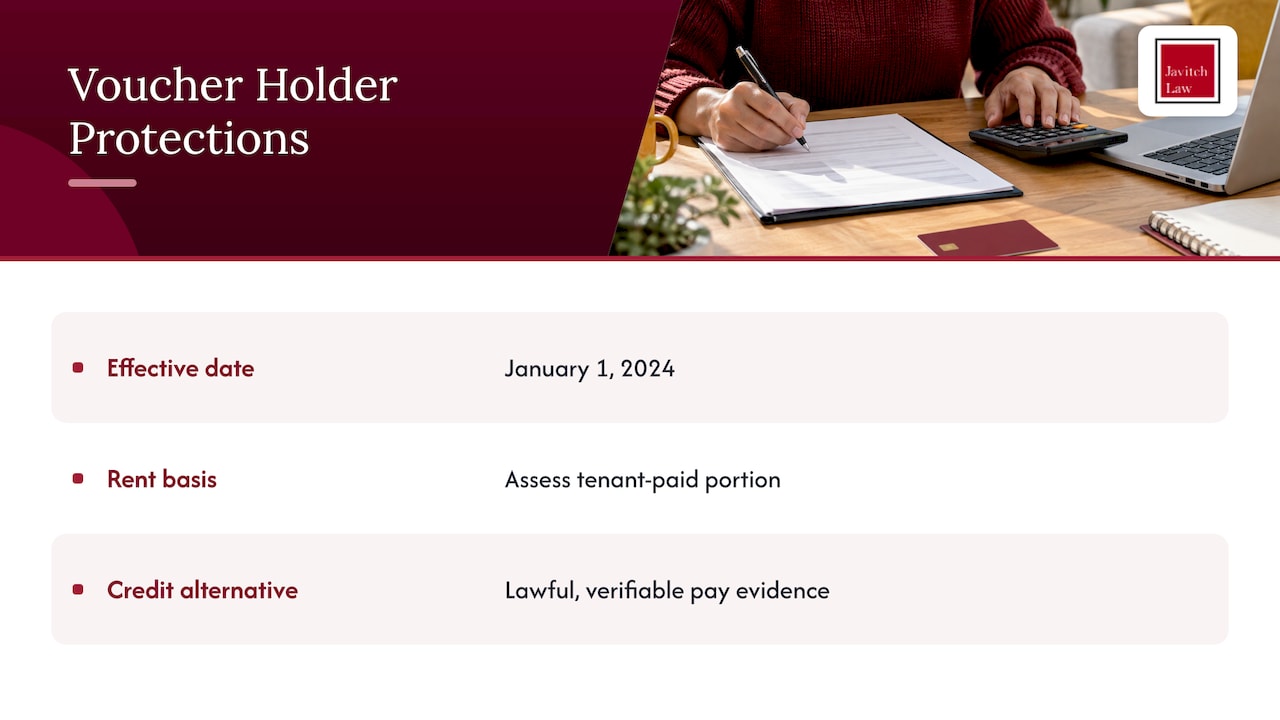
Senate Bill 267 amended Government Code section 12955, effective January 1, 2024. Under the current text of the statute, a landlord who assesses an applicant using a government rent subsidy must assess the tenant-paid portion of the rent, and must allow lawful, verifiable alternative evidence of ability to pay in place of credit history when the applicant elects that option.
In practical terms, a landlord who rejects a voucher holder on the basis of credit history, without offering that alternative or without looking at the portion of rent the tenant actually pays, may have departed from the statute. That is the kind of fact pattern worth documenting carefully.
What to document after possible discrimination
The strength of a housing claim often rests on what was recorded close to the event. The California Tenant Guide (2024 edition) advises documenting promptly, and HUD asks complainants for identifying details and a concise description of events. A workable routine:
- Write a timeline. Record what happened, on which date, and the names of every person involved, while memory is fresh.
- Preserve communications. Keep texts, emails, voicemails, portal messages and letters. Screenshot rather than rely on the platform to retain them.
- Save the housing details. Keep the listing, the address, the application, the screening criteria you were given and any denial notice.
- Identify the respondent. Note the owner, the property manager, the leasing agent and the management company, as you know them.
- Note comparisons. If you learned that others were offered a unit, a rate or a term that you were refused, record who told you and when.
- Do not delete anything and do not confront the landlord in writing without a record. Retaliation is its own violation, and HUD states that retaliation for making an allegation or taking part in a proceeding is illegal, including after the investigation ends.
Our team provides guidance on documenting violations as part of the case evaluation, so you do not need a finished file before you call. A clear timeline and the documents you already have are enough to begin.
Where complaints go and how long you have
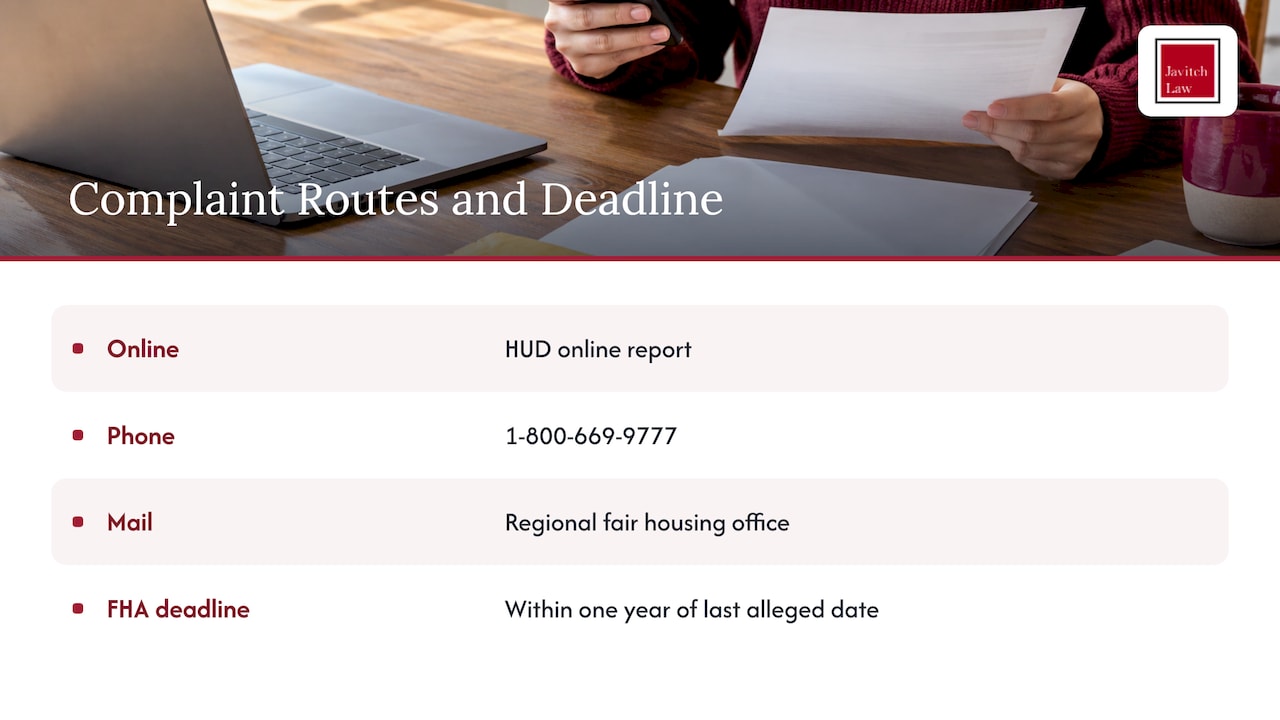
HUD accepts reports online, by phone at 1-800-669-9777, or by mail to a regional Office of Fair Housing and Equal Opportunity. It asks for your contact details, the respondent’s details, the identity of the housing or program and a short description of the event. Under the Fair Housing Act, HUD’s process page states that an allegation must be filed within one year of the last date of the alleged discrimination. HUD adds that it recommends filing as soon as possible.
In California, the CRD is the state agency that receives housing complaints under FEHA. Because deadlines, forums and the order of steps differ between the state and federal systems, and between agency complaints and court actions, the sequencing is a decision to make with counsel early rather than late.
What the agencies do not handle
A discrimination agency is not a general landlord-tenant tribunal. The 2024 California Tenant Guide explains that agencies focused on discrimination do not resolve unrelated repair, deposit or eviction disputes, and the CRD likewise excludes non-discrimination matters from its housing jurisdiction. If a landlord forced you out by making a unit unlivable, our guide to constructive eviction in California covers the separate rules that apply. Where the same facts show both a habitability problem and discriminatory treatment, the two can be evaluated together.
What a housing discrimination lawyer does
A complaint to an agency starts an investigation that the agency controls. An attorney works for you, and that changes several things.
Case evaluation. The first task is to match your facts to the statutes: which protected characteristic is involved, which law applies, what the deadlines are and which forum fits. A single set of facts may support claims under FEHA, the federal Fair Housing Act and, where a business establishment is involved, other California civil rights statutes.
Evidence. Counsel identifies what is missing, sends preservation demands so the landlord keeps its records, and organizes your documents so that the pattern is visible: the listing, the denial, the comparator, the message that revealed the reason.
Forum and strategy. Some matters are best presented to an agency, others filed directly in court. The government itself may also bring a case after an investigation; HUD notes that when it does, it charges no fees to the individuals alleging discrimination. A private attorney remains the person who decides, with you, how to pursue your own claim, including remedies that the agency’s case may not address.
Remedies. HUD’s process page lists compensation for actual damages, including out-of-pocket expenses, among the relief available through its process, and notes that agency-led cases may also seek policy changes and training. The relief in a private action depends on the statute and the facts, and no outcome can be promised in advance.
Retaliation. If a landlord responds to a complaint with a sudden notice, a rent change or a refusal to renew, counsel can address that conduct as a violation in its own right.
Costs
Attorney fees are the question most people ask first. Our firm handles most cases on a contingency-fee basis, in which the client pays nothing unless there is a recovery. The terms of any specific engagement are set out in a written agreement after the evaluation, and we do not publish a price list because the arrangement depends on the matter.
Examples of fact patterns worth an evaluation
The following are illustrations of the categories described above, not predictions of any outcome.
| Situation | Likely legal question |
|---|---|
| A property manager says a unit is rented, then shows it to another applicant the same week | False vacancy statement tied to a protected characteristic |
| An applicant with a housing voucher is rejected for credit history | Source-of-income protections and the 2024 alternative-evidence rule |
| A family is told children may not use common areas that adults may use | Familial status discrimination |
| A tenant with a disability asks in writing for an accommodation and receives no response | Reasonable accommodation under FEHA and the Fair Housing Act |
| A tenant reports discrimination and receives an eviction notice soon after | Retaliation |
| A listing states a preference for a type of tenant | Discriminatory advertising under Government Code section 12955 |
For a disability request, our walk-through of requesting a disability accommodation in California sets out the steps for putting the request in writing so there is a record.
Promo: speaking with Javitch Law Office
Javitch Law Office is a civil rights firm based in California with a nationwide reach, and it represents clients in discrimination matters involving housing, employment and public accommodations. We offer a personalized case evaluation, direct attorney contact and, in most discrimination and class cases, contingency representation. You can read about our work on the discrimination practice page or contact us through the firm’s website.

When you reach out, bring your timeline, the listing or application, the written communications and any denial or notice. If the incident was recent, say so at the outset, because the one-year federal filing window is the first deadline we check.
Perspective
Housing discrimination is rarely announced. It arrives as a unit that is suddenly unavailable, a screening rule that only some applicants meet, or a voucher that is not accepted. Because the conduct is quiet, the record matters more than the accusation, and the people who preserve their messages early are the people whose claims are easiest to evaluate.
Our firm takes cases that larger firms avoid and pursues legal battles that others abandon. In housing matters that means listening to the facts as the client lived them, applying both the California statutes and the federal Fair Housing Act, and speaking with the client directly rather than through layers of staff. We are admitted to federal courts nationwide, and we are committed to transparency, including the use of public records requests where government conduct is involved.
Most of our discrimination matters are handled on a contingency basis, so that the cost of asserting a civil right does not determine whether it is asserted. A family should not have to choose between a lawyer and a month’s rent.
Mark
FAQ
How long do I have to report housing discrimination?
Under the federal Fair Housing Act, HUD states that an allegation must be filed within one year of the last date of the alleged discrimination. Other deadlines apply to state agency complaints and court actions, and they differ by forum. Because time limits can end a claim, contact an attorney as soon as you suspect a violation.
Can a landlord evict me because I complained?
Retaliation for making an allegation or taking part in a HUD proceeding is illegal, according to HUD, and that protection continues after the investigation ends. Keep every notice you receive and tell your attorney the dates of both your complaint and the landlord’s action, since the sequence is central to a retaliation claim.
Does the law cover short-term rentals, mobile homes and subsidized housing?
Yes. The CRD states that covered California housing includes apartments, single- and multifamily homes, short-term rentals, shelters, dormitories, mobile homes and subsidized housing. Qualifying senior housing is an exception to some familial-status rules.
Will I have to pay a lawyer up front?
Our firm handles most discrimination and class action matters on a contingency-fee basis, so the client pays nothing unless there is a recovery. The terms of your engagement are explained in writing after the case evaluation.
Is a repair or security-deposit dispute a discrimination case?
Not by itself. State and federal discrimination agencies do not resolve ordinary repair, deposit or eviction disputes unless discrimination is part of what happened. If the way you were treated differed because of a protected characteristic, that difference is what makes it a discrimination matter, and it is worth describing in your evaluation.
Sources
- Housing Discrimination Under the Fair Housing Act, HUD
- Housing, California Civil Rights Department
- California Government Code section 12955
- Report Housing Discrimination, HUD
- FHEO’s Process to Report and Investigate Housing Discrimination, HUD
- California Tenants: A Guide to Residential Tenants’ and Landlords’ Rights and Responsibilities, 2024 Edition