
Due process rights are the constitutional guarantee that the government may not take a person’s life, liberty, or property without fair procedures. The Fifth Amendment applies that limit to the federal government, and the Fourteenth Amendment applies it to the states. The guarantee restrains government actors only. It does not govern a private company’s robocalls, a deceptive pricing scheme, or a surprise subscription renewal, which are addressed by statutory consumer protection law. For government conduct, such as a school discipline decision, a denied public records request, or retaliation against protected speech, due process is often the first question a civil rights attorney asks. At Javitch Law Office we handle both categories of dispute, and distinguishing them correctly is the first step in any case evaluation.
TL;DR
- Due process bars government deprivations of life, liberty, or property without fair procedures. Its core requirements are notice and a hearing before an impartial decision-maker.
- The clause protects only interests that qualify as life, liberty, or property, and the amount of process owed depends on a balancing test from Mathews v. Eldridge.
- It applies to government action, not to private businesses. Robocalls, false advertising, and auto-renewal disputes are governed by consumer statutes instead.
- If an agency or official denied you notice or a hearing, preserve the record and consult a civil rights attorney promptly, because filing deadlines are short.
Table of Contents
- What due process rights are
- When procedural due process applies
- How courts decide how much process is owed
- How the standard varies by type of proceeding
- Why due process does not reach private businesses
- Where due process overlaps with First Amendment and transparency claims
- What to do if an agency denied you notice or a hearing
- Our perspective
- Discuss your situation with Javitch Law Office
- FAQ
- Sources
What due process rights are
The text is brief. The Fifth Amendment provides that no person shall be deprived of life, liberty, or property without due process of law, and the Fourteenth Amendment repeats the formulation as a limit on the states. The Supreme Court has construed the Fourteenth Amendment to impose the same procedural limitations on the states that the Fifth Amendment imposes on the federal government, so cases under one amendment inform the other.
Courts recognize two branches:
- Procedural due process governs how the government acts. It asks whether the person received notice and a fair opportunity to be heard before a protected interest was taken.
- Substantive due process governs what the government may do at all, regardless of procedure. It concerns certain fundamental rights, and its scope has been contested. In 2022, for example, the Supreme Court held that the right to abortion is not a fundamental right, reversing a position held for nearly five decades.
Most people who search for this topic are asking about the procedural branch: what hearing they were owed, and whether they received it.
The protection extends to everyone within the jurisdiction. The U.S. Attorney’s Office for the District of Minnesota explains in its Know Your Rights guide that the due process clauses protect citizens and non-citizens alike.
When procedural due process applies
Procedural due process is not triggered by every unwelcome government decision. It applies only when a protected life, liberty, or property interest is at stake, and the range of such interests is not unlimited. Three questions structure the analysis.
Is there a protected interest?
Liberty includes freedom from physical restraint and a range of personal freedoms. Property is broader than land or money. It can include an entitlement created by statute, regulation, or contract, such as continued public employment or a benefit the government has promised to those who qualify. A student’s interest in public education is one example: in Goss v. Lopez (1975), the Court held that students facing suspension of ten days or less must receive notice of the charges and an opportunity to present their side. Government employees may likewise have a property interest in their jobs that entitles them to process before termination.
Did the government take it?
The deprivation must be attributable to the government. A suspension by a public school district, a denial of benefits by an agency, or removal from a public forum by an official qualifies. We return to the limit on private conduct below.
What process was due?
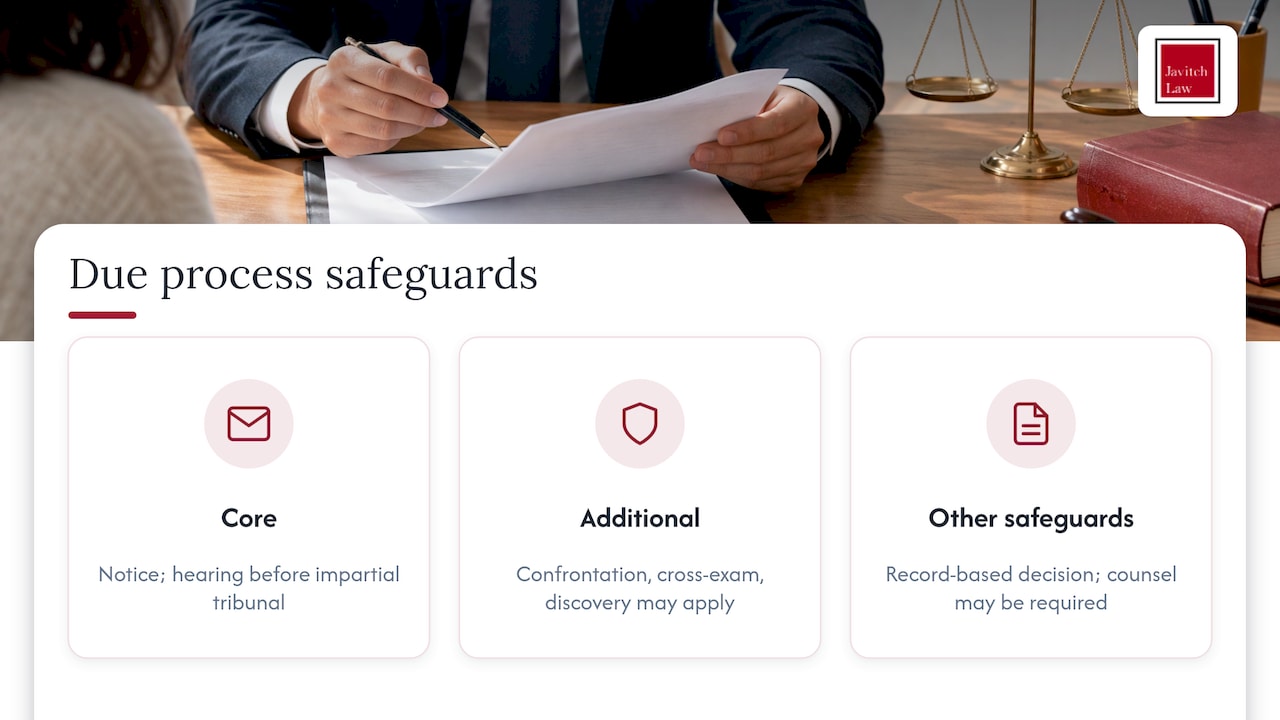
The core requirements are notice and a hearing before an impartial tribunal. Depending on the circumstances, fairness may also require confrontation and cross-examination, discovery, a decision based on the record, or representation by counsel. The requirements are not uniform.
How courts decide how much process is owed
In civil matters the Supreme Court applies the balancing test from Mathews v. Eldridge, 424 U.S. 319 (1976). Courts weigh three factors:
- The private interest affected by the official action.
- The risk of an erroneous deprivation through the procedures used, and the value of additional safeguards.
- The government’s interest, including fiscal and administrative burdens.
A worked example illustrates the test. A public school suspends a student for five days. The student’s interest in education is significant, the risk of error is real if no one hears the student’s account, and the burden of an informal conversation is small. Under Goss, that combination yields a modest but real entitlement: notice, an explanation of the evidence, and a chance to respond. A longer suspension or expulsion warrants more formal procedures.
The Court has described two purposes behind these rules. The first is reducing mistaken or unjustified deprivations. The second is dignitary: the value of being able to defend one’s interests even when the result cannot be changed.
How the standard varies by type of proceeding
The amount of process differs by setting.
| Setting | Governing approach |
|---|---|
| Criminal | A narrow inquiry into whether a procedure is offensive to fundamental fairness (Medina v. California, 1992) |
| Civil and administrative | The Mathews v. Eldridge balancing test |
| Immigration removal | A full and fair hearing and a reasonable opportunity to present evidence, without the full set of criminal-defendant rights |
The first two rows are described in the Constitution Annotated’s overview of procedural due process. On immigration, the Ninth Circuit’s guide states that noncitizens in removal proceedings are entitled to a full and fair hearing and that notice of the hearing must be reasonably calculated to reach them. The same guide reports that in Niz-Chavez v. Garland (2021) the Supreme Court required a Notice to Appear to be a single document containing the statutory information, including the time and date of the proceedings. Families dealing with detention and release logistics in these cases may find it useful to understand the immigration detention and bond process alongside the procedural rights described here.
Why due process does not reach private businesses
Many people who contact a civil rights firm describe conduct that feels like a denial of fairness but originates with a private company: a prerecorded call to a number that formerly belonged to someone else, a voice generated by artificial intelligence on a sales call, a fabricated “original” price, or a subscription that renewed without clear disclosure. These grievances are serious, but the Due Process Clause is not the source of the remedy.
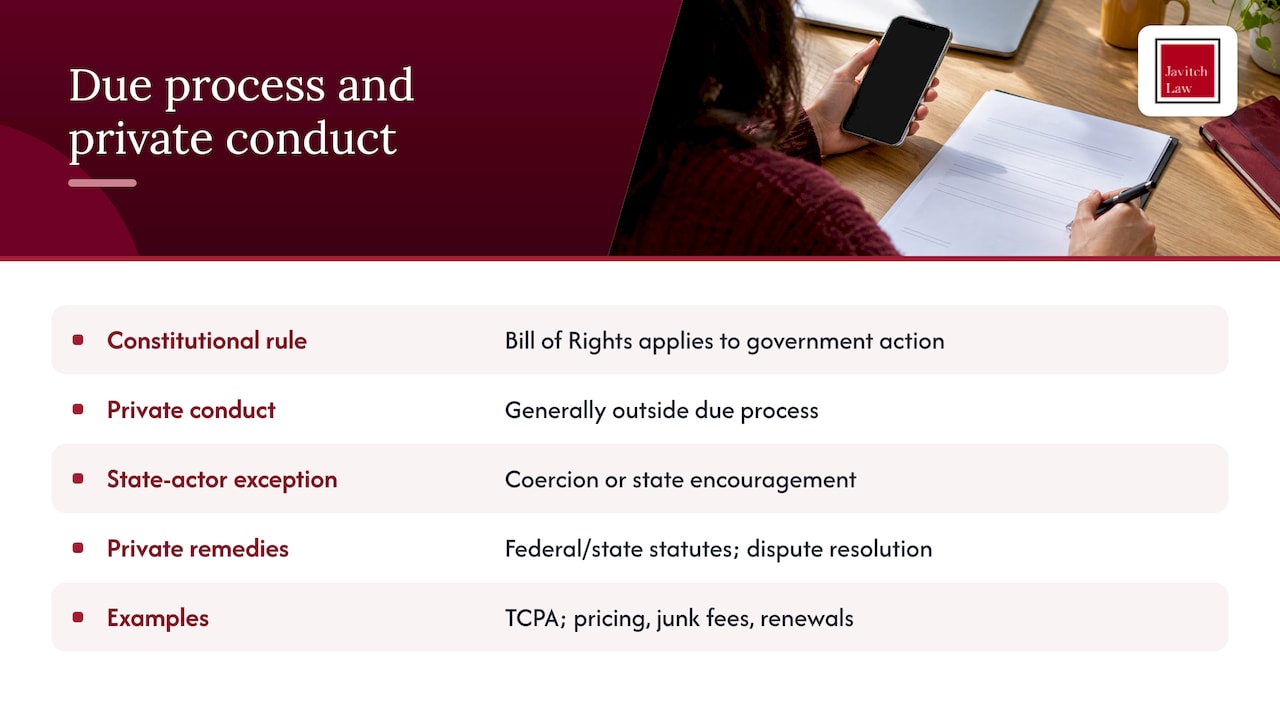
The governing principle is the state action doctrine. The Fourteenth Amendment, as the Constitution Annotated explains, erects no shield against merely private conduct, and the Bill of Rights guarantees apply to state and federal government action. In Jackson v. Metropolitan Edison Co. (1974), the Court declined to treat a regulated private utility’s shutoff of service as state action requiring a customer hearing. Professor Paul Verkuil summarizes the consequence in an Administrative Law Review article: when the constitutional requirement is not triggered, litigants seeking procedural protection from private parties must rely on state fair-procedure concepts, statutes, and alternative dispute resolution.
A private party can be treated as a state actor in limited circumstances, for example where the state has exercised coercive power or provided such significant encouragement that the choice must in law be deemed that of the State. Absent that showing, the claim lies elsewhere.
For private misconduct, the relevant sources of rights are consumer protection statutes at the federal and state levels, which are designed to guard against unfair business practices. These include the Telephone Consumer Protection Act for unwanted prerecorded and artificial-voice calls, and state laws on pricing, junk fees, and automatic renewals. Our pages on TCPA claims, wrong number calls, and surprise subscription renewals address those claims directly.
Where due process overlaps with First Amendment and transparency claims
Several government-facing matters combine due process with other rights.
- Speech and retaliation. A public body that removes a speaker, disciplines a public employee, or penalizes protected expression may violate the First Amendment and also fail to provide fair procedures. See our guides on public employee speech, First Amendment retaliation, and time, place, and manner restrictions.
- Schools. Public school discipline implicates the Goss framework. Discrimination by a school district raises separate statutory and constitutional claims.
- Government records. An agency that ignores or improperly denies a public records request has not necessarily violated due process, but the request process is governed by statute and enforceable in court. Our FOIA and public records practice handles those requests and litigation.
What to do if an agency denied you notice or a hearing
The steps below are general. The exact path depends on whether the actor is federal, state, or local and on the agency’s own rules.
- Identify the decision-maker and the interest. Write down who acted, what was taken (a job, a benefit, a place in school, a license, a right to speak), and under what authority.
- Preserve the record. Keep notices, emails, letters, and the dates on which you received each. Notice that arrives too late or does not state the charges is itself evidence. If the events were recorded, preserve the footage; in California, see our guide on recording police and preserving footage.
- Use the administrative process. Many agencies provide an internal appeal. Request any hearing in writing and keep a copy. Deadlines are often short.
- Note the filing deadlines. Some civil rights claims require an agency charge before suit, and the window to sue after a notice can be as short as 90 days. Our civil rights lawsuit timeline explains the sequence.
- Consider a federal civil rights action. Section 1983 of the Civil Rights Act of 1871 allows suits against state and local officials who violate constitutional rights. It does not reach federal officials, who may be sued in limited circumstances under a separate line of cases known as Bivens actions.
- Speak with a civil rights attorney. An attorney can evaluate whether a protected interest was at stake, what process was owed, and which forum and deadline apply. Our overview of what a constitutional rights attorney does and of civil rights lawsuit representation describes what to expect.
Our perspective
Clients often arrive convinced that a wrong is a due process violation, or that it is not. Both assumptions are frequently incorrect. The first question is always whether the conduct belongs to a government actor or a private one, because that answer determines the cause of action, the court, and the deadline.
Our practice spans both sides of that line. We represent clients in discrimination, First Amendment, and public records matters against public institutions, and in consumer class actions against companies, including TCPA, false pricing, and auto-renewal cases. We take cases that larger firms avoid, and we offer direct attorney contact and federal court admissions across the country. Most matters are handled on a contingency basis, so the client pays nothing unless there is a recovery.
Procedural fairness is also why we value transparency. Public records requests let a client see how a decision was made, which is often the evidence that decides whether notice and a hearing were adequate.
Mark
Discuss your situation with Javitch Law Office
If a public school, agency, or official acted against you without fair process, or if a business is calling you with prerecorded or artificial voices, charging you through a renewal you did not expect, or advertising a price that was never real, we can evaluate the claim and identify the correct legal theory. Our First Amendment practice and discrimination practice address government conduct, and our consumer practice addresses business conduct. Most class action and discrimination matters are handled on a contingency-fee basis, and case consultations are free. Start at javitchlawoffice.com.

FAQ
What are due process rights in simple terms?
They are the constitutional guarantee that the government must follow fair procedures before it takes away your life, liberty, or property. At minimum, that usually means notice of what the government intends to do and a chance to be heard by an impartial decision-maker. The exact procedures depend on what is at stake.
What is the difference between procedural and substantive due process?
Procedural due process concerns the fairness of the process, such as notice and a hearing. Substantive due process concerns whether the government may restrict certain fundamental rights at all, however fair the procedure. Most disputes with agencies, schools, and employers turn on the procedural branch.
Do due process rights apply to a company that calls me or charges my card?
No. The Due Process Clause limits government action, not private conduct. Disputes over robocalls, false advertising, junk fees, or automatic renewals are addressed by consumer statutes at the federal and state levels, and a private company’s conduct generally does not trigger a constitutional hearing right.
Do noncitizens have due process rights?
Yes. The due process clauses protect persons, not only citizens. In removal proceedings, a noncitizen is entitled to a full and fair hearing and a reasonable opportunity to present evidence, though not the same set of rights as a criminal defendant.
Sources
- Overview of Due Process, Constitution Annotated (Congress.gov)
- Overview of Procedural Due Process in Civil Cases, Constitution Annotated
- Overview of Procedural Due Process, Constitution Annotated
- Due Process Test in Mathews v. Eldridge, Constitution Annotated
- Overview of Substantive Due Process, Constitution Annotated
- Know Your Rights, U.S. Attorney’s Office, District of Minnesota
- Due Process in Immigration Proceedings, Ninth Circuit
- Fourteenth Amendment Equal Protection and Other Rights, GPO Constitution Annotated
- Privatizing Due Process, Administrative Law Review
- Due Process, Judicial Review, and the Rights of the Accused, Cleveland State Law Review
- Consumer Protection Law: A Beginner’s Guide, Library of Congress
- Goss v. Lopez, 419 U.S. 565 (1975)
- Using 42 U.S.C. § 1983 to Obtain Relief, Columbia Law School