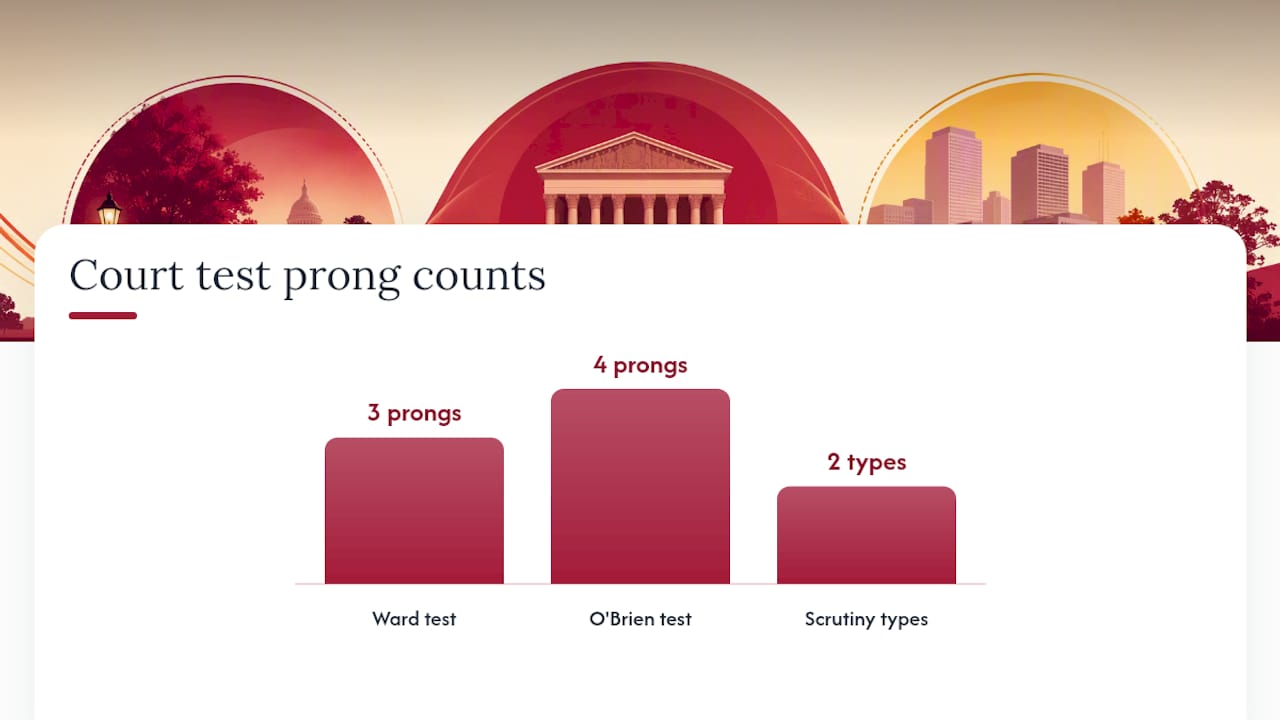
A content-neutral restriction on when, where, or how speech may occur is constitutional under the First Amendment only when it satisfies three requirements: it must be content neutral, narrowly tailored to serve a significant government interest, and leave open ample alternative channels for communication. That three-part framework, established in Ward v. Rock Against Racism (1989) and reinforced across decades of Supreme Court decisions, is the lens every court applies when a speaker challenges a government regulation on expressive activity.
Before going further, here is the quick-screen checklist:
- Content neutrality: Does the rule apply regardless of what the speaker is saying, or does it single out a subject, viewpoint, or message?
- Narrow tailoring and significant interest: Is the government pursuing a real, substantial objective (public safety, traffic flow, noise control), and is the restriction limited to what is actually necessary to achieve it?
- Ample alternative channels: Can speakers still reach their intended audience through other reasonable means of communication?
If a regulation fails even one of those prongs, it likely cannot survive a First Amendment challenge. Rules that are content-based or viewpoint-based trigger strict scrutiny, a far more demanding standard that the government almost never satisfies. That distinction is the fault line of the entire doctrine.
Key Takeaways
Time, place, and manner restrictions survive First Amendment challenge only when they are content neutral, narrowly tailored to a significant government interest, and leave open ample alternative channels for communication.
| Point | Details |
|---|---|
| Three-prong Ward test | Content neutrality, narrow tailoring to a significant interest, and ample alternative channels are all required. |
| Forum type controls scrutiny | Traditional public forums demand the most from the government; nonpublic forums require only reasonableness and viewpoint neutrality. |
| McCullen’s narrow-tailoring limit | A buffer zone or similar rule fails if less restrictive alternatives exist and the government has not shown they would be inadequate. |
| Viewpoint discrimination is fatal | Selective enforcement of a facially neutral rule against one viewpoint triggers strict scrutiny and is almost always unconstitutional. |
| Javitchlawoffice | The firm handles First Amendment and campus speech-zone challenges nationwide, including emergency injunctive relief for time-sensitive permit disputes. |
Table of Contents
- What are time, place, and manner restrictions?
- How do courts test whether a restriction is constitutional?
- Why does the forum type change everything?
- What do the leading Supreme Court cases actually hold?
- What does a lawful restriction look like, and what crosses the line?
- How do these rules apply in specific settings?
- How do you challenge a time, place, and manner restriction?
- When should you consult a First Amendment attorney?
- The municipal missteps that generate the most litigation
- Javitch Law Office handles First Amendment matters nationwide
- Sources
What are time, place, and manner restrictions?
The phrase “time, place, and manner” describes a category of government regulation that limits the circumstances of expression without touching its content. A city ordinance that bans amplified sound in residential neighborhoods after 10 PM does not care whether you are playing jazz or reading political speeches. A permit requirement for a parade on a public street applies equally to a labor union and a veterans’ group. Those are the kinds of rules the doctrine covers.
More precisely, time, place, and manner restrictions are content-neutral limitations imposed by the government on expressive activity to maintain public order and safety; they are reasonable when content-neutral, narrowly tailored to serve a significant government interest, and leave open ample alternative channels for communication.
Breaking down the three dimensions:
Time covers restrictions on when expression may occur: curfews on amplified sound, limits on early-morning demonstrations near hospitals, or rules prohibiting picketing outside a school during class hours.
Place governs where expression may happen: zoning rules that confine adult theaters to certain districts, buffer zones around clinic entrances, or prohibitions on posting signs on utility poles in a historic district.
Manner addresses how expression is delivered: decibel limits, sign-size caps, rules requiring a permit before assembling a crowd of a certain size, or restrictions on the use of sound trucks.
The government interests courts consistently recognize as significant include public safety, unobstructed pedestrian and vehicle traffic, noise control, access to medical facilities, and the orderly use of shared public spaces. Courts do not demand that the government prove its interest is compelling for a content-neutral rule; a significant or substantial interest is enough. That lower threshold is one reason well-drafted time, place, and manner rules tend to survive review.
Common examples in practice: a city-wide noise ordinance capping sound levels in residential zones; a park rule requiring a permit for gatherings above a certain size; a sign ordinance limiting yard signs to a certain maximum size; a buffer zone around a polling place on Election Day. Each of these restricts how or where speech occurs without saying anything about what the speaker may say.
How do courts test whether a restriction is constitutional?
Courts apply a structured, multi-step analysis. The controlling framework comes from Ward v. Rock Against Racism, 491 U.S. 781 (1989), and it works like this:
-
Is the regulation content neutral on its face and in its application? A rule is content neutral if it neither targets a particular message nor was adopted because of disagreement with the message. Courts look at the text of the ordinance, its stated justification, and whether enforcement patterns reveal a hidden content-based motive.
-
Is it narrowly tailored to serve a significant government interest? Under Ward, narrow tailoring does not require the least restrictive means possible. The government must show the restriction promotes a substantial interest and does not burden substantially more speech than necessary. That is a meaningful but not crushing standard.
-
Does it leave open ample alternative channels? Speakers must have a realistic way to reach their intended audience. A rule that effectively silences a speaker in every practical venue fails this prong even if it is technically content neutral.
United States v. O’Brien, 391 U.S. 367 (1968), predates Ward but covers overlapping ground for expressive conduct (symbolic speech). When someone burns a draft card, waves a flag, or wears an armband as a political statement, the O’Brien test asks: (1) Is the regulation within the government’s constitutional power? (2) Does it further an important or substantial government interest? (3) Is that interest unrelated to the suppression of free expression? (4) Is the incidental restriction on speech no greater than necessary? Courts and scholars have long noted that the O’Brien and Ward formulations converge in practice, with courts applying a deferential conception of “substantial” government interests and upholding many content-neutral regulations unless they are gratuitously overbroad.
Content-based vs. content-neutral: why it matters so much. A content-neutral law faces intermediate scrutiny under Ward. A content-based law, one that singles out a subject matter, a viewpoint, or a category of speakers, faces strict scrutiny: the government must show a compelling interest and a narrowly tailored means. Strict scrutiny is nearly always fatal. The practical consequence is that a municipality that drafts a facially neutral noise ordinance but then enforces it only against political protesters has converted a defensible rule into an unconstitutional one.
Signals that a regulation is actually content-based:
- The rule is triggered by the subject matter of the speech (e.g., it applies only to “political” signs or “religious” gatherings).
- It treats different speakers differently based on their message or identity.
- It contains exemptions that track content (e.g., news trucks are exempt from the sound ordinance, but political campaign vehicles are not).
- Enforcement records show the rule is applied against one viewpoint but not comparable expression from the opposing side.
Pro Tip: When evaluating a restriction, ask whether the government’s stated justification would apply equally to a speaker with the opposite message. If the answer is no, the rule is almost certainly content-based regardless of how it is written.
Why does the forum type change everything?
The location where speech occurs is not just a factual detail. It determines which legal standard applies and how much protection the speaker gets. Courts classify government-owned spaces into four categories, and the forum classification heavily affects the standard applied to restrictions.
| Forum type | Examples | Standard applied | Practical effect |
|---|---|---|---|
| Traditional public forum | Streets, sidewalks, public parks | Full Ward three-prong test (intermediate scrutiny for content-neutral rules; strict scrutiny for content-based rules) | Government faces the highest burden; most restrictions are closely examined |
| Designated public forum | University meeting rooms opened to the public, municipal auditoriums rented for community events | Same as traditional public forum while the forum remains open | Government can close the forum, but while open it must apply the same standard |
| Limited public forum | School bulletin boards, government employee lounges, internal agency channels | Viewpoint neutrality required; restrictions must be reasonable in light of the forum’s purpose | Government may limit use to specific topics or groups but cannot discriminate by viewpoint |
| Nonpublic forum | Military bases, airport terminals (restricted areas), government office lobbies | Reasonableness test tied to the forum’s purpose; viewpoint neutrality still required | Government has the most latitude; restrictions need only be reasonable, not narrowly tailored |
The same restriction can be lawful in one forum and unconstitutional in another. A university that bans all outdoor demonstrations on its campus sidewalks, which are open to the general public and function like traditional public forums, faces a much harder constitutional case than a federal agency that restricts access to its internal conference rooms. In the first scenario, the full Ward test applies. In the second, the government needs only to show the restriction is reasonable and viewpoint neutral.
For nonpublic forums, courts apply a reasonableness test tied to the forum’s purpose rather than the full Ward three-prong test. That distinction matters enormously in practice: a government employer restricting speech in an internal workplace channel is in a very different legal position than a city restricting speech on a public sidewalk.
One nuance worth flagging: when a court reviews a judicially imposed injunction affecting speech (as opposed to a legislative ordinance), it may apply a more demanding tailoring standard. Madsen v. Women’s Health Center, 512 U.S. 753 (1994), reflects this because injunctions carry a heightened risk of discriminatory application by a single judge rather than a legislature acting through general rules.
What do the leading Supreme Court cases actually hold?
The doctrine is built case by case. Here are the decisions that define it.
-
United States v. O’Brien, 391 U.S. 367 (1968). David O’Brien burned his draft card on the steps of a Boston courthouse to protest the Vietnam War. The Court upheld his conviction under a federal law prohibiting draft-card destruction, applying what became the O’Brien test for expressive conduct. The key doctrinal rule: when a regulation of conduct incidentally burdens speech, the government need only show an important or substantial interest unrelated to suppressing expression, and an incidental restriction no greater than necessary.
-
Tinker v. Des Moines Independent Community School District, 393 U.S. 503 (1969). Students wore black armbands to protest the Vietnam War and were suspended. The Court held that students do not “shed their constitutional rights at the schoolhouse gate” and that the school had no evidence of substantial disruption. Tinker established that symbolic speech in schools is protected unless the school can demonstrate a reasonable forecast of material disruption, a standard that has shaped campus speech doctrine ever since.
-
Clark v. Community for Creative Non-Violence, 468 U.S. 288 (1984). Protesters sought to sleep overnight in Lafayette Park and the National Mall to dramatize homelessness. The National Park Service prohibited camping. The Court upheld the ban, finding it a valid time, place, and manner restriction: content neutral, narrowly tailored to protect the parks, and leaving open ample alternatives (the protesters could demonstrate during the day). Clark confirmed that even expressive conduct tied directly to a political message can be regulated when the restriction targets conduct rather than the message itself.
-
Renton v. Playtime Theatres, Inc., 475 U.S. 41 (1986). Renton, Washington, enacted a zoning ordinance restricting adult theaters to certain areas of the city. The Court upheld it as a content-neutral regulation justified by secondary effects (crime, property values) rather than the content of the films. The secondary-effects doctrine allows place-based regulation when the government’s concern is the consequences of the activity, not the message. As the Constitution Annotated analysis notes, the distinction between ordinances that incidentally burden speech and those that directly regulate content requires careful factual support.
-
Ward v. Rock Against Racism, 491 U.S. 781 (1989). New York City required performers at the Naumburg Bandshell in Central Park to use city-provided sound equipment and a city sound technician, citing noise complaints from nearby residents. The Court upheld the rule and articulated the three-prong test that now governs all time, place, and manner analysis. Critically, the Court held that narrow tailoring does not require the least restrictive means, only that the regulation not burden substantially more speech than necessary to serve the government’s interest. Under the First Amendment Encyclopedia’s framing, Ward remains the leading framework courts use for legislative restrictions on expressive activity.
-
McCullen v. Coakley, 573 U.S. 464 (2014). Massachusetts created a 35-foot fixed buffer zone around abortion clinic entrances, applying to everyone. The Court unanimously struck it down as not narrowly tailored. Chief Justice Roberts wrote that the state had not shown that less restrictive alternatives, such as enforcing existing obstruction and harassment laws, would fail to address the problem. McCullen is now the leading case on the limits of content-neutral buffer zones and a warning that courts will scrutinize whether the government actually tried less burdensome options.
-
Million Youth March, Inc. v. Safir, 18 F. Supp. 2d 334 (S.D.N.Y. 1998), aff’d in part, 155 F.3d 124 (2d Cir. 1998). New York City initially denied a permit for the Million Youth March in Harlem, then issued one with severe restrictions on time, location, and crowd size. The Second Circuit found that the city’s permit conditions were not narrowly tailored and that the restrictions appeared to be driven by the anticipated content of the speakers’ message rather than neutral crowd-management concerns. The case is a sharp illustration of how permit conditions can become a vehicle for viewpoint discrimination even when the permit itself is nominally granted.
What does a lawful restriction look like, and what crosses the line?
Likely lawful restrictions:
- A city ordinance prohibiting amplified sound in residential zones between 10 PM and 7 AM. Rationale: Content neutral, serves the significant interest of residential quiet, and speakers can use amplification during daytime hours.
- A permit requirement for parades over a specified number of people on public streets, with objective criteria and a fixed processing timeline. Rationale: Neutral on its face, serves traffic and safety interests, and does not give officials discretion to deny based on content.
- A no-demonstration buffer zone around polling place entrances on Election Day. Rationale: Content neutral, serves the substantial interest in preventing voter intimidation, and speakers can reach voters outside the zone.
- A sign ordinance capping yard signs at a certain allowed size in a residential district. Rationale: Neutral, serves aesthetic and traffic-safety interests, and speakers can use other media.
- A park rule requiring advance notice for gatherings above a certain size. Rationale: Allows the city to plan for safety and sanitation without targeting any message.
Likely unlawful restrictions:
- An ordinance that exempts “news media” vehicles from a sound ordinance but not political campaign vehicles. Rationale: Speaker-based distinction that tracks content; likely content-based.
- A permit scheme that gives officials open-ended discretion to deny permits based on “community standards” or “public interest.” Rationale: Unbounded discretion is a prior restraint and invites viewpoint discrimination.
- A university rule confining all student demonstrations to a single, low-traffic “free speech zone” covering less than 1% of campus. Rationale: Alternative channels are not ample if speakers cannot reach their intended audience.
- A buffer zone that extends 100 feet from a clinic entrance with no showing that a smaller zone or targeted enforcement would be inadequate. Rationale: Fails narrow tailoring under McCullen.
- A noise ordinance enforced only when protesters criticize city government, while comparable sound levels at sporting events go unaddressed. Rationale: Selective enforcement converts a facially neutral rule into viewpoint discrimination.
Three short hypotheticals:
Hypothetical 1: A city requires a permit for any gathering of more than 10 people in a public park, but the permit application asks for a description of the “purpose and message” of the event. Analysis: The permit scheme is likely content-based. Requiring disclosure of the message gives officials information they can use to discriminate, and the Court has consistently held that permit systems must rest on objective, content-neutral criteria.
Hypothetical 2: A state university restricts all outdoor amplified sound to a single outdoor amphitheater on the edge of campus, available only on weekdays between noon and 1 PM. Analysis: The restriction likely fails the ample-alternative-channels prong. FIRE’s documentation of campus speech-zone cases shows courts look closely at whether alternative channels are genuinely accessible to the speaker’s intended audience. A one-hour window in a remote location is unlikely to satisfy that standard.
Hypothetical 3: A city bans all leafleting on public sidewalks in a downtown commercial district to prevent litter. Analysis: Almost certainly unconstitutional. Leafleting on public sidewalks is a core First Amendment activity in a traditional public forum. The government’s interest in preventing litter, while real, does not justify eliminating an entire mode of communication when targeted anti-litter enforcement would serve the same interest with far less burden on speech.
Viewpoint-discriminatory enforcement deserves its own emphasis. Officials sometimes enforce a facially neutral rule against one side of a debate while ignoring identical conduct by the other side. Courts treat selective enforcement as evidence that the rule is being used as a content-based tool, which triggers strict scrutiny regardless of how the ordinance reads on paper. Documentary evidence of enforcement patterns, which speakers were cited, which were not, and what they were saying, is often the most powerful evidence in a First Amendment challenge.
How do these rules apply in specific settings?
Campus speech and FIRE’s role
Public university campuses are a recurring battleground. A public university is a government actor bound by the First Amendment, but its spaces span multiple forum categories. A campus quad open to the general public functions like a traditional public forum. A classroom is a limited public forum. An internal faculty email system is a nonpublic forum.
The problem FIRE documents repeatedly is universities confining all expressive activity to small, low-traffic “speech zones” and restricting hours to narrow windows. Courts look closely at whether the alternative channels are genuinely accessible to the speaker’s intended audience, not just technically available. A speech zone in a parking lot behind the library does not give a student activist meaningful access to the student body passing through the main quad.
Tinker v. Des Moines remains the foundational case for student speech: schools must show a reasonable forecast of material and substantial disruption before restricting student expression. That standard applies in K-12 settings; public universities face the full Ward framework.
Private property open to the public
The First Amendment constrains government actors, not private ones. A privately owned shopping mall can prohibit leafleting on its property even though it is open to the public. Hudgens v. NLRB, 424 U.S. 507 (1976), settled that point at the federal level. Some states, notably California under Robins v. Pruneyard Shopping Center, 592 P.2d 341 (Cal. 1979), provide broader state constitutional protection for speech on private property open to the public. If you are challenging a restriction on private property, the threshold question is whether any state constitutional protection applies.
Permits and demonstrations
Permit schemes are constitutional when they are content neutral, administered by objective standards, and processed within a fixed timeline. The constitutional danger is unbounded official discretion. An ordinance that lets a mayor deny a permit because the event might be “controversial” or “contrary to community values” is a prior restraint and almost certainly unconstitutional. Permit-fee schemes are commonly upheld when content neutral and administered by objective standards, but permit denials that rely on content or viewpoint are constitutionally vulnerable.
The Million Youth March litigation is the clearest modern example of how permit conditions can become a vehicle for viewpoint discrimination. The city’s restrictions on time, location, and crowd size were not tied to neutral crowd-management data; they tracked the anticipated message of the speakers.
Emergencies and public health
Courts have generally allowed more intrusive restrictions during genuine emergencies, but the content-neutrality requirement does not disappear. A public-health order prohibiting all outdoor gatherings of more than 10 people applies equally to political rallies and birthday parties. An order that targets religious services while exempting comparable secular gatherings raises immediate First Amendment and Equal Protection concerns, as the Supreme Court’s COVID-era decisions made clear. The McCullen buffer-zone analysis remains instructive: even in a context where the government’s interest is substantial, the restriction must not burden more speech than necessary.
How do you challenge a time, place, and manner restriction?
If you believe a restriction is unconstitutional, the procedural steps matter as much as the legal theory.
-
Preserve the evidence immediately. Photograph or video the restriction (the sign, the ordinance text, the enforcement action). Gather witness contact information and written statements. Save all permit applications, denial letters, and official communications. Record dates, times, locations, and the names of any officials involved. Note whether comparable speech by other groups was treated differently.
-
Identify the forum type. Is the location a traditional public forum, a designated forum, or something else? The forum classification determines the standard and shapes your argument.
-
Exhaust administrative remedies where required. Some jurisdictions require an administrative appeal before a court challenge. Check whether the permit scheme has an internal appeal process and whether bypassing it will create a procedural barrier.
-
Assess the need for emergency relief. If the restriction will prevent a time-sensitive event (a demonstration scheduled for next week, a permit denial for an upcoming rally), you may need to file for a temporary restraining order (TRO) or preliminary injunction immediately. Courts can act within 24-48 hours on emergency motions when the First Amendment harm is imminent and irreparable.
-
File a § 1983 claim for constitutional violations. 42 U.S.C. § 1983 is the standard vehicle for challenging state and local government violations of constitutional rights. It allows claims for injunctive relief, declaratory judgment, and in some cases compensatory and nominal damages. Attorney’s fees are available under 42 U.S.C. § 1988 when a plaintiff prevails, which matters practically for counsel costs.
-
Target the right defendants. Name the officials with enforcement authority, not just the government entity. Individual-capacity claims can sometimes overcome qualified immunity arguments when the constitutional violation involves clearly established law, which time, place, and manner doctrine largely is.
Available remedies:
- Preliminary injunction: Stops enforcement of the restriction while the case proceeds. Requires showing likelihood of success on the merits, irreparable harm, balance of equities, and public interest. First Amendment cases often satisfy the irreparable-harm prong because loss of speech rights, even temporarily, is treated as per se irreparable.
- Permanent injunction: Entered after a full merits ruling; enjoins enforcement going forward.
- Declaratory judgment: A court declaration that the restriction is unconstitutional, useful even when the immediate event has passed and the case might otherwise be moot.
- Damages via § 1983: Available where officials acted under color of law to deprive constitutional rights; nominal damages of $1 are available even without proof of actual harm, following Uzuegbunam v. Preczewski, 141 S. Ct. 792 (2021).
The most important early evidence targets are: enforcement logs showing which speakers were cited; communications among officials about the restriction’s purpose; any prior legal challenges to the same rule; and data on whether alternative channels are genuinely accessible to the speaker’s audience.
When should you consult a First Amendment attorney?
Not every permit hassle or noise complaint rises to a constitutional violation, but several situations call for legal counsel quickly.
Consult an attorney when:
- A restriction is preventing you from reaching your intended audience at the time and place where that audience is actually present (a demonstration outside a city council meeting, a protest at a specific facility).
- The restriction is being enforced against your group but not against comparable groups with a different message or viewpoint.
- A permit has been denied, conditioned on content-related requirements, or delayed past the date of your planned event.
- A university is confining your speech to a designated zone that effectively prevents access to the campus community.
- You have received a cease-and-desist or citation from a government official for expressive activity in a public space.
What a first meeting covers:
A First Amendment attorney will want to know the specific facts: the text of the restriction or ordinance, the forum type, the timeline of events, what documentary evidence you have, and what remedy you are seeking. Bring copies of any permit applications, denial letters, official communications, and photographs of the location. The attorney will assess whether the restriction is facially content-based or content-neutral, whether the forum classification helps or hurts your claim, and whether emergency relief is feasible given your timeline.
Typical early timeline:
- Immediately: Preserve all evidence; do not delete communications or photos.
- Within 24-72 hours of a permit denial or enforcement action: Contact counsel; assess whether a TRO is needed.
- Within one week: Counsel sends a prelitigation demand letter to the permitting authority or government agency, citing the constitutional deficiency and requesting immediate relief.
- If the demand is refused: File for emergency injunctive relief; the preliminary injunction briefing schedule typically runs 2-4 weeks in federal court, though TRO hearings can be set within days.
Pro Tip: Courts evaluating preliminary injunctions in First Amendment cases often treat the loss of speech rights as per se irreparable harm. That means your strongest argument for emergency relief is usually the constitutional violation itself, not a showing of economic loss. Document the specific audience you cannot reach and why no alternative venue or time accomplishes the same communicative goal.
The municipal missteps that generate the most litigation
Most First Amendment litigation over time, place, and manner rules does not start with a government official trying to suppress a message. It starts with a poorly drafted ordinance or a permit administrator who has never read Ward.
The pattern is consistent: a city council passes a noise ordinance or a permit scheme that looks neutral on its face, but the drafters never asked whether the alternative channels they assumed exist are actually adequate. A rule that confines amplified speech to a single park pavilion available only by reservation, with a two-week advance notice requirement, may look reasonable in the abstract. In practice, it makes spontaneous political response to breaking news impossible, which is exactly the kind of speech the First Amendment most protects.
Enforcement is where the real damage happens. A facially neutral rule enforced selectively against one political viewpoint is not a time, place, and manner restriction anymore. It is viewpoint discrimination wearing a neutral rule as a disguise. Officials who apply a noise ordinance to a labor rally but look the other way at a comparable street festival have created a constitutional violation that no amount of after-the-fact justification will cure.
For advocates:
- Do document everything from the first contact with a permitting authority. Enforcement patterns are often the strongest evidence in a challenge.
- Do not assume a facially neutral rule is actually neutral. Ask whether comparable groups have been treated differently and whether the alternative channels the government points to are genuinely accessible to your specific audience.
For policymakers:
- Draft restrictions around the government’s actual operational need, not the broadest possible language. A rule that says “no amplified sound within 200 feet of a hospital” is defensible. A rule that says “no amplified sound that disturbs the peace” hands enforcement officers the discretion that courts find unconstitutional.
- Build in objective criteria for every permit decision and a fixed timeline for processing. Unbounded discretion is the fastest path to litigation.
The real-world cost of vague or overbroad regulations is not just legal fees. It is the chilling effect on speakers who never challenge the rule because they assume it is valid. That silent suppression is the part courts cannot see and the part that does the most damage to public discourse.
Javitch Law Office handles First Amendment matters nationwide
When a government restriction silences you at the moment it matters most, the question is not just whether the rule is unconstitutional. It is whether you have counsel who can move fast enough to do something about it.
Javitchlawoffice is a civil rights firm with nationwide reach that handles First Amendment violations including unconstitutional speech restrictions, permit denials, campus speech-zone challenges, and viewpoint-discriminatory enforcement. The firm’s approach combines direct litigation with prelitigation demand strategies that often resolve permit disputes before a court filing is necessary. For students and campus organizations facing speech-zone restrictions or permit conditions tied to message content, the firm’s student discrimination practice covers exactly these situations. If you believe a time, place, or manner restriction is being used to suppress your speech or target your viewpoint, contact Javitchlawoffice for a case evaluation.
This article is general legal information, not legal advice. For guidance specific to your situation, consult a qualified First Amendment attorney.
Sources
- Time, place, and manner limits on speech | FIRE
- Time, place and manner restrictions | First Amendment Encyclopedia
- First Amendment: Freedom of Speech | Legal Information Institute
- Content-Neutral Restrictions | Chicago Unbound (journal article)
This article is general information, not a substitute for advice from a qualified lawyer. Consult a qualified legal professional about your own circumstances before acting on anything here.