
If a government actor punished you for something you said, posted, or protested, you may have a First Amendment retaliation claim. The test has three parts: (1) you engaged in constitutionally protected expression, (2) the government took an adverse action that would chill a person of ordinary firmness from speaking again, and (3) your speech was a substantial or motivating factor in that action. The Congressional Research Service frames this as the controlling standard across federal circuits, and the Supreme Court has reinforced it through decisions like Mt. Healthy City School District Bd. of Ed. v. Doyle* and Nieves v. Bartlett.
The moment you suspect retaliation, three things matter most:
- Preserve everything. Save emails, texts, social-media posts, and any official notices exactly as they are. Do not delete, edit, or move files.
- Write down dates and witnesses. Record what happened, when, who was present, and what was said. Do it today, while memory is fresh.
- Identify the government actor. A private employer firing you for speech is not a First Amendment violation. The defendant must be a state, local, or federal official acting under color of law. If you are unsure, an attorney can sort it out quickly.
The statutory vehicle for suing state and local officials is 42 U.S.C. § 1983, which allows damages and injunctive relief. Attorney’s fees for prevailing plaintiffs flow from 42 U.S.C. § 1988. Both statutes are covered in detail below, along with the defenses you will face and the evidence that beats them.
Pro Tip: Do not wait to see how the situation “plays out.” Statutes of limitations for § 1983 claims are typically two to three years, and critical evidence disappears fast. Early action is not paranoia — it is strategy.

Table of Contents
- What counts as First Amendment retaliation?
- Who is protected, and where do retaliation claims most often arise?
- How do you prove a First Amendment retaliation claim?
- What defenses will the government raise?
- What remedies can you recover if you win?
- What are the procedural deadlines and early hurdles?
- How to document and preserve evidence for your claim
- What should you do right now?
- Key Takeaways
- What experienced civil rights litigators see in these cases
- Javitchlawoffice can evaluate your retaliation claim
- Useful sources and authorities
What counts as First Amendment retaliation?
First Amendment retaliation is a specific legal doctrine, not a general grievance about unfair government treatment. The constitutional claim arises when a government actor takes a punishing action because of protected expression. That “because of” link is what separates a retaliation claim from an ordinary policy dispute.
The First Amendment covers speech, press, assembly, petition, and expressive conduct (think protest marches or flag burning). What it does not cover is purely private conduct. A landlord evicting you for your political views, or a corporation firing you for a social-media post, is not a First Amendment violation because neither is a government actor. The state-action requirement is the threshold question in every case.
Courts recognize that retaliation takes many forms beyond the obvious. Firing a public employee is the classic example, but adverse actions also include:
- Retaliatory arrests or prosecutions
- Bad-faith code-enforcement inspections targeting a vocal critic
- Threatened prosecution without probable cause
- Denial of permits, licenses, or public benefits
- Public censure by a government body
That last one comes with an important caveat. The Supreme Court held in Houston Community College System v. Wilson (2022) that a formal public censure of an elected official, standing alone, was not a materially adverse action. The Court’s reasoning: censure is itself a form of speech, and elected officials accept a degree of public criticism as part of the job. The lesson is that not every government response to speech rises to the level of actionable retaliation. Severity and real-world chilling effect both matter, and courts draw those lines carefully.
Who is protected, and where do retaliation claims most often arise?
The First Amendment protects everyone from government retaliation for protected expression, but the strength of that protection varies significantly depending on who you are and what role you occupy.

Public employees sit in the most complicated position. Two Supreme Court decisions define the boundaries. In Pickering v. Board of Education (1968), the Court held that a public school teacher’s letter to a newspaper criticizing the school board was protected speech on a matter of public concern. The government’s interest in efficient operations had to be weighed against the employee’s speech rights. That balancing test, known as the Pickering balance, still governs today.
Garcetti v. Ceballos (2006) drew a sharp line inside that framework. When a public employee speaks pursuant to official duties, that speech is not protected by the First Amendment at all. A prosecutor who writes a memo recommending dismissal of a case is doing his job, not exercising citizen speech, so the government can discipline him for the content of that memo without triggering a constitutional claim. The Garcetti/Pickering distinction is the first fork in the road for any public-employee retaliation case.
Students retain First Amendment rights in public schools, though schools can regulate speech that substantially disrupts the educational environment. Protesters and journalists generally receive strong protection as private citizens engaging in classic public-concern speech. Petitioners who file complaints with government agencies or speak at public hearings are also protected.
A real-world example from the Tenth Circuit illustrates how these protections play out. In Timmins v. Green Mountain Water and Sanitation District, a public entity’s general counsel spoke openly at public meetings and to reporters about what she believed was corrupt conduct by board members. That speech, directed at the public rather than through internal channels, carried stronger protection than a purely internal memo would have.
The practical takeaway: if you spoke as a citizen on a matter of public concern, your claim is stronger. If you spoke as part of your job duties, Garcetti may cut it off entirely.
How do you prove a First Amendment retaliation claim?
The three-element test is the spine of every retaliation case. Each element has its own proof challenges, and the hardest one to win is usually causation.
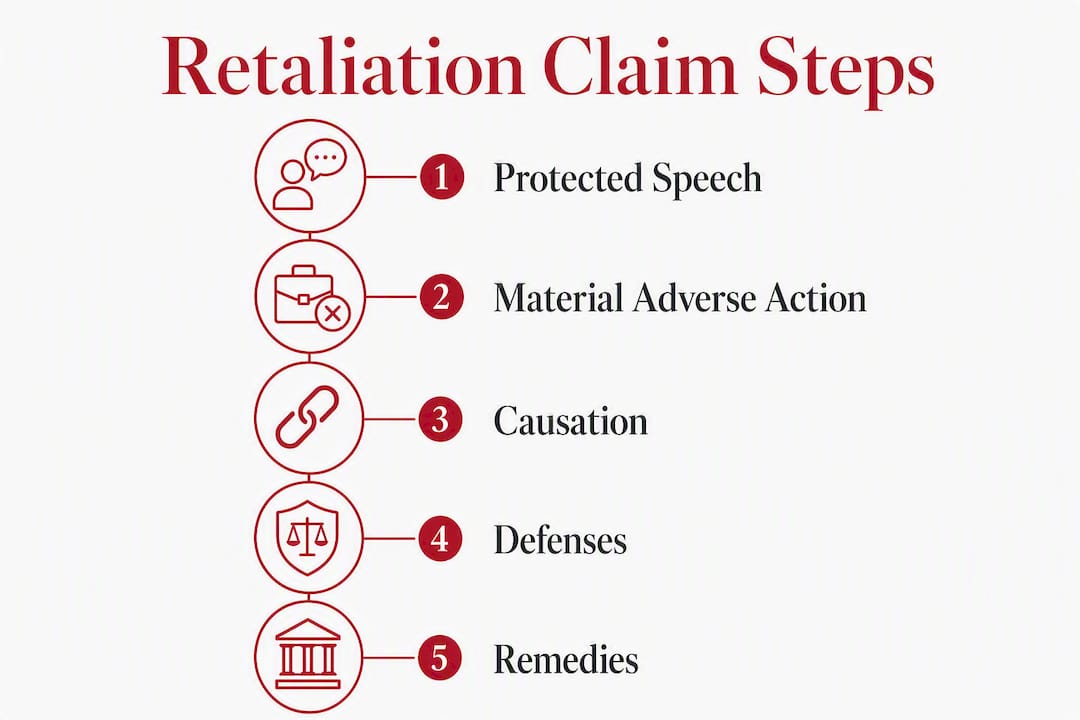
Element 1: Constitutionally protected expression
The speech must touch on a matter of public concern. Courts look at the content, form, and context of the expression. Criticism of government policy, reporting on official misconduct, participating in a protest, or petitioning a public body all qualify. Personal grievances about workplace conditions, by contrast, often do not.
For public employees, the Garcetti filter applies first: was the speech made as a citizen or as an employee carrying out job duties? If the latter, the analysis ends there.
Element 2: Materially adverse action
The action must be one that would deter a person of ordinary firmness from continuing to speak. This is an objective standard, not a subjective one. Courts ask what a reasonable person in the plaintiff’s position would do, not what this particular plaintiff felt. The inquiry is fact-intensive, and documented evidence showing how the official action actually changed the plaintiff’s behavior can be decisive.
Termination, demotion, arrest, and loss of a license are typically materially adverse. A single critical comment at a public meeting usually is not.
Element 3: Causation and the Mt. Healthy burden shift
This is where most cases are won or lost. The plaintiff must show that protected speech was a substantial or motivating factor in the government’s decision. Temporal proximity, meaning the adverse action followed closely after the speech, is the most common proof. Direct evidence of motive, such as a supervisor’s email referencing the plaintiff’s public criticism, is stronger still.
Once the plaintiff establishes motivating-factor causation, Mt. Healthy kicks in. The Supreme Court held that the defendant can escape liability by proving it would have taken the same action even without the protected speech. This burden-shifting framework means plaintiffs need to anticipate and undercut the government’s “we had other reasons” argument from day one.
| Element | Examples of what qualifies | Key evidence to gather |
|---|---|---|
| Protected activity | Public criticism of officials, protest participation, petition filing, press statements | Copies of speech, posts, recordings, meeting minutes |
| Adverse action | Termination, demotion, retaliatory arrest, permit denial, code-enforcement targeting | Official notices, arrest records, permit denials, inspection logs |
| Causation | Close timing between speech and action, supervisor comments referencing speech, inconsistent treatment of non-speaking peers | Emails, texts, comparator employee records, witness statements |
What defenses will the government raise?
Expect the government to fight hard on at least two fronts: qualified immunity and, in arrest or prosecution cases, probable cause.
Qualified immunity
Qualified immunity shields government officials from § 1983 damages unless the constitutional right they violated was “clearly established” at the time of the conduct. Courts ask two questions: Was there a constitutional violation? And was the right clearly established so that a reasonable official would have known the conduct was unlawful?
The “clearly established” prong has teeth. Even if a court agrees the official violated the First Amendment, qualified immunity can still end the damages claim if no prior case in that circuit put the specific conduct squarely on notice. This is why plaintiffs’ attorneys spend significant time finding on-point precedent before filing.
The probable-cause bar in retaliatory arrests and prosecutions
Retaliatory arrest and prosecution claims face an additional hurdle. The general rule from Hartman v. Moore (2006) is that a plaintiff must plead and prove the absence of probable cause for the prosecution. Nieves v. Bartlett (2019) extended that requirement to retaliatory arrests. The logic: if the government had legitimate grounds to arrest or prosecute, the First Amendment claim cannot proceed.
Nieves did create one important exception. A plaintiff can overcome the probable-cause bar by producing objective evidence that similarly situated individuals who did not engage in protected speech were not arrested for the same conduct. Statistical or documentary proof that the specific offense was rarely enforced against non-speakers is exactly the kind of comparator evidence that can save a claim.
Mt. Healthy’s “same decision” defense
Even after a plaintiff proves motivating-factor causation, the government can still win by showing it would have taken the same action for independent, non-speech reasons. A public employee with a documented history of performance problems, for example, gives the government a ready-made alternative justification. Plaintiffs need to attack that justification directly, usually by showing inconsistent treatment of similarly situated employees who did not speak out.
Other procedural defenses include absolute immunity for judges and prosecutors acting in their core functions, sovereign immunity in some contexts, and standing challenges when the plaintiff cannot show a concrete injury.
What remedies can you recover if you win?
The primary vehicle for suing state and local officials is 42 U.S.C. § 1983, which authorizes suits for constitutional violations committed under color of state law. Successful plaintiffs can recover:
- Compensatory damages for lost wages, emotional distress, and other concrete harm
- Nominal damages when a constitutional violation is proven but actual harm is hard to quantify
- Punitive damages in cases of egregious or malicious conduct by individual officials (not available against government entities themselves)
- Injunctive relief ordering the government to stop the retaliatory conduct or reinstate a terminated employee
- Attorney’s fees under 42 U.S.C. § 1988, which allows prevailing plaintiffs to recover reasonable legal costs from the defendant
The attorney’s fee provision matters enormously in practice. Civil rights cases are expensive to litigate, and § 1988 makes it financially viable for attorneys to take meritorious cases even when damages are modest.
| Remedy | Available against state/local officials (§ 1983) | Available against federal officials | Key limitations |
|---|---|---|---|
| Compensatory damages | Yes | Severely limited after Egbert v. Boule | Qualified immunity can bar recovery |
| Nominal damages | Yes | Rarely available | Must prove constitutional violation |
| Punitive damages | Yes (individuals only) | Rarely available | Not against government entities |
| Injunctive relief | Yes | Often the primary option | Must show ongoing or imminent violation |
| Attorney’s fees (§ 1988) | Yes | Not available under § 1988 for federal claims | Plaintiff must be the prevailing party |
Federal officials are a different story. Egbert v. Boule (2022) sharply curtailed Bivens remedies for constitutional claims against federal officers, making damages actions against them difficult to sustain in most new contexts. If your claim is against a federal official, injunctive relief and administrative remedies are often the realistic options.
What are the procedural deadlines and early hurdles?
Section 1983 does not have its own statute of limitations. Courts borrow the personal-injury limitations period from the state where the claim arose, which is typically two to three years. Missing that window ends the case, regardless of how strong the underlying claim is.
The clock generally starts running when the plaintiff knew or should have known about the adverse action and its connection to protected speech. In some cases, the continuing-violation doctrine can extend the period if the retaliation was part of an ongoing pattern, but courts apply that doctrine narrowly.
Early in litigation, defendants routinely file motions to dismiss arguing that the complaint fails to state a plausible claim, or that qualified immunity bars the suit as a matter of law. Courts can resolve qualified immunity at the pleading stage, before any discovery, which means a weak complaint can end the case before the plaintiff ever gets to gather evidence. This is one of the strongest arguments for retaining counsel before filing.
After surviving a motion to dismiss, defendants often move for summary judgment on qualified immunity grounds again, this time with a factual record. Discovery is therefore critical: depositions, document requests, and FOIA responses can surface the motive evidence needed to defeat summary judgment.
How to document and preserve evidence for your claim
Documentation failures are one of the most common reasons plaintiffs lose retaliation cases. The government’s “we had other reasons” defense is much harder to beat when the plaintiff cannot show a clean timeline or point to inconsistent treatment of non-speaking peers.
Start building your record immediately with these steps:
- Preserve all communications. Forward work emails to a personal account, screenshot texts, and save social-media posts with timestamps. Do not alter metadata.
- Keep a contemporaneous log. Write down every relevant event the day it happens: date, time, location, who was present, what was said, and how it connects to your protected speech.
- Photograph physical notices. Disciplinary letters, eviction notices, and inspection reports should be photographed in place before you handle them.
- Collect witness contact information. Names, phone numbers, and email addresses of anyone who witnessed the adverse action or the speech that preceded it.
- Identify comparators. Who else engaged in similar conduct but was not punished? Document their situations as specifically as possible.
- Submit FOIA or public-records requests. Government documents about the decision-making process, prior enforcement patterns, and internal communications about you can be obtained through the Freedom of Information Act or state equivalents. These records often contain the motive evidence that wins cases.
A simple timeline template helps organize everything:
| Date | Event | Supporting files | Witnesses | Relevance to claim |
|---|---|---|---|---|
| [Date of speech] | Public comment at city council meeting | Recording, meeting minutes | Names of attendees | Establishes protected activity |
| [Date of adverse action] | Termination letter received | Copy of letter | HR representative | Establishes adverse action |
| [Date of comparator event] | Non-speaking colleague retained after similar conduct | Performance reviews, emails | Supervisor | Supports causation/motive |
Pro Tip: When capturing screenshots, use your device’s built-in screenshot function rather than a third-party app. The native screenshot preserves the device timestamp in the file metadata, which can be important if authenticity is ever challenged.
Evidence that is most persuasive against the government’s common defenses: comparator records showing non-speakers were treated differently, emails or texts from officials referencing your speech, and a tight timeline showing the adverse action followed your speech by days or weeks rather than months.
What should you do right now?
If you believe you have been retaliated against for protected speech, the window to act is shorter than most people realize.
Immediate steps:
- Stop deleting anything. That includes emails, texts, voicemails, and social-media posts, even ones that seem irrelevant.
- Write a detailed account of what happened, in chronological order, today.
- Photograph or scan every official document you have received.
- Collect the names and contact information of everyone who witnessed the speech or the retaliation.
- Limit new communications about the dispute to what is necessary. Anything you write can be used against you in litigation.
When to call a lawyer:
- Before you respond to any internal investigation or disciplinary proceeding
- Before you file a formal complaint with an agency
- If you have been arrested or face prosecution you believe is retaliatory
- If you need help submitting a FOIA or public-records request
- Any time you are unsure whether your speech was protected or whether the adverse action rises to the level of a claim
What to bring to the first consultation:
A written timeline of events, copies of all relevant communications and official notices, the names of witnesses, any FOIA requests you have already submitted and the responses received, and a clear description of the speech or expression you believe triggered the retaliation.
Key Takeaways
A First Amendment retaliation claim requires proving protected expression, a materially adverse government action, and a causal link between the two, with the government bearing the burden to show it would have acted the same way regardless.
| Point | Details |
|---|---|
| Three-element test | Prove protected activity, materially adverse action, and that speech was a substantial or motivating factor in the government’s decision. |
| Mt. Healthy burden shift | Once you prove motivating-factor causation, the government must show it would have acted the same way without your speech. |
| Biggest defenses | Qualified immunity and the probable-cause bar (Nieves) can end claims early; comparator evidence is the strongest counter. |
| Preserve evidence now | Contemporaneous logs, preserved communications, and FOIA records are routinely decisive when motive is contested. |
| Javitchlawoffice | Javitchlawoffice handles § 1983 First Amendment retaliation claims and can evaluate your case, including evidence gaps and qualified-immunity exposure, in a free consultation. |
What experienced civil rights litigators see in these cases
The gap between a strong retaliation claim and a losing one is almost always evidentiary, not legal. The doctrine is well-settled. The three-element test is clear. What kills cases is the absence of a contemporaneous record.
Clients typically arrive with a vivid memory of what happened and very little paper. They deleted the supervisor’s email because it upset them. They did not write anything down at the time. They cannot name a single comparator employee. Against a government defendant with a full HR file and institutional memory, that evidentiary gap is usually fatal.
The cases that succeed share a pattern: the plaintiff documented the speech (a recording of the public meeting, a screenshot of the social-media post), documented the timing (a disciplinary notice dated three days after the speech), and identified at least one comparator (a colleague who did the same thing and kept their job). When those three things exist, the government’s “we had other reasons” defense becomes very hard to sell to a jury.
Qualified immunity is the other recurring obstacle. Courts in some circuits have granted immunity even when the underlying conduct was clearly retaliatory, simply because no prior case in that circuit addressed the specific factual configuration. The practical response is to plead broadly, cite multiple circuits’ precedent, and get into discovery as fast as possible. Once a plaintiff has the government’s internal communications, the “clearly established” argument often collapses.
On timeline and costs: § 1983 cases typically take two to four years from filing to resolution. Injunctive relief can sometimes be obtained faster through a preliminary injunction motion. Damages cases are longer. Attorney’s fees under § 1988 make it possible for attorneys to take strong cases on contingency, but plaintiffs should understand that litigation is a commitment, not a quick fix.
Javitchlawoffice can evaluate your retaliation claim
Facing government retaliation for speaking out is serious. The legal framework is technical, the defenses are aggressive, and the evidence window closes fast. Javitchlawoffice is a civil rights firm with nationwide reach that handles First Amendment retaliation cases under § 1983, including public-employee discipline, retaliatory arrests, and government censorship of speech. The firm also handles FOIA and public-records litigation to surface the government documents that often prove motive.
A free case evaluation covers the strength of your three-element claim, your exposure to qualified immunity and probable-cause defenses, what evidence you already have and what gaps need to be filled, and whether attorney’s fees under § 1988 make contingency representation viable. Bring your written timeline, copies of communications and official notices, and the names of any witnesses. You can reach Javitchlawoffice through the First Amendment practice page or the main site at javitchlawoffice.com.
This article provides general legal information, not legal advice. Laws and their application vary by jurisdiction and individual circumstances. Consult a qualified attorney to evaluate your specific situation.
Useful sources and authorities
The following primary authorities and doctrinal sources underpin the analysis above.
Supreme Court decisions
- Mt. Healthy City School District Bd. of Ed. v. Doyle, 429 U.S. 274 (1977): established the motivating-factor test and burden-shifting framework for retaliation claims.
- Pickering v. Board of Education, 391 U.S. 563 (1968): created the balancing test for public-employee speech on matters of public concern.
- Garcetti v. Ceballos, 547 U.S. 410 (2006): held that speech made pursuant to official duties is not protected by the First Amendment.
- Nieves v. Bartlett, 587 U.S. 391 (2019): extended the probable-cause requirement to retaliatory arrest claims and created the comparator-evidence exception.
- Hartman v. Moore, 547 U.S. 250 (2006): established the no-probable-cause requirement for retaliatory prosecution claims.
- Houston Community College System v. Wilson, 595 U.S. 468 (2022): held that a formal public censure of an elected official is not a materially adverse action.
- Egbert v. Boule, 596 U.S. 482 (2022): sharply restricted Bivens damages remedies for constitutional claims against federal officials.
Statutes
- 42 U.S.C. § 1983: the primary vehicle for damages and injunctive relief against state and local officials for constitutional violations.
- 42 U.S.C. § 1988: authorizes attorney’s fee awards to prevailing plaintiffs in civil rights cases.
Doctrinal guides and research
- Congressional Research Service Legal Sidebar (LSB11338): the most concise authoritative doctrinal overview of First Amendment retaliation law, covering the three-element test, Mt. Healthy, qualified immunity, and Egbert.
- LII / Legal Information Institute — Retaliatory Prosecution and Arrest: detailed annotation on the Hartman/Nieves probable-cause line and the comparator-evidence exception.
- First Amendment Clinic at UGA — Speech-Based Retaliation: practical overview of the Garcetti/Pickering distinction and common factual contexts for retaliation claims.
- First Amendment Coalition — Q&A on city retaliation: accessible explanation of the chilling-effect standard and the range of adverse actions courts have found actionable.
- Institute for Justice: active litigant and amicus filer in First Amendment retaliation cases at the Supreme Court level, including Lowery v. Mills.
- U.S. Constitution, First Amendment — Congress.gov: the text of the Amendment itself, the starting point for any constitutional analysis.