
The government cannot force you to say something you disagree with. That is the core rule. Under the First Amendment, the right to speak and the right to stay silent are two sides of the same coin — and compelled speech occurs whenever the government tries to flip that coin by force. In West Virginia State Board of Education v. Barnette (1943), the Supreme Court struck down mandatory flag salutes in public schools. In Janus v. AFSCME (2018), it held that requiring non-union public employees to pay agency fees violated the First Amendment. In Zauderer v. Office of Disciplinary Counsel (1985), the Court carved out a narrower lane: factual, uncontroversial commercial disclosures can survive constitutional challenge under reduced scrutiny. The practical verdict is this: government-imposed ideological scripts almost always fail; government-mandated factual disclosures tied to consumer protection often survive.
Key Takeaways
The First Amendment’s protection against compelled speech is as strong as its protection of the right to speak — and courts apply strict scrutiny to government-imposed ideological mandates while reserving reduced scrutiny only for narrow, factual commercial disclosures.
| Point | Details |
|---|---|
| Core constitutional rule | Government generally cannot force individuals or entities to express a message or fund another party’s speech. |
| Strict scrutiny applies | Ideological or political compulsion triggers strict scrutiny, which very few government mandates survive. |
| Zauderer exception | Purely factual, uncontroversial commercial disclosures tied to consumer protection face reduced scrutiny. |
| Janus changed the law | Public-sector employees cannot be required to pay union agency fees without affirmative, knowing consent. |
| Javitchlawoffice | The firm’s First Amendment practice handles compelled-speech claims, including mandatory disclosures, union fees, and school-based mandates. |
Table of Contents
- What counts as compelled speech under the First Amendment?
- The First Amendment foundation and the tests courts apply
- Landmark Supreme Court cases that shaped the doctrine
- Where compelled disclosure rules allow mandates and where they stop
- Compelled financial support and the Janus line
- How recent decisions are reshaping compelled-speech law
- Practical steps if you think you are being forced to speak
- A perspective on why compelled-speech protection matters
- How Javitchlawoffice can help with compelled-speech claims
- Sources
What counts as compelled speech under the First Amendment?
Compelled speech is not limited to forcing someone to recite words aloud. Courts recognize several distinct forms:
- Verbal compulsion: Mandatory pledges, oaths, or statements (flag salutes, loyalty oaths).
- Expressive conduct: Displaying a government-mandated message on a license plate, as in Wooley v. Maynard (1977), where New Hampshire required “Live Free or Die” on every plate.
- Compelled content creation: Forcing a graphic designer, writer, or website developer to produce expressive work carrying a message they reject — the issue at the center of 303 Creative LLC v. Elenis (2023).
- Compelled financial subsidization: Requiring someone to fund another party’s speech, as with union agency fees before Janus.
- Compelled disclosure: Mandating that a speaker include specific language in their communications — sometimes permissible, sometimes not, depending on the content and context.
One critical line separates compelled speech from two things it is often confused with. First, private rules — an employer requiring employees to follow a communication policy — do not raise First Amendment issues because the First Amendment constrains government actors, not private ones. Second, government speech — the government’s own messages on its own platforms — is not compelled speech at all; the government is allowed to say what it wants through its own channels.
The First Amendment foundation and the tests courts apply
The right not to speak flows directly from the same First Amendment text that protects the right to speak. Barnette made that explicit in 1943, and every major compelled-speech decision since has built on that foundation. The question courts face is not whether the right exists but how much protection it gets in a given context.
Courts apply different levels of scrutiny depending on what kind of compulsion is at issue:
- Strict scrutiny applies when the government compels ideological or political speech, or forces a private speaker to carry a message they find objectionable. To survive, the law must serve a compelling government interest and be narrowly tailored to achieve it. Very few laws pass this test.
- Intermediate scrutiny sometimes applies in commercial-speech contexts, though the line between intermediate scrutiny and the Zauderer standard has been contested in lower courts.
- The Zauderer standard (reduced scrutiny) applies when the government requires purely factual and uncontroversial disclosures in a commercial context, reasonably related to preventing consumer deception. The burden on the speaker must not be unduly burdensome. Calorie counts on menus and ingredient labels are the clearest examples of disclosures that fit this lane.
The threshold question — before any scrutiny analysis — is whether the challenged requirement actually compels speech. Courts ask whether the law targets expressive activity or merely regulates conduct that incidentally touches speech. A law that regulates how a business operates (hours, staffing) is different from one that dictates what a business must say.
Pro Tip: When evaluating whether a disclosure is “purely factual and uncontroversial,” ask whether a reasonable person in the speaker’s position would dispute the accuracy or neutrality of the required statement. If the disclosure carries an implicit ideological message or requires the speaker to endorse a contested position, it likely falls outside the Zauderer lane and into stricter review.
Landmark Supreme Court cases that shaped the doctrine
The compelled-speech doctrine did not arrive fully formed. It was built case by case, often in close votes, and the trajectory matters as much as any single holding.
- Minersville School District v. Gobitis (1940): The Court upheld mandatory flag salutes 8–1. Three years later, it reversed course almost entirely.
- West Virginia State Board of Education v. Barnette (1943): Reversed Gobitis 6–3. Jehovah’s Witness students could not be forced to salute the flag or recite the Pledge of Allegiance. The opinion’s language about “fixed stars” in the constitutional constellation became the doctrine’s north star.
- Wooley v. Maynard (1977): New Hampshire could not prosecute a couple for covering “Live Free or Die” on their license plate. The Court held that the state cannot compel individuals to be “mobile billboards” for its ideological message.
- Abood v. Detroit Board of Education (1977): The Court upheld agency-fee requirements for public-sector unions, reasoning that non-members could be charged for collective-bargaining costs but not for political activities. This holding stood for 41 years.
- Zauderer v. Office of Disciplinary Counsel (1985): An attorney who ran ads offering contingency-fee representation could be required to disclose that clients might owe court costs. The Court approved the disclosure under reduced scrutiny because it was factual and not unduly burdensome.
- Meese v. Keene (1987): The Court upheld a requirement that films from foreign governments be labeled “political propaganda” under the Foreign Agents Registration Act. The label helped the public evaluate the source of the speech rather than suppressing it.
- Planned Parenthood v. Casey (1992): The Court upheld informed-consent requirements for abortion providers, including mandated disclosures about fetal development. The plurality applied a rational-basis-like standard for factual medical disclosures, a holding later questioned by NIFLA.
- National Institute of Family and Life Advocates v. Becerra (NIFLA) (2018): California required licensed pregnancy centers to post notices about state-funded abortion services and unlicensed centers to disclose their status. The Court struck down both requirements 5–4, rejecting the idea that professional speech gets reduced First Amendment protection and expressing deep skepticism of government-drafted scripts.
- Janus v. AFSCME (2018): Overruled Abood 5–4. The Court held that requiring non-union public employees to pay agency fees compels them to subsidize speech on matters of public concern, violating the First Amendment. Affirmative consent is now required.
- 303 Creative LLC v. Elenis (2023): A 6–3 decision holding that Colorado could not require a web designer to create wedding websites for same-sex couples when doing so would require her to express messages she disagreed with. The Court treated website design as expressive, making the state’s anti-discrimination law a compelled-speech violation in that context.
The doctrinal arc runs from Barnette’s foundational “no orthodoxy” principle through Wooley’s mobile-billboard rule, Zauderer’s commercial-disclosure carve-out, Abood’s union-fee compromise, and then a sharp turn in 2018 with NIFLA and Janus — both of which expanded protection and narrowed government authority to compel expression.
Where compelled disclosure rules allow mandates and where they stop
The Zauderer standard is the government’s best tool for surviving a compelled-speech challenge. But it has real limits, and NIFLA drew them sharply.
A disclosure survives Zauderer review when it is:
- Purely factual: No contested scientific claims, no implied endorsements, no ideological framing.
- Uncontroversial: A reasonable speaker would not dispute the accuracy of the statement.
- Reasonably related to preventing deception: The disclosure must connect to the regulated activity, not serve as a vehicle for the government’s preferred message.
- Not unduly burdensome: The disclosure cannot crowd out the speaker’s own message or impose disproportionate compliance costs.
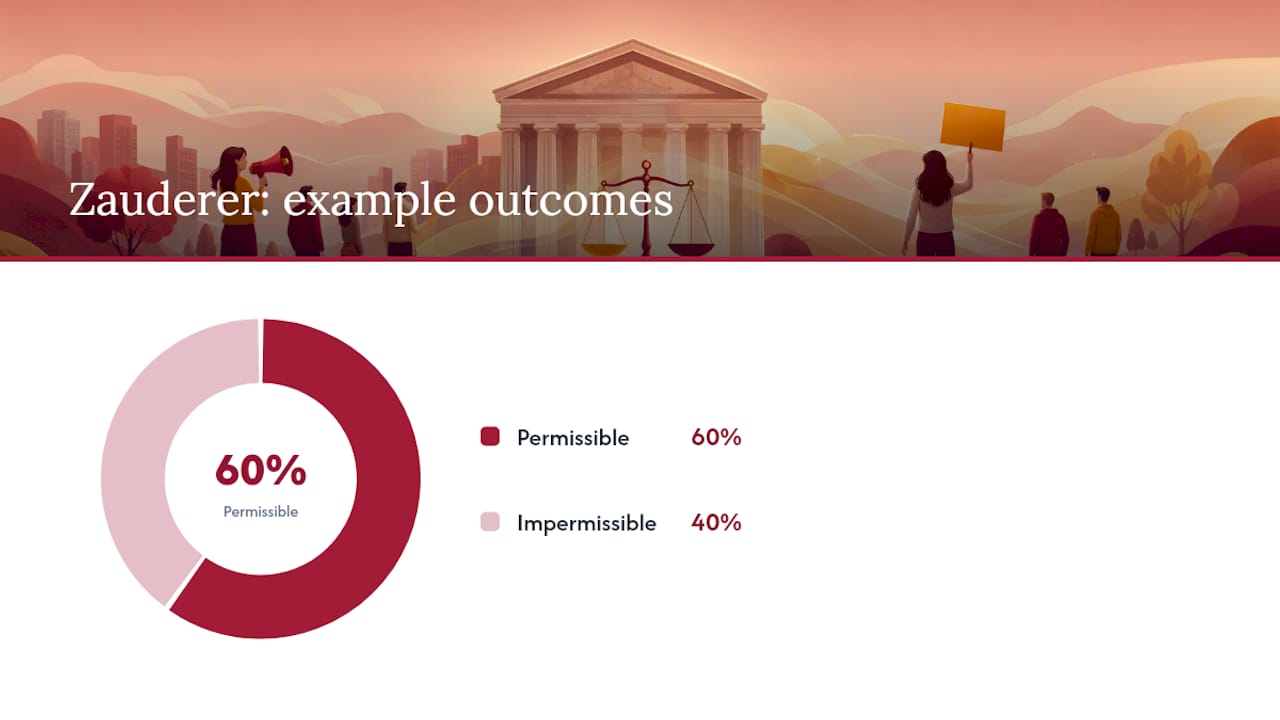
The contrast with impermissible compelled speech becomes clear in side-by-side examples:
| Disclosure type | Example | Likely outcome |
|---|---|---|
| Factual commercial disclosure | Calorie counts on restaurant menus | Permissible under Zauderer |
| Health warning on tobacco products | “Smoking causes lung cancer” | Permissible (factual, uncontroversial) |
| Government-drafted ideological notice | Pregnancy center required to advertise state abortion services | Impermissible (NIFLA) |
| Foreign-agent labeling | Films labeled “political propaganda” | Permissible (Meese v. Keene) |
| Compelled website content | Designer required to create same-sex wedding sites | Impermissible (303 Creative) |
The NIFLA Court’s rejection of a separate “professional speech” doctrine matters here. Before 2018, some lower courts had held that professional licensing gave the government broader authority to dictate what licensed professionals must say. The Supreme Court disagreed, and that rejection means medical providers, lawyers, therapists, and other licensed professionals now have stronger grounds to challenge government-drafted scripts.
Pro Tip: If you are challenging a disclosure requirement, the strongest argument is that the required statement goes beyond neutral facts and carries an implicit message the government wants spread. Courts look at whether the disclosure is tied to the speaker’s own regulated conduct or is instead a vehicle for government messaging on a contested topic.
Compelled financial support and the Janus line
Compelled subsidization is compelled speech by another name. When the government requires you to fund someone else’s expressive activity, it forces you to support a message you may reject — and the First Amendment treats that as a form of coercion.

Abood tried to split the difference: public employees could be charged for collective-bargaining costs (deemed non-political) but not for the union’s political expenditures. The problem, as Janus recognized, is that collective bargaining for public employees is inherently political. Wages, benefits, and work rules for government workers are matters of public concern, and funding negotiations over them means funding speech on those issues.
The practical consequences of Janus are significant:
- Public-sector employees who are not union members cannot be required to pay any fees to the union.
- Unions must obtain affirmative, knowing consent before collecting fees from non-members.
- Any fee arrangement that predates Janus and lacks that consent is constitutionally defective.
Beyond union dues, compelled-subsidization doctrine touches other areas:
- Commodity promotion assessments: The government has upheld some mandatory assessments that fund generic advertising (beef, mushrooms, pork) when the speech is characterized as government speech rather than private compelled speech. The line between government speech and compelled private subsidization remains contested.
- Bar association dues: After Janus, several courts have reconsidered whether mandatory state bar dues used for advocacy activities are constitutional. The issue is active in multiple circuits.
- Student activity fees: Board of Regents v. Southworth (2000) held that public universities may collect mandatory student activity fees for a broad range of student groups, provided the allocation is viewpoint-neutral. That holding predates Janus and its durability is an open question.
The Indiana Law Journal frames the key analytical question this way: is the government conscripting private actors to deliver a message the government could otherwise deliver itself? When the answer is yes, compelled-speech objections carry the most weight.
How recent decisions are reshaping compelled-speech law
The Court’s 2018 term was a turning point. NIFLA and Janus, decided within weeks of each other, signaled that a majority of the Court was willing to apply First Amendment scrutiny more aggressively to government mandates that had previously been treated as routine regulatory tools.
303 Creative extended that skepticism into a new domain: creative professionals and anti-discrimination law. The holding was narrow — it turned on the expressive nature of custom website design — but it opened a significant question about where expressive conduct ends and ordinary commercial service begins.
Several areas of active litigation reflect that uncertainty:
- Social media content moderation: Courts are divided on whether states can compel platforms to carry or remove certain speech. Moody v. NetChoice (2024) sent the cases back to lower courts for more analysis, leaving the question unresolved.
- Professional licensing disclosures: Therapists, financial advisors, and other licensed professionals face ongoing challenges to state-mandated disclosure scripts, particularly where the required language touches contested empirical claims.
- Compelled product labeling: Proposals to require labels on genetically modified foods, cell phones, and other products raise Zauderer questions when the required statements go beyond neutral facts.
- Employer speech mandates: Some states have enacted laws requiring employers to hold captive-audience meetings on certain topics; others have banned them. Both types of laws face First Amendment challenges from different directions.
The University of Illinois Law Review argues the doctrine needs a more structured framework that explicitly weighs whether the government is using private actors to spread its preferred message and whether dignity-based concerns call for heightened review. That scholarly critique tracks where the Court’s own reasoning has been heading.
Practical steps if you think you are being forced to speak
If a government mandate is requiring you to express a message you disagree with, the steps you take in the first days matter for any eventual legal challenge.
- Preserve the mandate in writing. Save every letter, email, regulation, or notice that describes what you are required to say or fund. A court needs to see the government’s exact language.
- Document your objection. Write down, in your own words, why the required statement conflicts with your beliefs or message. Contemporaneous records are far more credible than reconstructed ones.
- Gather witness information. Note the names and contact details of anyone who observed the mandate being applied to you or who can confirm the government’s demand.
- Preserve your own expressive materials. Save copies of your website, publications, or other content that shows your actual message — the contrast between what you say and what the government wants you to say is central to the claim.
- Track financial impact. If you are being required to pay fees that fund speech, keep records of every payment, including dates and amounts.
- Identify the government actor. Note the specific agency, official, or law imposing the requirement. Compelled-speech claims run against government actors, so precision about who is compelling what matters.
- Consult a First Amendment attorney before complying or refusing. Compliance can sometimes be treated as waiver; refusal can trigger enforcement. Getting legal advice before either move protects your options.
Common remedies in compelled-speech cases include:
- Pre-enforcement challenges: You do not have to wait until you are prosecuted. If the threat of enforcement is credible and the chilling effect on speech is real, courts can hear the case before any penalty is imposed.
- Injunctions: A court order stopping the government from enforcing the mandate while the case proceeds.
- Declaratory relief: A court ruling that the law is unconstitutional, which resolves the legal question without necessarily awarding damages.
- Emergency TROs (temporary restraining orders): Available when enforcement is imminent and the harm is irreversible. These require showing a likelihood of success on the merits and irreparable harm.
Pro Tip: Pre-enforcement challenges are often the most effective tool in compelled-speech cases. Courts have consistently held that the chilling effect of an unconstitutional speech mandate is itself an injury — you do not need to wait for a fine or prosecution to have standing to sue.
A perspective on why compelled-speech protection matters
The compelled-speech doctrine is sometimes treated as a niche constitutional curiosity — relevant to flag salutes and license plates but not much else. That reading is wrong, and the last decade of Supreme Court decisions proves it.
What the doctrine actually protects is something more fundamental than any particular case: the government’s inability to conscript private voices to carry its preferred message. When a state requires a pregnancy center to advertise abortion services, or requires a web designer to create content she finds objectionable, or requires a public employee to fund union speech she disagrees with, the mechanism is the same. The government is using private actors as its megaphone. NIFLA, Janus, and 303 Creative all said, in different contexts, that this is not a permissible use of regulatory power.
The doctrine’s unsettled edges — professional licensing, social media, commodity assessments — are not signs of weakness. They are signs that the underlying principle is being tested against genuinely hard facts. The question of whether a state can require a therapist to tell clients that conversion therapy is ineffective, or whether a platform can be compelled to carry political speech it would otherwise remove, does not have an obvious answer. What the doctrine provides is a framework for asking the right question: is the government imposing its orthodoxy on a private speaker, or is it requiring a neutral disclosure tied to a legitimate regulatory purpose?
That distinction, between orthodoxy and disclosure, is where most compelled-speech cases are actually won and lost. And it is why the evidence you preserve at the outset — the government’s exact language, your own expressive materials, the contrast between the two — determines whether a court sees a constitutional violation or a routine regulatory requirement.
How Javitchlawoffice can help with compelled-speech claims
Facing a government mandate that tells you what to say, what to fund, or what message to carry is a serious constitutional problem — and it is exactly the kind of case Javitchlawoffice handles.
Javitchlawoffice is a California-based civil rights firm with nationwide reach, and its First Amendment practice covers the full range of compelled-speech problems: mandatory disclosures that go beyond neutral facts, compelled subsidization of union or advocacy speech, and government-mandated content in professional or creative work. The firm also handles compelled-speech issues that arise in school settings through its student discrimination practice, and it represents clients whose religious convictions put them in direct conflict with government speech mandates through its religious discrimination practice. If you believe a government actor is requiring you to express a message you reject, bring the mandate’s exact language, your own expressive materials, and any financial records of compelled fees to an initial consultation. Contact Javitchlawoffice for a free case evaluation.
Sources
The cases and principles in this article come from primary Supreme Court opinions and peer-reviewed legal scholarship. For readers who want to go deeper:
- Compelled Speech | The First Amendment Encyclopedia
- Compelled Speech overview | Legal Information Institute (LII), Cornell Law School
- Flag Salutes and Other Compelled Speech | U.S. Constitution Annotated
- Toward a More Explicit, Independent, Consistent and Nuanced Compelled Speech Doctrine | University of Illinois Law Review
- Compelled Speech and the Regulatory State | Indiana Law Journal (excerpt)
Supreme Court opinions are freely available at supremecourt.gov and through Google Scholar. A case citation reads as: Party v. Party, volume U.S. page (year) — so Janus v. AFSCME, 585 U.S. 878 (2018) means volume 585 of the United States Reports, starting at page 878, decided in 2018. Full slip opinions for recent decisions are posted on the Court’s website the day they are handed down.
This article is general information, not a substitute for advice from a qualified lawyer. Consult a qualified legal professional about your own circumstances before acting on anything here.