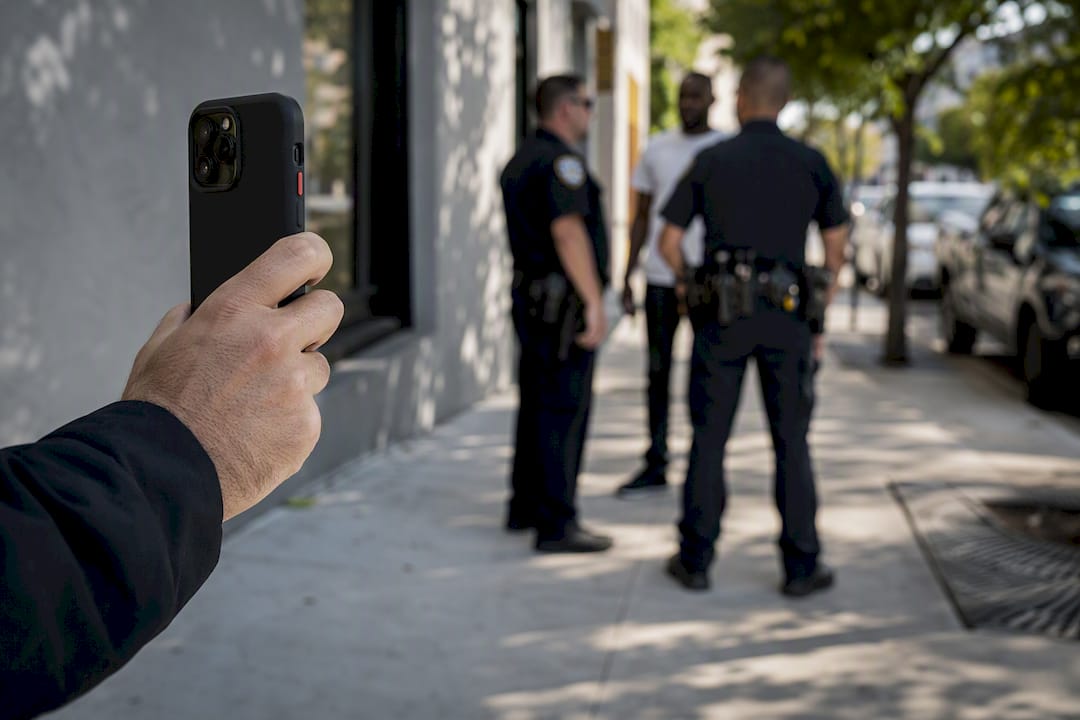
The First Amendment protects your right to record police officers performing their duties in public, and federal appellate courts have upheld that right consistently. Audio recording is usually legal too, even in states with strict wiretap laws, because on-duty officers in public have no reasonable expectation of privacy. The catch: officers can still stop, detain, or arrest you unlawfully, and reasonable safety-based orders about your physical position are legal even when the order to stop recording is not. Protect yourself first, assert your rights second.
TL;DR:
- Recording police on public property is protected by the First Amendment, but officers can lawfully order you to move if you’re obstructing an operation or scene.
- Most states’ wiretap laws do not forbid recording officers’ speech in public, as officers performing duties in public lack an expectation of privacy, even in states requiring consent.
- During encounters, stay safe by keeping your hands visible, obeying lawful orders, and calmly stating your purpose, then document everything afterward through secure backups.
- Police generally cannot search your device without a warrant, and refusing to unlock your phone or share passcodes is legally supported; consider using strong passphrases and cloud backups beforehand.
- Use of live streaming apps offers a delete-proof backup but exposes real-time location, so prepare your approach in advance and weigh safety versus evidentiary advantages.
Table of Contents
- What the Law Says: First Amendment, Federal Courts, and the Scope of the Right
- Audio Recording and State Wiretap Laws: What Actually Changes by State
- If an Officer Challenges You, Stops, or Arrests You: A Safety-First Script
- Device Seizure and Searches: Warrants, Incident-to-Arrest Limits, and Refusing to Unlock
- How to Protect Footage and Preserve Evidence After an Encounter
- When Your Rights Were Violated: Complaints, Oversight, and Legal Remedies
- How to Handle Recording in Private Property or Semi-Public Spaces
- Use of Bystander Live Streaming Apps and Their Advantages and Risks
- Impact of Federal vs. State Laws on Recording Police
- Qualifications and Precedence of Public vs. Private Officers
- Author Perspective: Why Documentation and Safety Both Matter
- If You Need Help: Javitch Law Office Services for Unlawful Searches, Deletions, and First Amendment Violations
- Sources
- FAQ
What the Law Says: First Amendment, Federal Courts, and the Scope of the Right
Every federal appellate circuit to rule on the question has recognized a First Amendment right to record on-duty police officers in public. The Supreme Court hasn’t taken a case squarely on point, but that circuit-level consensus gives the right real teeth. Courts treat filming officers the same way they treat other forms of newsgathering and public observation: a protected activity that the government can regulate only in narrow, content-neutral ways.
The right applies wherever you have lawful access. That includes sidewalks, parks, streets, courthouse steps, and the parking lot outside a police station. It gets murkier on private property, inside your own home during a police encounter, or in areas where you’d otherwise need permission to stand.
Courts allow what’s called time, place, and manner restrictions. That legal doctrine lets police:
- Order you to move back if you’re physically blocking an arrest or a traffic stop
- Restrict access to an active crime scene taped off for evidence collection
- Ask you to step outside a designated tactical perimeter during an unfolding incident
What officers cannot do is order you to stop recording simply because you’re recording. That distinction, drawn out clearly in EFF’s guide to recording law enforcement, is where most unlawful-order cases actually turn.
Audio Recording and State Wiretap Laws: What Actually Changes by State
Roughly a dozen states require consent from all parties before you record a private conversation. California, Florida, and Illinois are among them. That sounds alarming until you look at how courts have actually applied these laws to police encounters.
Federal courts have consistently rejected the argument that recording an on-duty officer’s voice in public violates wiretap statutes, reasoning that officers performing public duties in a public setting don’t have a reasonable expectation of privacy in what they say. That’s true in one-party consent states (where only you need to agree to the recording) and, in practice, in all-party consent states too, since the “expectation of privacy” element required to trigger those laws generally isn’t met on a public street.
Some quirks remain:
- A handful of state statutes carve out specific exceptions or add procedural wrinkles worth checking before you travel or relocate
- Recording inside a private space, like an officer’s unmarked vehicle interior or a private business, raises separate consent questions
- Secret recording, where the subject has no idea they’re being filmed, sometimes draws more scrutiny than open recording under state law
The safest practical move: record openly, in plain view, rather than hidden. It sidesteps most state-law arguments before they start, and it’s harder for an officer to later claim you were doing something covert.
If an Officer Challenges You, Stops, or Arrests You: A Safety-First Script
Legal rights matter, but they don’t stop a bullet or a taser. Your first job in any encounter is staying alive and uninjured, not winning a legal argument at the scene.
- Keep your hands visible and your movements slow. Don’t reach for anything sudden, even your own phone.
- State your purpose calmly. A simple line works: “I’m recording from a public sidewalk. I’m not interfering.”
- Decline consent to searches, verbally and once. “I don’t consent to a search” is enough. Repeating it doesn’t help.
- Refuse to delete anything. “I’m not going to delete my recording” is a factual statement, not a confrontation.
- Comply with movement orders, even ones you think are unlawful. Step back if told to step back. Challenge the order later, not in the moment.
- Ask if you’re being detained or are free to go. This single question often clarifies the entire interaction.
Pro Tip: Say the date, time, and your location out loud early in the recording. If the footage is ever seized or deleted, a witness statement or a partial audio clip that captures those details still helps establish what happened.
Advocacy groups including FIRE consistently recommend this order of operations: de-escalate now, document everything, and pursue legal remedies afterward rather than arguing constitutional law on the spot.
Device Seizure and Searches: Warrants, Incident-to-Arrest Limits, and Refusing to Unlock
Police can sometimes seize your phone. They generally cannot search its contents without a warrant, even when the seizure happens incident to a lawful arrest. Holding a device for safekeeping and searching what’s on it are two legally distinct acts, and officers routinely blur that line in the field.
If an officer asks for your passcode, you’re not required to give it. A calm “I don’t consent to a search of my device” is sufficient. The ACLU’s guidance on documenting police is direct on this point: officers may not legally delete your photos or videos, and doing so can itself become evidence of misconduct.
A few practical steps make a real difference before you ever need them:
- Use a passphrase instead of a short numeric PIN; longer strings are dramatically harder to compel or guess
- Consider disabling fingerprint or face unlock in situations where you anticipate police contact, since biometric locks carry different legal treatment than passcodes in some courts
- Set your phone to auto-upload photos and video to the cloud the moment they’re captured, so a seized device isn’t your only copy
If you’re read your rights and processed for an unrelated charge, understanding how bail and warrant processing works can help you plan your next several hours realistically.
How to Protect Footage and Preserve Evidence After an Encounter
The recording only helps you later if it survives the encounter intact. Upload it to cloud storage immediately, before you leave the scene if possible, and email a copy to a trusted contact as a backup. Duplicate the file onto a second device the same day.
Metadata matters more than people expect. Time stamps, GPS location data, and file creation dates all help establish exactly when and where the recording happened, which can matter enormously if the case turns on the sequence of events. Write down witness names and contact information while memories are fresh, including your own.
- Save the original, unedited file separately from any copy you plan to share or post
- Note badge numbers, patrol car numbers, and approximate times in a separate written record
- Think before posting publicly: blur bystanders’ faces if privacy is a concern, and avoid captions that guess at motive or legal conclusions you can’t yet prove
Pro Tip: If footage does get deleted from your device, don’t assume it’s gone. A digital forensics specialist can sometimes recover deleted files, and preserving the device untouched afterward protects the chain of custody a specialist would need.
When Your Rights Were Violated: Complaints, Oversight, and Legal Remedies
An unlawful stop, an illegal device search, or a deleted recording doesn’t have to be the end of the story. You have real options, and timing matters for most of them.
Filing an internal complaint with the department, or with a civilian oversight board if your city has one, creates a paper trail and starts a clock that can matter for later claims. FindLaw’s overview of recording rights notes that these administrative routes exist alongside, not instead of, civil litigation.
On the civil side, a lawyer evaluates whether you have a constitutional claim for retaliation or unlawful search, what damages you can document, and whether an injunction against a department’s policy makes sense. Bring what you have to a consultation:
- The original recording and any backup copies, with metadata intact
- Notes on badge numbers, patrol unit numbers, and the exact time and location
- Names and contact information for any witnesses
Javitch Law Office reviews cases involving First Amendment retaliation and can help determine whether what happened to you rises to an actionable claim.
How to Handle Recording in Private Property or Semi-Public Spaces
The rules shift once you leave public sidewalks and streets. Private property, your own home, a friend’s porch, or a business’s interior all involve different legal footing than a public right-of-way.
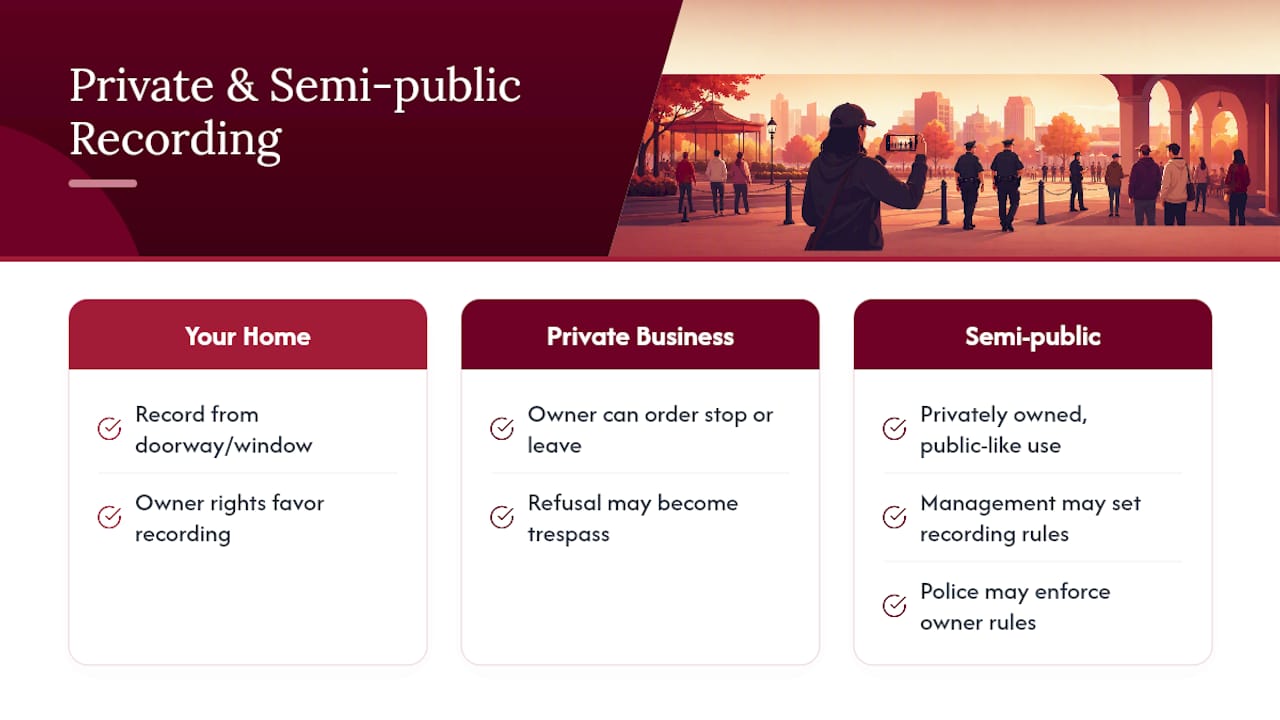
If police come to your home, you generally have the right to record them from inside your own doorway or through a window, since it’s your property and your reasonable expectation of privacy applies differently than an officer’s does. Recording inside someone else’s private business, a restaurant, a store, a private parking garage, is a different matter. The property owner or manager can ask you to stop filming or leave, and refusing can turn a legal recording into a trespass problem that has nothing to do with the police encounter itself.
Semi-public spaces create the trickiest gray zone. Shopping mall common areas, apartment building lobbies, and hospital waiting rooms function like public space in practice but remain privately owned. Management can set rules about recording on their property, and police called to those locations sometimes lean on that private authority to pressure you into stopping, even when the underlying constitutional question about filming officers doesn’t change.
The practical guidance holds steady across all these settings: know whose property you’re standing on, comply with a lawful property-owner request to leave rather than escalate a trespass dispute, and remember that stepping onto public sidewalk restores your full recording rights instantly.
Use of Bystander Live Streaming Apps and Their Advantages and Risks
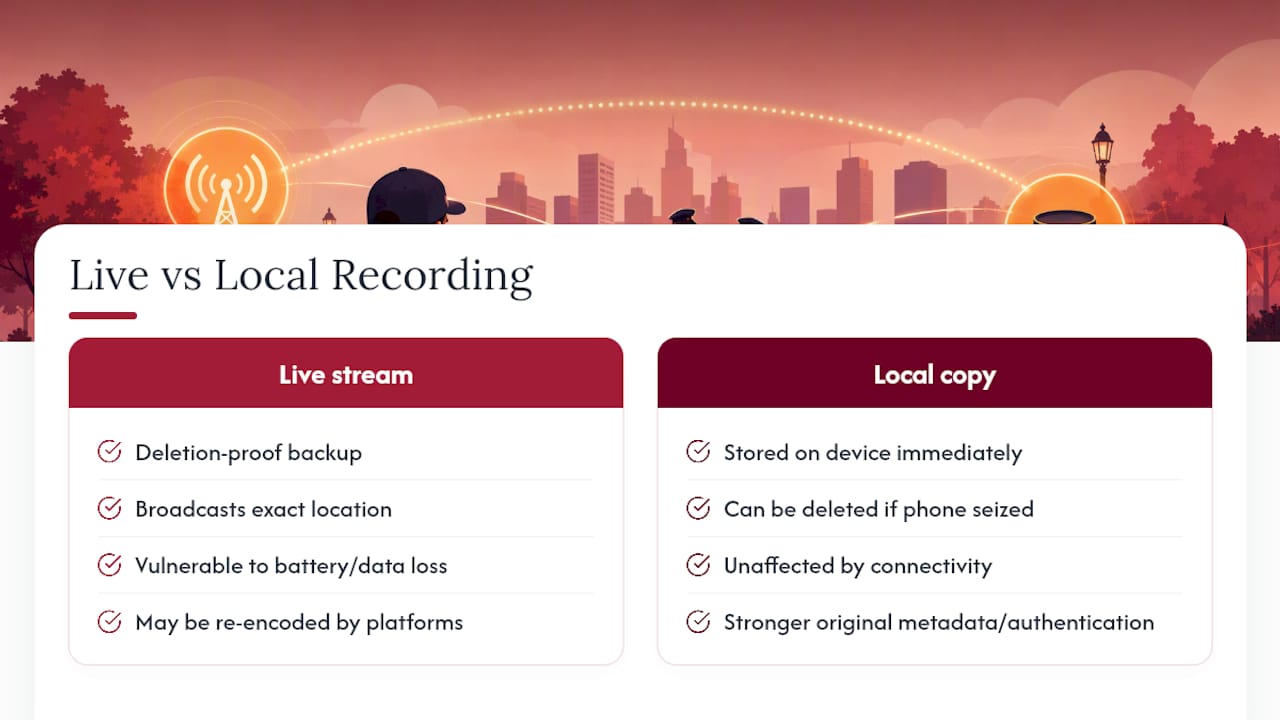
Streaming an encounter live, rather than recording locally, solves the deletion problem before it starts. If footage streams to a server the moment it’s captured, an officer seizing or smashing your phone afterward can’t erase what already left the device. That single advantage explains why live streaming has become a common recommendation among civil-rights observers documenting police encounters.
The tradeoffs are real, though. Live streaming to a public platform broadcasts your exact location in real time, which can matter for your safety if the situation is volatile or if you’d rather not be identified immediately. Battery drain and data connectivity also work against you: a stream that cuts out mid-encounter because of a dead connection leaves you with a fragmented, harder-to-use record rather than a clean file.
There’s also a chain-of-custody wrinkle worth knowing about if you ever need the footage in court. A file saved directly on your device, with its original metadata intact, is often easier to authenticate than a stream that got re-encoded and re-hosted by a third-party platform. That doesn’t make streaming a bad choice. It just means the strongest approach, when circumstances allow, is doing both: stream for the deletion-proof backup, and keep a local copy for the cleanest possible evidence file.
Weigh the tradeoff before the moment arrives, not during it. Deciding in advance which approach fits your situation means one less decision to make while your hands are already full.
Impact of Federal vs. State Laws on Recording Police
Federal constitutional law sets the floor. States can expand on that floor, but they generally cannot legislate it away entirely, since the First Amendment right recognized by federal appellate courts binds state and local governments too.
Where state law actually changes your practical situation is in three areas: wiretap and eavesdropping statutes, obstruction and interference statutes, and the specific procedures your local department follows for handling complaints. Wiretap laws, as covered earlier, rarely block audio recording of officers in public regardless of which consent regime your state uses. Obstruction statutes vary more meaningfully. Some states define interference narrowly, physical acts that actually impede an officer’s ability to act, while others give police and prosecutors more room to characterize mere proximity or a raised voice as obstruction.
This state-by-state variation is exactly why an arrest for recording, even a legally baseless one, can still happen and still cost you real time and money before a court sorts it out. The federal right protects you in the long run. It doesn’t guarantee a smooth encounter in the moment, and that gap between constitutional protection and street-level enforcement is the single biggest source of confusion for people who assume “the law is on my side” means “nothing bad can happen.” Both can be true at once.
Qualifications and Precedence of Public vs. Private Officers
Not every uniform you encounter carries the same legal authority, and that distinction affects how recording rights apply. Sworn municipal police officers, county sheriffs, and state troopers are government actors bound directly by the First Amendment. Their authority to detain, arrest, and use force comes from state law, and the constitutional limits on how they can respond to being recorded are well established through the appellate rulings covered earlier.
School resource officers occupy an interesting middle ground. Most are sworn police officers employed by a local department or contracted to a school district, which means they carry full arrest powers and remain bound by the same constitutional constraints as any other officer, including when it comes to recording. A minority of districts instead use unarmed campus security staff who are not sworn officers at all. That distinction matters because a private security guard, unlike a sworn officer, is not a government actor bound by the First Amendment in the same way, though state trespass and property law still apply on school grounds.
Private security guards at malls, apartment complexes, or event venues fall further from government authority. They can ask you to leave private property or stop recording there, and refusing may create a trespass issue, but they generally lack independent arrest power beyond what any private citizen holds, and they cannot invoke the same legal protections a police officer can when objecting to being filmed. Knowing which category of uniform you’re dealing with, sworn officer, contracted school resource officer, or private guard, changes what rights and risks actually apply.
Author Perspective: Why Documentation and Safety Both Matter
Recording police is one of the few tools an ordinary person has to hold power accountable in the moment it matters, not months later in a report nobody reads. That’s worth remembering when an officer tells you to stop. But no video is worth an injury or an unnecessary arrest. Document calmly, comply with safety orders, and if your footage gets seized or deleted, talk to a lawyer before you talk yourself out of pursuing it.
— Mark
If You Need Help: Javitch Law Office Services for Unlawful Searches, Deletions, and First Amendment Violations
When a recording encounter goes wrong, such as an unlawful device search, deleted footage, or a questionable arrest, some law offices specialize in these issues and may offer direct attorney contact and contingency-fee arrangements.
The firm’s First Amendment practice evaluates retaliation claims tied to recording, unlawful detention, and improper device seizures, building each case around the specific facts of what happened at the scene. When body-worn camera footage or dispatch logs from the responding agency would strengthen your case, the firm’s public records and FOIA team can pursue that evidence directly from the agency that holds it.
Before your consultation, gather what you have: the original recording with metadata intact, any backup copies, badge or unit numbers, and contact information for witnesses. That groundwork lets an attorney assess your case quickly and tell you honestly whether it’s worth pursuing.
Sources
For primary guidance beyond this article, consult the EFF’s recording law enforcement guide, the ACLU’s know-your-rights page on documenting police, and FIRE’s practical breakdown of recording in public. Readers exploring related remedies can also review the firm’s post on suing for public records.
This article is general information, not a substitute for advice from a qualified lawyer. Consult a qualified legal professional about your own circumstances before acting on anything here.
- EFF guide: Recording law enforcement (2026)
- ACLU — Recording and Documenting Police and Federal Agents (2026)
- FIRE — Recording police in public: What you need to know
- FindLaw — Do you have the right to record interactions with police?
FAQ
Can Cops Legally Tell You to Stop Recording?
No, not solely because you’re recording. Officers can order you to move for safety or to avoid interfering with their duties, but an order to stop recording simply because a camera is present isn’t legally valid.
Can a Cop Just Walk Up to You and Ask for ID?
Yes, an officer can approach and ask questions, including for ID, but whether you’re legally required to answer or identify yourself depends on your state’s stop-and-identify laws and whether you’re being lawfully detained.
Is It Illegal to Record in Public in the United States?
No. Recording in public, including recording police officers performing their duties, is generally protected by the First Amendment, subject to reasonable time, place, and manner limits.
Is It Illegal to Record Police in Florida?
No. Florida is an all-party consent state for private conversations, but courts have held that on-duty officers performing public duties in public lack a reasonable expectation of privacy, so recording them, audio included, is generally legal.