
The San Francisco Sunshine Ordinance, codified as Chapter 67 of the Administrative Code, makes public access the default for city meetings and records rather than the exception. If a department drags its feet or misapplies an exemption, the ordinance gives you three real levers: a complaint to the Sunshine Ordinance Task Force, a petition to the Supervisor of Records, or a referral to the Ethics Commission. Most disclosure disputes resolve through the SOTF’s Immediate Disclosure and 10 day response rules well before anyone needs a courtroom.
TL;DR:
- Filing a complaint with the Sunshine Ordinance Task Force should include specific details, the exact request date, and any written correspondence to strengthen your case.
- Departments must respond to records requests within one business day for readily available records or within 10 days under the California Public Records Act, with extensions only for specific reasons.
- San Francisco’s ordinance layers on top of state laws, narrowing deadlines and increasing transparency requirements for city agencies, especially in meeting notices, records, and disclosures.
- The Sunshine Ordinance provides faster administrative relief through the Supervisor of Records petition, which often results in a response within about 10 days, bypassing longer SOTF procedures.
- If agencies evade compliance after SOTF rulings, residents should consider consulting legal professionals for enforcement avenues like motions to compel or litigation.
Table of Contents
- Where Does the San Francisco Sunshine Ordinance Come From?
- What Does the Sunshine Ordinance Task Force Actually Do?
- How Do You File a Complaint With SOTF?
- What Happens After SOTF Rules? Understanding Enforcement
- How Fast Must the City Respond to Records Requests?
- Which City Agencies Fall Under the Sunshine Ordinance?
- Who Keeps San Francisco’s Records, and for How Long?
- Building a Request or Complaint That Actually Works
- When Should You Bring In a Transparency Attorney?
- A Publisher’s Take on Sunshine Ordinance Enforcement
- Get Legal Help With Sunshine Ordinance Disputes
- Sources
Where Does the San Francisco Sunshine Ordinance Come From?
The ordinance itself sits in Chapter 67 of the San Francisco Administrative Code, first adopted by voters in 1999 and amended several times since. The full text on AMLegal spells out definitions, meeting notice requirements, and records access rules in more granular detail than most residents ever need, but knowing it exists matters when a department cites vague “policy” instead of a specific legal basis for withholding something.
San Francisco’s ordinance doesn’t replace state law. It layers on top of the California Public Records Act and the Brown Act, tightening deadlines and closing loopholes those statutes leave open for city bodies. Where the CPRA gives agencies broad discretion on timing, Chapter 67 narrows it. Where the Brown Act allows certain closed sessions, the local ordinance often requires more disclosure of what happened inside them.
A few provisions come up constantly in practice:
- Section 67.21 governs records disclosure generally and includes the priority petition process for urgent matters.
- Section 67.25 creates the Immediate Disclosure mechanism, which forces a same-day or next-business-day response for records that should already be readily available.
- Section 67.29 and related provisions address meeting notice, agenda posting, and minutes requirements for city bodies.
The practical upshot: if you’re dealing with a San Francisco department, the Sunshine Ordinance almost always gives you a faster, more specific right than the CPRA alone would.
What Does the Sunshine Ordinance Task Force Actually Do?
The Sunshine Ordinance Task Force is the closest thing San Francisco has to a transparency watchdog with teeth, though its teeth are advisory rather than judicial. SOTF exists to make sure city operations stay open, and it does that through three main functions: advising departments before problems happen, accepting and investigating complaints after they do, and issuing formal Orders of Determination when it finds a violation.
Membership runs eleven volunteer members appointed by the Board of Supervisors, drawn from journalism, civil liberties advocacy, and the general public. That composition matters. It means the people reviewing your complaint aren’t city insiders defending city departments. They’re residents and press advocates who tend to read exemption claims skeptically.
SOTF meetings, along with its committees, are themselves public under the Brown Act and Chapter 67. Agendas, minutes, and audio archives live on the sf.gov site, and they’re worth pulling before you file anything.
Pro Tip: Search SOTF’s meeting archive for prior complaints involving the same department. If the task force has already ruled against that agency on a similar records issue, cite the case number in your own complaint. It strengthens your petition and speeds committee review.
The task force’s core value proposition is captured in how it frames its own mission: access is the default, secrecy is the narrow exception. That framing shifts the burden. Departments have to justify withholding, not the other way around.
Resources worth bookmarking before you need them:
- The SOTF complaint form and filing instructions on sf.gov
- Annual reports summarizing case outcomes and recurring compliance problems by department
- The task force’s rules of order, which govern how committees handle petitions
How Do You File a Complaint With SOTF?
Filing with SOTF is more accessible than most administrative processes in city government, and you don’t need an attorney to do it. The official complaint procedures lay out exactly what the task force wants to see.
- Choose your filing channel. You can submit online, by mail, by fax, or by email to the SOTF Administrator’s office at the Board of Supervisors. Online is fastest for routing to the right committee.
- Write a specific petition. Vague complaints get vague responses. Include the exact date you made your original request, who you contacted, what you asked for, and attach any written correspondence or denial you received.
- Flag priority status if it applies. Section 67.21(b) petitions get expedited handling when the underlying request involves time-sensitive public interest, so say explicitly if that applies to your situation.
- Wait for respondent notification. The department you’re complaining about gets notified and typically has a defined window to respond in writing before the matter goes to committee.
- Attend the committee hearing. Most complaints go first to the Complaint Committee, then to the full task force if unresolved. You can present your case in person or in writing.
- Expect one of several outcomes. SOTF can issue an Order of Determination finding a violation, refer the matter to the Ethics Commission for enforcement, or recommend the requester escalate to the Supervisor of Records or courts.
Pro Tip: Bring a printed timeline to the hearing, even a simple one page chart showing your request date, every follow up, and every non response. Committee members review dozens of petitions and a clear timeline gets you taken seriously faster than a narrative explanation.
What Happens After SOTF Rules? Understanding Enforcement
Here’s where a lot of people get confused, and it’s an important distinction: an SOTF Order of Determination is a finding, not a court order. It carries real weight, but it doesn’t compel compliance the way a judge’s ruling does.
That’s where the Ethics Commission comes in. When SOTF refers a matter for enforcement, the Ethics Commission applies Section 10 procedures to adjudicate whether a city officer or employee actually violated the ordinance, and it can impose administrative penalties in confirmed cases. This is a genuinely different track from SOTF’s advisory process. It’s slower, more formal, and treated more like a disciplinary proceeding.
There’s a faster middle option many requesters skip entirely: petitioning the Supervisor of Records directly. This administrative shortcut often produces a response within about 10 days, faster than waiting for a full SOTF hearing cycle. A well documented petition, one that lays out your original request, the department’s non response, and a clear legal basis, tends to move faster than jumping straight to a formal complaint.
Your escalation options, roughly in order of speed:
- Supervisor of Records petition for a quick administrative review when a department has simply gone silent or stonewalled without explanation.
- SOTF complaint when you need a formal finding, especially if the issue involves a pattern of noncompliance worth documenting publicly.
- Ethics Commission referral when SOTF has already found a violation and the department still hasn’t complied.
- Litigation, through a public records lawsuit, when administrative channels have been exhausted and records are still being withheld improperly.
Persistence matters at every stage. Even a favorable SOTF ruling sometimes requires follow up because departments occasionally treat an Order of Determination as a suggestion rather than a directive.
How Fast Must the City Respond to Records Requests?
The timelines are the single most useful piece of information in this entire ordinance, and most residents don’t know them going in. Under the Immediate Disclosure rules, records that are already readily accessible, meaning no research or redaction is needed, must be produced by the next business day, sometimes within 24 hours.
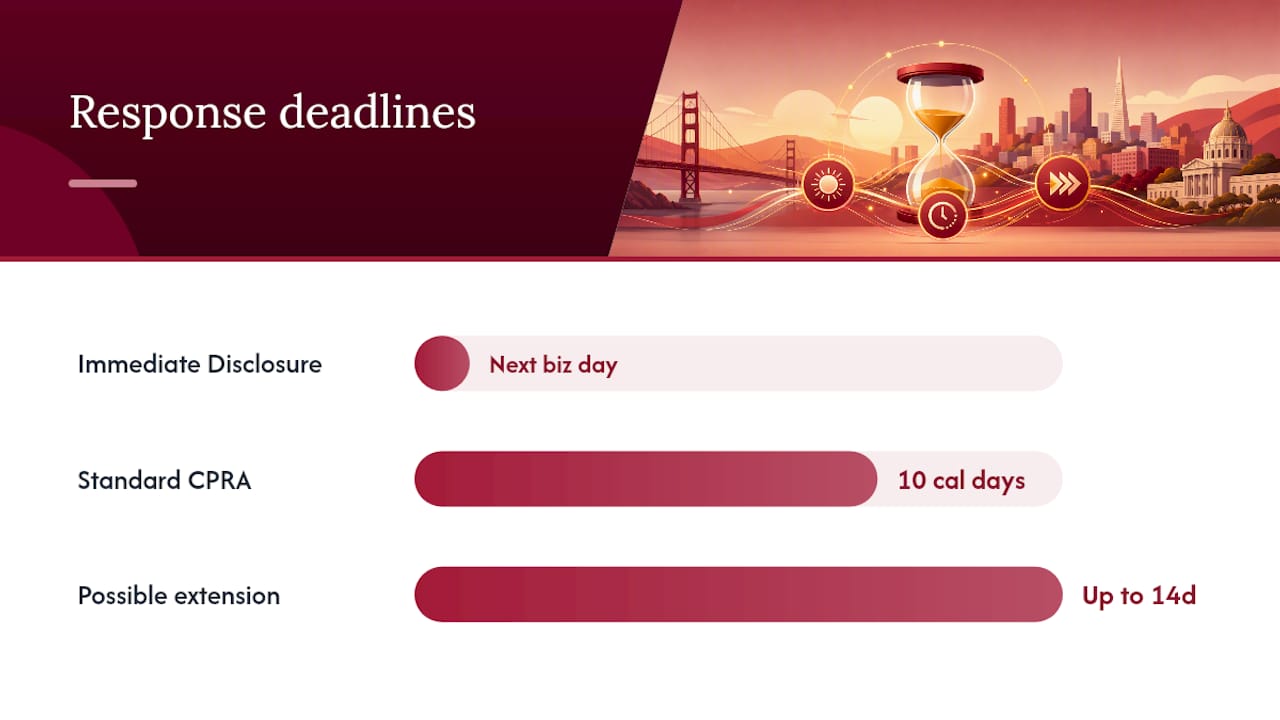
For everything else, the standard CPRA clock applies: a 10 calendar day response window from the date of your request. Departments can extend that by up to 14 additional days, but only for specific reasons, and they have to tell you in writing why. Valid reasons include needing to search and collect records from separate facilities, needing to consult with another agency with a substantial interest in the records, or compiling data that requires programming or clerical work not normally done.
A few practical rules to know before you submit anything:
- Immediate Disclosure applies to records already assembled, things like current contracts, meeting minutes, or existing correspondence, not to material that requires new compilation.
- Inspection is usually free. You have a right to view records in person at no cost; fees apply mainly to copies.
- Copying fees are typically capped at the direct cost of duplication, and departments cannot charge for staff time spent locating records under the standard request.
- Waiver requests are worth making explicitly if you’re a journalist, nonprofit, or researcher acting in the public interest. Some departments will waive fees when asked directly and given a reason.
Pro Tip: Label your request “Immediate Disclosure Request” in the subject line and first sentence if you believe the records already exist in ready-to-hand form. Departments sometimes default to the slower 10 day track simply because nobody flagged the faster option.
Which City Agencies Fall Under the Sunshine Ordinance?
Not every public body in San Francisco answers to Chapter 67. The ordinance covers city-created departments, boards, commissions, and the Board of Supervisors itself, but several bodies with quasi-independent status, including the San Francisco Housing Authority and the San Francisco Unified School District, operate under state law only, meaning the CPRA and Brown Act apply to them without the ordinance’s additional local requirements.
Even within covered agencies, common exemptions get invoked to justify withholding:
- Attorney-client privileged communications, though this gets asserted far more broadly than the law actually allows.
- Personnel records, particularly disciplinary files and performance reviews.
- Active law enforcement investigatory records, especially open case files.
- Security-sensitive infrastructure information, like building schematics for critical facilities.
If a department claims an exemption without specifying which one, or applies it to an entire document instead of the specific withheld portion, that’s a legitimate basis to challenge the response through an SOTF complaint or a Supervisor of Records petition.
Who Keeps San Francisco’s Records, and for How Long?
Records don’t sit around forever, and departments have a legal duty to plan for that under Chapter 8 of the Administrative Code. Each department must adopt a two-part Records Retention and Destruction Policy: a Part I general policy statement and a Part II schedule specifying exactly how long each record type gets kept before disposal.
That matters for requesters because a request for something that’s already been legally destroyed per an approved schedule will come back empty, and that’s not stonewalling. The consolidated Index of Records on the city’s data portal collects Part II schedules from participating departments in one place, letting you check retention windows before you file.
A few things worth knowing:
- Check the schedule first if you’re requesting older records; it saves a wasted request cycle.
- Ask for the retention schedule itself if a department claims records don’t exist. It’s a public record and reveals whether destruction was actually authorized.
- Report suspected improper destruction to the SOTF or Supervisor of Records immediately. Destroying records outside an approved schedule, especially after a request has already been filed, can itself become the basis of a complaint.
Building a Request or Complaint That Actually Works
Most disclosure failures aren’t really legal disputes. They’re documentation failures. A specific, well organized request forces a faster, cleaner response, and a well organized complaint gives SOTF exactly what it needs to rule quickly.
- Identify the likely custodian. Name the specific department or office, not just “the City,” and if possible name the division that would hold the record.
- Narrow your date range. “All emails” gets you a slow response and a fee dispute. “Emails between these two named staff, this specific three week window” gets you an answer.
- Specify the format you want. Native electronic files preserve metadata that PDFs strip out, which matters if litigation is even a remote possibility later.
- Flag Immediate Disclosure explicitly if the record should already be assembled and accessible.
- Keep a request log. Note the date sent, the channel used, and every follow up. This log becomes your exhibit if you escalate.
- Preserve your own correspondence. Save the original request and every reply as PDFs with timestamps, not just as emails that could get lost in a mailbox migration.
- Attach everything to an SOTF complaint if you file one. Include the original request, the response or non response, and your timeline log as exhibits.
Pro Tip: If a response comes back late or incomplete, reply in writing within a few days acknowledging the gap and setting a specific follow up date. That paper trail becomes powerful evidence if the matter later goes to SOTF or the Supervisor of Records, because it shows you gave the department a real chance to cure the problem before you escalated.
For readers who want request language modeled after successful FOIA and CPRA requests, keeping the ask narrow and the legal citation specific consistently produces faster turnaround than a broad, open-ended demand.
When Should You Bring In a Transparency Attorney?
Most Sunshine Ordinance disputes never need a lawyer. But certain patterns signal it’s time to consult one: a department repeatedly missing statutory deadlines, an overbroad privilege claim applied to an entire record set instead of specific withheld portions, or a records dispute tangled up with a broader civil rights or discrimination claim.
Reporting on the Mayor’s Office’s handling of a records request tied to a call with former President Trump documented exactly this pattern, SOTF found the office had violated transparency law by improperly withholding records, illustrating how even a favorable task force ruling sometimes needs follow through to produce actual compliance.
Legal remedies beyond the administrative track include motions to compel disclosure, fee dispute litigation when a department imposes unlawful charges, and formal lawsuits when an agency simply refuses to comply after exhausting SOTF and Supervisor of Records channels. Javitch Law Office’s public records practice has represented residents and advocates navigating exactly these escalation points, from drafting initial requests to litigating outright refusals.
A Publisher’s Take on Sunshine Ordinance Enforcement
Public access to government records isn’t a bureaucratic nicety. It’s how residents catch problems before they calcify into scandals, and the Trump call episode is a clean example of that in action. What tends to get missed is how often delay functions as the actual denial. A department that drags a response past 14 days, or slaps “privileged” on a whole file instead of the specific pages that qualify, is often just running out the clock on public attention.
Use the checklist. Document everything. If a department won’t budge after SOTF has already weighed in, that’s exactly when persistence and, sometimes, legal counsel start to matter.
— Mark
Get Legal Help With Sunshine Ordinance Disputes
Javitch Law Office is the alternative to going it alone once a department stops responding to SOTF findings or buries a legitimate request under a vague privilege claim. Our public records and civil rights team handles exactly the escalation points this guide covers: motions to compel, fee waiver disputes, and litigation when administrative channels have run their course.

We built our transparency practice around cases that started as a simple SOTF complaint and turned into something bigger, whether that meant a records dispute tangled up with a discrimination claim or a department that simply refused to comply after a favorable ruling. If you’re a resident, journalist, or advocate stuck past the point where a complaint form is enough, contact our public records and FOIA attorneys for an initial case assessment. We’ll tell you plainly whether litigation makes sense for your situation before you spend another month waiting on a response that isn’t coming.
This article is general information, not a substitute for advice from a qualified lawyer. Consult a qualified legal professional about your own circumstances before acting on anything here.
Sources
- THE SAN FRANCISCO SUNSHINE ORDINANCE OF 1999
- Sunshine Ordinance Task Force (SOTF)
- Sunshine Ordinance – San Francisco Ethics Commission