
McGill v. Citibank holds that predispute arbitration clauses waiving the right to seek public injunctive relief are unenforceable under California law. The Federal Arbitration Act does not preempt that rule. In practice, that means a California plaintiff can still pursue statutory injunctions under the Unfair Competition Law or the Consumers Legal Remedies Act even when a contract’s arbitration clause tries to shut that door. The catch: federal courts don’t always agree on what counts as “public,” and that fight is far from over.
TL;DR:
- A waiver of public injunctive relief in arbitration clauses is invalid under California law, but private damages claims can still proceed in arbitration.
- Courts assess whether the injunction benefits the public or individual, focusing on whether it targets ongoing conduct affecting others and policy-based harm.
- Federal courts, especially in the Ninth Circuit, are divided on whether the Federal Arbitration Act preempts this California rule, leading to inconsistent application.
- Effective pleadings should emphasize systemic conduct, include evidence of public impact, and frame injunctive relief as public, not private, to survive motions to compel.
- Ongoing litigation and advocacy efforts suggest the legal landscape remains unsettled, with potential future review by the U.S. Supreme Court looming.
Table of Contents
- What the McGill Rule Means Under California Law
- Public Injunctive Relief vs. Private Relief: How Courts Draw the Line
- State Courts vs. Federal Courts: Where McGill Gets Contested
- How to Plead Public Injunctive Relief and Survive a Motion to Compel
- Defense Strategies and How Plaintiffs Should Respond
- What to Watch Next in McGill Litigation
- A Practical Checklist Before You File or Respond
- Why This Rule Still Matters for California Consumers
- How Javitch Law Office Helps With Public Injunctive Relief Claims
- Primary Sources for Further Reading
- Sources
What the McGill Rule Means Under California Law
The California Supreme Court ruled in McGill v. Citibank, N.A. that a contract clause forcing a consumer to give up the right to seek public injunctive relief, in any forum, violates public policy under Civil Code §3513. That statute bars private parties from contracting away rights established for a public reason. The court built on the earlier Broughton and Cruz line of cases, which had already carved out public injunctive relief as something arbitration couldn’t fully absorb.
Here’s the important boundary: McGill doesn’t ban arbitration clauses generally, and it doesn’t force every dispute into court.
- It only invalidates the specific waiver of public injunctive relief.
- Private damages claims can still go to arbitration under the same agreement.
- The rule applies whether the waiver tries to kill the claim entirely or just redirect it somewhere the remedy isn’t available.
Public Injunctive Relief vs. Private Relief: How Courts Draw the Line
Courts ask whether the injunction primarily benefits the general public or just the individual plaintiff. Three factors do most of the work: the primary purpose of the requested order, who actually benefits from it, and how broad its practical scope is. An order stopping a company from running a deceptive ad campaign aimed at all California consumers reads as public. An order forcing a company to honor one customer’s refund reads as private, even if it’s dressed up in UCL language.
A useful working test:
- Does the injunction target ongoing or future conduct affecting people beyond the plaintiff?
- Would the remedy exist even if the individual plaintiff dropped out of the case?
- Is the harm alleged tied to a policy or practice, not a one-off contract dispute?
Pro Tip: Plead the injunction in terms of what the defendant must stop doing to the public at large, not what it owes you personally. Courts weigh the primary purpose and effect of the relief sought, and vague “and other relief as appropriate” language rarely survives a motion to compel.
State Courts vs. Federal Courts: Where McGill Gets Contested
California state courts treat McGill as settled. Federal courts, especially within the Ninth Circuit, have been messier. Some panels have questioned whether the FAA actually tolerates McGill’s carve out, and a handful of rulings have narrowed how the rule applies once a case lands in federal court.
- Post-McGill Ninth Circuit decisions have, in some instances, limited the rule’s reach or stayed proceedings pending further review, according to Orrick’s analysis of recent rulings.
- Defense counsel continue raising FAA preemption arguments in federal court even though the California Supreme Court already rejected that theory for state claims.
- Removal to federal court can change the outcome. A claim that survives a motion to compel in California Superior Court may face a tougher fight once it’s in federal district court.
If you’re evaluating forum strategy, don’t assume a win in state court predicts a win after removal. The uschamber.com case summary of McGill v. Citibank makes clear that business advocates have never stopped pushing the preemption argument, and that pressure shows up differently depending on which court hears it first.
How to Plead Public Injunctive Relief and Survive a Motion to Compel
The complaint has to do the heavy lifting before a judge ever reaches the arbitration clause. Vague references to “the public interest” won’t cut it.
- Allege a pattern or practice, not an isolated transaction. Widespread deceptive advertising, a standardized contract term, or a recurring billing practice all read as systemic.
- Frame the injury as one that will keep happening to other consumers absent an injunction, not just something that happened to your client once.
- Attach exhibits that show scale: advertising screenshots, the actual policy language, or a corporate memo describing the practice.
- Use consumer declarations, even a few, to demonstrate the harm isn’t unique to the named plaintiff.
Structure the opposition brief around the primary purpose and effect test that California courts apply, then walk through each factor with the specific facts pleaded in your complaint.
Pro Tip: Ask for forward-looking injunctive language, not backward-looking restitution. “Defendant shall cease representing X” reads as public. “Defendant shall refund plaintiff $200” reads as private every time.
Defense Strategies and How Plaintiffs Should Respond
Defense counsel rarely concede the public/private characterization without a fight. Expect them to try three moves: recharacterize the relief as individualized restitution, narrow the requested injunction to something case-specific, or argue the FAA preempts McGill outright in federal court.
- Plaintiffs should anchor every response in Civil Code §3513 and the McGill court’s own reasoning that a waiver eliminating public injunctive relief in any forum is void.
- When defendants argue preemption, point to the fact that the California Supreme Court already considered and rejected that exact argument.
- If the case gets removed, be ready to fight jurisdiction and choice-of-law questions early. Waiting until briefing on the merits is often too late.
What to Watch Next in McGill Litigation
The doctrinal fight over McGill hasn’t settled into a stable equilibrium, and counsel tracking this area should treat it as a moving target rather than fixed law.
- Business advocacy groups keep pressing for review. The Washington Legal Foundation has urged the U.S. Supreme Court to curb what it frames as California’s resistance to the FAA.
- The realistic odds of Supreme Court review remain uncertain, but repeated advocacy filings signal the issue is being teed up for a future petition.
- Watch Ninth Circuit docket activity closely. Panels there have already shown willingness to narrow McGill’s application in specific fact patterns.
Statistic Callout: No official count exists for how many McGill-based motions to compel arbitration have been filed statewide, but the volume of appellate commentary since 2017 signals this remains one of the most actively litigated arbitration issues in California consumer law.
A Practical Checklist Before You File or Respond
Whether you’re drafting a complaint or answering a motion to compel, a few steps make the difference between a public injunctive relief claim that survives and one that gets compelled into arbitration.
- Draft the complaint around systemic conduct, not the plaintiff’s individual grievance.
- Gather exhibits early: advertising materials, policy documents, consumer complaints filed with agencies like the Consumer Financial Protection Bureau.
- If served with a motion to compel, respond with declarations showing scope and repetition of the harm.
- Decide early whether federal removal helps or hurts your characterization argument, and brief jurisdiction before it becomes an afterthought.
Pro Tip: Keep a running file of every public-facing statement the defendant has made about the practice at issue. Those statements often become your strongest exhibit for showing the injunction serves the public, not just your client.
Why This Rule Still Matters for California Consumers
McGill gives California consumers a real tool against arbitration clauses that try to erase statutory injunctions entirely. That tool matters most in cases involving deceptive advertising, auto-renewal traps, and robocall violations, the kind of conduct Javitch Law Office sees repeatedly in consumer class action work. The firm’s civil-rights and consumer-protection practice tracks these appellate developments closely because the line between public and private relief often decides whether a claim survives at all.
— Mark
How Javitch Law Office Helps With Public Injunctive Relief Claims
Certain fact patterns where McGill comes up most include deceptive pricing, auto-renewal violations, robocall abuse, and other UCL and CLRA claims where a company tries to bury public injunctive relief inside an arbitration clause. Some legal teams specialize in consumer class actions and civil-rights litigation, so the public/private characterization fight is not unfamiliar territory.
If you’ve been served with a contract that waives your right to injunctive relief, or you’re a business owner trying to understand where that waiver actually holds up, a case review can clarify where you stand before a motion to compel forces the issue. Visit the consumer class action practice page to request a free case assessment and find out whether your claim has the systemic elements McGill protects.
Primary Sources for Further Reading
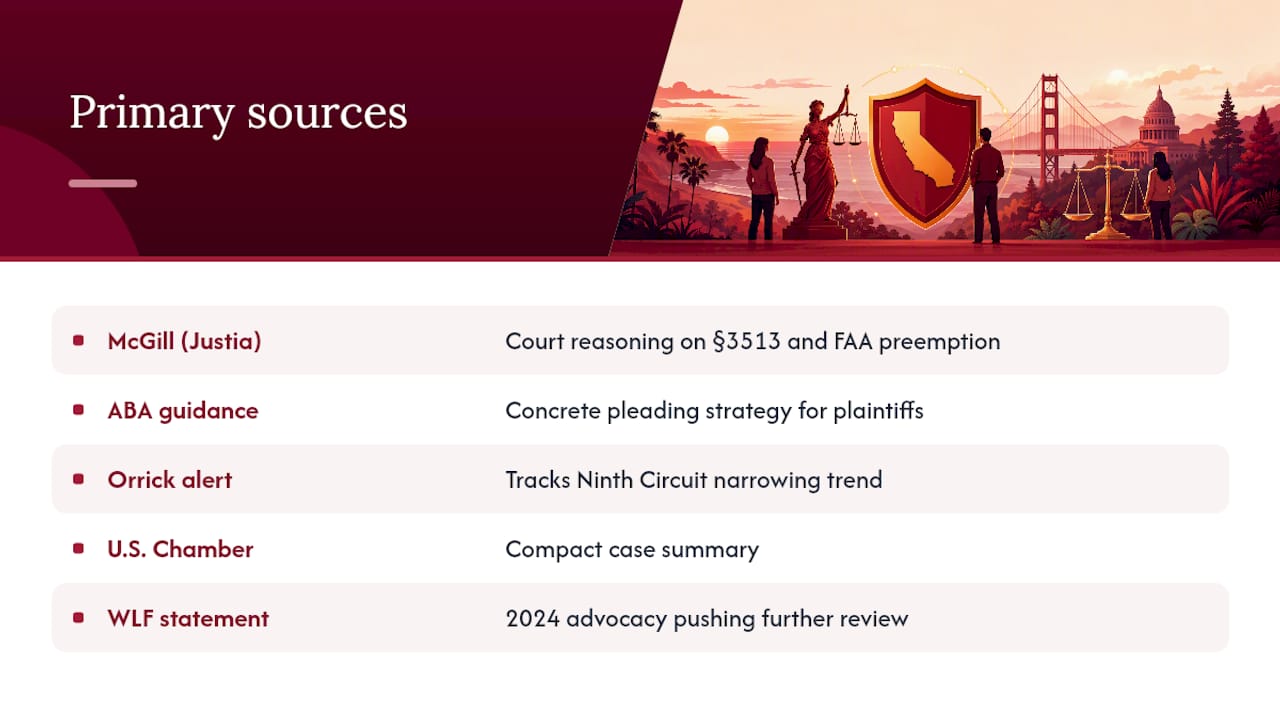
For direct research, start with the full McGill opinion on Justia, which contains the Court’s actual reasoning on Civil Code §3513 and FAA preemption. The ABA’s practitioner guidance offers concrete pleading strategy, while Orrick’s client alert tracks the Ninth Circuit’s narrowing trend. The U.S. Chamber’s case summary and the WLF’s 2024 statement round out the advocacy landscape pushing for further review.
Sources
- McGill v. Citibank, N.A. :: 2017 :: Supreme Court of California Decisions :: Justia
- Litigating motions to compel arbitration under the McGill rule | American Bar Association
- McGill v. Citibank, N.A. | U.S. Chamber of Commerce
- WLF urges Supreme Court to rein in California’s ongoing hostility to the Federal Arbitration Act | WLF (2024)