
A municipality can be sued under 42 U.S.C. § 1983 when its own policy, custom, or deliberate indifference to a training need causes a constitutional violation. That is the holding of Monell v. Department of Social Services, 436 U.S. 658 (1978), and it remains the controlling framework for every civil rights claim against a city, county, school district, or other local government entity. The Court in Monell drew a hard line: no respondeat superior, no automatic liability for what an officer does. The municipality itself must be the wrongdoer.
Three theories sustain municipal liability under this framework:
- Official policy — a written rule, ordinance, or formal decision by a final policymaker (Monell; Pembaur v. Cincinnati, 475 U.S. 469 (1986))
- Widespread custom or practice — conduct so persistent and well-settled that it effectively carries the force of policy
- Failure to train, supervise, or screen — deliberate indifference to a known training need that causes the violation (City of Canton v. Harris, 489 U.S. 378 (1989); Board of County Commissioners of Bryan County v. Brown, 520 U.S. 397 (1997))
Table of Contents
- What are the legal elements of a Monell claim?
- How does the “moving force” requirement work in practice?
- How do you plead a Monell claim that survives a motion to dismiss?
- What evidence do you need to build a Monell case?
- What procedural hurdles will you face in a Monell suit?
- What relief can you recover in a Monell suit?
- What do empirical studies say about Monell litigation outcomes?
- Key Takeaways
- Why Monell claims demand more than most lawyers give them
- Javitchlawoffice can help you pursue a Monell claim
- Key cases, statutes, and further reading
What are the legal elements of a Monell claim?
Every Monell claim, regardless of theory, requires four elements. Miss any one of them and the claim fails at the pleading stage or on summary judgment.
1. Deprivation of a federal right. The plaintiff must show an actual violation of a right secured by the Constitution or federal law. This is the predicate. Without it, there is no § 1983 claim at all, municipal or otherwise.
2. Attribution to the municipality. The violation must be traceable to an official policy, an entrenched custom, or deliberate indifference by policymakers. This is where most Monell claims live or die. A rogue officer acting on personal initiative does not expose the city to liability.
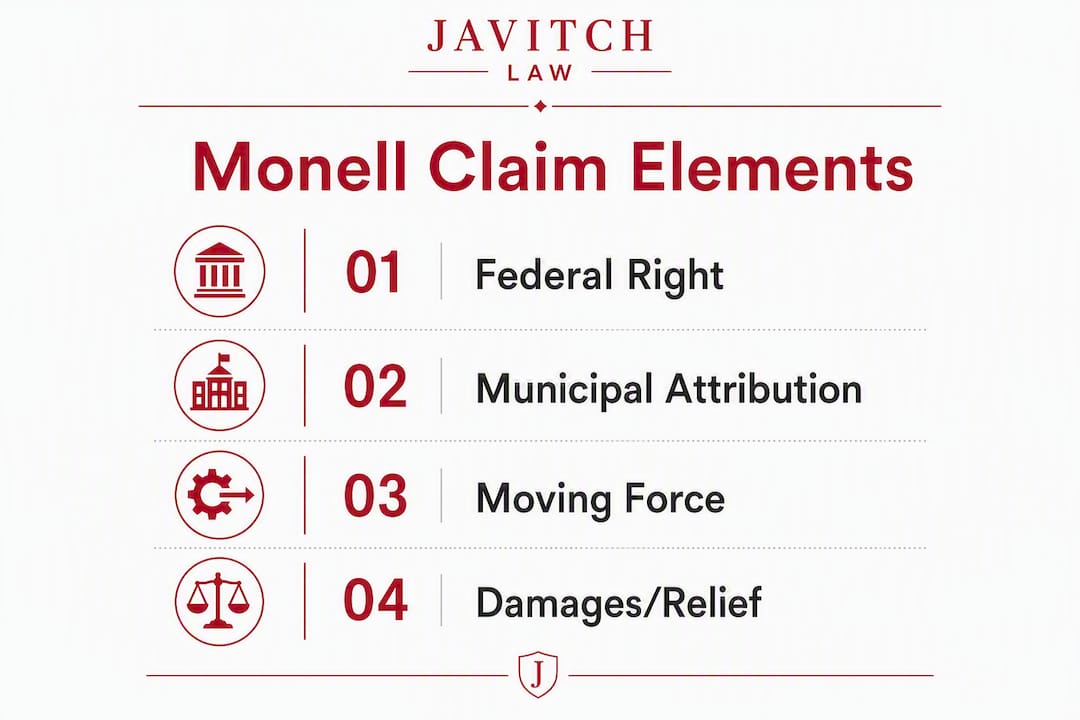
3. Causation — the “moving force” requirement. The municipal policy or custom must be the moving force behind the constitutional deprivation. Courts take this seriously. A loose connection between a policy and an injury will not survive summary judgment.
4. Damages or entitlement to relief under § 1983. The plaintiff must have suffered a cognizable injury for which § 1983 provides a remedy, whether compensatory damages, injunctive relief, or declaratory relief.
The three recognized theories in detail
Official policy. The clearest path. If the municipality has a written rule, ordinance, or formal resolution that on its face violates the Constitution, the plaintiff points to the document. Monell itself involved a formal city policy requiring pregnant employees to take unpaid leave before it was medically necessary. Pembaur v. City of Cincinnati extended this to single decisions: a single decision by an official with final policymaking authority constitutes official municipal policy, even without a written rule. The key is that the decision-maker must hold final authority under state law, not just supervisory rank.
Custom or practice. Harder to prove, but often more realistic. A custom is conduct that is so persistent, widespread, and well-settled that it effectively carries the force of law, even without formal adoption. Courts look for a pattern of similar incidents, supervisory awareness, and absence of corrective action. One incident almost never establishes a custom. Plaintiffs need documented prior complaints, discipline records, prior lawsuits, or statistical data showing the conduct was routine.
Failure to train, supervise, or screen. City of Canton v. Harris set out the failure-to-train standard, which requires proof that policymakers were deliberately indifferent to a known training need and that the deficiency caused the violation. Bryan County v. Brown applied the same deliberate indifference standard to hiring and screening decisions. Deliberate indifference typically means policymakers had notice of the need through prior similar unconstitutional conduct and failed to act. Connick v. Thompson, 563 U.S. 51 (2011), tightened this further: a single Brady violation by a prosecutor did not establish deliberate indifference to a training need without proof of a pattern of similar violations.
Final policymaker identification
Final policymaker status is a matter of state law and turns on local charters, ordinances, and delegation patterns. A police chief may be a final policymaker for patrol procedures but not for personnel decisions if those are reserved to a civil service board. Plaintiffs should research the specific municipal structure before alleging final policymaker status in a complaint. Getting this wrong invites a motion to dismiss that is hard to cure.
How does the “moving force” requirement work in practice?
Causation in a Monell case is not ordinary proximate cause. The plaintiff must show that the municipal policy or custom was the moving force behind the constitutional violation. This phrase comes from Monell itself and was amplified in Pembaur and Bryan County v. Brown.

What does “moving force” actually mean? It means the policy or custom must be the direct cause of the specific constitutional harm, not just a background condition that made the harm possible. A city’s general policy of aggressive policing does not become the moving force behind every excessive-force incident. The plaintiff must draw a direct line from the specific policy, custom, or training deficiency to the specific injury.
Three scenarios illustrate how courts apply this:
-
Single final-policy decision (Pembaur). A county prosecutor ordered deputies to forcibly enter a doctor’s office without a warrant. Because the prosecutor had final policymaking authority over that decision under Ohio law, the single order constituted official policy and was the direct moving force behind the Fourth Amendment violation. No pattern needed.
-
Failure to train with prior notice (Canton and Bryan County). In Canton, the city’s policy of leaving training decisions to shift supervisors, combined with evidence that officers routinely needed to make medical-care decisions, was enough to show deliberate indifference. In Bryan County, hiring a deputy with a violent criminal record without adequate screening was the moving force behind a subsequent use-of-force injury, but only because the plaintiff showed the specific risk the inadequate screening created.
-
Custom-based claims. Here, a single incident almost never suffices. Plaintiffs generally need records showing a pattern of prior misconduct or policymaker notice to survive motions. The pattern itself is the moving force evidence: it shows the municipality knew about the conduct, tolerated it, and effectively sanctioned it through inaction.
Framing causation allegations to survive Iqbal/Twombly
After Ashcroft v. Iqbal, 556 U.S. 662 (2009), and Bell Atlantic Corp. v. Twombly, 550 U.S. 544 (2007), conclusory causation allegations are fatal. Specific pleading guidance:
- Identify the precise policy, custom, or training gap by name or description
- Allege facts showing the municipality knew about the risk (prior incidents, complaints, audits)
- Connect the specific deficiency to the specific harm with factual allegations, not legal conclusions
- Allege that no corrective action was taken despite that knowledge
- Name the final policymaker and explain their authority under state law
How do you plead a Monell claim that survives a motion to dismiss?
Structure matters as much as substance. A well-organized complaint separates the § 1983 individual-capacity counts from the Monell municipal count, gives each count its own header, and ties every factual paragraph to the specific theory of liability. Judges reading a sprawling complaint that buries the Monell theory in a wall of text will grant the motion to dismiss.
Complaint structure for a Monell count
A workable structure looks like this:
- Jurisdiction and parties — identify the municipality as a “person” under § 1983 and plead its capacity to be sued
- Factual background — chronological facts about the incident, the actors, and the constitutional harm
- Individual-capacity counts — § 1983 claims against officers, with qualified immunity addressed
- Monell count — separate count with its own header; identify the theory (policy, custom, or failure to train); allege each element with specific facts
- Relief requested — damages, injunctive relief, declaratory relief, attorney’s fees under 42 U.S.C. § 1988
Pleading checklist: what to include
Practice guides and law reviews document the most common pleading pitfalls: failure to tie specific policies to injuries, inadequate allegations of notice or policymaker authority, and failing to plead custom with sufficient factual specificity. For each theory, include:
Official policy:
- Cite or quote the specific policy, ordinance, or resolution
- Allege the date it was adopted and by whom
- Identify the final policymaker who adopted or ratified it
- Allege how the policy caused the specific constitutional harm
Custom or practice:
- Allege at least three to five prior incidents of similar conduct with approximate dates
- Allege that supervisors or policymakers knew about the prior incidents
- Allege that no corrective action was taken
- Allege that the pattern was so persistent it constituted an unofficial policy
Failure to train/supervise/screen:
- Identify the specific training gap or screening failure
- Allege prior similar incidents that gave policymakers notice of the need
- Allege that policymakers chose not to act despite that notice
- Connect the specific training gap to the specific constitutional harm
Sample complaint language
Official policy theory: “Defendant City of [X], through its Police Department, maintained a written policy (General Order [No.]) authorizing officers to [describe conduct]. This policy was adopted by Chief [Name], who held final policymaking authority over departmental operations under [State] law. The policy was the direct and moving force behind the deprivation of Plaintiff’s [constitutional right].”
Custom theory: “On multiple prior occasions over several years, officers of Defendant City engaged in similar conduct, as documented in internal complaint records and prior civil rights lawsuits. Defendant’s supervisors were aware of this pattern and took no corrective action, thereby ratifying and perpetuating the custom. This entrenched custom was the moving force behind the constitutional violation Plaintiff suffered.”
Failure to train: “Defendant City failed to train its officers on [specific subject] despite knowledge, through prior incidents including [describe], that officers would routinely encounter situations requiring such training. This failure amounted to deliberate indifference to the rights of persons with whom officers come into contact, and was the direct cause of Plaintiff’s injuries.”
Pro Tip: Before filing, submit FOIA and public records requests for the department’s training curricula, use-of-force policies, complaint logs, and prior civil rights settlements. Courts are more forgiving of incomplete factual allegations when the plaintiff can show the key evidence is in the defendant’s control and that pre-filing investigation was attempted. Document every request and response in your file.
A note on notice pleading vs. plausibility
Federal courts apply the Iqbal/Twombly plausibility standard, not the old notice-pleading standard. But courts also recognize that Monell facts are often in the defendant’s exclusive control. Some circuits allow more latitude when plaintiffs allege that they sought records through FOIA or public records requests and were denied. Pleading those pre-filing efforts strengthens the complaint and signals to the court that the plaintiff is not speculating.
What evidence do you need to build a Monell case?
The factual predicate for a Monell claim rarely falls into your lap. It requires deliberate investigation before and during litigation. The evidence types that matter most map directly onto the three theories.
| Evidence Source | What It Proves | Theory Supported |
|---|---|---|
| Written policies, general orders, SOPs | Express official policy; policy content | Official policy |
| Training curricula, roll-call notes | What officers were (or were not) taught | Failure to train |
| Internal complaint and discipline records | Prior incidents; supervisory knowledge; pattern | Custom; failure to supervise |
| Prior civil rights lawsuits and settlements | Pattern of similar violations; municipal awareness | Custom; deliberate indifference |
| Internal emails, memos, meeting minutes | Policymaker knowledge; deliberate decisions | All three theories |
| Body-worn camera footage | Incident facts; officer conduct; policy compliance | Individual and Monell counts |
| Statistical data (use-of-force reports, arrest data) | Systemic patterns; disparate impact | Custom; failure to train |
| HR files, hiring and screening records | Screening failures; prior red flags | Failure to screen (Bryan County) |
| Independent audits, inspector general reports | Official findings of systemic problems | Custom; deliberate indifference |
| Press archives, news investigations | Public awareness; prior incidents | Custom; notice |
FOIA and public records requests
Knowing how to sue for public records is a core litigation skill in Monell cases. Submit requests early, before filing, and be specific. Effective request language for a police misconduct case:
“All complaints, grievances, or internal affairs investigations involving use of force by officers of [Department] from [Date] to [Date], including disposition records and any disciplinary actions taken.”
“All training materials, curricula, lesson plans, and roll-call training records used by [Department] for use-of-force training from [Date] to [Date].”
Common exemptions you will encounter: law enforcement investigative records, personnel privacy exemptions, and deliberative process privilege. When records are withheld, request a Vaughn index (a log describing each withheld document and the exemption claimed), then evaluate whether to litigate the denial. In many states, public records litigation is faster and cheaper than federal discovery.
Pro Tip: File FOIA and state public records requests the same day you open the file, not after you file the complaint. Agencies have statutory response windows, and the records you receive before filing will sharpen your allegations and reduce the risk of a successful motion to dismiss.
Discovery strategy
Once in litigation, sequence your discovery to build the Monell case systematically:
- Send targeted document requests for all evidence types in the table above on day one of the discovery period
- Issue litigation hold letters to the municipality immediately after filing to preserve ESI, body camera footage, and complaint records
- Depose the final policymaker first to lock in their account of the policy and their knowledge of prior incidents
- Depose trainers and supervisors to establish what training was provided and what gaps existed
- Use expert witnesses to analyze statistical patterns in use-of-force data or complaint records, which converts raw numbers into evidence of systemic failure
- At the meet-and-confer, narrow disputes early by identifying the specific custodians and date ranges most likely to hold relevant records
What procedural hurdles will you face in a Monell suit?
Monell claims are procedurally demanding. Municipalities move aggressively to dismiss Monell counts early in litigation, and the empirical record shows those motions succeed at higher rates than motions against individual-capacity claims. Knowing the playbook in advance is half the battle.
Common defensive strategies
-
Motion to dismiss for failure to plead. The most common early attack. Municipalities argue that the complaint’s Monell allegations are conclusory, that no specific policy is identified, or that the custom allegations lack factual specificity. The fix is granular pre-filing investigation and specific factual allegations, as described above.
-
Motion for summary judgment on causation. Even if the complaint survives, municipalities argue at summary judgment that the plaintiff has not produced evidence of a direct causal link between the policy and the harm. This is where the evidence table above becomes critical.
-
Qualified immunity for individual officers. Qualified immunity does not apply to municipalities directly. But it creates a strategic problem: some circuits treat a grant of qualified immunity to the officer as foreclosing a related Monell failure-to-train claim, while others allow the Monell claim to proceed regardless. This is the “backdoor municipal immunity” problem, and the circuit split makes jurisdiction choice strategically important.
-
Bifurcation. Municipalities often move to bifurcate the Monell count from the individual-capacity counts, arguing that if the individual claims fail, the Monell claim is moot. Courts sometimes grant bifurcation, which can delay and complicate Monell discovery.
-
“No underlying violation” argument. If the individual officer prevails (through qualified immunity or on the merits), some municipalities argue there is no predicate constitutional violation to support the Monell claim. Connick v. Thompson illustrates how this plays out: the Supreme Court reversed a $14 million Monell verdict because the plaintiff could not show a pattern of similar Brady violations sufficient to establish deliberate indifference.
Typical litigation timeline
A Monell case in federal court typically moves through:
- Filing and service (months 1–2)
- Motion to dismiss (months 3–6, with briefing and argument)
- Discovery (months 7–18, often extended in complex Monell cases)
- Summary judgment (months 19–24)
- Trial (months 25–36, if the case survives)
Monell counts are most vulnerable at steps 2 and 4. Many plaintiffs abandon the municipal count after a successful motion to dismiss, which is why pre-filing investigation is so important.
Counterstrategies
- Structure discovery to avoid premature dismissal. If the court grants a motion to dismiss with leave to amend, use the amendment to add the specific facts you have gathered through FOIA and early informal investigation.
- Oppose bifurcation. Argue that Monell discovery and individual-capacity discovery overlap substantially and that bifurcation would waste judicial resources.
- Address backdoor immunity in the complaint. In circuits where the issue is live, plead the Monell claim as independent of the individual-capacity outcome and cite circuit authority supporting that position.
- Use sealed or in-camera filings where personnel records or sensitive investigative files are at issue and the municipality resists production.
Pro Tip: Send a litigation hold letter to the municipality the day you file the complaint. Body camera footage, complaint records, and ESI are routinely overwritten on short retention cycles. A documented hold letter creates spoliation arguments if evidence disappears, and courts take those arguments seriously.
What relief can you recover in a Monell suit?
The remedies available against a municipality under § 1983 are broader than most plaintiffs expect, and they serve different strategic purposes.
-
Compensatory damages. The primary monetary remedy. Covers actual losses: medical expenses, lost wages, pain and suffering, emotional distress. Municipalities cannot claim Eleventh Amendment immunity in federal court because they are not “states” for Eleventh Amendment purposes, so compensatory damages are fully available.
-
Nominal damages. Available when a constitutional violation is proven but actual damages are difficult to quantify. Useful in cases where the primary goal is injunctive relief or a declaratory judgment.
-
Punitive damages. Not available against municipalities. The Supreme Court held in City of Newport v. Fact Concerts, Inc., 453 U.S. 247 (1981), that municipalities are immune from punitive damages under § 1983. Punitive damages remain available against individual officers in their personal capacity.
-
Injunctive relief. Often the most powerful remedy in a Monell case. A court can order the municipality to change its policies, implement new training programs, hire an independent monitor, or enter a consent decree. Injunctive relief drives systemic reform in a way that a damages payment never does.
-
Declaratory relief. A court declaration that the municipality’s policy or practice violates the Constitution. Useful as a standalone remedy or as a predicate for injunctive relief.
-
Attorney’s fees. Under 42 U.S.C. § 1988, a prevailing plaintiff in a § 1983 case is entitled to reasonable attorney’s fees from the defendant. This makes civil rights litigation economically viable even when damages are modest.
Indemnification and what it means for recovery
Because municipalities often indemnify officers, a successful Monell suit may produce the same financial recovery as a judgment against an officer alone. But the Monell claim remains uniquely valuable for injunctive relief and driving systemic reform. A damages payment to one plaintiff does not change the policy. An injunction does.
When monetary recovery against individual officers is uncertain (because of qualified immunity or limited personal assets), injunctive relief against the municipality may be the stronger strategic play. Consent decrees in particular can produce lasting structural changes that protect future victims.
What do empirical studies say about Monell litigation outcomes?
The honest answer is that Monell claims are hard to win. Empirical studies show Monell claims are dismissed more often than individual-capacity claims, and plaintiffs frequently abandon the municipal count during litigation because of expense and low success rates. Understanding why helps you avoid the same traps.
The most common failure points, drawn from empirical and scholarly work:
- Wrong policymaker — Plaintiffs allege that a supervisor was the final policymaker without checking state law. The municipality moves to dismiss, and the plaintiff cannot cure the defect.
The “backdoor municipal immunity” problem
Circuit splits on whether qualified immunity bars related Monell failure-to-train claims make jurisdiction choice and targeted pleadings strategically important. In circuits that treat qualified immunity as foreclosing the Monell claim, a plaintiff who loses the individual-capacity count on immunity grounds may lose the municipal count as well, even if the training failure was real and documented. In circuits that allow the Monell claim to proceed independently, the plaintiff has a second bite.
Before filing, research the circuit’s position on this issue. If you are in a circuit that applies backdoor immunity, consider whether to structure the complaint to minimize the risk, or whether the facts support a standalone municipal liability theory that does not depend on the individual officer’s liability.
Practical recommendations grounded in the empirical record
- Begin pre-filing investigation with FOIA and public records requests targeting prior incidents, discipline records, and training materials
- Focus on notice: the more documented evidence of prior similar conduct, the stronger the deliberate indifference argument
- Prepare for aggressive early motions and budget for them
- Consider injunctive relief as the primary remedy when damages avenues are weak
- Use local data strategies: discipline records, press archives, independent audits, and inspector general reports convert scholarly insights into factual predicates for a complaint
- The “moving force” requirement forces plaintiffs to investigate systemic failures rather than rely on isolated officer misconduct — treat this as a feature, not a burden, because systemic evidence is also what drives settlement
Key Takeaways
A successful Monell claim requires specific factual evidence tying a municipal policy, custom, or training failure directly to the constitutional harm, and that evidence must be gathered before filing, not after.
| Point | Details |
|---|---|
| Three theories of liability | Official policy, widespread custom, and failure to train/supervise/screen are the only recognized paths to municipal liability under § 1983. |
| Moving force causation | The municipal policy or custom must be the direct moving force behind the violation, not just a background condition. |
| Pattern evidence is critical | One incident rarely establishes a custom; prior complaints, discipline records, and prior lawsuits are the factual foundation courts require. |
| Empirical dismissal risk | Monell claims face higher dismissal rates than individual-capacity claims; pre-filing investigation and granular pleading are the primary defenses against early dismissal. |
| Javitchlawoffice approach | Javitchlawoffice handles civil rights and discrimination claims, including Monell-related matters, using FOIA litigation and public records strategies to build the factual record courts require. |
Why Monell claims demand more than most lawyers give them
The conventional wisdom in civil rights litigation is that you name the officer, add the municipality for good measure, and see what survives. That approach fails Monell counts at a predictable rate, and the empirical record is clear about why.
What most practitioners underestimate is how much the “moving force” requirement actually reshapes the entire investigation. It is not a pleading formality. It is a directive to look past the officer and ask whether the institution itself is the problem. That question requires a different kind of evidence, a different kind of discovery, and a different theory of the case.
The cases where Monell claims succeed tend to share one feature: the plaintiff came to court with documented evidence of prior incidents, supervisory knowledge, and a specific policy or training gap, gathered before the complaint was filed. Not after discovery opened. Before. That means FOIA requests, public records litigation, press archive searches, and a careful read of the municipality’s own documents. It means identifying the final policymaker under state law before alleging their authority in the complaint.
The Connick v. Thompson loss is instructive. A man spent 18 years on death row because prosecutors withheld exculpatory evidence. The jury awarded $14 million. The Supreme Court reversed because the plaintiff could not show a pattern of similar Brady violations. One incident, however egregious, was not enough. That outcome is not an argument against Monell claims. It is an argument for doing the factual work before you file.
Injunctive relief also deserves more strategic weight than it typically gets. A damages payment compensates one plaintiff. A consent decree with an independent monitor changes what happens to the next hundred. For plaintiffs whose primary goal is accountability rather than compensation, or whose damages case is complicated by qualified immunity for the individual officers, the injunctive track is often the stronger play.
The circuit split on backdoor municipal immunity is the other variable that practitioners routinely underweight. If you are in a circuit that treats a qualified immunity grant to the officer as foreclosing the Monell failure-to-train claim, your entire case strategy needs to account for that risk from day one. Jurisdiction choice, pleading structure, and the sequencing of motions all look different depending on where you are.
Javitchlawoffice can help you pursue a Monell claim
Civil rights claims against municipalities are among the most fact-intensive cases in federal litigation. Javitchlawoffice handles discrimination and civil rights litigation with a practice that spans First Amendment violations, antisemitic and racial discrimination, employment and housing bias, and government transparency through FOIA and public records litigation. That combination matters for Monell cases: the same public records tools that expose government misconduct in a transparency case are the tools that build the factual predicate for a municipal liability claim.

If you believe a city, county, school district, or other local government entity caused a constitutional violation through its policies, customs, or training failures, the time to act is now. Monell claims have strict statute of limitations deadlines (typically the state’s personal injury limitations period, applied through § 1983), and critical evidence, including body camera footage and complaint records, is routinely destroyed on short retention cycles. Javitchlawoffice offers case evaluations for civil rights matters, including First Amendment and free speech claims and discrimination cases involving municipal defendants. Contact the firm to discuss your case and what records to begin collecting.
Key cases, statutes, and further reading
The authorities below are the ones you need to cite in pleadings and rely on in briefing. Each entry notes where it is most useful.
-
Monell v. Department of Social Services, 436 U.S. 658 (1978) — The foundational authority for every Monell claim. Cite in the complaint’s municipal count, in opposition to motions to dismiss, and in any brief addressing the scope of § 1983 liability. Establishes that municipalities are “persons” under § 1983 and that respondeat superior does not apply.
-
Pembaur v. City of Cincinnati, 475 U.S. 469 (1986) — Essential for single-decision and final policymaker arguments. Cite when the Monell theory rests on a single official decision rather than a pattern or practice. Also the key authority for the proposition that final policymaker status is a matter of state law.
-
City of Canton v. Harris, 489 U.S. 378 (1989) — The controlling standard for failure-to-train claims. Cite in every failure-to-train count and in briefing on deliberate indifference. The “deliberate indifference” formulation originates here.
-
Board of County Commissioners of Bryan County v. Brown, 520 U.S. 397 (1997) — Extends the deliberate indifference standard to hiring and screening decisions. Cite when the Monell theory involves inadequate screening of personnel. Also the source of the “direct causal link” language for the moving force requirement.
-
Connick v. Thompson, 563 U.S. 51 (2011) — The cautionary authority for failure-to-train claims. Cite in briefing to show what deliberate indifference requires and, more importantly, to distinguish your facts from a single-incident case. If you have pattern evidence, Connick is your foil.
-
42 U.S.C. § 1983 — The statute. Cite in the jurisdictional section of the complaint and in every § 1983 count. The text is short; quote the relevant portion directly in the complaint.
-
Third Circuit Model Instructions for § 1983 Claims — Useful for understanding how courts frame the elements at trial and for structuring jury instructions in cases that reach that stage.
-
Making Out the Monell Claim under Section 1983, Touro Law Review — The most practical secondary source for pleading guidance. Use for drafting checklists, failure-to-train analysis, and deliberate indifference standards.
-
Backdoor Municipal Immunity, Yale Law Journal — The key secondary source on the circuit split concerning qualified immunity and Monell failure-to-train claims. Use when briefing the backdoor immunity issue and when choosing jurisdiction.
-
Municipal Immunity, Virginia Law Review — The empirical source for dismissal rates and indemnification patterns. Use in case assessment and when advising clients on litigation risk and strategy.
-
Standalone Municipal Liability, Michigan Law Review — Addresses custom-based claims and the pattern evidence required. Use when the Monell theory rests on widespread practice rather than an express policy.
A note on FOIA and public records resources: The firm’s guide on how to sue for public records covers request drafting, exemption responses, and litigation strategy for obtaining municipal records. Use it alongside the primary authorities above to build the factual predicate for a Monell complaint.
This article provides general legal information, not legal advice. Monell doctrine and § 1983 litigation involve complex, fact-specific questions that vary by jurisdiction. Consult a qualified civil rights attorney to evaluate your specific situation.
Recommended
- How to Sue for Public Records: A Guide to FOIA and State Records Litigation | Javitch Law Office
- Consumer Class Action Lawyers | TCPA, Auto Renewal, Price Rule
- First Amendment Violations: When Free Speech Leads to Retaliation | Javitch Law Office
- Javitch Law Office | Civil Rights & Consumer Protection Attorneys