
California’s anti-SLAPP statute, Cal. Civ. Proc. Code § 425.16, gives defendants a powerful early exit from lawsuits targeting protected speech or petitioning activity. File the motion, and discovery freezes automatically. Win it, and you recover mandatory attorney fees. Lose it on frivolous grounds, and you pay the plaintiff’s fees instead. The stakes are high on both sides, which is why understanding the mechanics before a deadline hits matters more than most litigants realize.
Here is what this guide covers and what you should know immediately:
- Who this is for: defendants facing claims arising from speech or petitioning activity, plaintiffs trying to survive or oppose a motion, and counsel advising either side in California state or federal court.
- Immediate procedural effects: filing an anti-SLAPP motion triggers an automatic stay of all discovery by operation of law; the court schedules a hearing promptly, typically within about a month of service unless the court’s docket requires otherwise; a prevailing defendant recovers attorney fees as a matter of right.
- Fee risk runs both ways: a frivolous motion exposes the moving party to a fee award in the plaintiff’s favor under § 425.16©(2).
- Deadlines are short: the motion must generally be filed within 60 days of service of the complaint, though courts have discretion to allow later filing.
Pro Tip: If you have been served with a complaint and believe your conduct involved protected speech or petitioning activity, contact counsel before the 60-day window closes. Missing that deadline does not automatically bar the motion, but it forces you to argue for the court’s discretion rather than relying on the statutory right.
Key Takeaways
California’s anti-SLAPP statute gives defendants a powerful, early-dismissal tool, but fee exposure on both sides means the motion must be filed only when the protected-activity showing is genuinely strong.
| Point | Details |
|---|---|
| Two-step test governs every motion | Defendant shows protected activity at Step 1; plaintiff must produce admissible evidence of probability of prevailing at Step 2. |
| Discovery freezes automatically | Filing the motion stays all discovery by operation of law; lifting the stay requires a noticed motion showing good cause. |
| Fee-shifting runs both ways | A prevailing defendant recovers mandatory fees; a frivolous motion triggers a mandatory fee award to the plaintiff under § 425.16©(2). |
| § 425.17 limits the statute’s reach | Public-interest suits and certain commercial-actor claims are exempt; check these carveouts before filing. |
| Javitch Law Office handles these cases | The firm provides anti-SLAPP motion drafting, opposition strategy, and First Amendment litigation in California state and federal courts. |
Table of Contents
- What California’s anti-SLAPP statute actually says
- How the two-step motion process works in California courts
- What types of claims typically draw anti-SLAPP motions
- Where § 425.17 limits the statute’s reach
- Step-by-step checklist for defendants preparing an anti-SLAPP motion
- How plaintiffs can push back against an anti-SLAPP motion
- How anti-SLAPP issues play out in federal court
- Why anti-SLAPP strategy is more nuanced than most guides admit
- Javitch Law Office handles anti-SLAPP and First Amendment cases in California
- Primary sources and further reading
- Sources
What California’s anti-SLAPP statute actually says
The statute’s core command appears in CCP § 425.16(b)(1):
Plain English: if a lawsuit targets something you said or did in connection with a public issue, you can move to strike it early. The plaintiff then has to show, with admissible evidence, that the claim has a real chance of winning. If they cannot, the case is dismissed and you recover fees.
The statute identifies four categories of protected activity. The California Anti-SLAPP Project (CASP) and the Reporters Committee for Freedom of the Press both track how courts apply each one:
-
Statements or writings made before a legislative, executive, judicial, or other official proceeding. Example: testimony at a city council hearing, a declaration filed in a prior lawsuit, or a complaint submitted to a licensing board.
-
Statements or writings made in connection with an issue under consideration or review by a governmental body. Example: a letter to a planning commission opposing a development project, or a public comment submitted during an agency rulemaking.
-
Statements made in a public forum in connection with an issue of public interest. Example: a Yelp review of a business on a matter of public concern, a social media post about a public figure’s conduct, or a newspaper op-ed.
-
Any other conduct in furtherance of the exercise of the constitutional right of petition or free speech in connection with a public issue or an issue of public interest. This catch-all covers activity that does not fit neatly into the first three categories but still advances protected expression.
The phrase “in connection with a public issue” is where most disputes arise. Courts look at whether the statement contributed to public discourse on a topic of general interest, not just whether it touched on something the speaker cared about personally. A purely private dispute between neighbors over a fence line, for example, rarely qualifies. A dispute over a neighbor’s public statements at a zoning hearing is a different matter entirely.
How the two-step motion process works in California courts
The Judicial Branch of California lays out the procedural framework clearly, and the two-step structure is the heart of every anti-SLAPP motion.
Step 1: The defendant’s burden. The moving party must show that the challenged cause of action arises from protected activity. This is a threshold showing, not a full merits argument. Courts look at the principal thrust of the plaintiff’s claim. If the gravamen of the complaint is the defendant’s protected speech or petitioning conduct, Step 1 is satisfied.
Step 2: The plaintiff’s burden. Once the defendant clears Step 1, the burden shifts. The plaintiff must demonstrate a probability of prevailing on the merits, meaning they must produce admissible evidence sufficient to sustain a favorable judgment if the evidence is credited. Allegations alone are not enough at this stage.
The procedural timeline works as follows.
- File within 60 days of service of the complaint. Courts can allow later filing, but you need a good reason.
- Discovery stays automatically the moment the motion is filed. No depositions, no document requests, nothing, until the motion is resolved or the court lifts the stay.
- The clerk schedules a hearing within 30 days of service of the motion, unless the docket requires otherwise.
- Opposition and reply follow the standard California briefing schedule unless the court orders otherwise.
- The court rules on both steps at the hearing. A ruling for the defendant triggers mandatory fee-shifting.
- Appeals from a grant or denial of an anti-SLAPP motion are immediately appealable as a matter of right, which can extend the litigation calendar significantly.
The discovery stay deserves special attention. Under § 425.16, the stay is automatic and covers all discovery in the action, not just discovery related to the motion. A party who needs specific discovery to oppose the motion can file a noticed motion for good cause, but courts scrutinize these requests carefully. The bar is not low: you need to show that the discovery is essential to your opposition and that you cannot reasonably oppose without it.
Fee-shifting is mandatory, not discretionary. A prevailing defendant recovers attorney fees and costs as a matter of right. The Bar Association of San Francisco’s practice note flags the flip side: if the court finds the motion frivolous or filed solely to cause delay, it must award fees to the plaintiff under § 425.16©(2). That provision has real teeth. Courts have used it, and the resulting fee awards can be substantial.
Evidentiary materials to attach when filing:
| Document | Purpose |
|---|---|
| Defendant’s declaration | Establishes context, timing, and purpose of the protected activity |
| Contemporaneous records (emails, posts, meeting minutes) | Corroborates that the act occurred in a protected context |
| Public-record documents | Confirms the governmental or official proceeding connection |
| Witness declarations | Verifies the public nature of the forum or proceeding |
| Copies of the challenged statements | Ties the plaintiff’s claim directly to the protected activity |
What types of claims typically draw anti-SLAPP motions
Defamation is the most common target. A plaintiff who sues over a statement made in a public forum about a matter of public interest will almost always face an anti-SLAPP motion, and California courts have a long track record of granting them in that context. California defamation laws intersect heavily with § 425.16 because the same facts that support a defamation claim often arise from protected speech.
Beyond defamation, courts have applied the statute to invasion of privacy claims, intentional infliction of emotional distress, malicious prosecution, and business interference claims, when the underlying conduct involves protected activity.
A few illustrative cases show how courts draw the lines:
In Equilon Enterprises v. Consumer Cause, Inc., the California Supreme Court confirmed that the defendant bears only the initial burden of showing the claim arises from protected activity — the plaintiff then carries the full probability-of-prevailing burden. The court rejected the argument that the defendant must also negate the plaintiff’s claims at Step 1.
In Wilbanks v. Wolk, the court applied anti-SLAPP protection to statements made on a website about a matter of public concern, reinforcing that online speech in a public forum qualifies under the third protected category.
Sarver v. Chartier addressed the intersection of anti-SLAPP and the First Amendment in the context of a film depicting real events, with the court analyzing whether the creative work constituted protected expression on a public issue.
The DWT Media Law Monitor has tracked the volume of California anti-SLAPP appellate opinions and noted that the docket remains heavy, reflecting how frequently the statute is litigated across claim types.
Practical fact patterns worth comparing to your situation:
- A homeowner association sends a cease-and-desist letter after a member speaks at a board meeting. The member’s speech at the meeting is protected; the HOA’s responsive lawsuit may be subject to an anti-SLAPP motion.
- A consumer posts a critical review of a contractor on a public platform. The contractor sues for defamation. The review, made in a public forum on a matter of public interest, fits squarely within the third protected category.
- A doctor files a peer-review complaint against a colleague. The colleague sues for interference. The complaint, made in connection with an official proceeding, falls under the first protected category.
- A citizen submits public comments opposing a permit application. The permit applicant sues for tortious interference. The comments, made in connection with a governmental decision, are protected under the second category.
Where § 425.17 limits the statute’s reach
CCP § 425.17 was enacted specifically to curb perceived abuses of § 425.16. The Legislature recognized that some defendants were using anti-SLAPP motions to defeat legitimate public-interest lawsuits, and § 425.17 carves out two significant exceptions.
The first exception covers public-interest litigation. If a plaintiff sues on behalf of the general public, seeks only injunctive relief or statutory penalties available to the public, and does not stand to gain a personal financial benefit beyond what the general public would receive, § 425.16 does not apply. Consumer protection class actions and environmental enforcement suits often fall here.
The second exception targets commercial actors. When a defendant primarily sells goods or services and the challenged statement is a representation of fact about the defendant’s own business, products, or services made to actual or potential customers, the anti-SLAPP statute does not shield that statement. This prevents businesses from using § 425.16 to deflect ordinary false-advertising or consumer-fraud claims.
Courts and practitioners must evaluate § 425.17 before filing. A motion that ignores a clear § 425.17 exemption is not just likely to fail; it risks the frivolous-motion fee sanction. The Thomson Reuters Practical Law resource on California anti-SLAPP practice covers these exemptions in detail and is worth consulting before filing in any commercial context.
Step-by-step checklist for defendants preparing an anti-SLAPP motion
Filing a well-supported motion is not complicated, but it requires discipline on timing and evidence. Here is a practical sequence:
-
Identify the protected activity. Read the complaint carefully. What conduct does the plaintiff actually complain about? Map it to one of the four statutory categories. If the gravamen of the claim is something other than protected speech or petitioning, the motion will fail at Step 1.
-
Check § 425.17. Before drafting anything, confirm that neither the public-interest exception nor the commercial-actor exception applies to the plaintiff’s claims.
-
Calculate the 60-day deadline. Count from the date of service of the complaint. Build in time for drafting, client review, and filing logistics. Courts can extend the deadline, but relying on that discretion is a gamble.
-
Gather declarations and exhibits. You need contemporaneous evidence: timestamped posts or emails, meeting minutes, public-record documents, and witness declarations that establish the context and purpose of the protected activity. Declarations should be specific and factual, not conclusory.
-
Draft the memorandum of points and authorities. Lead with the Step 1 showing. Identify the protected category, quote the relevant statutory language, and tie the plaintiff’s specific allegations to that category. Then address Step 2: explain why the plaintiff cannot show a probability of prevailing, using the complaint’s own allegations and any admissible evidence already in the record.
-
File the notice of motion, memorandum, and supporting declarations. Serve opposing counsel simultaneously. The clerk will schedule the hearing.
-
Monitor the discovery stay. Once filed, all discovery is stayed. If the plaintiff files a motion to lift the stay, prepare to oppose it unless the requested discovery is genuinely narrow and essential.
-
Prepare a fee declaration. If you win, you will need to submit evidence of reasonable attorney fees promptly. Keep contemporaneous billing records from the start.
Pro Tip: The Bar Association of San Francisco’s anti-SLAPP practice note warns explicitly against filing motions designed primarily to delay rather than to vindicate a genuine protected-activity claim. Courts recognize delay tactics, and the § 425.16©(2) sanction is not theoretical. Every factual assertion in the motion should be well supported before you file.
For context on how pretrial motions in California interact with discovery and scheduling, Rubin Law’s overview of California pretrial practice provides useful procedural background.
How plaintiffs can push back against an anti-SLAPP motion
Facing an anti-SLAPP motion does not mean the case is over. Plaintiffs have real options, and the right strategy depends on the strength of the underlying evidence and the nature of the protected activity claimed.
-
Build the Step 2 record immediately. The plaintiff’s burden at Step 2 requires admissible evidence, not just well-pleaded allegations. Gather declarations from witnesses, collect documentary evidence, and identify any expert input needed to establish the elements of the claim. The opposition brief must attach this evidence, not just describe it.
-
Challenge Step 1 directly. If the defendant’s conduct was not actually protected activity, say so with specificity. Courts sometimes grant anti-SLAPP motions on weak Step 1 showings because the plaintiff failed to contest them adequately. Analyze whether the defendant’s conduct truly arose from speech or petitioning in connection with a public issue, or whether it was purely private conduct dressed up in constitutional language.
-
Consider a strategic amendment. If the complaint as filed is vulnerable at Step 2, amending to add more specific factual allegations or to drop the weakest claims can sometimes reduce fee exposure. Courts have discretion on how to handle amendments filed after an anti-SLAPP motion is pending, so timing and framing matter.
-
Move to lift the discovery stay for targeted discovery. If you need specific documents or testimony to oppose the motion and cannot reasonably obtain them otherwise, file a noticed motion for good cause. Keep the request narrow. Courts are more receptive to a request for a single category of documents than to a broad discovery demand.
-
Assess settlement posture early. Once an anti-SLAPP motion is filed, the fee clock is running. If the defendant has a strong Step 1 showing and the plaintiff’s evidence is thin, an early settlement that avoids a fee award may be the most protective outcome. Conversely, if the plaintiff has strong evidence and the motion looks weak, litigating through the hearing may be worth the cost.
-
Watch for dismissal traps. Plaintiffs sometimes try to dismiss claims after an anti-SLAPP motion is filed to avoid a fee award. Courts often retain jurisdiction to determine prevailing party status for fee purposes even after dismissal, so voluntary dismissal alone does not reliably eliminate fee exposure.
How anti-SLAPP issues play out in federal court
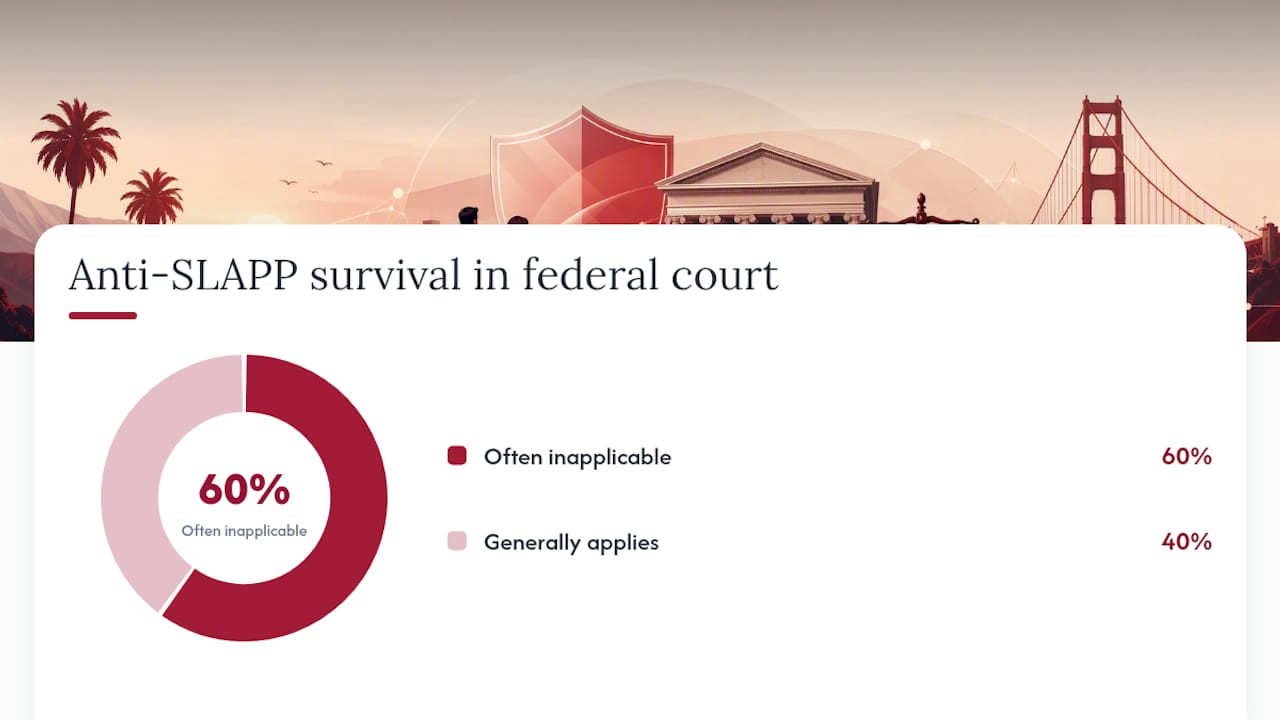
California’s anti-SLAPP statute does not travel seamlessly into federal court. The Erie doctrine requires federal courts sitting in diversity to apply state substantive law but federal procedural rules, and several provisions of § 425.16 create direct conflicts with the Federal Rules of Civil Procedure.
| Provision | California State Court | Federal Court in California |
|---|---|---|
| Discovery stay | Automatic on filing | Often held inapplicable; FRCP governs discovery |
| 60-day filing deadline | Statutory right | Courts split; often treated as directory, not mandatory |
| Fee-shifting for prevailing defendant | Mandatory | Generally upheld as substantive state law |
| Fee sanction for frivolous motion | Mandatory | Generally upheld |
| Expedited hearing schedule | Required by statute | Subject to federal court’s own scheduling order |
The Thomson Reuters Practical Law resource notes that federal courts in California frequently decline to apply the automatic discovery stay and the strict timing provisions, treating them as procedural devices incompatible with the Federal Rules. Fee-shifting, by contrast, is widely treated as substantive and therefore applicable in federal diversity cases.
The Makaeff v. Trump University litigation generated significant discussion of these Erie issues, with the Ninth Circuit grappling with which aspects of § 425.16 survive in federal court. The practical takeaway: if you are in federal court and want the full benefit of California’s anti-SLAPP protections, including the discovery stay, you may not get them. Counsel should brief Erie issues early and not assume that state-court anti-SLAPP practice maps directly onto federal procedure.
Forum selection matters. A defendant who has a choice between state and federal court and wants the automatic discovery stay and the strict 60-day filing right is generally better positioned in California state court. A plaintiff with a strong case and a preference for moving quickly through discovery may find federal court more favorable for exactly the same reason.
Why anti-SLAPP strategy is more nuanced than most guides admit
The conventional framing of anti-SLAPP law treats it as a clean win for defendants: file the motion, freeze discovery, collect fees. That picture is accurate when the motion is well-targeted. When it is not, the statute becomes a liability.
The fee-shifting provision cuts both ways, and courts have become more attentive to motions that look like delay tactics dressed in constitutional language. A defendant who files an anti-SLAPP motion on a weak Step 1 showing, hoping to force a settlement through discovery pressure, is taking a real financial risk. The § 425.16©(2) sanction is not a theoretical backstop; it is an active tool that courts use.
On the plaintiff’s side, the instinct to dismiss and regroup after an anti-SLAPP motion is filed is understandable but often counterproductive. Courts retain jurisdiction over fee questions after dismissal, which means the plaintiff who walks away from a weak claim may still owe the defendant’s legal fees. The better move is usually to assess the Step 2 evidence honestly before filing the complaint, not after the motion lands.
The statute’s interaction with § 425.17 is also underappreciated. Public-interest litigation and consumer-protection claims occupy a space where § 425.16 and § 425.17 push in opposite directions, and the line between them is not always obvious. Practitioners who skip the § 425.17 analysis and assume the anti-SLAPP statute applies are setting up a motion that may fail at the threshold.
What actually works is straightforward: a well-documented showing that the defendant’s conduct falls within a specific protected category, combined with a clear-eyed assessment of whether the plaintiff can produce admissible evidence at Step 2. That combination, done honestly, produces the outcomes the statute was designed to create.
Javitch Law Office handles anti-SLAPP and First Amendment cases in California
When a lawsuit targets your speech, your public comments, or your petitioning activity, the procedural clock starts immediately. Javitch Law Office represents clients in First Amendment and free speech litigation, including anti-SLAPP motions, opposition strategy, and appellate work in California state and federal courts.

The firm’s practice covers the full range of claims where anti-SLAPP issues arise: discrimination and civil rights cases, consumer protection litigation, and government transparency matters where public records and petitioning activity intersect. Unlike a general litigation firm, Javitch Law Office focuses on cases where constitutional rights are at stake, which means the anti-SLAPP analysis is not an afterthought but a core part of case strategy from day one.
If you have been served with a complaint and need to evaluate whether an anti-SLAPP motion applies, or if you are facing a motion and need to build your opposition record, contact Javitch Law Office for a case evaluation. The 60-day filing window does not wait.
Primary sources and further reading
Use official and primary sources when drafting filings. Secondary resources are useful for practice context, but courts expect citations to the statute itself and binding California authority.
- Cal. Civ. Proc. Code § 425.16 — FindLaw annotated text: the operative statutory text, including all four protected categories, the 60-day filing reference, the discovery stay, and the fee-shifting provisions.
- Cal. Civ. Proc. Code § 425.17 — California Legislative Information: the statutory exemptions enacted to limit § 425.16 misuse, including the public-interest and commercial-actor carveouts.
- Judicial Branch of California — Special Motions to Strike (SLAPPs): official court guidance on filing procedures, reporting requirements, and practical process points.
- Reporters Committee for Freedom of the Press — California Anti-SLAPP Guide: practical, journalist-focused summary of protected activity categories and public-interest speech protections.
- California Anti-SLAPP Project (CASP) — § 425.16 Resources: practitioner-oriented statutory summaries and appellate ruling tracking.
- Bar Association of San Francisco — Anti-SLAPP Practice Note: tactical guidance on fee exposure, discovery stay mechanics, and federal-court issues.
- Thomson Reuters Practical Law — Anti-SLAPP Motions (CA): two-step test summary, procedural deadlines, and Erie doctrine analysis.
- DWT Media Law Monitor — California Anti-SLAPP Appellate Opinions: survey of appellate activity and examples of how courts apply the two-step test in published opinions.
This article provides general legal information about California’s anti-SLAPP statute and is not a substitute for professional legal advice. Statutory deadlines, procedural rules, and case law evolve; confirm current requirements with the official sources above or a qualified California attorney before taking any action.
Sources
- California Code, Code of Civil Procedure - CCP § 425.16
- California Code, CCP § 425.17
- Special Motions to Strike Strategic Lawsuits Against Public Participation (SLAPPs) | Judicial Branch of California
- Anti‑SLAPP Motions (Bar Association of San Francisco practice note)
- California Anti‑SLAPP — Reporters Committee for Freedom of the Press
- Anti‑SLAPP Motions (CA) - Practical Law - Thomson Reuters
- Another bumper crop of California anti‑SLAPP opinions — DWT Media Law Monitor
Recommended
- How to Sue for Public Records: A Guide to FOIA and State Records Litigation | Javitch Law Office
- California Public Records Act Lawyer: Enforcing Your Right to Government Transparency | Javitch Law Office
- Javitch Law Office | Civil Rights & Consumer Protection Attorneys
- California’s 90 Day Price Rule: Fighting Deceptive Pricing Practices | Javitch Law Office