
Federal courts are courts of limited jurisdiction, restricted to three categories: cases involving the United States as a party, cases raising a genuine federal question, and diversity cases between citizens of different states worth more than $75,000. State courts handle everything else, from divorces to murder trials to slip-and-fall lawsuits, because they hold general jurisdiction. The two systems mostly run on separate tracks, but the Supremacy Clause means federal law wins whenever the two actually conflict.
TL;DR:
- Federal courts only hear cases involving the U.S. government, federal questions, or diversity with over $75,000 in controversy; most others stay in state courts.
- The federal system is limited to three tiers, with specialized courts for bankruptcy, claims against the government, and international trade, unlike the broader state court structure.
- Federal jurisdiction is often lost if the complaint does not specify the federal connection or fails the citizenship and dollar thresholds for diversity cases.
- Cases can be moved between systems via removal or certification, but federal courts must accept the highest state court’s interpretation of state law.
- Choosing the correct court at the outset affects legal strategy, timing, costs, and the likelihood of success, making early jurisdictional assessment crucial.
Table of Contents
- Federal vs. State Court Structure: How Each System Is Built
- Which Cases Go to Federal Court vs. State Court?
- How Judges Are Selected and Why It Matters
- How Cases Move Between Federal and State Court
- Deciding Where to File: A Practical Checklist
- How Javitch Law Office Evaluates Federal vs. State Filings
- Why Venue Choice Deserves More Attention Than It Gets
- Get a Jurisdictional Review Before You File
- Primary Sources and Further Reading
- Sources
Federal vs. State Court Structure: How Each System Is Built
Picture the federal system as a narrow pyramid with strict entry rules, and the state system as a much wider structure that handles nearly everything a person could sue over. That contrast in structure explains most of the confusion people have about federal court jurisdiction.
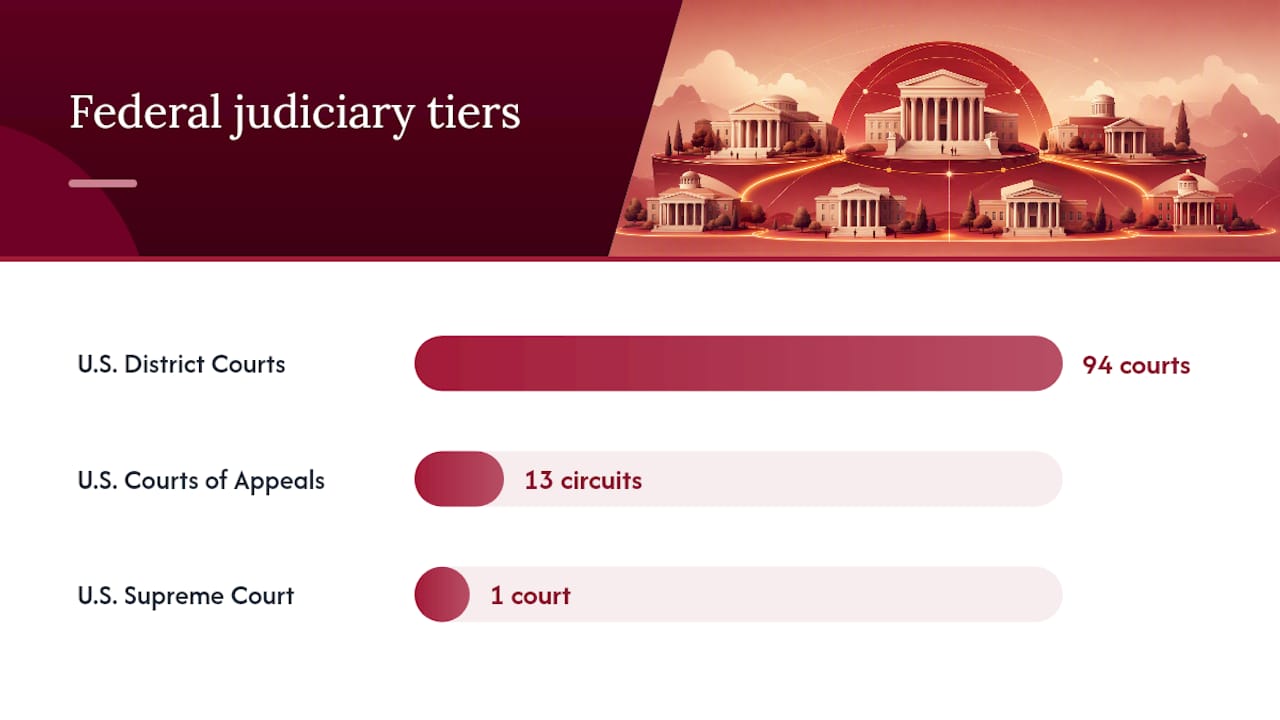
The federal judiciary runs on three tiers. At the bottom sit 94 U.S. District Courts, the trial-level courts where federal cases begin. Above them are 13 U.S. Courts of Appeals, organized by geographic circuit, which review district court decisions for legal error. At the top sits the U.S. Supreme Court, which reviews a small number of cases each year chosen largely at its own discretion. Beyond these general courts, Congress has created specialized federal forums for particular subject areas:
- U.S. Bankruptcy Courts, which handle all bankruptcy filings and operate as units of the district courts
- U.S. Court of Federal Claims, which hears monetary claims against the federal government
- U.S. Court of International Trade, which handles disputes over customs and international trade law
- U.S. Tax Court, which resolves disputes between taxpayers and the IRS before any tax is paid
State courts follow a different, more variable model, but most states still land on a familiar three-tier setup: trial courts, an intermediate court of appeals, and a state supreme court (sometimes called a court of appeals, as in New York, which flips the naming convention). Some smaller states skip the intermediate appellate layer entirely and send appeals straight to the state’s highest court. States also run their own specialized courts, including family courts, probate courts, small claims courts, and in some states, business or commercial courts designed to handle complex civil disputes faster.
Appeals in both systems typically move one step at a time. A losing party in federal district court appeals to the circuit court of appeals covering that district, and from there, may ask the Supreme Court to hear the case through a petition for a writ of certiorari, which the Court grants in only a fraction of cases filed. State cases move from trial court to intermediate appellate court to the state’s highest court. The two systems intersect at exactly one point: the U.S. Supreme Court can review a state supreme court’s decision, but only if the case turns on a genuine federal question, such as a claimed violation of the U.S. Constitution or a federal statute. A state supreme court’s ruling on a purely state-law issue, like the interpretation of a state’s own contract statute, is final. No federal court gets a say.
Which Cases Go to Federal Court vs. State Court?
Whether your case belongs in federal court comes down to three narrow doors, and if your facts don’t fit through one of them, you’re in state court by default. Federal courts don’t get to hear a case just because it feels important or the amount at stake is large. They need a specific jurisdictional hook.
Pro Tip: Before you assume your dispute qualifies for federal court, check whether it fits one of the three bases below. A surprising number of federal complaints get dismissed or sent back to state court because the plaintiff assumed jurisdiction existed instead of confirming it.
- The United States is a party. Cases where the federal government sues someone, or gets sued, generally belong in federal court. This includes disputes over federal taxes, federal contracts, and claims against federal agencies.
- Federal question jurisdiction. The case must arise under the U.S. Constitution, a federal statute, or a federal treaty. Civil rights claims under statutes like Title VII, First Amendment claims against government actors, and federal consumer protection claims under laws like the Telephone Consumer Protection Act all clear this bar because Congress created the right being enforced.
- Diversity jurisdiction. This applies when the parties are citizens of different states (or a foreign citizen and a U.S. citizen) and the amount in controversy exceeds $75,000. Both conditions must be met. A dispute under the threshold amount between residents of different states stays in state court no matter how diverse the parties are, because it fails the dollar requirement.
Missing either the citizenship requirement or the dollar threshold in your complaint is one of the most common reasons federal cases get dismissed or sent back down to state court, according to legal reference guidance on subject-matter jurisdiction. Courts look at what’s actually stated in the complaint, not what a plaintiff hopes to eventually prove, so vague or padded damage claims tend to get challenged early.
Most federal claims don’t actually require federal court. This is the part people miss: federal question jurisdiction is usually concurrent, meaning state courts can hear federal claims too, unless Congress specifically made federal jurisdiction exclusive. A person suing under a federal civil rights statute can often choose to file in state court, and many do, particularly when local juries or faster dockets favor their case.
A short list of matters that stay almost entirely in state court: divorce and child custody, wills and estates, most contract and personal injury claims, and the vast majority of criminal prosecutions, since most crimes are defined by state law. On the other end, a handful of areas belong to federal court exclusively, meaning no state court may hear them at all. Bankruptcy is the clearest example. Patent and copyright infringement claims, and most admiralty and maritime cases, also fall under exclusive federal jurisdiction.
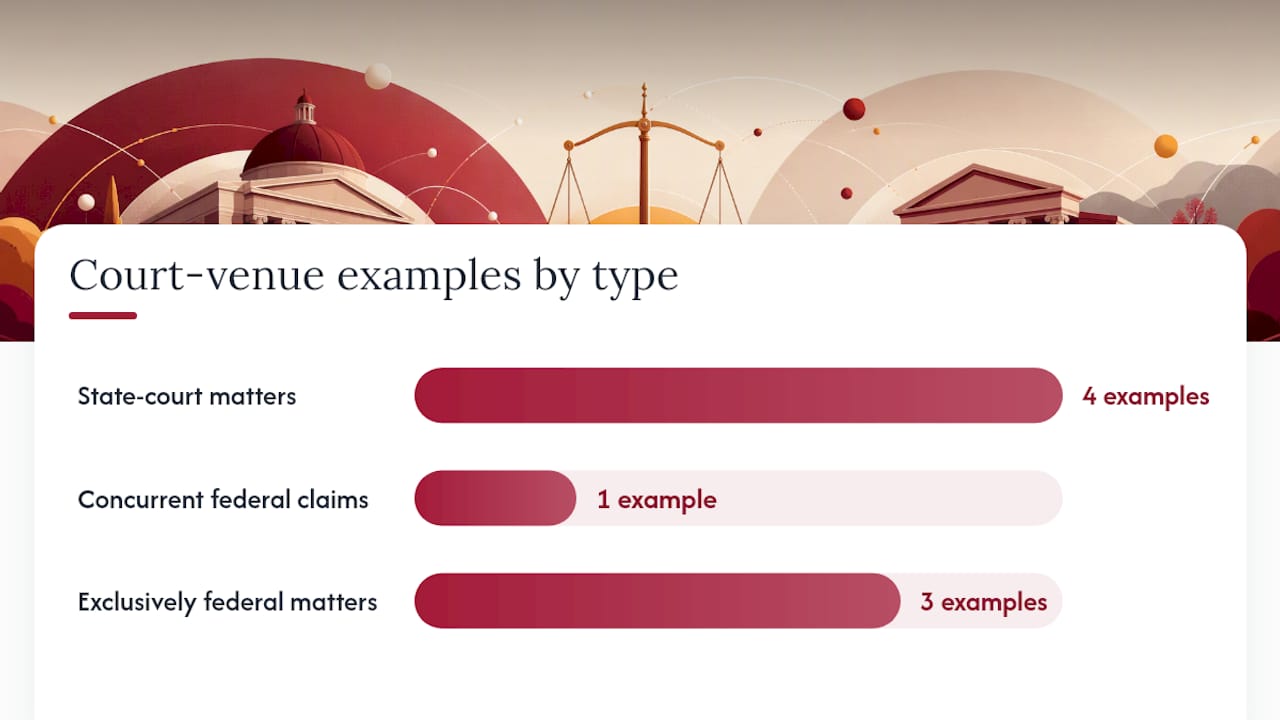
The Federal Judicial Center notes that despite the outsized attention federal courts get, they resolve a small fraction of the country’s total case volume. Family law disputes, landlord-tenant conflicts, and routine personal injury claims mostly live and die in state court, where the vast majority of American litigation actually happens.
How Judges Are Selected and Why It Matters
The path to the bench looks almost nothing alike in the two systems, and that difference shapes how each courtroom actually operates. Federal judges are nominated by the President and confirmed by the Senate. Once confirmed to an Article III court, they hold office for life during good behavior and can only be removed through impeachment, a process that has happened to very few federal judges in the country’s history. That lifetime tenure was designed to insulate judges from political pressure and public opinion.
State judicial selection is far less uniform, and the method varies significantly depending on where you file:
- Partisan elections, where judicial candidates run under a party label
- Nonpartisan elections, where candidates appear on the ballot without party affiliation
- Gubernatorial appointment, often paired with later retention elections
- Legislative appointment, used in a small number of states
- Merit selection systems, where a nominating commission screens candidates before a governor picks from a shortlist
State judges typically serve fixed terms, commonly ranging from six to fourteen years depending on the state and level of court, rather than lifetime appointments.
This distinction matters beyond trivia. A federal judge with lifetime tenure has less incentive to worry about how a ruling will look in the next election cycle, while an elected state judge operates within a local legal culture that a repeat litigant, or their attorney, often understands well. Selection method also shapes recusal practices, since a state judge who received campaign contributions from a party’s industry may face recusal motions that simply don’t arise in the federal system. For attorneys weighing where a case might land, judicial selection is one more factor behind the broader jurisdictional strategy.
How Cases Move Between Federal and State Court
The federal and state systems aren’t sealed off from each other. Several legal doctrines govern how a case can shift from one track to the other, and understanding them explains a lot of the tactical maneuvering that happens early in litigation.
- Removal. If a plaintiff files in state court but the case actually qualifies for federal jurisdiction, the defendant can remove it to federal court, typically within 30 days of receiving the complaint. This is a common defense tactic in cases with a federal claim buried inside a larger state-law lawsuit, or in diversity cases where a defendant believes a home-state jury will be less favorable.
- Certification of state-law questions. When a federal court is deciding a case and runs into a genuinely unsettled question of state law, it can pause the case and certify that question directly to the state’s highest court rather than guess at the answer. This preserves the state court’s authority over its own laws and avoids a federal court accidentally creating bad precedent on an issue it has no business deciding.
- Abstention. Federal courts sometimes decline to hear a case, or a portion of it, out of respect for ongoing state proceedings, a principle courts call comity. This shows up most often when a state criminal or civil enforcement action is already underway and a federal court is asked to intervene.
- Habeas corpus. State prisoners can challenge their convictions in federal court through a habeas petition, arguing a federal constitutional violation occurred during their state trial. Federal habeas review is narrow and comes with strict procedural limits, including exhaustion requirements and tight filing deadlines.
- Supremacy Clause conflicts. When a state law directly conflicts with a valid federal law or the Constitution, federal law controls. This has played out in disputes over immigration enforcement, cannabis regulation, and various consumer protection statutes, where state rules have been challenged as inconsistent with federal law.
Pro Tip: If you’re anticipating removal, don’t assume it favors the plaintiff or the defendant automatically. Removal usually benefits defendants who want a federal jury pool and federal procedural rules, so if you’re filing suit and want to stay in state court, plead your damages and claims carefully to avoid giving the other side an easy basis to remove.
One limit worth remembering: federal courts must accept a state supreme court’s own definitive interpretation of that state’s law. A federal court cannot override a state’s highest court on a question of pure state law just because a federal judge might have read the statute differently.
Deciding Where to File: A Practical Checklist
Choosing a forum is rarely just a legal technicality. It affects your jury pool, your timeline, your discovery obligations, and often your odds of winning outright. Here’s the sequence worth working through before you or your attorney file anything.
- Run the subject-matter test first. Does your claim involve the federal government, a genuine federal statute or constitutional issue, or diverse citizenship with damages over $75,000? If none apply, state court is your only option.
- Consider what remedy you actually need. Some remedies, like certain federal civil rights damages or class-wide injunctive relief, are more established in federal court. Others, like specific state consumer protection remedies, may only exist under state statutes.
- Think about venue and jury pool. Federal juries are drawn from a wider geographic area (often an entire federal district), while state juries are typically pulled from a single county. That difference can matter enormously in cases with strong local sentiment either way.
- Map out timing and discovery differences. Federal courts follow the Federal Rules of Civil Procedure uniformly nationwide, with generally stricter case management deadlines. State procedural rules vary widely by state and can be faster or slower depending on the jurisdiction and how backlogged the local docket is.
- Weigh removal risk. If you file in state court but your claim touches federal law or involves diverse, high-dollar parties, expect the possibility that the other side removes it to federal court regardless of your preference.
Pro Tip: Bring your documents, correspondence, and a clear timeline of events to your first consultation with an attorney. Jurisdictional analysis moves faster when a lawyer can see the actual facts instead of a verbal summary.
Cost and timeline differences between the two systems are real but not universal. Federal cases often move on stricter, more predictable scheduling orders, but that doesn’t necessarily mean faster resolution, since federal procedural rules and discovery obligations can be more demanding. State court costs vary enormously depending on the county and docket congestion. For consumer claims and discrimination cases that might qualify as class actions, the calculus shifts again, since class-wide relief often favors federal court under Federal Rule of Civil Procedure 23. When you sit down with counsel, ask directly: does my claim satisfy federal jurisdiction, what remedies are realistically available in each forum, and is there a meaningful removal risk if I file in state court? A lawyer with genuine federal litigation experience should be able to answer all three without hesitation. If your case involves civil rights violations, First Amendment retaliation, or a potential class action, specialized federal counsel is usually worth seeking out early, before deadlines for removal or amendment start running.
If your situation involves a recent arrest tied to the underlying dispute, timing matters on a different front too. Resources like this explainer on calling a lawyer versus a bondsman walk through which call to make first when the clock is already running.
How Javitch Law Office Evaluates Federal vs. State Filings
Deciding where to file isn’t a formality inside our practice. It’s the first strategic decision in a case, and it shapes everything downstream. Javitch Law Office litigates in federal courts nationwide, alongside California’s state court system, which gives us a direct comparison point most local firms don’t have.
Before filing, our attorneys work through a jurisdictional checklist: does the claim satisfy federal question or diversity requirements, what remedies are actually available in each forum, does the case have genuine class-action potential under Rule 23, and how real is the removal risk if we file in state court. That analysis looks different depending on the case type. Civil rights claims under federal antidiscrimination statutes, First Amendment retaliation claims against government actors, and consumer class actions under statutes like the TCPA often point toward federal court, though the right answer always depends on the specific facts. Every case is different, and this overview isn’t a substitute for individualized legal advice about your situation.
Why Venue Choice Deserves More Attention Than It Gets
Most people treat “where do I file” as an afterthought, something their attorney sorts out while they focus on the actual dispute. That’s backwards. The forum you land in shapes your jury pool, your procedural deadlines, your discovery burden, and sometimes the very legal standard applied to your claim. I’ve seen the conventional wisdom that federal court is always the “stronger” venue lead people astray. Federal court makes sense when your claim and remedy genuinely call for it, not simply because it sounds more serious.
The bigger mistake I see is people waiting too long to sort this out. Jurisdictional missteps, like filing in the wrong forum or missing the window to challenge removal, are hard to unwind once a case is underway. If you’re weighing a claim right now, start gathering your documents, timeline, and correspondence today, and get a jurisdictional review from an attorney before you file anything.
— Mark
Get a Jurisdictional Review Before You File
Choosing the wrong court can cost you months, and sometimes your entire claim, if a case gets dismissed or bounced between systems on a technicality. The firm evaluates whether claims belong in federal court, state court, or both before filing.
If your situation involves discrimination in employment, housing, or education, First Amendment retaliation, or a pattern of consumer harm that could support a class action, the jurisdictional analysis above is exactly the kind of work we do before a single document gets filed. We also handle cases involving religious discrimination and discrimination against students in high school and college settings.
Bring whatever documentation you have, emails, contracts, notices, or a written timeline of what happened, and schedule an initial case evaluation. Our attorneys will walk through whether your claim fits federal jurisdiction, state jurisdiction, or both, and what that means for your options going forward.
Primary Sources and Further Reading
- Comparing Federal and State Courts, U.S. Courts: official breakdown of court structure and jurisdiction.
- What Kinds of Cases Belong in Federal Court, U.S. District Court, District of Kansas: plain-language guide to subject-matter jurisdiction.
- Federal and State Court Relations Overview, Constitution Annotated (LII/Cornell): Supremacy Clause and federal review of state decisions.
- Federal and State Courts: Structure and Interaction, Congressional Research Service: doctrines governing removal, certification, and abstention.
This article is general information, not a substitute for advice from a qualified lawyer. Consult a qualified legal professional about your own circumstances before acting on anything here.
Sources
- What kinds of cases belong in federal court (subject matter jurisdiction)? | United States District Court - District of Kansas
- Comparing federal & state courts | United States Courts
- Federal and state court relations overview | Constitution Annotated (LII/Cornell)