
Class action attorneys get paid out of the settlement fund itself, not directly out of your pocket, and federal judges have to sign off on the amount under Rule 23. Requested fees commonly land somewhere in a moderate percentage range of the recovery, though courts routinely trim requests they see as excessive. If the case loses, you owe nothing.
TL;DR:
- Attorneys’ fees are paid out of the settlement fund only if the case succeeds, and courts review these requests to ensure fairness and reasonableness.
- Typical fees range from 25% to 33%, with the percentage often decreasing as the total settlement amount increases; a smaller percentage can still result in a large payout due to scale.
- Courts scrutinize costs, service awards, and cy pres distributions that reduce the amount distributed to class members, and require detailed fee petitions for transparency.
- Objections to fee requests are more likely to succeed if they highlight disproportionate fees, lack of disclosure, or conflicts of interest, with deadlines set in settlement notices.
- Fee approval occurs only after final court approval, and delays can happen due to appeals, meaning checks typically arrive months after settlement approval.
Table of Contents
- How Class Action Attorney Fees Get Paid From a Settlement
- Percentage, Lodestar, or Both: How Courts Set the Fee
- What Percentage Do Class Action Lawyers Actually Take?
- Costs, Service Awards, and Cy Pres: The Other Deductions
- Rule 23 Oversight: What Makes a Fee Request Fair, and How to Object
- If the Class Action Loses, Do You Owe Anything?
- When to Bring In Javitch Law Office
- Objecting or Opting Out: Your Options and the Fee Fight
- When Are Class Action Attorney Fees Actually Paid?
- How Much of Your Settlement Actually Disappears Into Fees
- Fee Petitions and What Firms Are Required to Disclose
- Landmark Rulings That Shaped Class Action Fee Law
- Federal Versus State Class Actions: How Fee Rules Differ
- Why the Fee Conversation Deserves More Attention Than It Gets
- Get a Free Case Evaluation From Javitch Law Office
- Sources
How Class Action Attorney Fees Get Paid From a Settlement
Every dollar in a class settlement flows through what lawyers call the common fund. It’s a single pool of money the defendant agrees to pay, and everything else gets carved out of it before individual class members see a check.
The order matters. Courts typically approve deductions in roughly this sequence:
- Attorney fees and any accrued interest
- Litigation costs (experts, depositions, court filings)
- Service awards to the named plaintiffs
- Notice and claims administration expenses
- Remaining funds distributed to the class
A federal judge reviews each of these line items before final approval, because absent class members, the ones who never showed up in court and may not even know the case exists, can’t negotiate their own cut. The Cornell Legal Information Institute’s text of Rule 23 makes this oversight duty explicit: the court has to protect people who aren’t in the room.
This structure is also what makes class actions work at all for small individual claims. Nobody would hire a lawyer to fight over a $40 overcharge on their phone bill. The common fund lets one law firm front the cost and risk for thousands of people who could never justify suing alone, and get paid only if the case succeeds.
Percentage, Lodestar, or Both: How Courts Set the Fee
Judges don’t just accept whatever number an attorney proposes. Three methods dominate federal courts, and which one applies often depends on the circuit and the size of the fund.
- Percentage-of-fund method. The court awards a set percentage of the total recovery, often anchored to a circuit “benchmark” (25% is common) that the request is measured against.
- Lodestar method. The court multiplies hours reasonably worked by a reasonable hourly rate, then sometimes applies a multiplier to account for risk, delay in payment, or the difficulty of the case.
- Hybrid cross-check. Many judges calculate the percentage award, then run the lodestar math as a sanity check to make sure the fee isn’t wildly out of proportion to the actual work performed.
Court guides on fee practice describe this cross-check as standard procedure in most large settlements, not an exception, according to a chapter on court-awarded attorneys’ fees from the Litigation Ethics Conference. Judges weigh the risk counsel took on, the complexity of the claims, the results actually achieved for the class, hours logged, and prevailing market rates in that district.
Pro Tip: If a settlement notice lists both a percentage and a lodestar figure, compare them. A wide gap between the two numbers is often exactly what triggers judicial scrutiny or an objection.
What Percentage Do Class Action Lawyers Actually Take?
Expect somewhere in the neighborhood of 25% to 33% of the fund in a lot of cases, though the exact figure swings with the circuit, the case type, and above all, the size of the recovery. Fee practices vary enough that no single number applies everywhere. One legal blog summarizing published fee awards puts the common range at roughly 25 to 33 percent, which lines up with what most practitioners see in routine consumer and employment settlements.
Here’s the part that surprises a lot of people: the percentage tends to shrink as the settlement grows. Empirical research examining federal fee awards from 1993 to 2008 found that recovery size is the single strongest predictor of the fee ratio, and that ratio falls as the fund gets bigger, according to the Eisenberg and Miller study on attorneys’ fees in class actions. A judge is far more comfortable awarding 30% of a $2 million fund than 30% of a $200 million one.
Two quick examples show why this matters to your check:
- A $3 million settlement with a 30% fee award leaves $2.1 million for costs, service awards, and the class.
- A $100 million settlement with a 15% fee award still pays counsel $15 million, but leaves $85 million for the class, a far larger dollar amount to the firm even at a lower rate.
Scale changes the math for everyone at the table.
Costs, Service Awards, and Cy Pres: The Other Deductions
Attorney fees aren’t the only bite taken out of a settlement fund before class members get paid. Courts scrutinize several other categories just as closely.
- Litigation costs. Expert witness fees, deposition transcripts, e-discovery vendors, and court filing fees all get reimbursed from the fund, typically supported by itemized invoices.
- Notice and administration. A third-party claims administrator handles mailing notices, processing claims, and cutting checks, and that work isn’t free.
- Service awards. Named plaintiffs who sat for depositions and helped drive the case sometimes receive an incentive payment, though courts increasingly scrutinize these awards for size and fairness, a point raised in Vanderbilt Law’s analysis of incentive awards for representative plaintiffs.
- Cy pres distributions. When money is left over because class members didn’t claim their full share, or a claim is too small to distribute practically, courts sometimes redirect it to a charitable organization related to the case rather than let it revert to the defendant. Javitch Law Office has written about how cy pres distributions work and what they mean for class members expecting a payout.
Each of these reduces what actually lands in your check, which is exactly why courts review them line by line.
Rule 23 Oversight: What Makes a Fee Request Fair, and How to Object
Rule 23 doesn’t let a settlement close on a handshake. The court must independently find that any fee request is fair and reasonable before approving it, and judges routinely ask pointed questions about hours billed, results achieved, and whether the request lines up with awards in comparable cases.
Objections tend to succeed, or at least get taken seriously, when they hit one of a few specific problems:
- The percentage looks disproportionate to the actual risk or complexity of the case.
- Disclosure is thin, meaning the fee motion doesn’t clearly break down hours, rates, or costs.
- A conflict of interest exists between class counsel and the class, such as a settlement that pays attorneys well while leaving class members with coupons instead of cash.
If something about a settlement notice bothers you, start by reading it in full, then pull the actual fee motion filed with the court, which is a public document. From there, a conversation with independent counsel can help you decide whether a formal, timely objection is worth filing. Courts set strict deadlines for objections, usually printed right in the notice, and missing that window generally forfeits your right to be heard.
If the Class Action Loses, Do You Owe Anything?
Nothing. That’s the entire point of contingency representation. Class counsel gets paid only if the case produces a recovery, whether through settlement or trial verdict, and if it doesn’t, class members typically owe no fees at all, a point confirmed plainly by Super Lawyers’ explainer on class action payment structures.
Firms usually advance litigation costs, expert fees, filing fees, deposition costs, out of their own pocket as the case proceeds. They only recoup those advances from the eventual settlement fund. If there’s no fund, there’s usually nothing to recoup.
The one place to pay close attention is the retainer agreement itself, if you’re a named plaintiff rather than an absent class member. Most standard agreements mirror the no recovery, no fee structure, but unusual cost repayment clauses do exist. Read that section before signing anything.
When to Bring In Javitch Law Office
Reach out if a settlement notice reads like legal fog, if the fee request looks disproportionate to what the class actually received, or if you’re weighing whether to step up as a lead plaintiff or file an objection.
Javitch Law Office handles consumer class actions involving TCPA robocall violations, deceptive auto renewal practices, and false pricing, alongside discrimination cases in employment, housing, and public accommodations. That range means the firm regularly reviews fee motions and settlement structures across very different case types, not just one narrow niche.
Before reaching out, gather three things: the class notice you received, the fee motion or memorandum filed with the court, and any claims administrator report showing how the fund is being allocated. Those three documents let an attorney assess your situation quickly instead of starting from scratch.
Objecting or Opting Out: Your Options and the Fee Fight
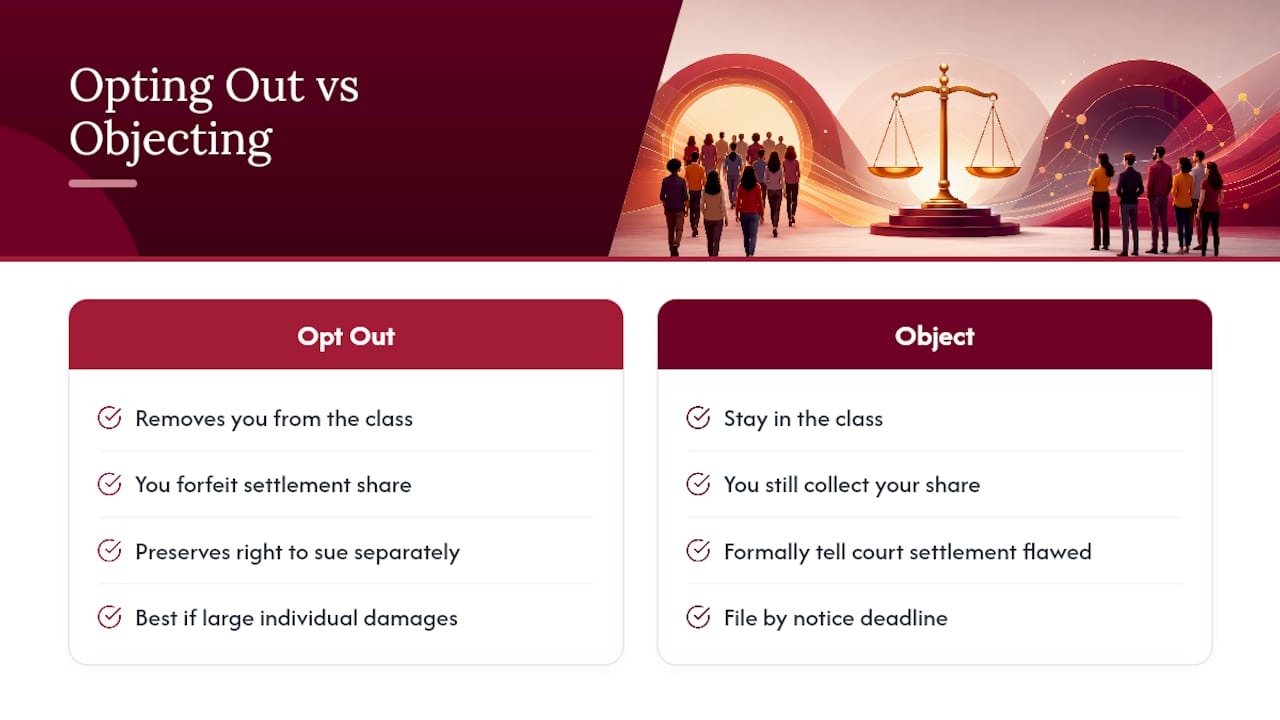
Every class member typically gets two off ramps before a settlement becomes final: opting out, or objecting while staying in.
Opting out removes you from the class entirely. You give up your share of the settlement, but you also preserve your right to sue the defendant separately. This only makes sense if you believe your individual damages are large enough to justify your own lawsuit, which for most consumer claims (a $15 overcharge, an unwanted robocall) isn’t realistic. For employment or discrimination claims with substantial individual damages, it’s worth a serious conversation with counsel.
Objecting is different. You stay in the class and still collect your share, but you formally tell the court you think something about the settlement, often the fee request specifically, is unfair. Objections get filed with the court by the deadline printed in the settlement notice, and a well written one lays out specific grounds: the fee percentage compared to similar cases, a lack of disclosure in the fee motion, or a mismatch between what class counsel is asking for and what class members are actually getting.
Judges take objections seriously, but courts also see boilerplate or professional objector filings, ones filed by repeat players hoping for a payout to withdraw, and tend to give those less weight than a specific, well documented objection from an actual class member. If you’re objecting, attach evidence: your own settlement notice, a comparison to fee awards in similar cases, or a calculation showing the requested lodestar multiplier looks unusually high. A vague objection rarely moves the needle. A specific one sometimes changes the outcome entirely.
When Are Class Action Attorney Fees Actually Paid?
Not until the settlement receives final court approval, and often not for months after that. The typical sequence runs like this: the parties reach a settlement, the court grants preliminary approval, notice goes out to the class, objections and opt outs get filed, and then a final fairness hearing takes place. Only after the judge grants final approval, and any appeals of that approval are resolved, does money actually move.
That last part trips people up. If someone appeals the fee award or the settlement itself, and appeals do happen, especially from professional objectors, payment can be delayed by another year or more while the appellate court sorts it out. Attorneys don’t get an advance on their fee just because a settlement was announced in a press release.
Once approval is final and unappealed, the claims administrator processes the fund according to the court-approved distribution plan: fees and costs come out first, then service awards, then payments to the class. Some settlements pay everyone out in one lump distribution. Others, particularly in large consumer cases with rolling claims, distribute funds in waves as claims get verified.
If you’re wondering why your check hasn’t arrived months after you got a notice that a settlement was reached, the answer is almost always procedural timing, not anything wrong with your claim.
How Much of Your Settlement Actually Disappears Into Fees
This is the number that matters most to you personally: what’s left after everyone else gets paid.
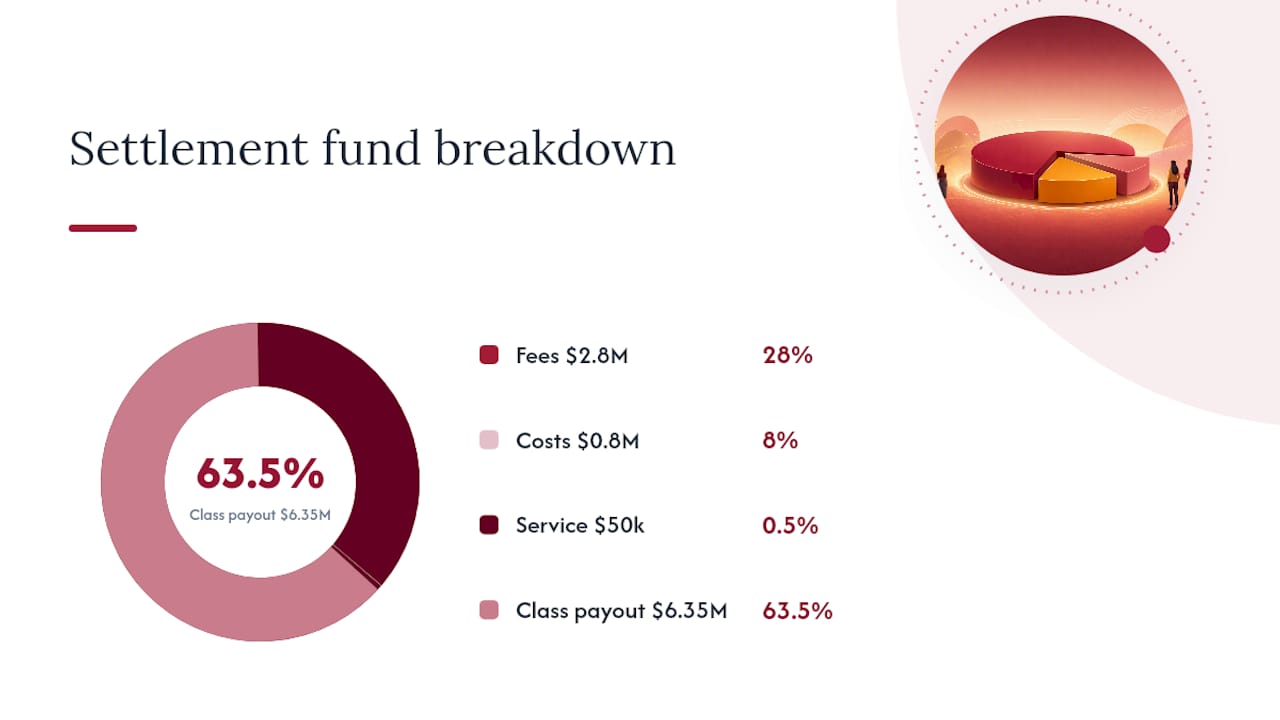
If a settlement fund is $10 million and the court approves a 28% fee award plus $800,000 in costs and $50,000 in service awards, roughly $6.35 million remains for distribution to the class. Divide that by the number of class members who actually file valid claims, not the total class size, and you get your real per-person payout. Claims rates in consumer class actions are often surprisingly low, sometimes in the single digits, which means the amount left over gets split among far fewer people than the headline class size suggests.
This is why the scaling effect discussed earlier isn’t just an academic curiosity. A smaller fee percentage on a massive settlement can still leave more money per class member than a larger percentage on a modest one, and the Eisenberg and Miller data on fee-to-recovery ratios backs that pattern up across a large dataset of federal cases.
It’s also worth remembering that a lower fee percentage doesn’t automatically mean a better deal for the class. A settlement with a modest fee award but a tiny overall fund, maybe because the case had weak facts or the defendant capped its exposure, can leave you with less money than a settlement with a higher fee percentage attached to a genuinely strong recovery. The percentage number alone tells you less than the actual dollar figure landing in your account.
Fee Petitions and What Firms Are Required to Disclose
Class counsel doesn’t just ask for a fee. They file a formal fee petition, a detailed motion that lays out the hours worked, the hourly rates charged, the costs incurred, and the legal justification for the requested percentage or multiplier.
That petition is a public court filing, which means anyone, including you as a class member, can read it. Transparency requirements generally push attorneys to disclose:
A breakdown of hours by task or timekeeper, the rates charged for each attorney and paralegal involved, an itemized list of litigation costs with supporting documentation, and an explanation of any requested multiplier above the base lodestar figure.
Courts increasingly expect this level of detail rather than a bare request for “30% of the fund.” A NYU Law Review analysis of fee awards notes that judges weigh disclosure quality alongside case outcomes when deciding whether a fee request holds up to scrutiny, and a thin or vague petition invites exactly the kind of judicial pushback that can shrink an award. If you want to understand exactly what your case’s attorneys are asking for and why, the fee petition itself, not the settlement notice summary, is where the real detail lives.
Landmark Rulings That Shaped Class Action Fee Law
A handful of court decisions set the framework judges still apply today. You don’t need to read the opinions yourself, but knowing the names helps you understand why your settlement notice is worded the way it is.
The shift toward the percentage method itself traces back to appellate decisions in the 1990s that pushed courts away from a pure lodestar approach, largely because lodestar calculations were seen as encouraging attorneys to run up billable hours rather than settle efficiently. That shift is part of why most federal circuits now use percentage as the primary method, with lodestar serving as the cross-check rather than the main event, a structure confirmed across court guidance on fee methodology.
Rule 23 itself was substantially amended in 2003 specifically to tighten fee review procedures, adding language requiring courts to scrutinize fee requests as a distinct step from approving the settlement’s fairness to the class. Before that amendment, some courts treated fee approval almost as a formality once the underlying settlement looked reasonable. The current text of Rule 23 makes clear that fee review is its own independent inquiry, not a rubber stamp attached to settlement approval.
The broader empirical record, most notably the Eisenberg and Miller dataset spanning 1993 to 2008, gave courts something they’d lacked before: actual data on what fee awards looked like across thousands of cases, rather than judges guessing at what “reasonable” meant case by case. That dataset is still cited in fee opinions today.
Federal Versus State Class Actions: How Fee Rules Differ
Rule 23 governs federal class actions, but plenty of class actions get filed and stay in state court, where the rules can look noticeably different.
Most states have adopted a version of Rule 23 for their own civil procedure rules, but the details diverge. Some state courts apply stricter benchmark percentages than the federal norm. Others give trial judges wider discretion with less appellate oversight of fee awards. A few states have specific statutory caps on fees in certain case types, particularly consumer protection claims, that don’t exist in federal practice.
The Class Action Fairness Act of 2005 also reshaped this landscape by making it easier for defendants to move large, multistate class actions from state court into federal court, which is part of why many consumer class actions you’ll encounter today, even ones that started as state filings, end up litigated under federal Rule 23 standards regardless of where they were originally filed.
If your settlement notice cites a state statute rather than Rule 23, the fee review standard may differ from everything described above. It’s worth checking which court and which rule actually governs your specific case before assuming the federal norms apply.
Why the Fee Conversation Deserves More Attention Than It Gets
Most people skim past the fee section of a class action notice entirely. That’s a mistake, and the empirical research backs up why: recovery size predicts fee ratios far more reliably than case complexity or attorney reputation, according to the Eisenberg and Miller findings. That means the loudest, most aggressively marketed settlement isn’t necessarily the one with the fairest fee structure.
The conventional advice, “don’t worry about the lawyers’ cut, the court handles it,” undersells how much variation exists between similar cases. Judges usually approve requested fees, and when they cut them, the cuts tend to be proportional trims rather than wholesale denials. That means the fee amount requested in the initial motion matters more than most class members assume, because it rarely gets slashed dramatically after the fact.
What should you actually prioritize? Read the fee petition, not just the settlement summary. Compare the requested percentage against the size of the fund, not against some abstract sense of fairness. And if a service award or cy pres provision looks unusual, ask why before the objection deadline passes, not after. The system has real oversight built in. It works best when class members actually use it.
— Mark
Get a Free Case Evaluation From Javitch Law Office
If a class settlement notice landed in your mailbox and the fee section left you with more questions than answers, that’s exactly the kind of situation worth a second set of eyes. Javitch Law Office reviews settlement structures, fee motions, and objection deadlines for consumers dealing with TCPA violations, deceptive auto renewal charges, false pricing claims, and civil rights violations in employment, housing, and public accommodations.

Before you reach out, pull together three things: the settlement notice you received, the fee motion filed with the court (usually available on the case docket), and any distribution report from the claims administrator. Having those on hand means a faster, more useful case evaluation instead of a back and forth over paperwork. If you’re weighing whether to file an objection, considering opting out, or just want a plain-language read on whether a fee request looks fair, request a free case evaluation through Javitch’s consumer class action practice page and get a direct answer instead of guessing.
This article is general information, not a substitute for advice from a qualified lawyer. Consult a qualified legal professional about your own circumstances before acting on anything here.
Sources
- Federal Rule of Civil Procedure 23 — Cornell LII
- Attorneys’ fees in class actions: 1993–2008 (Eisenberg & Miller) — U.S. Courts
- Chapter 5 — Court-awarded attorneys’ fees, reimbursement of costs, service awards, and cy pres (Litigation Ethics Conference) — 2024