
Cy pres lets a court direct leftover class-action settlement funds to a nonprofit whose work is “as near as possible” to the class’s interests — French for “as near as possible,” borrowed from trust law. Courts use it when distributing residual or unclaimed funds directly to class members is impractical, too costly, or simply impossible. According to Cornell Law School’s Wex legal dictionary, cy pres permits courts to allocate settlement residuals to charity-directed relief when direct distribution is infeasible.
If you are a class member and a proposed settlement includes a cy pres award, here is what to do right now:
- Locate the class notice and settlement agreement (check your email, PACER, or the settlement administrator’s website).
- Note every deadline, especially the objection deadline, which is often 30–45 days before the fairness hearing.
- Consider proposing an alternative recipient or requesting a second-round distribution if the residue is large enough.
- Ask the court for a docket copy or settlement administration report if recipient information is not publicly disclosed.
Key Takeaways
Cy pres is a court-approved mechanism for directing unclaimed class-action settlement funds to a nonprofit, but it is a last resort that requires a substantial nexus between the recipient’s mission and the class’s harm.
| Point | Details |
|---|---|
| Cy pres is a last resort | Courts should use cy pres only after direct distribution and additional rounds are genuinely infeasible. |
| Disclosure is often missing | A majority of federal securities settlement dockets lacked public evidence identifying cy pres recipients, per the Emory Law Journal study. |
| Nexus test is the key standard | The recipient’s mission must connect meaningfully to the litigation’s subject matter; a mismatch is a concrete objection point. |
| State rules vary significantly | Washington’s Civil Rule 23 amendment directs residual funds to legal aid, offering a codified model other states have not yet matched. |
| Javitchlawoffice can help | The firm reviews settlements, drafts objections, retrieves records, and represents class members at fairness hearings. |
Table of Contents
- What is cy pres and where does the doctrine come from?
- When do courts use cy pres in a class action settlement?
- What are the alternatives to cy pres?
- How are cy pres recipients chosen, and what conflicts should you watch for?
- What can you do if your settlement includes a cy pres proposal?
- What do notable cases and state rules tell us about cy pres practice?
- What reforms would make cy pres work better?
- The case for treating cy pres as a last resort, not a convenience
- Javitchlawoffice can help you evaluate a cy pres settlement
- Sources
What is cy pres and where does the doctrine come from?
The phrase “cy pres” is a shortened form of the Old French “cy pres comme possible,” meaning “as near as possible.” It originated in charitable trust law, where courts used it to redirect a donor’s gift when the donor’s original charitable purpose could not be carried out. Rather than letting the gift fail entirely, a court would find the “next best” use that honored the donor’s intent.
Class-action practice borrowed the concept in the late twentieth century, but the purpose shifted. In trust law, the guiding question is: what did the donor intend? In a class action, the question becomes: what outcome comes closest to compensating the class or deterring the defendant’s conduct? The American Law Institute’s Principles of the Law of Aggregate Litigation and major practice guides treat cy pres as a last resort, not a default, and recommend that parties document every effort to locate and compensate class members before a court awards cy pres funds to a third party.
The Federal Rules of Civil Procedure, specifically Rule 23, govern class-action settlements and require judicial approval of any distribution plan. Courts applying cy pres in that context are expected to tie the recipient’s mission to the litigation’s purpose, not simply pick a well-regarded charity.
When do courts use cy pres in a class action settlement?
Cy pres is not automatic. Courts reach for it only when direct distribution runs into a genuine obstacle. The most common triggers are:
- Unidentifiable class members. When the class is so large or diffuse that individual class members cannot be located, mailing checks is not feasible.
- Economically infeasible pro-rata shares. When the residue is spread so thin that individual payments would be negligible, the cost of cutting and mailing checks exceeds their value.
- Unclaimed or undeliverable funds. After the claims period closes, checks returned as undeliverable or simply never cashed create a residue that the settlement agreement must address.
- Settlement terms that pre-designate cy pres. Parties sometimes negotiate a cy pres clause upfront, specifying the recipient in the agreement itself.
The judicial tests courts apply vary by circuit and state. Two standards dominate the case law. The substantial-nexus test asks whether the proposed recipient’s mission is meaningfully connected to the subject matter of the litigation. A data-privacy class action, for example, would have a stronger nexus to a digital-rights nonprofit than to a general food-bank. The reasonable-approximation test is slightly more flexible, asking whether the distribution furthers the class’s interests even if the fit is not perfect. As the Boston University Law Review analysis by Gauch explains, circuits apply these tests unevenly, which means knowing which standard your district court tends to follow can sharpen an objection or a recipient proposal considerably.
Pro Tip: Check the settlement agreement before the fairness hearing. If it is silent on what happens to residual funds, the court has wide discretion to revert funds to the defendant, escheat them to the state, or order cy pres — and defense counsel often pushes for a cy pres clause precisely to “close the books.” Raising this at the hearing is one of the most effective levers a class member has.
What are the alternatives to cy pres?
Courts weighing what to do with leftover funds have four main options. Each carries different tradeoffs for class members, defendants, and the public.
| Option | When courts use it | Class-member impact |
|---|---|---|
| Pro-rata redistribution | Residue is large enough to make individual payments meaningful; class members are identifiable | Class members receive additional compensation |
| Reversion to defendant | Settlement agreement requires it; residue is small; no viable cy pres recipient | Defendant keeps unclaimed money; class gets nothing more |
| Escheat to government | No agreement provision; state law requires it after a dormancy period | Funds go to state treasury; class members may claim later under unclaimed-property rules |
| Cy pres to nonprofit | Direct distribution is infeasible; a nexus-qualified recipient exists | Class gets indirect benefit through a related organization |
The American University Law Review’s practice guide confirms that the court’s choice among these options depends on the settlement agreement’s language, applicable statutes, and judicial discretion. A few courts have also ordered lottery-style or second-round distributions, reopening the claims process to reach class members who missed the first window. That approach fits best when the residue is large, the class is still identifiable, and the case’s compensatory goals have not yet been fully met.
The practical signal: if the residue is meaningful in absolute dollars and class members can still be located, pro-rata redistribution is almost always the outcome most favorable to the class. Cy pres should come second, not first.
How are cy pres recipients chosen, and what conflicts should you watch for?
Recipient selection is where cy pres goes wrong most often. Courts use several methods: parties propose recipients in the settlement agreement, judges draw from presumptively approved lists, or an independent fiduciary is appointed to vet candidates. In practice, the first method is by far the most common, which creates the conflict-of-interest problem the empirical literature documents.

An Emory Law Journal study of 373 federal securities class-action settlements found that a majority of dockets lacked public evidence identifying cy pres recipients, and that many identified recipients appeared unrelated to the class’s interests. That is not a minor procedural gap. It means that in the majority of cases studied, class members had no way to verify whether the charity receiving their unclaimed funds had any connection to the harm they suffered.
The conflict types that recur in the case law and scholarship include:
- Counsel’s favored charities. Class counsel proposes a recipient where they or their firm has a donor relationship, alumni tie, or board seat.
- Judicial connections. A judge’s alma mater or a charity the judge has publicly supported appears on the proposed list.
- Preselected recipients with no nexus. Defendants agree to cy pres only if a particular charity, often one with no relationship to the litigation’s subject matter, receives the funds.
A defensible selection process looks different. Strong selections share a substantive nexus to the class’s interests, carry no conflicts of interest for counsel or the court, have the organizational capacity to account for the funds after distribution, and reach the same geographic population the class action covered.
Pro Tip: When reviewing a proposed settlement, search the recipient charity’s Form 990 (available free on ProPublica Nonprofit Explorer) and cross-check it against the litigation’s subject matter. A mismatch between the charity’s stated mission and the class’s harm is a concrete, documentable objection point.
Transparency safeguards courts should require include public disclosure of proposed recipients before the fairness hearing, a docketed approval order with written findings tying the recipient to class interests, and a post-distribution accounting filed with the court. Without those safeguards, the Washington University Law Review notes, cy pres creates incentives for self-dealing that undermine the settlement’s legitimacy.
What can you do if your settlement includes a cy pres proposal?
A class member is not powerless. Courts take well-grounded objections seriously, especially when they raise nexus or conflict concerns backed by the record. Here is a practical sequence:
- Find the class notice. Check your email, the settlement administrator’s website, or PACER (the federal court’s public docket system, accessible at pacer.gov for a small per-page fee). The notice must describe the proposed distribution plan; for details on how legal disclaimers like this work, see the Legal Disclaimer | Jeffrey Le Pere.
- Read the settlement agreement. Look for the residual-funds clause. Does it name a recipient? Does it require a second-round distribution before cy pres kicks in? Is the recipient’s mission connected to the litigation’s subject matter?
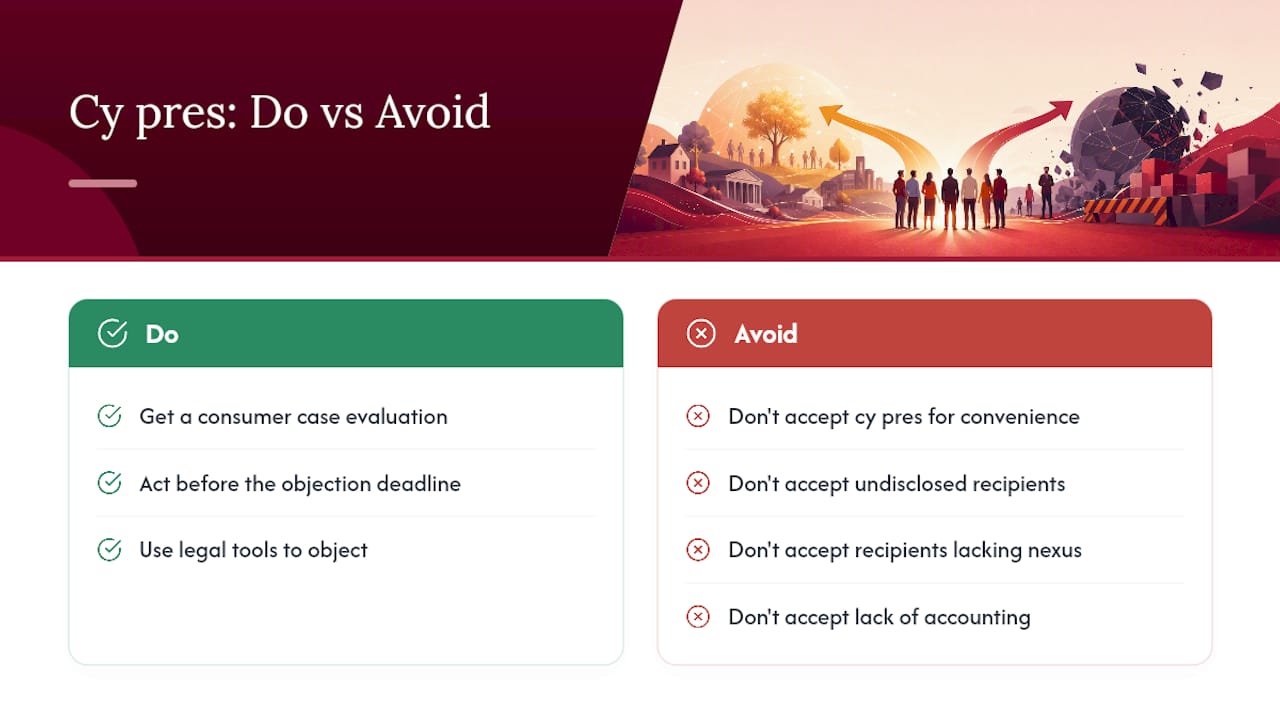
- Check the objection deadline. Objection deadlines are typically set 30–45 days before the fairness hearing and are strictly enforced. Missing the deadline forfeits your right to object.
- Draft a concise objection. Effective objection points include: lack of nexus between the proposed recipient and the class’s harm; a disclosed or undisclosed conflict of interest; failure to attempt additional distribution rounds before resorting to cy pres; and inadequate public notice of the recipient’s identity.
- Propose an alternative recipient or distribution method. Courts can and do substitute recipients when an objector identifies a better-qualified organization. A short letter proposing a recipient with a clear nexus to the litigation’s purpose carries real weight.
- Request records. If the settlement administrator’s reports are not on the docket, ask the court for an accounting. Practice guides stress that parties should make a record at the fairness hearing about distribution efforts and why cy pres is appropriate — if that record is thin or missing, that is itself an objection point.
- Contact counsel. If the residue is large, a conflict is documented, or disclosure is absent, consulting a firm experienced in class-action litigation is worth the call. The threshold for getting help is lower than most class members assume.
The ABA’s practice guide also notes that cy pres is negotiable at the settlement stage. Defense counsel often pushes for a cy pres clause to close the books cleanly. If you are involved early enough in a case, negotiating the recipient’s identity or requiring a second-round distribution in the agreement is the most powerful leverage point available.
What do notable cases and state rules tell us about cy pres practice?
Courts across the country have applied cy pres in ways that range from tightly disciplined to openly criticized. The Supreme Court addressed the doctrine’s legitimacy in Frank v. Gaos (2019) but resolved the case on Article III standing grounds, leaving the substantive cy pres standards to the circuits. The Ninth Circuit has applied a nexus-based test; the Third Circuit has emphasized that cy pres should be a last resort after reasonable efforts to distribute directly.
At the state level, the variation is sharper. Several states have moved to codify how residual funds must be handled, reducing judicial discretion and the opportunity for self-dealing.
| Jurisdiction | Rule or approach | Key requirement |
|---|---|---|
| Washington | Civil Rule 23 amendment | Portion of residual funds directed to a designated legal-aid recipient (Legal Foundation of Washington cited in practice commentary as model) |
| California | Court discretion with nexus review | Courts apply substantial-nexus test; State Bar of California materials address cy pres in consumer settlements |
| Federal (general) | Rule 23 judicial approval | No mandatory recipient; court must approve distribution plan; ALI Principles recommend last-resort framing |
Washington’s approach is the most frequently cited model for codified distribution. The University of Washington Law Review documents how state-level statutory or rule-based experiments can reduce self-dealing incentives by directing a predictable portion of residual funds to legal-aid or public-interest organizations. The Legal Foundation of Washington, which provides civil legal aid to low-income residents, is the named recipient in Washington’s rule, giving the distribution a built-in nexus to access-to-justice goals.
The practical takeaway: if your case is in a state with a codified rule, the settlement agreement should reflect that rule. If it does not, that is a concrete objection.
What reforms would make cy pres work better?
The empirical record points to a clear set of reforms.
- Mandatory pre-hearing disclosure. Proposed recipients, their missions, and any connections to counsel or the court should be filed on the docket before the fairness hearing, giving class members time to object.
- Presumptions favoring nexus-qualified recipients. Courts should start with a presumption that the recipient must have a direct connection to the litigation’s subject matter, placing the burden on parties to justify any deviation.
- Independent trustees or fiduciaries. Rather than letting counsel propose recipients, courts can appoint an independent trustee to vet candidates and make a recommendation. The Boston University Law Review argues this approach returns cy pres to its trust-law roots, where a fiduciary’s duty runs to the beneficiaries, not to the parties.
- Required post-distribution accounting. After funds are transferred, the recipient should file a report with the court confirming how the money was used. This closes the accountability loop that currently stays open in most settlements.
- Documented distribution efforts before cy pres. Courts and counsel should be required to show what steps were taken to locate class members and whether a second-round distribution was considered and why it was rejected.
Judges and counsel can adopt most of these practices right now, without waiting for rule changes, by building them into settlement paperwork and fairness-hearing records. The Washington University Law Review analysis of cy pres-only settlements underscores that the absence of these safeguards is not just a theoretical problem — it produces outcomes where class members receive nothing while unrelated charities benefit from their unclaimed funds.
The case for treating cy pres as a last resort, not a convenience
The cy pres doctrine is genuinely useful in the narrow set of cases where direct distribution is impossible. The problem is that “impossible” has been stretched far beyond its original meaning. When a court approves a cy pres award because cutting individual checks is inconvenient rather than truly infeasible, it is not honoring the class’s interests. It is letting defendants off the hook and letting counsel pick charities they like.
At Javitchlawoffice, consumer class actions and public accountability work are at the core of what the firm does. The pattern the empirical literature identifies — recipients chosen without disclosure, no nexus to the class’s harm, no post-distribution accounting — is exactly the kind of institutional opacity the firm’s public records and FOIA practice is built to challenge. Class members who suspect a cy pres proposal is being used to benefit counsel or the defendant rather than the class have real legal tools available. The question is whether anyone helps them use those tools before the objection deadline passes.
If you are looking at a settlement notice that mentions cy pres and something feels off, a consumer class action evaluation is the right first call.
Javitchlawoffice can help you evaluate a cy pres settlement
When a settlement notice lands in your inbox and the residual-funds clause points to a charity you have never heard of, the clock is already running. Javitchlawoffice works with class members on exactly these situations: reviewing settlement agreements for nexus and conflict problems, drafting objections for the fairness hearing, retrieving docket records and settlement administrator reports through public records and FOIA requests, and proposing or vetting alternative recipients when the proposed cy pres award does not hold up.

Starting is straightforward. Bring the class notice, the case name or docket number, and any settlement documents you have received. The firm offers a free case evaluation, and most cy pres objection matters can be assessed quickly once the settlement agreement is in hand. Objection deadlines are strict, so the earlier you reach out, the more options remain open. Contact Javitchlawoffice to schedule your evaluation.
Sources
- The Missing Millions: Cy Pres in Federal Securities Class Actions (Emory Law Journal)
- A practical guide to the undistributed settlement funds problem and the cy pres solution (American Bar Association)
- Law
- As near as possible: Returning class action cy pres to its roots in trust law (Boston University Law Review, GAUCH)
- State approaches to residual class action funds and legal aid (University of Washington Law Review)
This article provides general legal information, not legal advice. Rules governing cy pres distributions vary by jurisdiction and case. Confirm current procedures with the court’s docket or a qualified attorney before taking action in your case.
This article is general information, not a substitute for advice from a qualified lawyer. Consult a qualified legal professional about your own circumstances before acting on anything here.