
To certify a class action in federal court, a plaintiff must satisfy all four prerequisites of Federal Rule of Civil Procedure 23(a) and fit the case into at least one category under Rule 23(b). There is no shortcut around this test, and no judge grants certification on the strength of a well-written complaint alone.
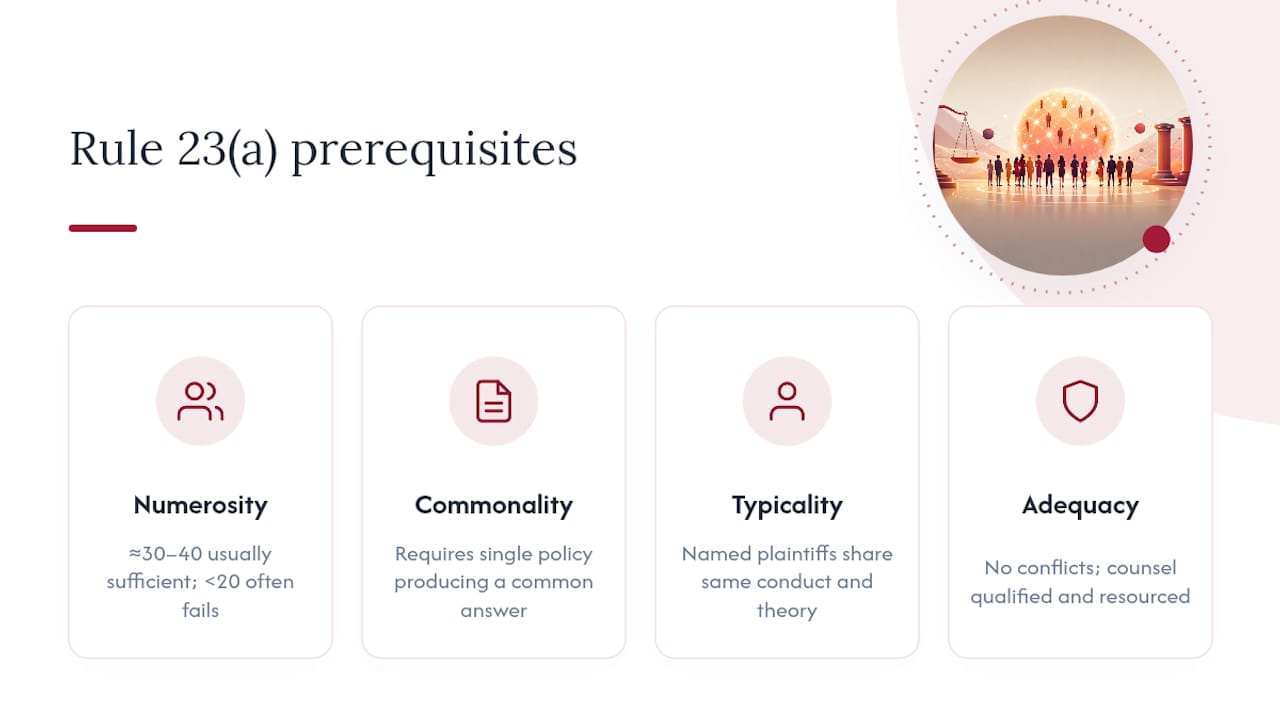
The four Rule 23(a) prerequisites are:
- Numerosity — the class is so large that joining every member individually would be impractical.
- Commonality — at least one legal or factual question is common to the whole class.
- Typicality — the claims of the representative plaintiffs mirror the claims of the class.
- Adequacy — the named plaintiffs and their counsel can fairly protect the interests of absent class members.
Courts do not take these on faith. Federal judges apply what’s called a “rigorous analysis” at the certification stage, and the plaintiff carries the burden of proving each element by a preponderance of the evidence, sometimes wading into the merits of the case to test whether the proof actually holds up on a classwide basis. Once a class clears that bar, the certification order still has to define the class and its claims, and, for cases seeking money damages, the court has to appoint class counsel and send notice to everyone potentially affected.
Key Takeaways
Class certification requires satisfying all four Rule 23(a) prerequisites and at least one Rule 23(b) category, proven by the plaintiff under a rigorous analysis standard.
| Point | Details |
|---|---|
| Four mandatory prerequisites | Numerosity, commonality, typicality, and adequacy under Rule 23(a) must all be satisfied; missing one defeats certification. |
| Pick the right Rule 23(b) path | Damages classes under (b)(3) need predominance and superiority, which raises the evidentiary bar considerably. |
| Class definitions must be administrable | Objective, verifiable criteria beat vague or conclusory language every time a court reviews a class definition. |
| Evidence beats narrative | Uniform policies, centralized records, and a damages model tied to the liability theory carry more weight than individual anecdotes. |
| Get guidance before filing | Javitch Law Office evaluates certification prospects and helps build the evidentiary record for consumer and civil rights class claims. |
Primary Sources and Further Reading
- Rule 23. Class Actions | Federal Rules of Civil Procedure, the full statutory text governing certification.
- Class Action Litigation: A Primer, a background report on the rigorous analysis standard and predominance under Comcast.
- Class Actions: Overview and Key Issues, a summary covering numerosity practice and ascertainability concerns.
- Class certification in consumer and employment litigation in California, for readers comparing federal Rule 23 practice with California state court procedure.
Table of Contents
- What Are the Class Certification Requirements Under Rule 23(a)?
- Which Rule 23(b) Category Fits Your Class Claims?
- How Should a Class Be Defined to Survive Certification?
- What Evidence Do Courts Expect at the Certification Stage?
- What Must a Certification Order Include?
- How Are Settlements Approved and When Do Classes Get Decertified?
- A Practical Checklist for Counsel and Class Members
- How We Approach Class Certification Risk
- How Javitch Law Office Can Help With Class Certification
- Frequently Asked Questions
- Sources
What Are the Class Certification Requirements Under Rule 23(a)?
Rule 23(a) is the gatekeeper. Miss any one of its four elements and the case never becomes a class action, no matter how compelling the underlying facts are. Judges walk through these one at a time, and a weakness in a single element can sink an otherwise strong motion.
Numerosity asks whether there are enough class members that individual lawsuits would be unworkable. There’s no statutory number attached to this requirement, but practice has settled into a rough guideline: classes of 30 to 40 members are usually found numerous enough, while classes under about 20 tend to struggle unless the members are geographically scattered or otherwise unable to coordinate litigation on their own. A tight-knit group of 15 coworkers who could plausibly join one lawsuit looks different to a court than 15 consumers spread across 40 states who have never met each other and have no practical way to organize.
Commonality requires at least one question of law or fact shared by every class member. This sounds easy to satisfy, and before 2011 it often was. Then the Supreme Court decided Wal-Mart Stores, Inc. v. Dukes, and the standard tightened considerably. The plaintiffs in that case, a nationwide group of female employees alleging pay and promotion discrimination, could point to a shared employer and a shared grievance. What they couldn’t point to was a single policy or practice that caused the harm uniformly. Wal-Mart’s managers made pay and promotion decisions with broad individual discretion, and the Court held that a class needs a common contention capable of generating a common answer, not just a common question. Since then, plaintiffs have had to identify the specific policy, template, or practice that ties every class member’s injury together, rather than gesturing at a shared grievance.
Typicality overlaps with commonality but asks a narrower question: do the named plaintiffs’ claims arise from the same conduct and legal theory as the rest of the class? A named plaintiff whose injury stems from a different cause, or who faces a unique defense the rest of the class doesn’t, usually fails typicality even if commonality is satisfied.
Adequacy examines two things: whether the named plaintiffs’ interests conflict with the class’s interests, and whether class counsel is qualified and resourced to litigate the case competently. A named plaintiff who took a side deal, has a grudge unrelated to the class claims, or stands to gain disproportionately from a settlement can torpedo adequacy on its own.
The clearest classwide harm claims we’ve seen at intake usually trace back to one document: a standard form contract, a uniform pricing algorithm, or a written company policy applied the same way to everyone. That single artifact often does more to satisfy commonality than pages of anecdotal complaints.
Pro Tip: If your evidence for commonality is a stack of individual stories rather than one policy, template, or practice tying them together, expect a defense motion to exploit that gap immediately.
Which Rule 23(b) Category Fits Your Class Claims?
Satisfying Rule 23(a) only gets a plaintiff halfway there. The case also has to fit one of three categories under Rule 23(b), and each category demands a different kind of proof.
- Rule 23(b)(1) applies when separate lawsuits would risk inconsistent rulings that leave a defendant facing incompatible obligations, or when individual suits would effectively decide the rights of absent class members without their participation. This category shows up most often in cases involving a limited fund, like a pension plan or insurance pool, where paying one claimant in full could leave nothing for the rest.
- Rule 23(b)(2) covers cases seeking injunctive or declaratory relief, where the defendant has acted (or refused to act) in a way that applies generally to the whole class. Civil rights and discrimination cases frequently fit here, particularly when the requested remedy is a policy change rather than a check.
- Rule 23(b)(3) is the workhorse for consumer and employment class actions seeking money damages. This category requires two extra showings beyond Rule 23(a): common questions must predominate over questions affecting only individual members, and a class action must be superior to other available methods of resolving the dispute.
Predominance is where most certification fights actually get decided, and Comcast Corp. v. Behrend raised the stakes considerably. The Supreme Court held that a damages model offered to prove classwide harm has to actually match the theory of liability the plaintiffs are pursuing. A generic damages estimate that doesn’t tie back to the specific conduct alleged won’t survive a predominance challenge, even if liability itself could plausibly be proven on a classwide basis. This turned expert economic testimony into a front-line issue at certification rather than something litigated only after a class was already certified.
Superiority asks a more practical question: would resolving these claims as a class action actually work better than the alternatives? Courts weigh whether individual class members have much incentive to sue on their own (usually not, when each person’s damages are small), whether other similar suits are already underway, and whether managing the case as a class action is feasible given the number of members and the complexity of the claims. A TCPA robocall case with thousands of $500 statutory damages claims is close to the textbook example: no individual plaintiff would sue alone over $500, so class treatment is often the only realistic path to enforcement.
How Should a Class Be Defined to Survive Certification?
A class definition that a court can’t administer without holding mini-trials for each member is a class definition that gets rejected, no matter how well the rest of the certification motion is argued. Courts expect what’s often called ascertainability: an objective, administrable way to determine who belongs in the class without digging into the merits of each person’s individual claim.

The most common certification killer isn’t a weak legal theory. It’s a class definition drafted so loosely that identifying members would require exactly the kind of individualized inquiry Rule 23 exists to avoid.
Compare two ways of defining essentially the same consumer class:
Weaker definition: “All consumers who were harmed by Defendant’s deceptive marketing practices.” This phrasing invites exactly the problem courts reject. “Harmed” and “deceptive” are conclusions, not criteria, and a court would need individualized fact-finding to determine who actually qualifies.
Stronger definition: “All persons who purchased Product X from Defendant’s website between January 1, 2024, and December 31, 2025, and were charged the disputed $9.99 processing fee.” This version ties membership to objective, verifiable facts: a purchase, a date range, and a specific charge that presumably shows up in the defendant’s own transaction records.
The stronger version also happens to serve the plaintiff’s own interests. An administrable class definition makes notice easier to execute, makes claims administration cleaner if the case settles, and gives the defendant less room to argue that the class is a moving target.
What Evidence Do Courts Expect at the Certification Stage?
Certification motions live and die on documents, not adjectives. Judges want to see the specific proof that each Rule 23 element is met, not a narrative summary of why the case feels classwide.
The strongest certification records typically include:
- A uniform document, policy, or practice applied to every class member the same way (a form contract, a scripted sales pitch, an automated pricing rule).
- Centralized business records showing the class members and the conduct at issue, ideally something the defendant already keeps in the ordinary course of business.
- Statistical sampling or survey evidence, when individualized proof isn’t available for every member but a representative sample can stand in for the whole.
- An expert-built damages model tied directly to the liability theory, addressing the Comcast predominance problem head-on rather than as an afterthought.
Timing matters as much as substance. Rule 23© directs courts to decide certification at “an early practicable time,” but in practice that usually means after a period of class discovery focused narrowly on the issues relevant to certification, not the full merits of the case. A rough sequence looks like this:
| Stage | What Happens |
|---|---|
| Complaint filed | Plaintiff alleges classwide claims and proposes a class definition. |
| Class discovery | Parties exchange documents and depositions limited to certification issues (not full merits discovery). |
| Certification motion and opposition | Plaintiff files the motion with supporting evidence; defendant responds, often with its own expert rebuttal. |
| Hearing and decision | Court applies the “rigorous analysis” standard and rules on each Rule 23 element. |
| Possible interlocutory appeal | Either side may petition under Rule 23(f) within 14 days of the certification ruling. |
Expert admissibility disputes frequently surface at this stage, and courts are split on how deeply to apply Daubert scrutiny to a certification-stage expert report versus a trial expert report. The safer assumption for practitioners is that a damages expert’s methodology will get real scrutiny at certification, not a pass until trial, so the model needs to be defensible the first time it’s filed.
What Must a Certification Order Include?
A certification order isn’t a one-line ruling. Rule 23© requires it to define the class, state the claims, issues, or defenses to be treated on a classwide basis, and appoint class counsel under Rule 23(g). Skipping any of these pieces invites a challenge on appeal.
For Rule 23(b)(3) classes, the certification order also has to address notice, and Rule 23©(2) is specific about what that notice must contain: the nature of the action in plain language, the class definition, the claims and defenses at issue, the class member’s right to appear through their own counsel, the mechanics of opting out, and the binding effect of any judgment on those who stay in. Individual notice is required “when feasible,” which in practice means most consumer classes with identifiable customer records get direct mail or email notice, while classes without a clean membership list may rely on published notice instead.
Appointing class counsel under Rule 23(g) isn’t a formality either. Courts weigh the work counsel has already put into identifying and investigating the claims, counsel’s experience litigating class actions and the relevant substantive law, the resources counsel is willing to commit to the case, and counsel’s knowledge of the specific legal issues involved. A firm that shows up with a thin investigation and no track record in the relevant practice area, whether that’s consumer class actions or discrimination litigation, gives a court a reason to hesitate on the whole motion, not just the counsel appointment.
How Are Settlements Approved and When Do Classes Get Decertified?
Certification isn’t the finish line. It’s the point where the case’s structure locks in, and that structure can still change.
Under Rule 23(e), no class settlement becomes final without court approval, and judges scrutinize proposed settlements for fairness, adequacy, and reasonableness before signing off. That review typically weighs:
- Whether the settlement was reached through arm’s-length negotiation rather than collusion between class counsel and the defendant.
- Whether the relief offered to the class is reasonable given the strength of the claims and the risks of continued litigation.
- Whether class counsel’s proposed fee award is proportionate to the benefit actually delivered to the class.
- Whether any class members have objected, and how substantial those objections are.
Courts hold a fairness hearing before finalizing approval, giving class members a chance to object or, for Rule 23(b)(3) classes, to have already opted out before the deadline passes.
Decertification is the other side of this coin. A class that looked cohesive at the certification stage can fall apart once discovery or trial reveals individualized issues the court didn’t anticipate, particularly around damages calculations or affirmative defenses that apply differently to different members. Defendants routinely move to decertify mid-case for exactly this reason, and a certification order is never treated as permanently settled law in the case.
Rule 23(f) gives either side a narrow window, 14 days from the certification ruling, to petition the court of appeals for permissive review of that decision. Appellate courts don’t have to take the appeal, but they often do when certification effectively decides the case’s fate: a certified class creates enormous settlement pressure on defendants, while a denied certification can leave individual plaintiffs with claims too small to litigate alone. That asymmetry is exactly why Rule 23(f) exists, and why both sides treat the certification ruling as the real fight in most class litigation.
None of this works without proper notice. Absent class members have due process rights that depend entirely on getting meaningful notice and a real opportunity to exclude themselves before they’re bound by a judgment or settlement they never actively joined.
A Practical Checklist for Counsel and Class Members
Certification motions succeed or fail on preparation done long before the motion is filed. The work looks different depending on which side of the case you’re on.
| For Plaintiffs’ Counsel | For Putative Class Members |
|---|---|
| Compile centralized records proving a uniform policy or practice tied to the claims. | Read any notice carefully; it must explain your right to opt out and the deadline to do so. |
| Retain a damages expert early and build a model that maps directly to the liability theory. | Understand that staying in the class binds you to the outcome, including a settlement you didn’t negotiate. |
| Draft an objective, administrable class definition before filing, not after a defense challenge. | Ask how experienced counsel is with cases like yours before assuming your interests are protected. |
| Build a briefing roadmap addressing each Rule 23(a) and (b) element with citations to specific evidence. | Consider whether your individual damages are large enough that opting out and suing separately makes more sense. |
| Prepare a notice plan (mail, email, or publication) appropriate to how identifiable the class is. | Keep your own documentation of the underlying conduct in case questions arise later. |
Pro Tip: When presenting a damages model at certification, walk the court through why the same inputs work for every class member, not just why the total number looks big. Judges have seen plenty of impressive-sounding aggregate figures collapse under a predominance challenge because the underlying methodology didn’t scale evenly across the class.
Courts manage complex certification fights with tools worth knowing about even outside the evidence itself. Judges frequently issue case management orders that phase discovery, first addressing certification issues and only later opening full merits discovery. Some certify subclasses when one issue unites the whole group but damages or liability details diverge for a subset of members, preserving the class mechanism without pretending everyone’s claim is identical.
How We Approach Class Certification Risk
Class certification motions reward discipline over enthusiasm. A theory that sounds compelling in a client intake call has to survive contact with Rule 23’s actual text, and that means testing the evidence before filing, not after a defendant’s opposition brief exposes the gaps.
The decision point that matters most, in our experience, comes early: does the harm trace back to one policy, one form, one algorithm, or one company-wide practice, or does it trace back to a series of individual circumstances that happen to look similar from a distance? Cases built on a uniform practice, like a robocall campaign run off the same autodialer script or a lease addendum applied identically to every tenant, tend to have real certification prospects. Cases where the underlying facts vary meaningfully from person to person are often better served as strong individual claims than as a class action that a defendant can pick apart on commonality grounds.
That distinction shapes how we advise clients from the first consultation. Civil rights claims, consumer protection violations under statutes like the TCPA, and systemic discrimination claims in employment or housing all show up regularly in our practice, and each brings its own certification wrinkles. Discrimination cases in particular often turn on whether a challenged decision was made through centralized policy or decentralized manager discretion, which is precisely the line Wal-Mart v. Dukes drew. Knowing that line before filing, rather than discovering it during a certification hearing, is what separates a certification motion that gets granted from one that becomes a cautionary tale.
How Javitch Law Office Can Help With Class Certification
Javitch Law Office evaluates class certification the way it should be evaluated: by testing whether the evidence actually supports commonality, typicality, and a workable damages model before ever filing a motion, not after a defense brief exposes the gaps. That upfront rigor is the real difference between a certification motion that survives a rigorous analysis and one that gets picked apart on predominance grounds. Our team handles case evaluation, certification strategy, notice planning, and settlement oversight for consumer, employment, and civil rights class claims.

If you’re considering a class action, whether you’re weighing whether your situation supports classwide treatment or you’ve received a notice and aren’t sure what your options are, bring what you have to a consultation: the underlying complaint or notice, sample documents showing the conduct at issue, relevant communications, and any damages calculations you’ve already worked out. If your case involves deceptive pricing, unwanted robocalls, or auto-renewal violations, our consumer class action practice handles exactly these disputes. If it involves systemic bias in employment, housing, or education, our discrimination practice is the right starting point. Schedule a consultation and we’ll tell you plainly whether your facts support a class claim or a stronger individual case.
Frequently Asked Questions
What are the four requirements for class certification under Rule 23? Numerosity, commonality, typicality, and adequacy of representation. All four must be met before a court will even consider which Rule 23(b) category applies.
How many class members are needed to satisfy numerosity? There’s no fixed number in the rule itself, but courts commonly treat classes of 30 to 40 members as sufficiently numerous, while classes under about 20 face a tougher argument unless individual joinder would otherwise be impractical.
What is the difference between Rule 23(b)(2) and Rule 23(b)(3)? Rule 23(b)(2) covers claims seeking injunctive or declaratory relief for conduct that applies generally to the class. Rule 23(b)(3) covers claims for money damages and requires the additional showings of predominance and superiority.
Does California follow the same class certification requirements as federal court? State courts in California often look to federal Rule 23 case law as persuasive authority, but California civil procedure has its own certification standards and doesn’t impose a fixed numerosity minimum, so the analysis can differ in a state court filing versus a federal one.
Can a certification decision be appealed right away? Yes, under Rule 23(f), either side can petition for permissive interlocutory appeal within 14 days of the certification ruling, though the appellate court isn’t required to accept the appeal.
What happens to a class after it’s certified if new problems come up? Defendants can move to decertify at any point before final judgment if discovery reveals individualized issues that undermine commonality, typicality, or predominance. Certification is never treated as permanently locked in.
This article provides general information about federal class action procedure and is not a substitute for advice from a qualified attorney about your specific situation.
Sources
- Rule 23. Class Actions | Federal Rules of Civil Procedure
- Class Action Litigation: A Primer (CRS background report)
- Class Actions: Overview and Key Issues (EveryCRSReport summary)