
A California fair housing complaint is filed with the state Civil Rights Department (CRD) or with the U.S. Department of Housing and Urban Development (HUD), generally within one year of the discriminatory act. A court lawsuit is a separate route with a two-year deadline, and a complaint to either agency is not required before you sue. The agencies investigate at no cost to you, but the choices you make at intake, the evidence you attach and the way you preserve your court claim shape what you can recover. Javitch Law Office represents clients in discrimination matters, including housing, and can evaluate a case before you decide which route to take.
TL;DR
- File with CRD or HUD within one year of the last discriminatory act. A complaint filed with one agency is automatically sent to the other.
- A private lawsuit in California court has a separate two-year deadline, and you may sue without first filing an agency complaint.
- Strong complaints name the respondent, give dates and quote what was said, and attach the lease, notices, advertisements and written requests.
- Remedies can include out-of-pocket losses, access to the housing, emotional distress damages, civil penalties or punitive damages, and attorney’s fees.
- Procedures changed on January 1, 2026 under SB 477, so confirm the current steps on the CRD site before you file.
Table of Contents
- What counts as housing discrimination in California
- Choosing between the CRD, HUD and a lawsuit
- How to file with the Civil Rights Department
- How to file with HUD
- What you can recover
- Recent changes to the deadlines and procedure
- Pitfalls that cost complainants their claims
- Where Javitch Law Office fits
- Our perspective
- FAQ
- Sources
What counts as housing discrimination in California
Two bodies of law apply at once. The federal Fair Housing Act prohibits discrimination based on race, color, national origin, religion, sex, familial status and disability, and it covers most housing with narrow exemptions, such as owner-occupied buildings of four or fewer units, according to HUD’s Fair Housing brochure. Familial status means having children under 18 in the household, being pregnant, or being in the process of securing custody of a child.
California’s Fair Employment and Housing Act (FEHA) is broader. Government Code section 12955 makes it unlawful to discriminate or harass in housing based on race, color, religion, sex, gender, gender identity or expression, sexual orientation, marital or familial status, national origin, ancestry, source of income, disability, veteran or military status, or genetic information. The CRD’s housing page adds protected characteristics such as citizenship, immigration status and primary language, and lists the conduct that can violate the law:
- refusing to rent or sell, or falsely stating that housing is unavailable;
- denying a loan or insurance, or cancelling a housing agreement;
- refusing reasonable disability accommodations or modifications;
- imposing rules that restrict families with children;
- refusing tenants who use Section 8 vouchers;
- applying blanket criminal-history bans or discriminatory tenant screening;
- retaliating against someone who asserts a right.
“Source of income” includes public assistance and housing subsidies, including Section 8 vouchers, under section 12955. Our article on source of income discrimination in California explains how that protection works in practice, and our piece on familial status violations covers the conduct most often directed at families with children.
Which complaints are filed most often
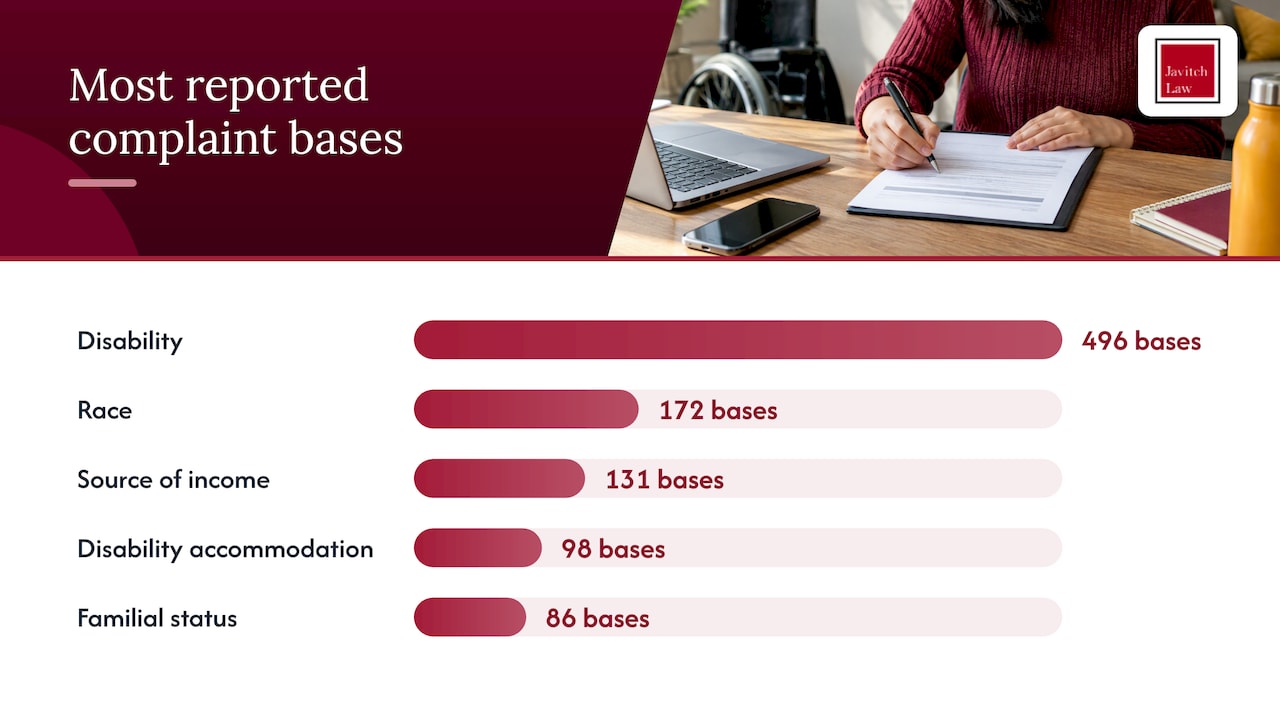
In its 2021 Annual Report, the CRD reported 1,401 bases for 898 housing cases. Disability was cited most often (496), followed by race (172), source of income (131), a requested or used disability accommodation (98), familial status (86), color (83) and national origin (75). One case can cite more than one basis, which is why the bases outnumber the cases.
Volume continues at a similar level. The 2025 Annual Report states that the CRD received 39,199 intake forms in 2025 across all subject areas and investigated 7,289 complaints, including 1,292 housing complaints.
Choosing between the CRD, HUD and a lawsuit
You have three routes, and they can be coordinated.
The CRD enforces FEHA. According to its housing page, a complaint filed with HUD is automatically filed with the CRD as well, and a complaint filed with the CRD that describes a federal violation is automatically filed with HUD while the CRD investigates. In practice, one filing reaches both agencies. Disability Rights California notes that the agencies coordinate and will not separately investigate the same issue.
HUD accepts reports online, by phone at 800-669-9777 or by mail. HUD asks for your name and address, the name and address of the person or organization you are accusing, the address of the housing involved, a short description of what happened and the dates.
A civil lawsuit is filed in court. Under California law, an aggrieved person may sue within two years after the discriminatory practice occurred or ended, and the two years exclude the time a CRD proceeding was pending. No CRD complaint is required first, according to the statutory text for Government Code sections 12989.1 and 12989.2.
| Route | Deadline | Who runs it | Typical outcomes |
|---|---|---|---|
| CRD complaint | One year from the last act in most non-employment cases | State agency investigation | Settlement, conciliation, CRD lawsuit if reasonable cause is found |
| HUD complaint | One year after the act occurred or ended | Federal agency investigation | Conciliation, charge before an administrative law judge or federal court |
| Private lawsuit | Two years, excluding time a CRD proceeding was pending | You and your attorney, in court | Damages, injunction, attorney’s fees |
The agency and court routes are not mutually exclusive in sequence. Because the one-year agency window is shorter than the two-year court window, the first decision is not which route is better but how to avoid losing any of them.
How to file with the Civil Rights Department
Step 1: Submit the intake form
The CRD’s complaint process begins with an intake form submitted through the California Civil Rights System. An unfiled complaint remains available in the system for 30 days. In most non-employment cases, the form must be submitted within one year of the date you were last harmed.
The common failure here is counting from the wrong date. The clock runs from the last discriminatory act, not from the date you learned the law protected you. A landlord’s denial in March and a retaliatory notice in September are separate acts with separate dates, and a careful complaint identifies each.
Step 2: Complete the intake interview
Submitting the form starts an intake interview, after which the CRD decides whether to accept the case for investigation. If it does, the CRD prepares a complaint for your signature and sends it to the respondent, meaning the landlord, property manager, lender or other party you accuse. Signing the complaint is the act that formally opens the case, so read the CRD’s draft for accuracy about dates, names and the protected characteristic involved.
Step 3: Assemble the evidence
The CRD asks for the specific facts and records about each incident, the name and contact information of the person or entity that harmed you, copies of documents, and the names and contact details of witnesses. For housing cases it specifically recommends:
- the lease or rental agreement and any lease violation notices;
- property rules and policies;
- eviction notices;
- advertisements and links to listings;
- court documents such as an unlawful detainer or a restraining order;
- for disability claims, documents showing your accommodation request and the denial, along with medical documentation.
Two habits improve almost every file. First, write a dated timeline the same day something happens, including who said what. Second, make written requests: an accommodation request made by email or letter proves the request and the response, while a verbal request leaves only your word. Screenshots of listings should show the date and the full page, since advertisements are often edited or removed.
Step 4: Know what the CRD does next
The CRD evaluates the allegations, investigates the facts and legal issues, and may attempt conciliation or refer the matter to dispute resolution. If it finds no reasonable cause, the case is closed. If it finds reasonable cause, it notifies the parties and may file a lawsuit. State law requires the CRD to commence proceedings within 30 days and to complete its investigation within 100 days unless that is impracticable, in which case it must give written reasons. In practice, delay is common, so keep copies of everything you send.
How to file with HUD
Filing with HUD follows the same one-year window. HUD must notify the respondent, investigate and decide whether there is reasonable cause, and it must tell the parties if it cannot finish within 100 days, according to its brochure. After a reasonable cause charge, either side has 20 days to elect a civil trial in federal district court, where the Department of Justice files on the complainant’s behalf. If no one elects it, a HUD administrative law judge hears the case, with HUD attorneys representing the complainant at no cost.
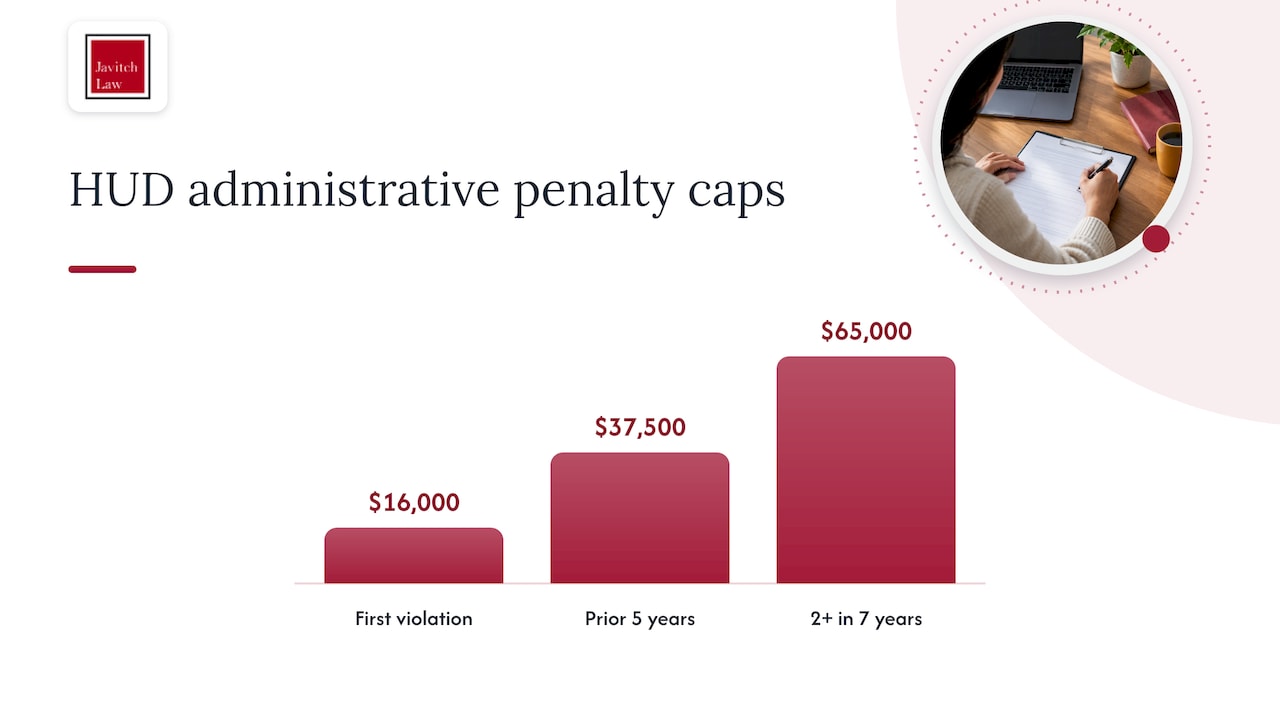
The brochure states maximum administrative civil penalties of $16,000 for a first violation, $37,500 if there was a violation in the preceding five years, and $65,000 for two or more violations in the preceding seven years. These are penalty caps in the administrative process, and they are separate from damages to you. The regulation at 24 CFR 180.671 allows a separate penalty for each distinct discriminatory practice and directs the judge to weigh prior violations, financial resources, the nature of the violation, culpability and deterrence.
What you can recover
The CRD lists these possible outcomes: out-of-pocket losses, an injunction, access to the housing you were denied, policy changes, training, reasonable accommodations, emotional distress damages, and civil penalties or punitive damages. In a California civil action, the court may award actual and punitive damages and injunctions, and may award the prevailing party reasonable attorney’s fees and costs, including expert witness fees, against any party other than the state, under Government Code section 12989.2.
The CRD’s published results show the range. Its 2025 Annual Report describes an $80,000 settlement for a tenant evicted for operating a licensed childcare business, a settlement of nearly $50,000 for a domestic violence victim’s family that also changed policies at nearly 100 Northern California properties, and $85,000 with the owners of about 100 San Diego County condominiums over children being targeted for playing outside. The 2023 Annual Report reports a $3 million settlement with Vasona Management affecting more than 2,000 families at nearly 50 apartment complexes. Past results do not predict any individual outcome, but they show that remedies often include changes to how a property operates, not only money.
Recent changes to the deadlines and procedure
SB 477, approved October 3, 2025, amended the FEHA enforcement procedures, and its housing changes took effect January 1, 2026. According to the bill text, it defines “group or class complaint,” tolls the private civil action deadline during a timely appeal of a CRD closure until one year after written notice that the closure stands, changes the timing of right-to-sue notices for related director or group complaints, and removes county-location provisions for CRD housing civil actions. The amended section 12981 also requires free dispute resolution before the CRD files a housing civil action.
Two practical consequences follow. If the CRD closes your complaint, an appeal affects when your court deadline resumes, so note the date on every closure notice. And if your complaint is part of a pattern affecting many tenants, group complaint rules may apply. Because procedures were revised recently, confirm the steps on the CRD’s own pages at the time you file.
Pitfalls that cost complainants their claims
- Missing the one-year window. The agency deadline is short, and it is the reason to act promptly even if you are still hoping to resolve things with a landlord.
- Filing a thin narrative. An intake that says only “my landlord discriminated against me” gives an investigator nothing to test. Name the date, the person, the words used and the comparison, such as a similar applicant who was accepted.
- Skipping the accommodation paper trail. Disability was the most cited basis in the CRD’s 2021 data. A request that is documented, specific and tied to a disability-related need is far easier to prove than a conversation in a hallway.
- Overlooking retaliation. Rent increases, notices or reduced services that follow a complaint can be a separate violation under section 12955.
- Assuming the agency will pursue everything. If the CRD finds no reasonable cause, it closes the case. Your court rights may remain, but only within the two-year period.
Small claims court is available for claims of $12,500 or less, the 2024 limit described by Disability Rights California, but it awards only money, not injunctions, so it cannot compel a landlord to change a policy or grant an accommodation.
Where Javitch Law Office fits
Our practice covers discrimination in employment, housing and public accommodations. For a housing matter, we evaluate the facts, identify the claims under FEHA, the Fair Housing Act and, where it applies, the Unruh Civil Rights Act, and advise on which forum and sequence protect your deadlines. Most of our cases proceed on a contingency-fee basis, meaning you pay nothing unless there is a recovery. You can see the scope of our work on our discrimination practice page, or read about housing discrimination in California and the Unruh Act’s minimum damages.
If you want an attorney to review your timeline and documents before you file, start with a free case consultation through our site. If your problem concerns other conduct, such as robocalls, wrong-number calls or deceptive pricing, our practice pages cover those separately.
Our perspective
A fair housing complaint is won or lost on the record you build in the first weeks: dated notes, written requests, preserved listings and a clear account of how similar applicants or tenants were treated. Agencies investigate many matters at once, and a file that is organized from the start gives the investigator, and later a court, something concrete to evaluate.
We take cases that larger firms avoid, and clients deal directly with an attorney. In housing matters that means reviewing the one-year agency deadline and the two-year court deadline together, so that choosing one route does not forfeit the other. It also means treating source of income, disability accommodation and familial status claims as the specific, document-driven claims that they are.
Our nationwide federal court admissions matter when a case involves federal law, and our use of public records requests can help establish how a housing provider or public agency actually behaved. Most of our matters proceed on a contingency basis, so the cost of bringing a well-founded claim does not fall on the person who was harmed.
Mark
FAQ
Do I need a lawyer to file a fair housing complaint in California?
No. You may submit an intake form to the CRD or report to HUD yourself. An attorney helps most with choosing the forum, framing the claims, preserving the court deadline and negotiating a settlement. Our firm offers a free case consultation to evaluate these questions.
Can I file with both the CRD and HUD?
You generally file with one. The CRD’s housing page states that a HUD complaint is automatically filed with the CRD and that a CRD complaint describing a federal violation is automatically filed with HUD. The agencies coordinate rather than investigating the same issue twice.
Can I sue without filing an agency complaint first?
Yes. California law allows a civil action within two years of the discriminatory practice without first filing with the CRD, and the period excludes time a CRD proceeding was pending. Because the agency deadline is one year, deciding early between the two routes protects your options.
What documents should I gather first?
Start with your lease, any notices, the original advertisement, written communications and your own dated timeline. For a disability claim, add your accommodation request, the response, and medical documentation. List the names and contact information of any witnesses.
Does the CRD charge a fee?
The CRD’s complaint process does not require you to pay a filing fee, and HUD attorneys represent complainants at no cost in an administrative hearing, according to HUD’s brochure. Private representation is a separate arrangement, and ours is generally contingent.
Sources
- Complaint Process, California Civil Rights Department
- Housing, California Civil Rights Department
- Report Housing Discrimination, HUD
- Fair Housing: Equal Opportunity for All, HUD
- California Government Code section 12955
- California Government Code, FEHA housing enforcement provisions
- SB 477 bill text
- CRD 2021 Annual Report
- CRD 2023 Annual Report
- CRD 2025 Annual Report
- 24 CFR Subtitle B, Regulations Relating to Housing and Urban Development
- Housing: Frequently Asked Questions, Disability Rights California