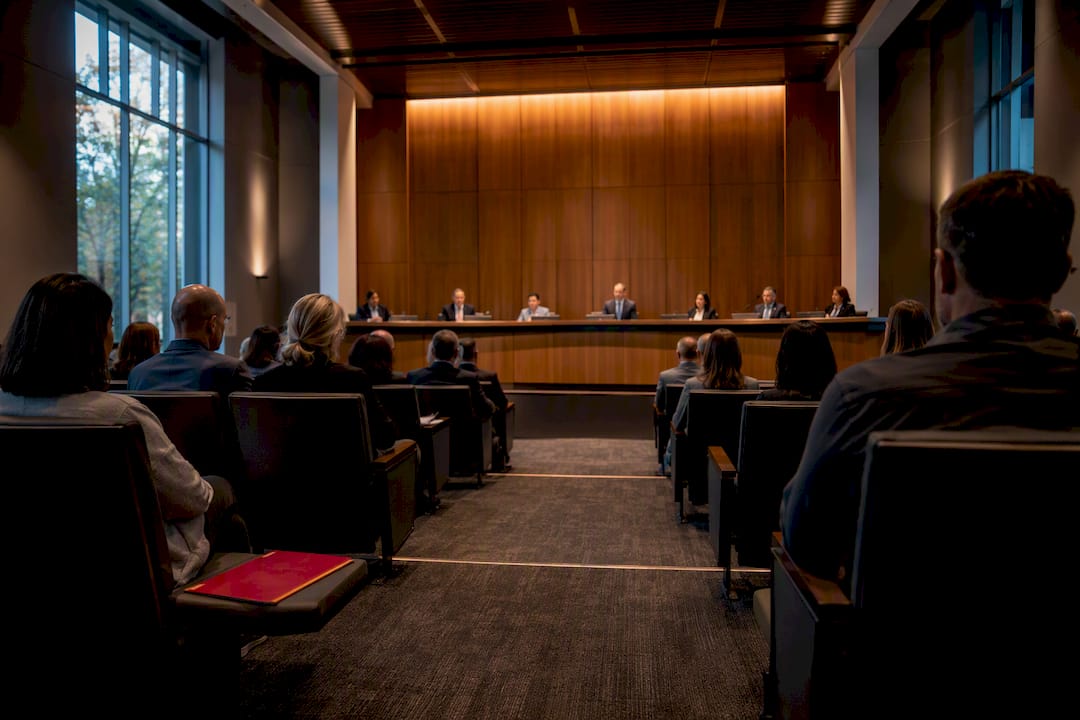
If a city council or school board deliberates outside a properly noticed public meeting, votes by secret ballot, or lets a quorum reach consensus through a chain of emails, that is a Brown Act violation. Start by writing down exactly what happened, who was involved, and when, because deadlines for challenging the action start running fast. Everything below explains how to confirm the violation, preserve proof, and decide whether a cure-and-correct demand, a complaint, or a lawsuit is the right next move.
TL;DR:
- Serial communications among members can violate the Brown Act if they collectively discuss an item outside a public meeting, even without direct meetings.
- Inadequate or last-minute agenda notices and undisclosed votes are common violations that undermine transparency and can lead to legal actions.
- Evidence preservation, including emails, screenshots with timestamps, and witness statements, is critical for increasing the chances of winning a violation case.
- Civil remedies do not require proof of intent, but criminal charges do; enforcement can come from city attorneys, district attorneys, or private citizens.
- Most violations are unintentional procedural errors rather than malicious acts, making early documentation and correction opportunities essential.
Table of Contents
- What Legally Counts as a Brown Act Violation?
- What Are Common Brown Act Violations And Real Examples?
- How Do You Document And Preserve Evidence Of A Violation?
- What Remedies Exist And Who Enforces The Brown Act?
- How Do You Report A Brown Act Violation?
- Why Most Brown Act Violations Aren’t Malicious, But Still Matter
- How Javitch Law Office Handles Brown Act Cases
- Where To Find The Official Rules
- Sources
What Legally Counts as a Brown Act Violation?
The Ralph M. Brown Act (Gov. Code § 54950 et seq.) requires that all meetings of local legislative bodies in California be open to the public, with only narrow exceptions. It covers city councils, school boards, water districts, planning commissions, and any other multi-member body created by state or local law. A violation happens whenever that body deliberates, gathers information, or reaches consensus outside a properly noticed public meeting.
The doctrine that trips up the most officials is the serial meeting rule: a quorum can violate the law without ever sitting in the same room, if members pass information or opinions through a chain of one-on-one conversations, texts, or emails that functionally adds up to a private discussion. Closed sessions are allowed only for specific, listed purposes like pending litigation or personnel matters, and the Bagley-Keene Guide from the California Department of Justice makes clear those exceptions are read narrowly, not expanded to fit convenient circumstances.
A few things to keep in mind when you’re sizing up a suspected violation:
- The Act applies to deliberation and information gathering, not just formal votes.
- Courts and city attorneys are told to favor public access when a statute is ambiguous.
- Criminal charges require proof the violation was knowing and intended to deprive the public, but civil remedies do not always require that same intent.
What Are Common Brown Act Violations And Real Examples?
Most Brown Act violations fall into a handful of recognizable patterns. Recognizing the pattern is the first step toward building a case.
- Serial communications. A council member emails two colleagues about an upcoming vote, one of them forwards a reply to a third, and suddenly a quorum has discussed the item without a single public meeting. This is the most common violation because it rarely feels like a “meeting” to the people doing it.
- Inadequate agenda notice. An item gets added the morning of the meeting, or a matter is discussed under “general business” with no specific description, denying the public a fair chance to weigh in.
- Improper location or format changes. A body relocates mid-meeting, cuts off remote access, or excludes the public during a disruption without following the narrow rules that allow it.
- Secret ballots and undisclosed votes. Any vote taken without a public record of how each member voted violates the transparency requirement at the heart of the law.
- Misuse of closed sessions. Bodies sometimes stretch a personnel or litigation exception to cover policy discussions that belong in open session.
Recent enforcement actions show how these patterns play out. In Oakland, the city attorney found that closed-door meetings on encampment policy violated transparency law because the discussions should have happened in public session. A Fresno court reached a similar conclusion after investigative reporting exposed a pattern of private budget discussions, and a judge ruled against the city for conducting deliberations outside noticed meetings. Berkeley has faced comparable scrutiny over committee communications that bypassed public notice. None of these cases involved a single dramatic secret meeting. They involved small, repeated shortcuts that added up.
How Do You Document And Preserve Evidence Of A Violation?
Evidence wins these cases, and evidence disappears fast if you wait. The moment you suspect a violation, start collecting everything connected to the decision in question.
- Save agendas, staff reports, and meeting minutes exactly as posted, including the timestamp of when they went online.
- Preserve emails, texts, and calendar invites among members, especially anything showing a chain of communication that could add up to a serial meeting.
- Take screenshots that show a visible date and time, not just the content, since a cropped screenshot with no timestamp carries less weight later.
- Request original files through a Public Records Act request rather than relying on forwarded copies, which can be altered or incomplete.
- Ask witnesses who attended the meeting to write down what they saw while it is fresh, including who spoke, what was said, and roughly when it happened.
A witness declaration should identify the meeting date, the speaker’s name and title, a direct account of what was said or done, and a statement that the account is true under penalty of perjury if you plan to use it in litigation. Public records requests strengthen a challenge because they force an agency to produce its own internal communications, which often confirm a pattern that outside observers only suspected. Our guide to FOIA requests walks through how to frame those requests so agencies cannot stall behind vague responses.
Pro Tip: Build your evidence file in chronological order from day one. A well-organized timeline is often what convinces an agency to cure a defect voluntarily instead of forcing a lawsuit.
What Remedies Exist And Who Enforces The Brown Act?
Timing controls everything here, and it is stricter than most people expect. To challenge an action taken in violation of the Brown Act, you generally must serve a written cure-and-correct demand within 90 days of the action, or within 30 days if the defect involves an inadequate agenda description. Brown Act at a Glance](https://www.santacruzca.gov/Government/City-Departments/City-Clerk/The-Ralph-M.-Brown-Act-at-a-Glance). published by the City of Santa Cruz.
Not every violation supports voiding the agency’s action. Courts tend to nullify decisions tied to clear procedural defects, like a missing agenda item or a secret vote, more readily than they nullify decisions where the underlying deliberation was substantively fair but technically flawed.
Enforcement runs on two separate tracks. Civil remedies, including injunctions and voiding a decision, do not require proof of intent. Criminal prosecution does. The California Attorney General’s office confirms that a knowing violation intended to deprive the public of information can be prosecuted as a crime, but civil challenges only need to show the violation occurred.
Several actors can step in:
- City or county attorneys, who often issue findings after internal or public pressure.
- District attorneys, who can pursue criminal charges in cases involving knowing intent.
- The California Attorney General, who can weigh in on matters of statewide significance.
- Private citizens, who can file civil suits directly when an agency ignores a cure-and-correct demand.
How Do You Report A Brown Act Violation?
Reporting works best as a sequence, not a single phone call. Here is the order that gives you the strongest position:
- Preserve everything first. Build your evidence packet, following the steps above, before you contact anyone.
- Draft the cure-and-correct demand. Identify the specific statutory violation, cite the action taken, and send it to the agency’s clerk and legal counsel within the applicable deadline.
- File a complaint if the agency doesn’t respond. Send your documentation to the city or county attorney, and to the district attorney if you believe the conduct was intentional.
- Consider civil litigation. If the cure period lapses without correction, you have 15 days to decide whether to sue.
- Talk to an attorney early, especially before deadlines expire. Bring your timeline, all preserved records, and any witness statements to the first consultation.
Advocacy groups like ACLU Northern California publish intake resources that can help you sort a minor procedural slip from a pattern worth escalating.
Why Most Brown Act Violations Aren’t Malicious, But Still Matter
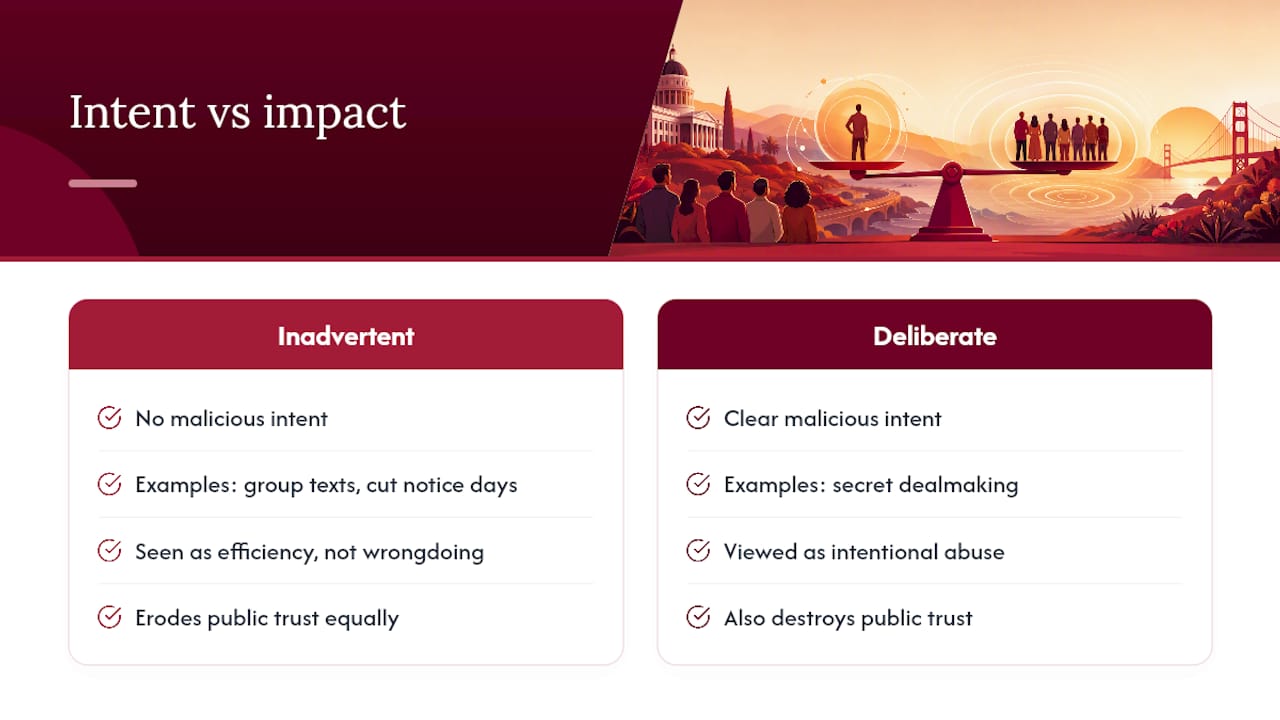
Most Brown Act violations don’t come from officials plotting in a back room. They come from a council member replying to a group text without thinking it through, or a clerk shaving a day off notice because the agenda ran late. That is precisely why the law is written to favor public access regardless of intent. If enforcement only caught the deliberate schemers, the sloppy shortcuts that quietly erode public trust would never get corrected.
The pattern we see most often is procedural laziness dressed up as efficiency. A committee that used to argue policy in open session starts settling things over email because it is faster. Nobody involved thinks they are breaking the law. But the effect on public trust is the same either way: decisions get made before residents ever get a chance to weigh in. Early documentation is what separates a case that ends with a quiet correction from one that drags through a year of litigation over a decision that already happened.
— Mark
How Javitch Law Office Handles Brown Act Cases
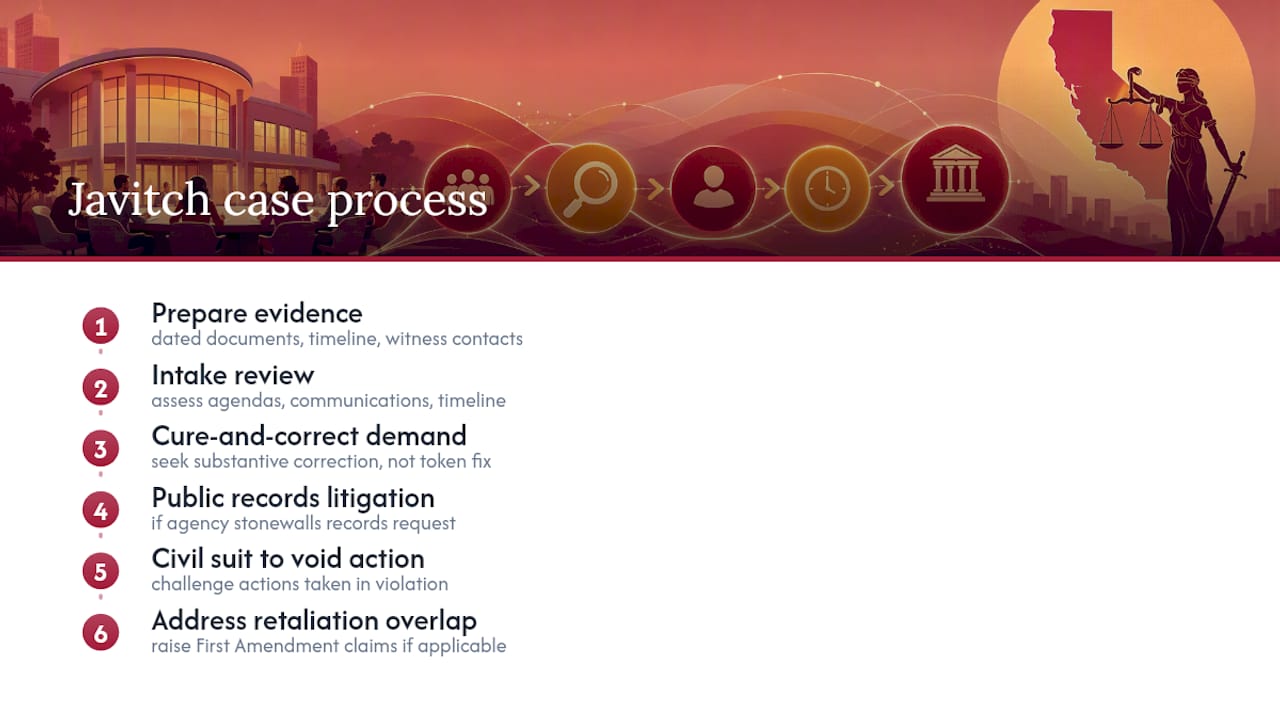
Our firm works directly with California residents and advocacy groups who need help proving a transparency violation, not just suspecting one. That work usually starts with an intake review of your evidence packet: the agendas, communications, and witness accounts you have already gathered, plus a timeline showing when the violation occurred and when deadlines expire.
From there, services can include drafting a cure-and-correct demand aimed at forcing a real correction rather than a token response, filing public records litigation when an agency stonewalls a records request tied to the violation, and pursuing civil suits to void an action taken in violation of the law. If your case also touches First Amendment retaliation, that overlap may be addressed in the same review.
Before you schedule a consultation, gather your dated documents, a written timeline of events, and contact information for anyone who witnessed the meeting or communications in question. Reach out to discuss your situation, and bring what you have. The sooner your deadlines are mapped out, the more options stay open.
Where To Find The Official Rules
Read the statute itself at Gov. Code § 54950 et seq., consult the Bagley-Keene Guide for open-meeting principles, and check your county’s own explainer, such as Ventura County’s Brown Act page, for local contact points.
This article is general information, not a substitute for advice from a qualified lawyer. Consult a qualified legal professional about your own circumstances before acting on anything here.