
California amended its Automatic Renewal Law effective July 1, 2025, and the update raises the bar substantially. Businesses now need to express affirmative consent for auto-renewal terms, advance notice before renewals and fee changes, annual reminders, and a working cancellation option, with consent records kept under BPC sections 17600 through 17606. If you run a subscription business, audit your enrollment flow now. If you’re a consumer with a charge you don’t recognize, check your account settings and cancel today.
TL;DR:
- Businesses must now obtain specific, clear “yes”" consent for auto-renewal and keep records for at least three years, including consent and disclosure proof.
- They need to send annual renewal reminders, notice of fee changes, and cancellation options that are easy and immediate online, matching the signup process.
- The amendments cover any contract renewing automatically or converting from free to paid, regardless of sales channel, and require compliant cancellation flows.
- Companies should audit all recurring offers, implement separate consent, automate notices within legal windows, and test cancellation UX to avoid enforcement risks.
- Consumers should document all signup and cancellation interactions, as the law prioritizes real-time cancellation ability over legal language alone.
Table of Contents
- What Changed Under the 2025 Auto Renewal Law California Amendments
- Who the Law Covers: Scope and Key Definitions
- Business Compliance Checklist for California’s Auto Renewal Regulations
- What to Do If You Spot an Unwanted Auto Renewal Charge
- Enforcement of California’s Auto Renewal Contract Law
- Key Dates and a Realistic Compliance Timeline
- Common Pitfalls We See in Auto Renewal Compliance Work
- The Real Compliance Gap Nobody Talks About
- Get Help With Auto Renewal Compliance or a Consumer Claim
- Where to Read the Actual Law
- Sources
- FAQ
What Changed Under the 2025 Auto Renewal Law California Amendments
The prior version of California’s auto renewal statute was already stricter than most states, but it had gaps. AB 2863 closed them. The Attorney General’s consumer alert and the bill text itself lay out several concrete new obligations that didn’t exist under the old rules.
- Express affirmative consent. A business must get a separate, clear “yes” specifically for the auto-renewal or continuous-service term, not a bundled agreement buried in general terms of service.
- Recordkeeping. That consent has to be retained for at least three years, or one year after the contract ends, whichever period runs longer.
- Annual reminders. Every ongoing subscription requires a yearly notice sent through the same method the customer used to sign up, spelling out the service, the charge, and how to cancel.
- Notice windows. Free trials or promotions running longer than 31 days need a cancellation notice sent 3 to 21 days before they convert to paid. Renewals for terms of one year or longer require notice 15 to 45 days out.
- Fee-change notices must go out with enough lead time for the consumer to cancel before getting charged the new rate.
- Easy cancellation. Online enrollments must allow immediate online cancellation. No phone-only cancellation lines, no forced chat sessions, no maze of account settings.
- Free-to-pay conversion is now its own defined category under the statute, closing a loophole that let some “free trial” offers dodge the stricter renewal rules.
Together, these amendments push California closer to a true “click to cancel” standard, matching signup friction with cancellation friction instead of letting one be instant and the other take fifteen minutes on hold.
Who the Law Covers: Scope and Key Definitions
The statute covers any business offering an “automatic renewal” or “continuous service” to a California consumer, whether that offer is made online, in a store, over the phone, or through an app. The rules apply to contracts entered, amended, or extended on or after July 1, 2025 — older contracts that haven’t been touched since then generally fall under the prior version of the law.
Three terms matter most for figuring out if you’re covered:
- Automatic renewal: A contract that renews automatically at the end of a defined term unless the consumer cancels, like an annual software license or a streaming plan billed yearly.
- Continuous service: An ongoing arrangement with no fixed end date that keeps charging until canceled, common with gym memberships and cloud storage plans.
- Free-to-pay conversion: Any offer that starts free (or heavily discounted) and automatically shifts to a paid recurring charge, the exact structure behind most streaming and software trial funnels.
Enrollment medium matters too. If someone signed up online, the annual reminder and cancellation option both need to work online, not funnel back to a phone tree. A subscription sold in person needs a cancellation path that doesn’t require an in-person visit.
Business Compliance Checklist for California’s Auto Renewal Regulations
Getting compliant isn’t a single fix. It’s a sequence, and skipping steps is how companies end up defending a class action instead of a support ticket.
- Inventory every recurring offer. List every subscription, membership, and continuous-service product, including free trials that convert to paid. Don’t forget legacy products your marketing team may have forgotten about.
- Separate consent from general terms. Add a distinct, unchecked checkbox or equivalent affirmative action for the auto-renewal term itself. A single “I agree to the Terms of Service” checkbox covering everything is no longer sufficient.
- Timestamp and store consent records. Retain proof of that consent, along with the specific disclosure language shown at signup, for three years or one year past termination, whichever is longer.
- Build automated notice workflows. Set up triggers for the 3 to 21 day free-trial window, the 15 to 45 day annual-renewal window, and fee-change notices, and make sure timezone handling doesn’t push a notice outside the legal window by even a day.
- Add a direct cancellation control. Build an account-level “cancel subscription” button that works without a phone call, and match the cancellation medium to how the customer originally enrolled.
- Rewrite acknowledgments. Make sure the auto-renewal terms, price, and cancellation method appear in visual and temporal proximity to the consent action itself, not several screens away.
- Run cancellation UX testing. Have someone outside the project try to cancel a test account. If it takes more clicks than signing up did, that’s a compliance problem waiting to surface in a demand letter.
- Document the remediation. Keep records of what you changed, when, and the testing that confirmed it worked. That paper trail matters if regulators or plaintiffs’ attorneys come asking.
Pro Tip: Treat the cancellation flow as a mirror of the signup flow. If a customer can enroll in two taps but needs four steps and a hold-music session to leave, that asymmetry is exactly what the amended law targets.
What to Do If You Spot an Unwanted Auto Renewal Charge
Start with the acknowledgment you received at signup. It should list the auto-renewal terms, the price, and how to cancel, and under the amended law that information has to be easy to find in your account settings, not hidden in a footer link.
- Look for a direct cancellation option first, since businesses covered by the statute are now required to offer immediate online cancellation for accounts opened online.
- If there’s no online option, use the toll-free number, email address, or postal address the company provided at signup, and keep a copy of whatever confirmation you receive.
- Screenshot the cancellation confirmation screen and save any emails documenting the request. Under the recordkeeping rule, the business is required to hold its own proof of your consent, so your documentation should match theirs.
- If a charge still hits your card after a documented cancellation, dispute it directly with your card issuer or bank, or consult a California Lemon Law attorney who can help protect your consumer rights. Most disputes move faster with dated proof of your cancellation attempt in hand.
- For patterns that look intentional, such as an obstructive cancellation process or repeated charges after cancellation, file a complaint with the California Attorney General’s office or talk to a consumer class action attorney about your options.
Pro Tip: Save your original signup confirmation the day you enroll, not the day you decide to cancel. Businesses have to keep that record for years. You should too.
Enforcement of California’s Auto Renewal Contract Law
The California Attorney General’s office is the primary enforcer, and it has made this statute a public priority. Attorney General Bonta framed the 2025 amendments as a direct response to businesses making sign-up simple and cancellation deliberately complicated, which tells you where enforcement attention is likely to land first.
- California Attorney General and local district or city attorneys can pursue enforcement actions against noncompliant businesses.
- Private consumers can bring civil claims, including class actions, when a business fails to obtain proper consent or blocks easy cancellation.
- Remedies commonly include injunctive relief forcing a business to fix its practices, restitution to affected consumers, statutory penalties, and attorneys’ fees in successful private actions.
Missing consent records or an obstructive cancellation flow are the two issues that turn a minor compliance gap into serious litigation exposure, since both are easy for a plaintiff’s attorney to document and hard for a business to explain away after the fact.
Key Dates and a Realistic Compliance Timeline
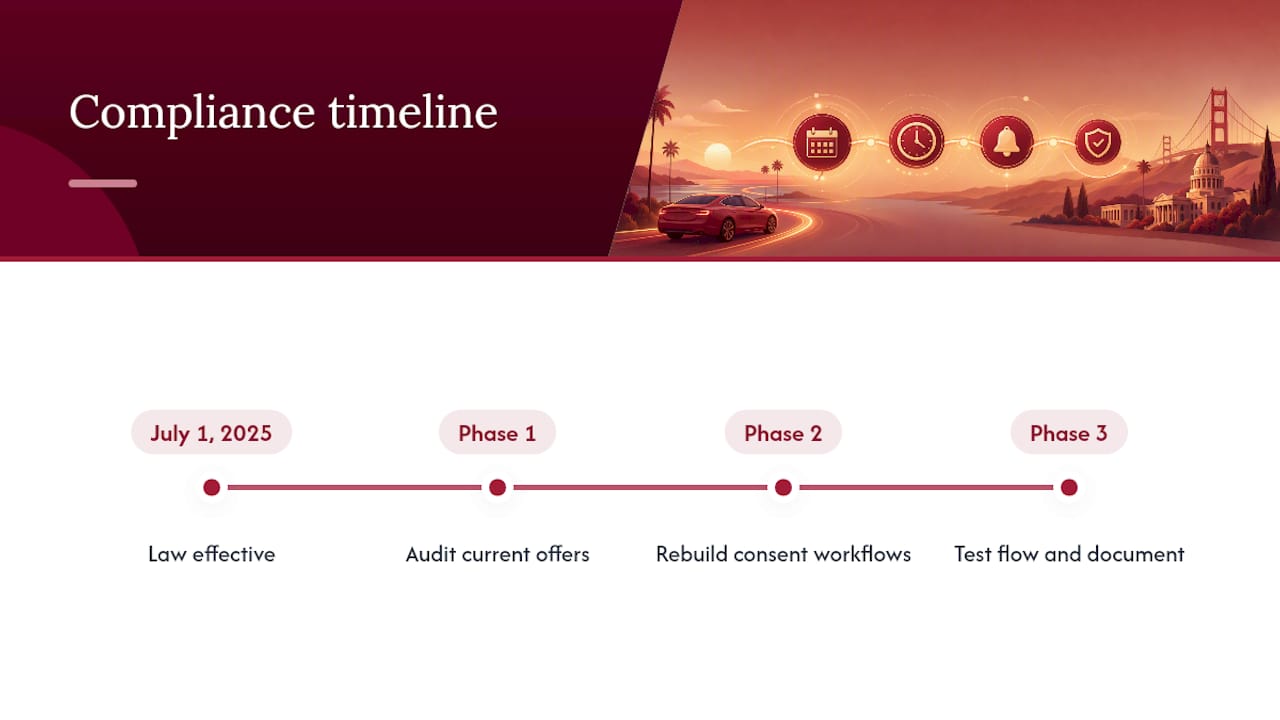
The amendments took effect July 1, 2025, and apply to any contract entered, amended, or extended on or after that date. If your terms haven’t changed since before then, you may still be operating under the older framework, but any renewal, price change, or amendment now triggers the new rules.
For a business starting late, a realistic project runs in three phases: audit your current subscription and continuous-service offers first, then rebuild the consent, notice, and cancellation workflows around the statutory windows, and finally test the entire flow end to end before pushing it live. Each phase should leave a paper trail, since documented remediation is itself evidence of good faith if a regulator or plaintiff’s attorney ever asks questions.
Common Pitfalls We See in Auto Renewal Compliance Work
The two mistakes that show up again and again are thin consent records and cancellation flows that quietly work against the customer. A checkbox pre-checked by default, a “cancel” button that only opens a chat queue, a notice that goes out two days late because of a timezone bug. Any one of these is fixable, but left alone they compound into class-action exposure.
When Javitch Law Office evaluates a potential consumer claim, the most useful documents are the original enrollment acknowledgment, any renewal or fee-change notices actually received, and a timeline of cancellation attempts with dates. Businesses considering a compliance review should expect it to cover consent capture, notice timing logic, and a hands-on test of the actual cancellation path, not just a read-through of the written policy.
The Real Compliance Gap Nobody Talks About
Most coverage of this law treats it as a checklist problem: add a checkbox, send a reminder email, done. That undersells what actually changed. The amendments target the gap between signup friction and cancellation friction, and that gap is a design choice most companies made deliberately, long before anyone called it a dark pattern.
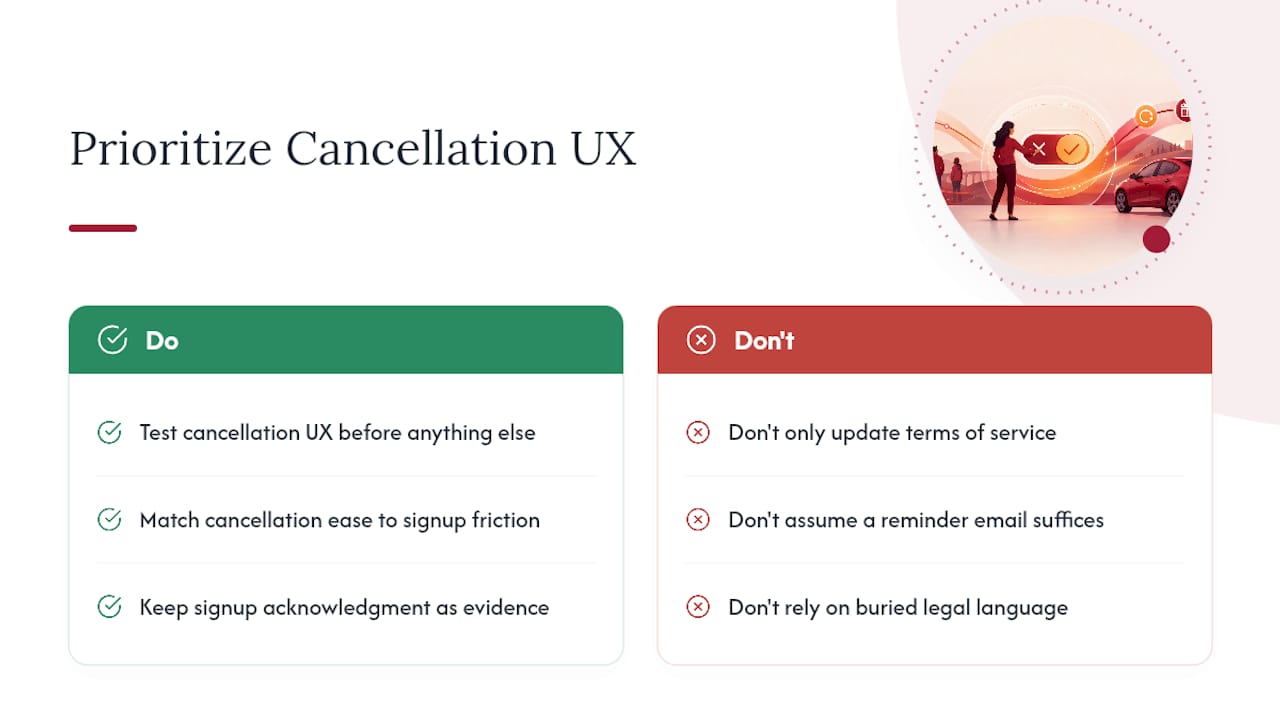
The conventional advice, update your terms of service and move on, misses that a compliant terms document sitting on top of a broken cancellation flow is still noncompliant. Regulators and plaintiffs’ attorneys aren’t auditing your legal language first. They’re testing whether a real customer can cancel in the time it took them to sign up.
If you run a subscription business, prioritize the cancellation UX test before you touch your privacy policy. If you’re a consumer who got burned by a renewal you never meant to agree to, your signup acknowledgment is worth more than any argument you could make on the phone with customer service. Keep it, and don’t let a company convince you it doesn’t exist.
— Mark
Get Help With Auto Renewal Compliance or a Consumer Claim
Legal professionals work both sides of California’s automatic renewal statute: helping businesses build compliant consent, notice, and cancellation systems, and representing consumers who got hit with charges they never knowingly agreed to. If your company processes recurring subscriptions in California, a compliance review can catch the consent-capture and cancellation-flow gaps that turn into class-action exposure before they do.
For consumers, if you’ve documented a canceled subscription that kept charging, or an auto-renewal you never actually agreed to, that paper trail may support a claim. Related guidance on the click to cancel requirement explains what businesses owe you at the moment you try to leave. Start with a free case evaluation through the firm’s consumer class action practice and bring your signup confirmation, any renewal notices, and your cancellation attempt records. That’s the fastest way to find out whether you have a claim worth pursuing.
Where to Read the Actual Law
The statutory text itself, AB 2863 and BPC sections 17600 through 17606, is the authoritative source for exact requirements. The Attorney General’s consumer alert summarizes it in plain language, and Cooley’s compliance advisory breaks down practical implementation steps for businesses. For federal context on negative-option practices generally, see the FTC’s rulemaking materials.
This article is general information, not a substitute for advice from a qualified lawyer. Consult a qualified legal professional about your own circumstances before acting on anything here.
Sources
- Attorney General Bonta Issues Consumer Alert on California’s Automatic Renewal Law | State of California - Department of Justice - Office of the Attorney General
- California Code, BPC 17602 — Article 9. Automatic Purchase Renewals 17600 - 17606
- California Automatic Renewal Law Amendments Take Effect on July 1, 2025 // Cooley
FAQ
Can I dispute an automatic renewal charge?
Yes. If you canceled before the renewal date or never gave express affirmative consent to the auto-renewal term, dispute the charge with your card issuer or bank and keep your cancellation documentation on hand.
Are auto-renewal clauses enforceable in California?
They’re enforceable only when the business followed the statutory requirements: clear disclosure, express affirmative consent to the renewal term specifically, proper notice, and an accessible cancellation method under BPC 17602.
What are the general rules for auto-renewal contracts in California?
Businesses must get express affirmative consent for the renewal term, send annual reminders and advance notice before renewals or fee changes, and allow immediate online cancellation for online enrollments, with consent records kept for three years or one year post-termination.
Do the new California auto renewal rules apply to auto repair shops?
The 2025 amendments to the Automatic Renewal Law apply broadly to any business offering subscription or continuous-service contracts to California consumers, including service plans sold by auto repair or maintenance businesses that auto-renew.
What should a business do first to comply with the amended law?
Start by inventorying every recurring offer and testing your existing cancellation flow, since obstructive cancellation and missing consent records are the two issues most likely to trigger enforcement or a private lawsuit.