
Yes. California requires click-to-cancel for online subscriptions, effective starting mid-2025 under Assembly Bill 2863, which amended the state’s Automatic Renewal Law. The California Attorney General’s consumer alert confirms it: if you signed up for something online, the business has to let you cancel it online, too, without jumping through extra hoops.
What that means in practice:
- Consumers can now demand a prominent cancel button or a pre-formatted termination email instead of getting routed into a retention call.
- Businesses must apply the “same-medium” rule: however you enrolled someone, that’s how they get to leave.
Key Takeaways
California’s AB 2863 requires businesses to make canceling an online subscription as easy as signing up for one, effective July 1, 2025.
| Point | Details |
|---|---|
| Effective date | AB 2863 took effect starting in mid-2025, amending California’s Automatic Renewal Law statewide. |
| Same-medium rule | Cancellation must use the same channel as enrollment: online, phone, or in person. |
| Renewal notice windows | Annual plans need 15 to 45 days’ notice; trial conversions need 3 to 21 days; price changes need 7 to 30 days. |
| Document everything | Save screenshots, timestamps, confirmation emails, and call logs to support any refund or complaint. |
| Legal help available | Javitch Law Office reviews cancellation disputes and unauthorized renewal charges for possible claims. |
Table of Contents
- Is Click to Cancel Required in California Right Now?
- What Subscriptions and Sign-Up Methods Does the Law Cover?
- How Do I Cancel a Subscription in California Right Now?
- What Should Businesses Do to Comply With AB 2863?
- Who Enforces Click-to-Cancel and What Happens If a Business Ignores It?
- When Should You Talk to an Attorney About a Cancellation Dispute?
- Why This Law Matters and What Actually Changes Behavior
- How Javitch Law Office Can Help With a Cancellation Dispute
- Frequently Asked Questions
- Sources
Is Click to Cancel Required in California Right Now?
It is, and it has been enforceable since July 1, 2025. AB 2863 rewrote California’s Automatic Renewal Law to close a gap that had let companies make sign-up effortless and cancellation miserable. The statute itself requires:
- A visible click-to-cancel button or link for anyone who enrolled online, or a pre-formatted email the business must honor without delay.
- The same-medium rule: phone sign-ups need a phone cancellation path, and that path has to work, not just exist on paper.
- Renewal notices sent within a window before any renewal on a plan with an initial term of a year or longer, and those notices must spell out the length, cost, billing frequency, and how to cancel.
- Trial-to-paid conversions require advance notice before the charge hits.
- Price-change notices must be sent before the new rate applies, within a specified advance notice period.
The Los Angeles Times summarized the intent bluntly: cancellation is supposed to be a one-click snap, not a maze.
Once you click cancel, the business has to process it immediately, not “within a few billing cycles.” A retention offer can be presented once, but it cannot replace or delay the actual cancellation option.
Pro Tip: If a company offers you a discount to stay, that’s fine to consider, but you should still be able to say no and complete the cancellation in the same interaction. If the “cancel” button routes you into an endless offer loop with no exit, that’s the obstruction AB 2863 was written to stop.
What Subscriptions and Sign-Up Methods Does the Law Cover?
AB 2863 covers automatic renewals and “free-to-pay” conversions, meaning free trials that quietly become paid subscriptions count under the amended Automatic Renewal Law. Streaming services, software subscriptions, phone plans, and membership programs all fall under it.
- Online enrollment triggers a right to online cancellation.
- Toll-free phone enrollment triggers a right to phone cancellation, with prompt answering required.
- In-person or mail enrollment carries its own same-medium expectations.
Not everything is covered the same way. Business-to-business enterprise contracts, one-time purchases with no recurring charge, and services sold outside California’s consumer protections sit outside AB 2863’s reach. Separately, California’s Home Solicitation Sales Act gives a three-business-day cancellation right for certain in-home sales, which is a different rule entirely and shouldn’t get confused with the subscription cancellation right. Businesses can still require login authentication before processing a cancellation, but they cannot use that step to bury or stall the request.
How Do I Cancel a Subscription in California Right Now?
Start with the same channel you used to sign up. If you enrolled through a website, look for the cancel button inside your account settings, not buried in a help article three clicks deep. If you signed up over the phone, use that same toll-free number.
- Find the cancellation path. Online accounts should have a visible cancel option; for example, the Refund & Cancellation Policy | 1-Hour Book Publisher shows how small businesses can clearly display cancellation methods; phone enrollments require a working phone line back.
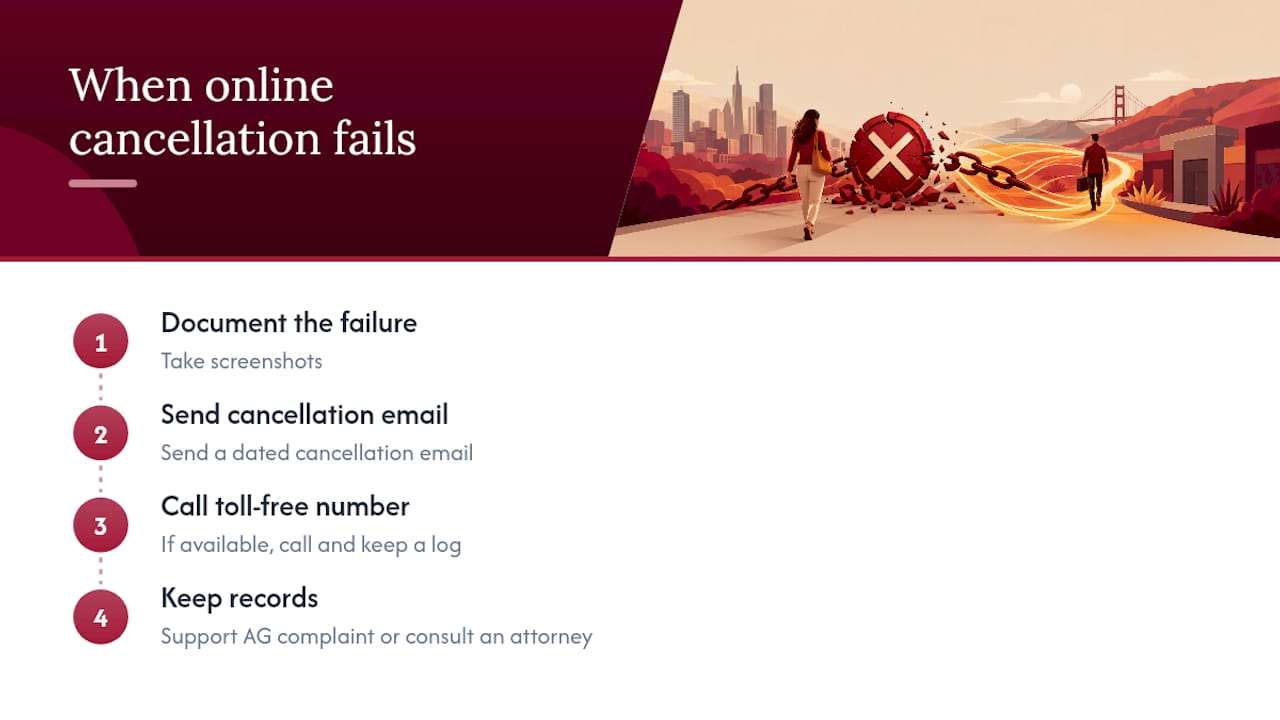
- Use the click-to-cancel button or the pre-formatted email the business is required to provide. Screenshot the confirmation page and note the timestamp.
- If the button is missing, hidden, or broken, send a dated email requesting cancellation, or call the toll-free number and keep a log of the call, including hold time and any voicemail you leave.
- Save everything: confirmation receipts, call logs, voicemail transcripts, and billing statements showing the charge you’re disputing.
A basic cancellation email should include your account ID, the date, a clear statement that you want to cancel, and a request for written confirmation. That paper trail matters more than most people realize, especially if the company keeps charging you anyway.
Pro Tip: If a cancel flow seems designed to frustrate you, document the failure step by step. Screenshot each page, check the browser’s timestamp, and try the process on both desktop and mobile. Companies sometimes fix the desktop flow and leave the mobile one broken, and that inconsistency is exactly the kind of evidence an attorney needs.
What Should Businesses Do to Comply With AB 2863?
Product, legal, and support teams all have work to do here, and the fixes aren’t cosmetic.
- Put the cancel link where people can actually find it, inside account settings or subscription management, and make sure clicking it processes the cancellation immediately rather than opening a support ticket queue.
- Publish clear alternate cancellation channels. A toll-free number, email address, or mailing address should be listed plainly, and if you require authentication, provide a fallback route for people who’ve lost access to their login.
- Automate renewal and price-change notices. Annual plans need the 15 to 45 day window; trial conversions need the 3 to 21 day window; price changes need 7 to 30 days. Missing one of these windows is one of the easier violations for regulators to spot.
- Staff your cancellation channels properly. Phone lines need to be answered promptly during business hours, and voicemail cancellation requests must be processed or returned within a short business time frame learn more.
- Keep records. Log every cancellation attempt, the channel used, and the resolution time. If a complaint or lawsuit surfaces later, that log is your defense.
Pro Tip: Run your own cancellation flow the way a frustrated customer would. If your team can’t cancel a test account in under a minute without calling support, regulators and plaintiffs’ attorneys will notice the same friction your customers do. Update your terms of service and privacy policy language to reflect the new cancellation mechanics, and build an internal escalation path for disputed cancellations before you need one, not after.
Who Enforces Click-to-Cancel and What Happens If a Business Ignores It?
The California Attorney General’s office is the primary enforcer, and the FTC’s negative-option rulemaking adds a federal layer for companies operating nationally, though it doesn’t replace California’s own requirements for state residents.
- Consumers can pursue refunds for unauthorized renewal charges.
- Courts can order cancellation of invalid renewals and injunctive relief against ongoing violations.
- Companies that fail to obtain proper consent or obstruct cancellation face potential statutory penalties.
Attorney General Rob Bonta framed the update as giving consumers the power to manage and cancel subscriptions as easily as they signed up, specifically to shut down deceptive design that traps people in recurring charges.
To file a complaint, gather screenshots, confirmation emails, and call logs before you contact the Attorney General’s consumer complaint line. The stronger your documentation, the faster a claim tends to move.
When Should You Talk to an Attorney About a Cancellation Dispute?
If a company repeatedly refuses to process your cancellation, keeps charging you after you’ve documented a clear cancellation attempt, or ignores the one-business-day voicemail rule, that’s worth a legal consultation rather than another angry phone call.
Before you reach out, gather:
- Screenshots and timestamps of the cancel flow, including any dead ends or loops.
- Copies of the pre-formatted cancellation email and any confirmation you received.
- Call logs, voicemail recordings, and billing statements showing unauthorized charges.
- Any written communication with the company’s support team.
Pro Tip: Attorneys use this evidence to establish a pattern, not just a single bad interaction. One broken cancel button might be a bug; the same broken button across dozens of complaints looks like a design choice.
Why This Law Matters and What Actually Changes Behavior
As a California-based firm handling consumer protection cases, we’ve watched dark-pattern cancellation flows generate real financial harm for years. AB 2863 finally puts teeth behind a simple idea: exiting a subscription should take the same number of clicks as joining one. If you’re a product manager, test your own cancel flow before regulators do.

How Javitch Law Office Can Help With a Cancellation Dispute
If a company kept charging you after a documented cancellation attempt, or built a cancel flow designed to wear you down, that’s not just annoying. It may be a violation of California’s Automatic Renewal Law, and it’s the kind of case Javitch Law Office handles regularly through its consumer protection and class action work.
A free case evaluation typically starts with a review of your documentation: screenshots, confirmation emails, call logs, and billing statements. From there, the firm can determine whether a demand letter, individual claim, or broader class action fits your situation, particularly if other customers report the same obstruction. The firm’s experience spans consumer class actions, automatic renewal disputes, and enforcement actions against companies that rely on deceptive billing practices. If you believe a business ignored California’s click-to-cancel requirements, visit Javitch Law Office to start a free consultation and find out what your evidence supports.
Frequently Asked Questions
Is click-to-cancel effective in California right now? Yes. It has been enforceable since July 1, 2025, under the amended Automatic Renewal Law, and the Attorney General’s office has already issued public guidance confirming compliance expectations.
Do all subscriptions in California need a click-to-cancel button? Any subscription enrolled online needs an online cancellation option. Phone or in-person enrollments trigger the same-medium rule instead, meaning the cancellation channel has to match how you signed up.
What should I do if a company won’t let me cancel online? Document the failure with screenshots, send a dated cancellation email, and if there’s a toll-free number, call it and keep a log. That record supports a complaint to the California Attorney General or a consultation with an attorney if the charges continue.
Does California’s click-to-cancel law replace the FTC’s rule? No. The FTC’s rulemaking operates at the federal level and can affect companies nationwide, but it doesn’t override California’s own Automatic Renewal Law for state residents.
Can a business ask me to log in before canceling? Yes, authentication is allowed, but it cannot be used to delay or obstruct the cancellation itself, and businesses must offer a fallback route if you can’t access your account.
This article is general information, not a substitute for advice from a qualified lawyer. Consult a qualified legal professional about your own circumstances before acting on anything here.
Sources
- Attorney General Bonta Issues Consumer Alert on California’s Automatic Renewal Law | State of California - Department of Justice - Office of the Attorney General
- Click To Cancel: California Updates Automatic Renewal Law, Echoing FTC’s Proposed Negative Option Rule | Davis Wright Tremaine
- FTC negative option rulemaking | Federal Trade Commission
- Canceling subscriptions will be a ‘one-click’ snap in California under new law | Los Angeles Times
Recommended
- California’s 90 Day Price Rule: Fighting Deceptive Pricing Practices | Javitch Law Office
- FOIA Requests: Accessing Government Records in California and Federal Agencies | Javitch Law Office
- Auto Renewal Law: How to Escape Unwanted Subscription Traps | Javitch Law Office
- Legal Resources & Blog | Javitch Law Office