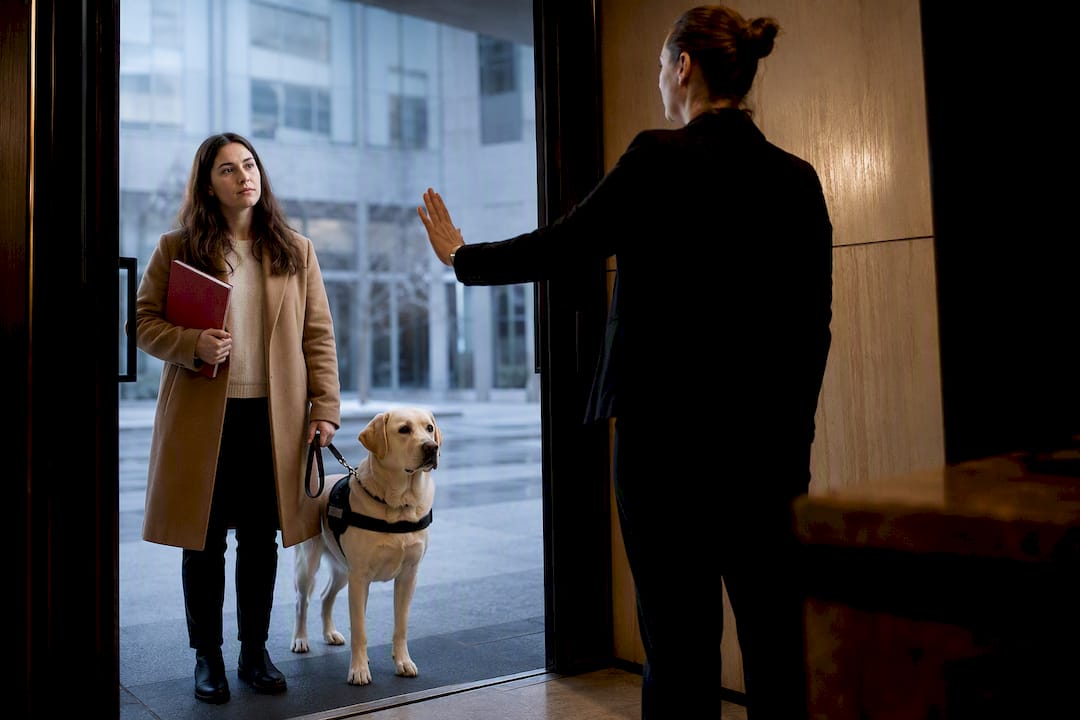
A business that turns away your service dog is almost always breaking federal law. Under the ADA, most public accommodations must allow your service animal in, no-pet rules do not apply, and there is no fee they can charge you for it. Your first move isn’t arguing. It’s documenting the incident on the spot, then deciding whether to file a complaint or call an attorney.
TL;DR:
- Businesses can lawfully exclude a service animal only if it is out of control, not housebroken, or poses a direct safety threat, based on specific behavior.
- Airlines follow different rules under the Air Carrier Access Act, requiring advance documentation and allowing denials for safety, size, or behavior issues.
- Immediate documenting steps include recording staff names, quotes, timestamps, photos, and witness contacts to build a strong record for claims.
- Filing complaints should target the appropriate agency: DOJ for public accommodations, DOT for airlines, HUD for housing, or EEOC for workplace issues.
- Private lawsuits offer the potential for damages and injunctive relief when pattern denials, retaliation, or financial harm occur, but are more costly and complex.
Table of Contents
- What To Do Right After A Service Animal Access Denial
- When Can A Service Animal Legally Be Denied?
- Why Airlines Follow Different Rules Under The ACAA
- Building A Record: How To Document The Denial
- Filing A Complaint: Agencies, Timelines, And Legal Options
- What Happens Next: Timelines And Realistic Outcomes
- How Javitch Law Office Evaluates Service Animal Denial Claims
- Talk To Javitch Law Office About Your Denial
- Sources
What To Do Right After A Service Animal Access Denial
The five minutes after a denial matter more than the argument itself. Getting loud rarely changes a staff member’s mind, but a calm, specific response builds the record you’ll need later.
Start with language, not confrontation. Say something close to: “My dog is a service animal trained to perform tasks related to my disability. Federal law requires you to allow it.” That single sentence does two things: it states your rights and it signals you know the law, which often ends the dispute right there.
If staff push further, redirect them to the only two questions they’re legally allowed to ask: whether the dog is required because of a disability, and what task it’s trained to perform. Businesses cannot demand medical documentation, ask about your diagnosis, or require proof of certification. No such certification exists under federal law anyway.
Here’s the sequence to follow while the incident is still happening:
- Ask for the name and title of the person denying entry.
- Request a manager or supervisor if the front-line employee won’t budge.
- Photograph the entrance, posted signage, and the animal’s harness or vest if visible.
- Get contact information from any witnesses, including other customers.
- Keep any receipt, appointment confirmation, or ticket showing you were there.
- Ask the manager directly: “Can you tell me the specific policy that allows you to deny my service animal?” Their answer, recorded verbatim, becomes evidence.
Leave once you’ve gathered what you need or if the situation escalates toward hostility. Your safety outranks any single interaction, and a documented denial is just as actionable whether you leave in two minutes or twenty.
Pro Tip: Record the exchange in a voice memo or typed note within the hour, while the exact wording is still fresh. Memory fades fast, and “the manager said something about liability” is far weaker evidence than the manager’s actual words.
When Can A Service Animal Legally Be Denied?
Not every denial is unlawful, and knowing the narrow exceptions helps you judge whether you have a real claim. A service animal is legally defined as a dog individually trained to perform tasks directly related to a person’s disability, covered under ADA Title II for government facilities and Title III for private businesses open to the public.
Businesses can lawfully exclude a service animal only under specific, individualized circumstances:
- The dog is out of control and the handler doesn’t take effective action to control it.
- The dog is not housebroken.
- The animal poses a direct threat to health or safety that can’t be reduced through reasonable accommodation.
- Allowing the animal would fundamentally alter the nature of the service (a sterile surgical field is the classic example).
None of these can be applied based on breed, size, or assumptions about a type of dog. A staff member cannot deny a pit bull mix simply because of stereotypes about aggression. The exclusion has to be based on that specific animal’s actual behavior in that specific moment.
Two other rules trip up a lot of businesses. First, they can enforce standard licensing and vaccination requirements that apply to all dogs, but they cannot demand service-animal registration or certification papers, because no federal registry exists. Second, miniature horses get a separate but similar accommodation category under the ADA, with their own set of assessment factors around size, weight, and whether the facility can reasonably handle the animal.
Even when exclusion is lawful, the business generally still has to serve you. If your dog gets removed from a restaurant dining room for genuinely being out of control, the restaurant still has to offer you the meal, delivery, or a workaround, just without the animal present in that instance. If they refuse the underlying service entirely, that’s a separate, and often stronger, claim.
Why Airlines Follow Different Rules Under The ACAA
Air travel operates under a completely different framework than restaurants, stores, or hotels, and this is where a lot of confusion, and a lot of unlawful denials, happen. The ADA governs public accommodations on the ground. Airlines instead follow the Air Carrier Access Act (ACAA), enforced by the U.S. Department of Transportation, not the DOJ.
Under the ACAA, airlines can require you to submit a DOT-mandated form attesting to your dog’s training, health, and behavior, typically before travel. They can also deny transport in specific, documented circumstances:
- The animal poses a genuine safety risk to crew or other passengers.
- Size or weight makes safe accommodation in the cabin impossible.
- Health documentation required by the airline wasn’t submitted in advance.
- The animal has a documented history of aggressive or disruptive behavior.
Airline staff training gaps drive a disproportionate share of these disputes, and one denial at a given carrier is often not an isolated event. If it happens to you, ask for a supervisor immediately, photograph your boarding pass and any forms you submitted, and get the names of every employee involved before you leave the gate area.
If the airline still denies boarding and you believe the denial was unlawful, you can file a complaint directly through the DOT Air Consumer Service Animal Complaint Form. Keep a copy of everything you submitted to the airline in advance, since the form process often turns on whether your documentation was complete and on time.
Building A Record: How To Document The Denial
A complaint or lawsuit lives or dies on specifics. “They were rude to me” doesn’t move an investigator. “The manager, identified as Store Manager Dana R., stated at 2:47 PM that ‘we don’t allow dogs regardless of what they say they’re for’” does.
Capture these details as close to the moment as possible:
- Exact quotes from staff, in their words, not your paraphrase.
- Full names, job titles, and physical descriptions if names weren’t given.
- Timestamps for when the denial happened and how long it lasted.
- Photos or video of the location, signage, and the interaction if safely possible.
- A description of the physical layout (entrance, front desk, seating area).
- Names and phone numbers of any witnesses willing to be contacted later.
Beyond the moment itself, preserve every digital trail connected to the visit. That means saving reservation confirmations, app messages, receipts, and any follow-up emails with the business. If the location has visible security cameras, request in writing that footage be preserved before it’s overwritten, which often happens within days.
Specific facts matter because a documented, contemporaneous record supports pattern evidence, meaning proof this wasn’t a one-off misunderstanding but part of how a location treats service animal handlers generally. That distinction often decides whether an agency opens a full investigation.
A basic incident log should include: date and time, exact location and address, staff names and titles, verbatim quotes, your responses, witness names and contact info, and a list of physical evidence collected (photos, receipts, screenshots).
Pro Tip: Email yourself the incident log the same day, even if it’s rough. The timestamped email creates an independent record showing when the account was written, which matters if the case ever turns into a credibility dispute.
Filing A Complaint: Agencies, Timelines, And Legal Options
Where you file depends entirely on where the denial happened. Getting this wrong wastes months.
- A retail store, restaurant, or hotel denial goes to the DOJ under ADA Title III.
- A government building or public transit denial falls under ADA Title II, also DOJ.
- An airline or airport gate denial goes to the DOT through its air consumer complaint form.
- A denial tied to a rental unit or housing application goes to HUD.
- A workplace denial of a service animal as a disability accommodation goes to the EEOC or your state’s fair employment agency.
Administrative complaints are free and don’t require a lawyer, but they’re slower and limited in what they can secure. A DOJ investigation can result in a settlement, a consent decree requiring policy changes and staff training, or, in serious or pattern cases, a lawsuit brought by the government itself. What it generally cannot do is get you individual monetary damages.
A private lawsuit is where damages, injunctive relief, and attorney’s fees typically come from. It’s also the stronger route if the denial reflects a pattern, if you suffered real financial or emotional harm, or if you experienced retaliation for asserting your rights.
| Path | Who handles it | Typical outcome | Cost to you |
|---|---|---|---|
| DOJ complaint (ADA Title II/III) | U.S. Department of Justice | Policy change, training, settlement | Free |
| DOT complaint | U.S. Department of Transportation | Airline compliance review, fines | Free |
| HUD complaint | Housing agencies | Mediation, housing remedy | Free |
| Private lawsuit | Civil rights attorney | Damages, injunction, fees | Contingency or hourly |
If your situation involves a pattern of denials, a business that retaliated after you complained, or you’re seeking real damages rather than just a policy fix, that’s the point to talk to an attorney rather than rely on an agency alone.
What Happens Next: Timelines And Realistic Outcomes
Administrative investigations move slower than most people expect. A DOJ complaint can take several months to a year before you hear a substantive update, and many close with a mediated settlement rather than a public enforcement action. DOT complaints against airlines tend to move faster, often within a few months, since carriers face regulatory pressure to respond.
Court outcomes vary more widely. A judge or settlement can require an injunction forcing a specific policy change, mandatory staff training, or monetary damages depending on the harm shown. Some cases resolve with all three.
Cost is where the paths diverge sharply. Filing with the DOJ, DOT, HUD, or EEOC costs nothing. Private litigation usually runs on contingency for discrimination claims, meaning you pay nothing upfront and the attorney is paid from any recovery, though hourly arrangements exist for certain matters. If your goal is simply getting a business to change its policy, an agency complaint may be enough. If you want compensation for what the denial cost you, a lawsuit is usually the only route that gets there.
How Javitch Law Office Evaluates Service Animal Denial Claims
A civil rights law firm with nationwide reach offers legal representation focusing on discrimination in public accommodations, employment, and housing. Not every denial needs a lawyer, and the firm is candid about that. Cases that warrant representation tend to involve a repeated pattern at the same business, a particularly severe or humiliating incident, retaliation after the person asserted their rights, or a goal beyond a policy fix, like real financial damages or a formal injunction.
Before reaching out, preserve what you already have: your incident log, photos, witness names, and copies of any complaint already filed with the DOJ or DOT. A consult moves faster and more productively when that record already exists.
Talk To Javitch Law Office About Your Denial
Javitch Law Office gives you what a DOJ or DOT complaint alone often can’t: a direct path toward personal damages and a lawyer who can push back on a business that keeps denying access. Where an agency complaint focuses on policy change, working with a civil rights firm keeps your specific harm and your specific remedy at the center of the case.
The firm handles public accommodation and disability discrimination claims, including cases arising from unlawful service animal denials, and reviews these situations through a free case evaluation. Bring your incident log, any photos or witness contact information, and copies of any complaint already filed with the DOJ or DOT. If the denial happened at a school, university, or through an employer, the same evaluation applies, since those claims often overlap with broader discrimination law. Readers still sorting out the difference between a service animal and an emotional support animal can also check this ESA rights guide before their consult, since that distinction often shapes what protections actually apply. Start with a free case review to find out whether your situation supports a formal legal claim.
This article is general information, not a substitute for advice from a qualified lawyer. Consult a qualified legal professional about your own circumstances before acting on anything here.
Sources
- Ada
- Ada
- Service Animals | U.S. Department of Transportation
- Service Animals and Assistance Animals | U.S. Department of Justice