
Title VI of the Civil Rights Act of 1964 prohibits discrimination based on race, color, or national origin in any program or activity that receives federal financial assistance, and that includes most public schools, colleges, and state agencies in the United States. If you believe a school, college, or federally funded program treated you differently because of your race, color, or ethnicity, two agencies handle most complaints: the Department of Education’s Office for Civil Rights for education matters, and the Department of Justice or the relevant funding agency for everything else.
The very next step matters more than people realize.
- Write down what happened, when, and who was involved, while the details are still fresh.
- Save emails, texts, photos, disciplinary records, or anything else tied to the incident.
- File a complaint with the appropriate agency or talk to a lawyer before a filing deadline passes.
Quick fact: Title VI applies to any recipient of federal financial assistance, which covers a much wider net than most people assume, including libraries, hospitals, transit agencies, and public universities.
Key Takeaways
Title VI protects against race, color, and national origin discrimination in federally funded programs, and the strength of any claim depends on documentation, timing, and choosing the right enforcement path.
| Point | Details |
|---|---|
| Protected categories are narrow | Title VI covers race, color, and national origin only, not disability or sex, which fall under separate statutes. |
| Deadlines are strict | Most agencies apply a 180-day filing deadline, with shorter windows possible after internal grievance processes. |
| Hostile environment requires severity | Isolated minor incidents rarely qualify; a pattern that is severe or pervasive, with institutional notice, usually does. |
| Administrative and legal routes differ | Agency complaints can force policy changes and training, but individual damages typically require federal litigation. |
| Javitch Law Office handles evidence early | The firm helps preserve documentation and coordinate administrative and litigation strategy for Title VI discrimination cases nationwide. |
Table of Contents
- What Counts as Title VI Discrimination?
- Who Has to Follow Title VI, and Who Can File a Complaint?
- When Does Harassment Cross Into a Hostile-Environment Violation?
- How Do You File a Title VI Complaint?
- What Can Agencies Actually Require, and What Are the Limits?
- When Private Litigation Makes Sense
- How Do Courts Decide Who Wins a Title VI Case?
- Title VI Does Not Cover Every Type of Discrimination
- How Title VI Differs From Title IX and the ADA
- Title VI Beyond the Classroom
- Why Compliance Reviews Matter More Than Most People Realize
- A Practitioner’s Take on What Actually Moves These Cases
- How Javitch Law Office Handles Title VI Discrimination Claims
- Frequently Asked Questions
- Sources
What Counts as Title VI Discrimination?
Title VI’s statutory language, 42 U.S.C. § 2000d, bars exclusion, denial of benefits, or discrimination “on the ground of race, color, or national origin” in any program receiving federal funds. That phrase “national origin” does more work than its plain wording suggests. It covers ancestry and country of origin, but courts and agencies have also applied it to language access and treatment of students with limited English proficiency.
The reach of the law is broad by design.
- Public preK through 12th grade schools that accept federal funding (nearly all of them do).
- Colleges and universities receiving federal grants or where students receive federal financial aid.
- Public libraries, state agencies, and any organization operating on federal grant dollars.
The Department of Education’s Office for Civil Rights has also clarified that harassment tied to shared ancestry or ethnic characteristics, including certain forms of religiously connected discrimination, falls under Title VI’s protection. A Sikh student harassed for wearing a turban, or a Jewish student targeted over perceived ethnic identity, can raise a Title VI claim even though the harassment is framed around religion.
Who Has to Follow Title VI, and Who Can File a Complaint?
Any entity that accepts federal money, called a “recipient,” has to comply with Title VI across its entire operation, not just the specific program the funding touched. A university that gets federal research grants for its chemistry department still has to follow Title VI in its athletics program, its housing office, and its disciplinary proceedings. The obligation extends to subrecipients too, meaning a nonprofit or contractor working under a federally funded agency inherits the same duty.
Filing a complaint is not limited to the person directly harmed.
- The student, employee, or resident who experienced the discrimination can file.
- Parents or guardians can file on behalf of a minor child.
- Third parties, including advocacy organizations and community groups, can file when the victim is a minor or fears retaliation.
Coverage runs across everything a recipient does. Classroom instruction, extracurricular clubs, athletics, disciplinary decisions, and even off-campus program activities connected to the institution all fall inside Title VI’s reach.
When Does Harassment Cross Into a Hostile-Environment Violation?
Not every unpleasant interaction rises to a Title VI violation. The legal test has two parts: the conduct has to be offensive both to the person experiencing it (subjective) and to a reasonable person in that situation (objective), and it has to be severe or pervasive enough to interfere with someone’s ability to participate in or benefit from the program. A single rude comment usually will not meet that bar. A pattern of racial slurs, repeated physical intimidation, or a coordinated harassment campaign generally will.
Institutional response is the hinge point in most cases.
- The school or agency has to have actual or constructive notice of the harassment, meaning someone in a position to act knew or reasonably should have known.
- Once on notice, the institution has a duty to respond promptly and effectively.
- A failure to act, or a response that is slow and inadequate, can itself become the basis for liability.
Courts and OCR also look at context that extends beyond the schoolyard. Off-campus conduct and social media harassment can count when the effects spill into the educational environment, such as a group chat that leads to a hostile classroom the next morning.
Pro Tip: Screenshot everything immediately. Social media posts and group chats get deleted fast, and a complaint without contemporaneous evidence is much harder to prove months later.
How Do You File a Title VI Complaint?
Start by identifying which agency actually funds the program you’re complaining about. Education-related complaints go to the Department of Education’s Office for Civil Rights. Transportation programs go through agencies like the Federal Highway Administration. If you’re not sure who has jurisdiction, the Department of Justice’s Federal Coordination and Compliance Section will route your complaint to the right office.
- Identify the funding agency, or send it to DOJ if you’re unsure.
- Put the complaint in writing and sign it, including specific dates, the people involved, and what happened.
- Attach supporting evidence such as emails, records, or witness names.
- Submit within the deadline and track any confirmation the agency sends back.
Timelines are strict. Most agencies apply a 180-day deadline from the date of the alleged discrimination. If you went through an internal school or agency grievance process first, a shortened window after that process wraps up may apply for filing with OCR, so track those internal deadlines closely rather than assuming you have the full 180 days.
After filing, expect intake review, a decision on whether the agency will accept or dismiss the complaint, an investigation if accepted, and possible resolution negotiations.
- Intake and jurisdictional review (does the agency have authority here).
- Formal investigation, including records requests and interviews.
- Resolution discussions or a formal finding.
What Can Agencies Actually Require, and What Are the Limits?
Administrative remedies focus on fixing the institution, not compensating the individual. When OCR finds a violation, resolution agreements typically require policy changes, mandatory staff training, ongoing reporting, and monitoring to confirm the hostile environment doesn’t resurface.
- Corrective-action agreements requiring specific policy revisions.
- Staff and administrator training on recognizing and responding to discrimination.
- Reporting and monitoring obligations that can run for years.
- Remedial steps for the specific individuals harmed, such as record corrections or transfer options.
When voluntary compliance fails or a recipient refuses to correct a violation, OCR can refer the matter to the Department of Justice, which can pursue formal enforcement action, including the termination of federal funding in the most serious cases.
Administrative agreements rarely deliver individual monetary damages. That’s the practical ceiling on what a complaint to OCR or another agency can accomplish, and it’s the reason many people who suffered real harm eventually look at federal court instead.
When Private Litigation Makes Sense
Filing an administrative complaint does not automatically block you from suing in federal court, and plaintiffs often pursue both routes depending on timing and the relief they need. A private lawsuit can seek injunctive relief and, where the law allows it, compensatory damages that an agency resolution agreement typically won’t provide.
- Injunctions ordering an institution to change a specific policy or practice.
- Compensatory relief in cases where intentional discrimination is proven.
- Discovery tools unavailable in an administrative complaint, including depositions and document subpoenas.
Proving intentional discrimination is the harder legal lift. The Department of Justice’s Title VI Legal Manual explains that courts weigh direct evidence, circumstantial evidence, and statistical patterns together rather than requiring one smoking-gun document. An attorney’s role often comes down to organizing that evidence into a coherent narrative and deciding whether to run an administrative complaint and a lawsuit in parallel or sequence one before the other. For readers weighing which route fits a specific school situation, our breakdown of Title IX versus Title VI walks through how the two overlap.
Pro Tip: Talk to a lawyer before you file the administrative complaint, not after. Early legal review can shape how you phrase the complaint in a way that preserves your later litigation options.
How Do Courts Decide Who Wins a Title VI Case?
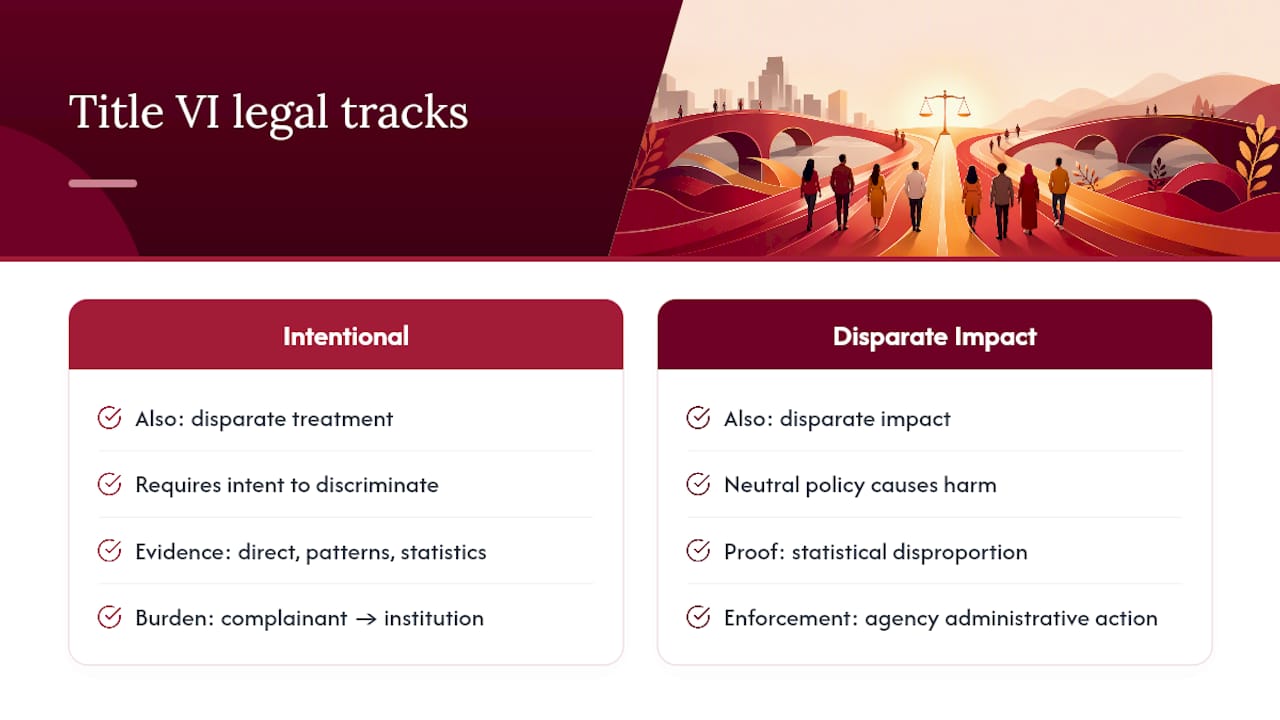
Title VI claims split into two very different legal tracks, and mixing them up is the most common mistake people make when researching their own case. The first track is intentional discrimination, sometimes called disparate treatment, which requires showing the institution acted “because of” race, color, or national origin. The second track involves regulations addressing disparate impact, where a facially neutral policy produces discriminatory effects, though private plaintiffs generally cannot sue directly under this theory after the Supreme Court’s ruling in Alexander v. Sandoval; federal agencies still enforce disparate-impact regulations administratively.
For intentional discrimination claims, the burden starts with the person alleging harm. A complainant has to show enough evidence that a reasonable finder of fact could conclude the institution acted with discriminatory intent. The DOJ’s Title VI Legal Manual explains that this rarely comes down to a single document or admission. Instead, courts look at a combination of direct statements, circumstantial patterns such as inconsistent discipline between students of different races, and statistical evidence showing disproportionate treatment.
Once a complainant makes that initial showing, the burden typically shifts to the institution to offer a legitimate, nondiscriminatory explanation for its actions. The complainant then gets a chance to show that explanation is pretext, meaning it’s a cover story rather than the real reason. This back-and-forth structure means a single piece of missing evidence rarely sinks a case outright, but a well-documented pattern makes an enormous practical difference in how agencies and courts evaluate credibility.
Title VI Does Not Cover Every Type of Discrimination
A student denied a wheelchair-accessible classroom is facing a real civil rights problem, but it is not a Title VI problem. Title VI’s protected categories are narrow and specific: race, color, and national origin. It does not reach disability discrimination, which falls under the Americans with Disabilities Act and Section 504 of the Rehabilitation Act, and it does not reach sex-based discrimination, which is governed by Title IX.
This distinction trips people up constantly, and for good reason: the discriminatory conduct can look nearly identical on the surface. A school that fails to accommodate a student’s disability and a school that harasses a student over their ethnicity might both create a hostile environment, but they trigger entirely different statutes, different enforcement offices within OCR, and sometimes different filing deadlines.
Sexual harassment, gender-based discrimination, and pregnancy discrimination in schools fall under Title IX, not Title VI, even when the same office (OCR) handles both. Age discrimination has its own separate statute. Religious discrimination sits in an interesting middle ground: Title VI does not list religion as a protected category, but OCR guidance recognizes that harassment targeting a group’s shared ancestry or ethnic characteristics, including certain antisemitic or Islamophobic harassment, can fall under Title VI when the conduct is tied to ethnicity rather than religious belief alone.
If you’re not sure which statute covers your situation, that uncertainty alone is a good reason to get a legal opinion before filing, since filing under the wrong law can cost you valuable time against a deadline.
How Title VI Differs From Title IX and the ADA
Confusing these three laws is common, and the confusion has real consequences for where and how you file. Title VI, Title IX, and the ADA all prohibit discrimination in federally funded programs, but they protect different characteristics and sometimes carry different procedural rules.
Title IX prohibits sex discrimination in federally funded education programs specifically, covering issues like athletic equity, sexual harassment, and pregnancy accommodation. It only applies to education, unlike Title VI, which reaches any federally funded program, not just schools. The ADA and Section 504 prohibit disability discrimination and require reasonable accommodations, a concept that has no real equivalent in Title VI, which prohibits discriminatory treatment rather than requiring affirmative accommodation.
The practical overlap shows up most often in schools, where a single incident can implicate more than one statute at once. A female Latina student harassed with both racial and sexual comments could have claims under both Title VI and Title IX simultaneously, filed with the same OCR office but analyzed under separate legal standards. Our comparison of Title IX and Title VI breaks down how to tell which statute, or both, applies to a specific set of facts.
Title VI Beyond the Classroom
Education gets most of the attention in Title VI discussions, but the law reaches far past school hallways. Any program receiving federal financial assistance has to comply, which pulls in transportation, healthcare, and housing in ways that surprise a lot of people researching their rights for the first time.
Transit agencies that receive federal highway or transit funding have to ensure their services, from bus routes to construction projects, don’t disproportionately harm or exclude communities based on race or national origin. The Federal Highway Administration’s Title VI guidance addresses how transportation planning decisions, like where a new highway gets built or which neighborhoods lose bus access, can trigger Title VI scrutiny when the burden falls unevenly along racial lines.
Healthcare providers that accept Medicare, Medicaid, or other federal funding are also bound by Title VI, which affects language access for patients with limited English proficiency and equal treatment across hospital systems. Public housing authorities and any federally subsidized housing program carry the same obligations, covering everything from tenant selection to maintenance response times.
The common thread across all these sectors is the federal money itself. It doesn’t matter whether the entity is a school district, a city bus system, or a hospital network. Accepting federal financial assistance means accepting Title VI’s terms, and the enforcement mechanism, whether it’s OCR, FHWA, or another agency’s civil rights office, tracks whichever agency wrote the check.
Why Compliance Reviews Matter More Than Most People Realize

Federal agencies don’t just wait for complaints to roll in. Many run mandatory compliance reviews, proactively auditing recipients for patterns that suggest discrimination even when no one has filed a formal complaint yet. These reviews can examine disciplinary data, enrollment patterns, program access, and language assistance measures across an entire school district or agency.
This proactive layer matters for two reasons. First, it means an institution’s discriminatory pattern can surface even without a single individual complaint, since statistical disparities in something like school discipline rates can trigger agency attention on their own. Second, it means the paper trail from a compliance review, if one exists for the institution involved, can become powerful supporting evidence for someone filing an individual complaint later.
Monitoring doesn’t end once a resolution agreement gets signed either. Agencies typically require ongoing reporting for a set period after a violation is found, checking whether the corrective measures actually stuck. An institution that agreed to retrain staff and revise its discipline policy might have to submit data for several years showing the disparity actually closed. If you’re gathering evidence for your own complaint, asking whether the institution has been subject to a prior compliance review or resolution agreement is worth doing early, since a history of past findings can shape how seriously an agency treats a new complaint.
A Practitioner’s Take on What Actually Moves These Cases
The cases that fall apart are almost always the ones where evidence got collected too late. People wait weeks to write down what happened, and by the time they call a lawyer, the timeline is fuzzy and the paper trail is gone. Early legal review does more than protect a deadline. It helps decide whether to run an administrative complaint and a lawsuit together, or one after the other, so you don’t accidentally close a door you needed open.
How Javitch Law Office Handles Title VI Discrimination Claims
If you’re dealing with racial or ethnic harassment at school, discriminatory discipline, or a hostile environment tied to national origin or shared ancestry, Javitch Law Office gives you a direct path to legal representation instead of navigating agency paperwork alone. Unlike filing a complaint with OCR by yourself, where you’re managing deadlines and evidence standards without guidance, working with an attorney means someone experienced with Title VI’s evidentiary demands is building your case from day one.
Our student discrimination practice handles cases involving harassment, disciplinary bias, and denial of educational benefits at both the K-12 and college level, while our antisemitic and racial discrimination attorneys take on cases where ethnicity-based harassment overlaps with religious targeting. If your situation involves speech or protest issues tied to a discrimination claim, our First Amendment attorneys can evaluate that angle too.
An initial consultation is free, and bringing whatever documentation you already have, incident dates, emails, disciplinary records, witness names, helps us evaluate your case quickly. Many discrimination and civil rights matters are handled on contingency, meaning you don’t pay unless we recover for you. Javitch Law Office is based in California and represents clients nationwide. Reach out for a case evaluation to find out where your situation stands.
Frequently Asked Questions
What is Title VI discrimination? Title VI discrimination happens when a program or institution receiving federal financial assistance treats someone worse because of their race, color, or national origin, including through harassment severe enough to create a hostile environment.
Who enforces Title VI complaints? The Department of Education’s Office for Civil Rights handles education-related complaints, while the Department of Justice and other agency civil rights offices, such as the FHWA, cover programs in transportation, healthcare, and housing.
How long do I have to file a Title VI complaint? Most agencies apply a 180-day deadline from the date of the alleged discrimination, though a shorter window can apply after an internal grievance process.
Can I sue in federal court instead of filing an administrative complaint? Yes. Filing with an agency doesn’t automatically prevent you from pursuing a private lawsuit, and many plaintiffs use both routes depending on the relief they need.
Does Title VI cover disability or sex discrimination? No. Disability discrimination falls under the ADA and Section 504, and sex discrimination in education falls under Title IX, not Title VI.
This article is general information, not a substitute for advice from a qualified lawyer. Consult a qualified legal professional about your own circumstances before acting on anything here.