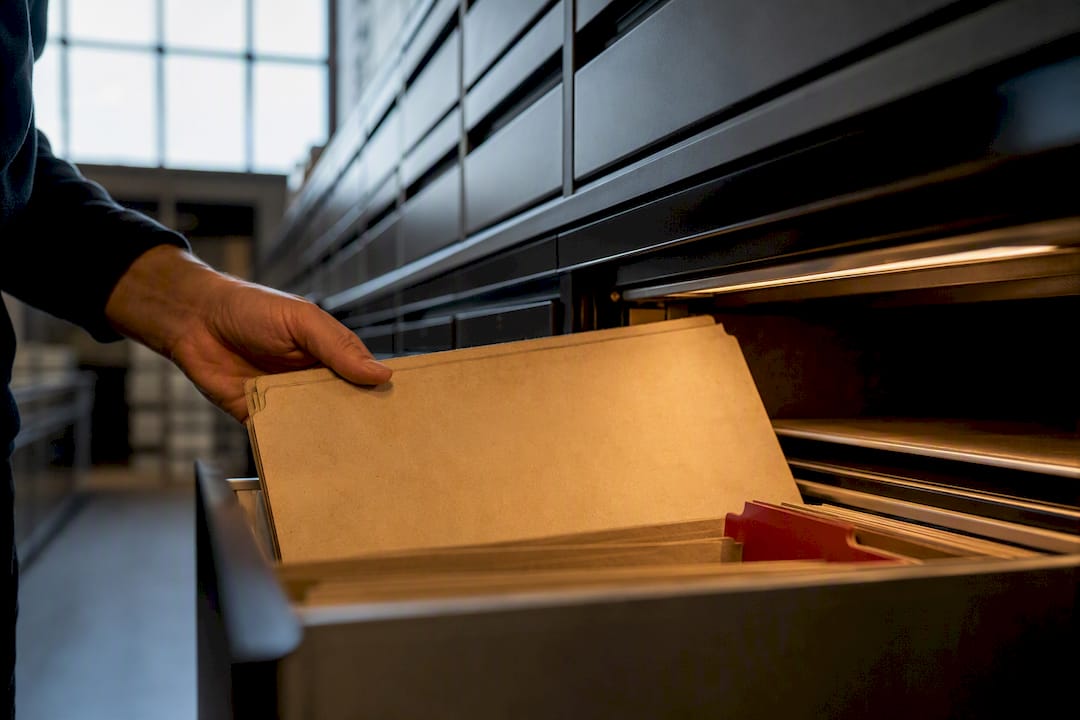
Yes, you can request police records in California, and you don’t need a lawyer or a special reason to do it. Under the California Public Records Act, any person can submit a request to a law enforcement agency’s records unit or through its online portal. Include the incident date, location, and case number if you have one. Recent laws, SB 1421 and SB 16, also opened the door to many use-of-force and officer-misconduct records that used to stay sealed.
TL;DR:
- Most police records in California are accessible to the public unless they are protected by specific exemptions, especially records related to officer misconduct and use-of-force after laws SB 1421 and SB 16 took effect.
- Submitting a detailed written request through the appropriate agency’s records unit or online portal, including incident details and case numbers, increases the chance of a swift response and reduces delays.
- Agencies have around 45 days to respond to records requests, with possible extensions if active investigations are underway or if the request is particularly broad.
- Denials must specify the exact legal exemption relied upon; vague or unjustified refusals can be challenged through appeals or legal action, with maintaining a clear paper trail essential.
- Using public databases like the Police Records Access Project can save time before filing formal requests, but missing or redacted documents may necessitate a direct request to the agency.
Table of Contents
- Understanding a Police Records Request in California
- How Do You Submit a Police Records Request?
- How Long Does an Agency Have to Respond?
- What If the Agency Denies or Delays Your Request?
- Searchable Alternatives: The Police Records Access Project
- Writing a Police Records Request: Sample Letter and Checklist
- When to Get Legal Help With a Blocked Request
- Why Persistence Beats Perfection on Records Requests
- How Javitch Law Office Helps When Records Requests Stall
- Sources
- FAQ
Understanding a Police Records Request in California
Not every document sitting in a police file is public, but more of them are than most people assume. The California Public Records Act (CPRA) treats government-held documents as public unless a specific exemption applies, and that includes a lot of police paperwork: incident reports, arrest logs, traffic collision reports, and calls-for-service data.
The bigger shift came from two state laws. SB 1421, effective in 2019, and SB 16, effective in 2022, forced agencies to release records tied to officer-involved shootings, use-of-force incidents causing death or serious injury, and sustained findings of sexual assault, dishonesty, or discriminatory conduct by officers, according to a summary from UC Berkeley’s Police Records Access Project. That’s a real change from the old rule, where personnel files were essentially locked.
A basic incident report is different from a personnel file. A “sustained” finding means internal affairs investigated a complaint and found it credible, which is the trigger that makes many SB 1421 records disclosable. Expect redactions around:
- Victim and witness identifying information
- Juvenile names and case details
- Details tied to an active criminal investigation
How Do You Submit a Police Records Request?
Start by identifying the right records custodian. That’s usually a Records Unit or Public Records division within the specific police department, sheriff’s office, or state agency that handled the incident.
- Gather your identifying details. Write down the incident date and approximate time, the location, any case or report number, and names of people involved if you know them.
- Describe exactly what you want. “All body camera footage and the incident report from the traffic stop on Main Street on March 4, 2026” works far better than “records about my arrest.”
- Pick your submission channel. Most agencies accept requests through an online public records portal, records unit email, mail, fax, or in person. The Alameda County Sheriff’s Office, for example, lists email, mail, fax, and walk-in options with separate procedures depending on how you request a report.
- Confirm identity or authority requirements. Some agencies ask crash-report requesters or victims to show ID, and some require notarized authorization if you’re requesting records on someone else’s behalf.
Pro Tip: Even when an agency lets you call in a request, put it in writing anyway. A written request creates a paper trail that matters if the agency delays, denies, or gives you an incomplete response, according to the First Amendment Coalition’s police transparency guidance.
How Long Does an Agency Have to Respond?
California law gives agencies a short statutory period to respond to a standard CPRA request, with a possible extension if unusual circumstances are cited, such as needing to search multiple facilities or consult with another agency, according to the Covina Police Department’s public records policy.
SB 1421 and SB 16 records run on a different clock. Penal Code §832.7 sets a 45-day expectation for releasing specified investigative and disciplinary records, though that timeline can stretch if an active criminal investigation is still open.
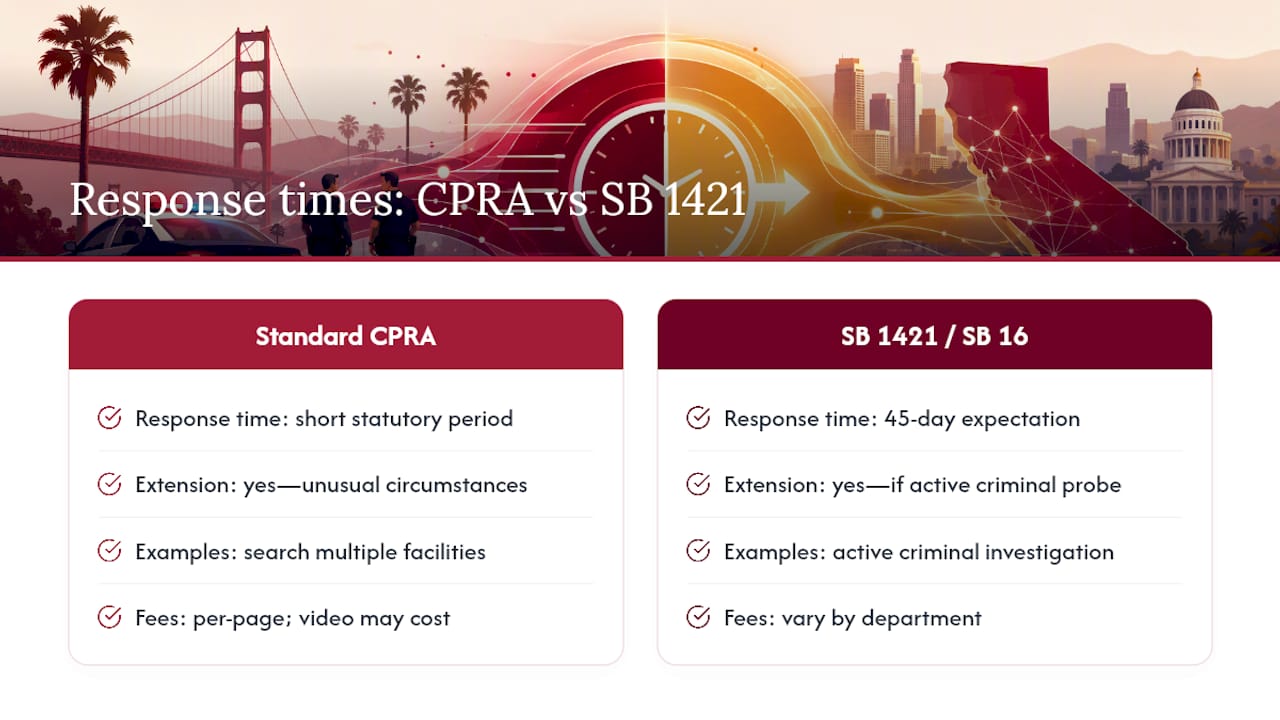
Fees vary by department. Most charge a per-page copying fee, and some add duplication costs for video or audio. Agencies generally can’t charge you for staff time spent reviewing or redacting documents, and some departments offer fee waivers for indigent requesters or cases showing clear public interest. San Jose Police Department, for instance, publishes its own fee schedule and directs requests through its Open Records Center. Whatever the agency decides, its written response has to state clearly whether records will be released, and if not, which exemption applies.
What If the Agency Denies or Delays Your Request?
Agencies can lawfully withhold certain records. Common grounds include protecting victim privacy, shielding juvenile records, and preserving an active criminal investigation. Genuinely confidential personnel matters that fall outside the SB 1421 and SB 16 disclosure categories can also stay sealed.
But a denial isn’t supposed to be vague. The agency must cite the specific CPRA exemption it’s relying on, and it has to do that in writing within the statutory response window. If you get a denial that just says “records are confidential” with nothing more specific, that’s a red flag worth pushing back on.
Practical next moves if you hit a wall:
- Narrow or clarify your request and resubmit; overly broad requests get rejected more often than specific ones
- File a formal administrative appeal with the agency if it offers one
- Dispute unreasonable fees in writing before paying them
- Petition a superior court to compel disclosure if the agency still won’t budge
Keep every email, letter, and fee receipt tied to your request. That paper trail becomes evidence if you end up appealing or filing suit later.
Searchable Alternatives: The Police Records Access Project
Before filing a formal CPRA request, it’s worth checking whether the record you want already sits in a public database. The Police Records Access Project database aggregates roughly 1.5 million pages from about 12,000 cases across nearly 700 California agencies, covering many of the misconduct and use-of-force files that SB 1421 and SB 16 made public.
It’s a genuine timesaver, but it has limits:
- Some documents carry redactions the project didn’t have authority to remove
- Multimedia like body camera footage isn’t always included
- Coverage isn’t complete for every agency in the state yet
Search the database first. If the record you need is missing, redacted more heavily than you’d like, or simply isn’t there, file a direct CPRA request with the agency for the original.
Writing a Police Records Request: Sample Letter and Checklist
A clean, specific request letter gets processed faster than a vague one. Structure it like this:
- Date and your contact information at the top
- Addressee: “Records Custodian, [Agency Name] Records Unit”
- Subject line: “Public Records Act Request”
- Body: a precise description of the records sought, including date, location, case number if known, and preferred format (paper copies, PDF, or CD)
- Fee waiver request, if applicable, stating the public interest or your financial circumstance
- Closing: your contact information and a request for confirmation of receipt
Pro Tip: If you need records quickly for a pending legal matter, say so explicitly and ask for expedited handling. Agencies aren’t required to grant it, but naming the urgency and reason sometimes moves your request up the queue.
Before you hit send, run through this short checklist:
- Case or incident number included, if you have it
- Proof of identity or authority attached, if the agency requires it
- Delivery method confirmed (portal, email, mail, or fax)
- A copy of your own request saved somewhere you can find it later
When to Get Legal Help With a Blocked Request
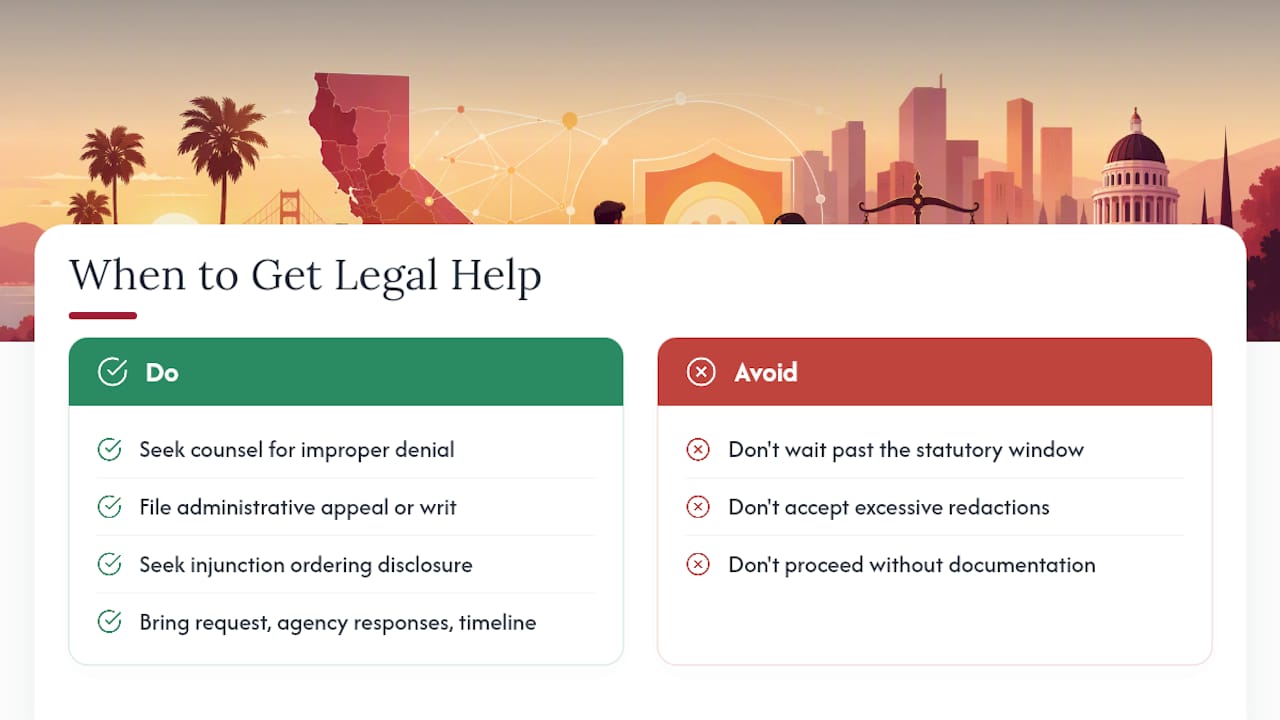
Most CPRA requests resolve without a lawyer. But if an agency denies your request without citing a valid exemption, keeps delaying past the statutory window, or redacts far more than the law allows, that’s when legal remedies start to matter: an administrative appeal, a writ petition, or a court injunction ordering disclosure.
An attorney evaluating your case will want to see your original written request, every response from the agency, any fee correspondence, and a timeline of what happened when. If you’re facing a flat denial with no cited exemption, or the same runaround for months, that’s usually the signal to stop waiting.
Javitch Law Office’s public records litigation guidance walks through how enforcement actions typically unfold, and the firm’s FOIA request overview explains what a complete denial letter should actually contain under state and federal law.
Why Persistence Beats Perfection on Records Requests
Most people give up after one denial letter, and that’s usually the wrong move. A specific, written request with a case number attached beats a vague one every time, and checking a database before filing anything saves real time. California’s transparency laws moved fast between 2019 and 2022, but agencies still vary wildly in how smoothly they comply. Expect some friction. Document everything. The requesters who get results tend to be the ones who don’t take the first “no” as final.
— Mark
How Javitch Law Office Helps When Records Requests Stall
Some readers hit a wall no checklist fixes: an agency that ignores deadlines, redacts records with no legal basis, or denies a request without naming an exemption. That’s a different problem than a slow bureaucracy, and it’s the one this type of law practice is built to handle.
An initial consultation focuses on your paper trail. Bring your original request, every response or non-response from the agency, fee receipts, and a simple timeline of dates. The firm evaluates whether the agency’s stated exemption actually holds up under Penal Code §832.7 and the CPRA, and whether an administrative appeal or a court petition is the faster path to the records you’re owed. If you’ve hit a denial that doesn’t add up, visit the Public Records & FOIA Attorneys page and request a case review.
This article is general information, not a substitute for advice from a qualified lawyer. Consult a qualified legal professional about your own circumstances before acting on anything here.
Sources
- Police Transparency Handbook — First Amendment Coalition
- Penal Code §832.7 — California Legislature
- California Public Records Act - Covina Police Department
FAQ
Can I get a copy of a police report in California?
In most cases, yes. Incident reports, arrest logs, and collision reports are generally public under the CPRA, though victim privacy, juvenile information, and active-investigation details are commonly redacted.
How can I access police records in California?
Submit a written request to the agency’s records unit through its online portal, records email, mail, or in person, describing the incident date, location, and case number as specifically as possible.
Are California police reports public record?
Most standard incident and arrest reports qualify as public records under the CPRA, and SB 1421 and SB 16 extended that access to many use-of-force and sustained-misconduct files as well.
Can anybody pull public records in California?
Yes. The CPRA doesn’t require you to state a reason or prove any special interest; any person can submit a request, though some record types still carry limited exemptions.
What should I do if a police department denies my records request?
Ask the agency to cite the specific CPRA exemption it relied on, and if the denial looks unjustified, consider an administrative appeal or legal action to compel disclosure.