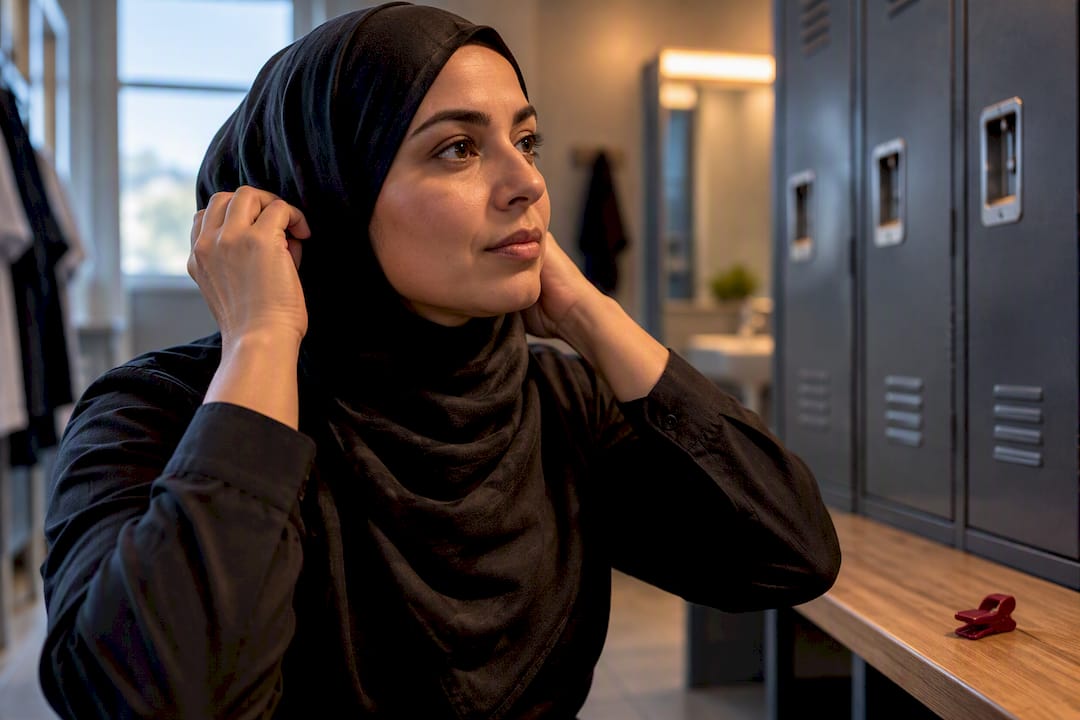
Under U.S. law, you generally may wear religious attire at work and school. Employers and schools must generally accommodate sincerely held religious dress and grooming practices unless doing so creates an undue hardship for the business. Your next move: tell your manager, HR, or a school official about the conflict, and write it down. That single step starts the clock on your legal protections.
TL;DR:
- Employers covered by federal law must engage in a genuine interactive process and cannot deny religious dress accommodations based solely on customer preferences or brand image.
- Safety, security, health, and specific operational requirements are the only valid reasons for denying a religious accommodation, and even then, modifications are usually possible.
- Applicants retain protection from discrimination, and suspicion about a religious reason can trigger liability under the Abercrombie ruling, making employer motives critical.
- Requesting an accommodation requires simple, clear communication to the right person, with written follow-up, and employers are expected to respond within a reasonable timeframe with good-faith effort.
- State and local laws often extend protections to smaller employers and add further safeguards beyond federal statutes, especially in public school settings and public accommodations.
Table of Contents
- What Does Federal Law Require for Religious Dress?
- What Religious Attire and Grooming Practices Are Protected?
- How Do You Request a Religious Accommodation?
- When Can Employers Legally Restrict Religious Dress?
- What Are Students’ Religious Dress Rights in School?
- What Do State and Local Laws Add to Federal Protections?
- How Fast Must Employers and Schools Respond to Requests?
- What Myths Persist About Religious Dress Accommodations?
- Where Can You Find Help With Religious Attire Rights?
- Why the “Just Ask Nicely” Advice Falls Short
- How Javitch Law Office Can Help With Your Case
- Where to Verify the Legal Details
- Sources
- FAQ
What Does Federal Law Require for Religious Dress?
Title VII of the Civil Rights Act of 1964 is the law doing most of the heavy lifting here. It bans religious discrimination in employment and requires covered employers to reasonably accommodate an employee’s sincerely held religious dress or grooming practice, unless the accommodation would impose an undue hardship on the business.
Coverage isn’t universal. Title VII applies to private employers with 15 or more employees, along with employment agencies, labor unions, and federal government agencies, according to the EEOC. If you work for a five-person shop, Title VII itself doesn’t reach you, though many states fill that gap with their own, sometimes broader, civil rights statutes.
“Religion” under Title VII is defined more loosely than most people expect. It covers traditional, organized faiths, but also covers moral or ethical beliefs about right and wrong that are sincerely held with the strength of religious views, even if they aren’t part of a formal denomination. An employer can’t deny a request just because the belief seems unconventional or isn’t shared by other members of a recognized faith. The sincerity of the belief matters far more than its popularity or theological pedigree.
The U.S. Equal Employment Opportunity Commission enforces this law, and its guidance is where most of the practical detail lives. Two documents matter most for dress and grooming questions:
- The EEOC’s religious garb and grooming guidance, which spells out employer obligations and common accommodation scenarios.
- The EEOC’s general Q&A on religious discrimination, which covers notice, undue hardship, and enforcement basics.
The employer’s core duty: engage with the employee, discuss the conflict, and grant an accommodation unless it can show actual undue hardship. Customer preference and brand image are generally not valid defenses, according to that same EEOC guidance. A retailer that wants a uniform “look” can’t use that alone to reject a hijab, a beard, or a turban.
The Supreme Court reshaped part of this landscape in 2015 with EEOC v. Abercrombie & Fitch. The case involved a Muslim job applicant who wore a headscarf to her interview and was passed over, in part because the company assumed her scarf would conflict with its “look policy.” She never explicitly said the word “religious accommodation.” The Court sided with the EEOC anyway, holding that an employer can be liable when the need for accommodation was a motivating factor in an adverse decision, even without direct notice from the applicant, according to the Supreme Court’s opinion.
That ruling flipped the practical question employers now have to ask. Before Abercrombie, the fight was often about what the employer knew. After it, the fight is about employer motive, meaning an employer who merely suspects a religious reason behind an applicant’s appearance and rejects them on that suspicion can still be on the hook. Academic commentary on the decision has noted this shift puts real pressure on employers to slow down and ask questions rather than guess and reject, since assuming a conflict and acting on that assumption carries legal risk.
Pro Tip: If you’re an applicant, not yet an employee, you still have protection. Abercrombie applies at the hiring stage, not just after you’re on payroll.
What Religious Attire and Grooming Practices Are Protected?
Most religious dress and grooming questions fall into a handful of recognizable categories, and the EEOC’s own guidance lists several by name.
Commonly protected practices include:
- Head coverings such as the hijab, the Sikh turban, and the Jewish kippah (yarmulke)
- Uncut hair, beards, and dreadlocks worn for religious reasons, including Sikh, Rastafarian, and some Orthodox Jewish observance
- Religious jewelry, including crosses, Stars of David, and other symbolic pendants
- Modest dress requirements, such as ankle length skirts, long sleeves, or specific coverage rules tied to a faith tradition
- Ceremonial items like the Sikh kirpan (a small ceremonial dagger), religious markings such as ash crosses, and prayer garments
The list above is illustrative, drawn from EEOC guidance on religious discrimination, not exhaustive. New requests come up that don’t map neatly onto any prior example, and that’s fine. The legal test isn’t whether your practice appears on some official roster. It’s whether the belief behind it is sincerely held.
“Sincerely held” is a lower bar than people assume, but it isn’t a rubber stamp. An employer generally can’t second-guess whether your interpretation of your own faith is theologically correct. What they can look at is whether the practice appears to be asserted for religious reasons at all, as opposed to, say, a personal style preference dressed up as faith. Someone who has observed a practice consistently, even if they only recently began doing so, usually still qualifies. Belief can deepen or change over a lifetime, and the law doesn’t punish that.
Borderline cases tend to cluster around two issues. First, practices that are partly cultural and partly religious, where an employer might ask for a brief explanation of the religious dimension. Second, practices that intersect with workplace safety, which is where things get genuinely complicated rather than just contested.
A kirpan worn near heavy machinery, loose robes near conveyor belts, or long hair near open flame all raise legitimate safety questions that a hijab worn in an office setting simply doesn’t. Employers can’t use safety as a blanket excuse, but they don’t have to ignore real risk either. The resolution usually involves modification, not outright denial. A sheathed and secured kirpan, a hairnet, or a fitted alternative to a loose garment often satisfies both sides. The interactive process exists precisely to find that middle ground.

How Do You Request a Religious Accommodation?
You don’t need a lawyer’s vocabulary to trigger your rights. The EEOC has been clear that there are no “magic words” required, according to its guidance on religious garb and grooming requests. Telling your supervisor “my faith requires me to wear a head covering, and I need an exception to the uniform policy” is enough to start the clock.
Here’s the practical sequence:
- Identify the right person to notify. In a workplace, that’s usually a direct supervisor or HR. In a school, it’s typically a teacher, principal, or district Title IX/504 coordinator, depending on the issue.
- State the conflict plainly. Name the policy that conflicts with your practice and the specific accommodation you’re asking for. You don’t need to cite Title VII or use legal terms.
- Put it in writing, even if you spoke first. A follow-up email restating what was discussed creates a timestamped record that protects you later.
- Expect follow-up questions. The employer or school may ask for more detail about the practice or the conflict. Answer directly, but you’re not obligated to justify the theology behind your faith.
- Engage in the back-and-forth. This is the “interactive process,” and the EEOC requires employers to participate in it in good faith. If they propose an alternative, consider it seriously; if it doesn’t work for your practice, say why.
- Get the resolution in writing. Whatever gets agreed to, whether that’s a uniform exception, a modified grooming policy, or a schedule adjustment, ask for written confirmation.
Reasonable accommodations vary a lot depending on the job and the faith. Some real-world patterns: a retail employer allowing a modified uniform (a longer skirt, a company-branded hijab, a beard exception); a hospital permitting a covered version of a standard scrub cap instead of requiring a bare head; a manufacturing employer offering a reassignment away from exposed machinery instead of denying a kirpan outright; a school allowing a student to wear a yarmulke during a standardized sports uniform requirement.
Pro Tip: Never assume silence means denial. If your employer hasn’t responded within a reasonable window, follow up in writing and ask for a status update. That follow-up becomes part of your record if things later go sideways.
When Can Employers Legally Restrict Religious Dress?
The exceptions are narrower than most employers think, and narrower than most employees fear.
“Undue hardship” is the legal hinge the whole system swings on. For religious accommodation claims specifically, courts have historically treated undue hardship as something more than a minor or trivial burden on business operations, a lower bar for the employer to clear than the “significant difficulty or expense” standard used in disability accommodation cases under the Americans with Disabilities Act. That distinction matters because it means employers can’t reject a religious accommodation just because it’s inconvenient or requires some adjustment. Administrative hassle, a coworker’s personal discomfort, or a manager simply preferring not to bother, don’t meet the bar.
Legitimate limitations tend to cluster in a few recognizable categories:
- Genuine safety risk. A loose garment near an industrial mixer, an uncovered beard near open flame in a kitchen, or a religious item that can’t be secured near moving machinery.
- Security requirements. Certain law enforcement, correctional, or high-security settings may restrict items that could conceal contraband or weapons, though even here, employers generally must consider modifications before outright denial.
- Health and sanitation rules. Food service and healthcare settings sometimes require head coverings or restrict jewelry for hygiene reasons, but a religious head covering usually satisfies the same hygiene goal as a company-issued cap.
- True uniformity needs in narrow contexts, though this is the exception used most often as a pretext and scrutinized most heavily by courts.
What doesn’t count: customer complaints, a company’s branding preferences, or a supervisor’s personal opinion about how the workplace should look. The EEOC has repeatedly rejected these as valid grounds for denial. Courts examining religious accommodation cases tend to ask a consistent question: did the employer actually try to find a workable modification, or did it jump straight to “no”? Employers that skip the interactive process and deny outright tend to lose. Employers that document a real attempt at compromise, and can point to a specific, provable operational burden, tend to win.
What Are Students’ Religious Dress Rights in School?
Public school students carry a different, and in some ways stronger, layer of protection: the First Amendment. Courts have long recognized that students don’t lose constitutional rights at the schoolhouse gate, a principle traced back to the landmark student speech framework established in Tinker v. Des Moines. Religious dress, head coverings, and religious jewelry generally fall under protected expression, and schools can only restrict them when there’s a genuine, specific concern about disruption or safety, not a vague discomfort with religious visibility.
Federal statutory protections layer on top of that constitutional baseline. Depending on the situation, Title VI and Title IX can come into play too, particularly when religious dress intersects with national origin or sex-based dress rules, such as requirements that disproportionately burden girls or specific ethnic groups.
Common friction points show up in predictable places:
- Physical education and athletics. A student asking to wear a hijab or modified uniform during gym class or a sports competition, which most governing athletic bodies now explicitly permit with minor modification.
- Assemblies and photo days. Requirements to remove head coverings for ID photos or yearbook pictures, which schools generally must accommodate with alternatives.
- Religious markings. Ash crosses on Ash Wednesday or henna markings tied to religious observance, which schools sometimes mistakenly treat as violating “no markings” dress codes.
- Safety equipment conflicts. Lab goggles, hard hats in shop class, or helmets in athletics, where a modification (a properly fitted alternative) is usually workable.
If a school denies a request, the escalation path typically runs from teacher to principal to the district’s Title IX or civil rights coordinator, and from there to a formal written complaint with the district. Parents and students who hit a wall at that level have grounds to pursue outside help, including from a student discrimination lawyer familiar with how these disputes typically resolve.
What Do State and Local Laws Add to Federal Protections?
Federal law sets the floor, not the ceiling. Many states have their own civil rights statutes that mirror Title VII but apply to smaller employers, sometimes covering businesses with as few as one or five employees, well below the federal 15-employee threshold.
Some state laws also define “undue hardship” differently, occasionally making it even harder for an employer to deny an accommodation than federal law requires. California, for instance, has a long history of aggressive state-level civil rights enforcement through its own employment discrimination agency, running parallel to the EEOC. That matters practically: if your employer has fewer than 15 workers, you may still have real protection, just through a different door.
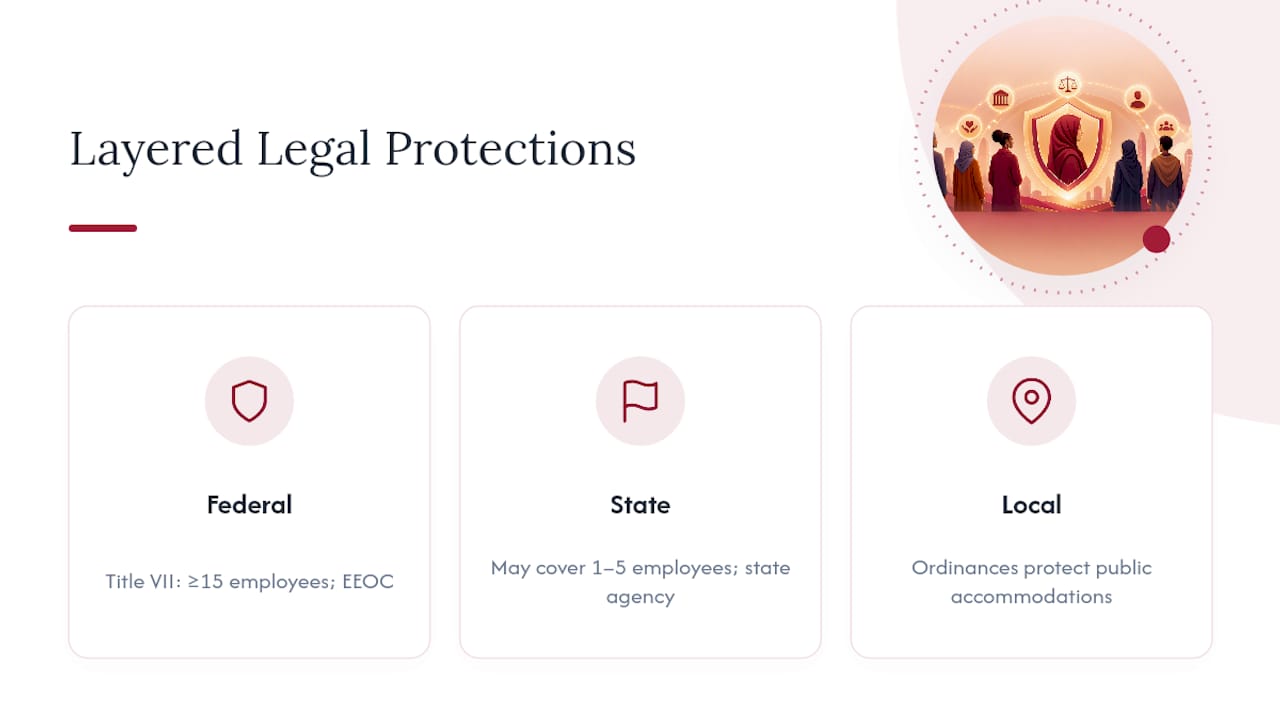
Local ordinances in some cities add another layer, particularly around public accommodations, meaning businesses open to the public, like restaurants and retail stores, may face dress code restrictions beyond what state and federal employment law covers.
The upshot: don’t assume you’re unprotected just because your employer is too small for Title VII. Check your state’s civil rights agency and your city’s human rights commission before concluding you have no case. A regional employment attorney, or a firm handling workplace discrimination claims across multiple jurisdictions, can usually identify which statute actually applies to your situation faster than a general search.
How Fast Must Employers and Schools Respond to Requests?
Neither Title VII nor its regulations set a specific deadline for responding to a religious accommodation request.
What the law requires is good-faith, reasonably prompt engagement once notice is given. An employer that ignores a request for an extended period is at risk of violating its obligations. Delays can be evidence of bad faith in the required interactive process.
In practice, many HR departments respond within a short time to routine requests, but more complex cases might take longer. Communication about timelines is important.
Schools may take longer due to administrative layers, making documentation of each step critical.
If a clear request goes unanswered for multiple weeks, it should be considered a warning sign.
What Myths Persist About Religious Dress Accommodations?
A few misconceptions come up constantly, and they cause real harm because people believe them and don’t push back.
Myth: You need to belong to a recognized, organized religion. False. Sincerely held moral or ethical beliefs held with religious intensity can qualify, even outside traditional denominations.
Myth: Employers can deny accommodations for “customer comfort” or brand image. Also false, and this is one of the most common illegal justifications employers still lean on, despite the EEOC’s guidance explicitly rejecting it.
Myth: You have to use formal legal language to request an accommodation. Not true. Plain, direct language about the conflict and the need for an exception is legally sufficient.
Myth: Only employees, not job applicants, are protected. Abercrombie settled this. Applicants are protected too, even before they’re hired.
Myth: If your employer didn’t know for certain, they’re safe. Also wrong after Abercrombie. Suspected religious need can be enough to trigger liability if it motivated the decision.
Believing any of these can talk someone out of asking for something they’re legally entitled to. That’s the real cost of the myth.
Where Can You Find Help With Religious Attire Rights?
You don’t have to navigate an accommodation dispute alone, and several resources exist specifically for this.
The EEOC itself is the first stop for most workplace disputes, both for guidance and for filing a formal charge. Its religious discrimination resource page collects fact sheets, guidance documents, and contact information for regional offices.
For students and families, district Title IX and civil rights coordinators are the formal internal channel, and most state departments of education maintain a civil rights complaint process independent of the school district.
Faith-based advocacy organizations focused on specific communities, Sikh American groups, Muslim civil rights organizations, and Jewish anti-discrimination organizations among them, often have experience with the exact fact patterns their communities face and can offer both guidance and, sometimes, legal referrals.
Employment and civil rights attorneys become relevant once informal channels stall, particularly in cases involving repeated denial, retaliation, or a policy that affects more than one employee. A religious discrimination lawyer can evaluate whether your documented interactions rise to a viable claim before you invest more time in an internal process that isn’t going anywhere.
Why the “Just Ask Nicely” Advice Falls Short
Most guides on this topic stop at “notify your employer and they have to accommodate you.” That’s true as far as it goes, but it understates how much the outcome depends on what happens after notification, not the notification itself.
The real leverage point is the interactive process. Employers who skip it, who deny a request on the spot without a genuine back-and-forth, hand employees a much stronger legal position than employers who engage seriously and can point to a specific, documented burden. Most people don’t realize that a poorly handled denial is often more damaging to the employer’s case than the denial itself.
My honest read: the Abercrombie decision deserves more attention in everyday advice than it gets. It means suspicion alone can create liability, which should make employers more cautious, and it should make employees less hesitant to speak up even informally. If there’s one thing worth prioritizing above all else, it’s building a paper trail from the very first conversation. Verbal promises evaporate. Emails don’t.
— Mark
How Javitch Law Office Can Help With Your Case
If your employer or school has denied a religious accommodation, or dragged out the interactive process until you gave up asking, that pattern is exactly what a religious discrimination lawyer case is built around. We take cases often declined by larger firms, working directly with clients and handling most discrimination matters on a contingency basis, meaning clients owe nothing unless there is a recovery.
Before a consultation, gather what you already have: the date you made your request, who you spoke to, any written responses (or lack of them), and copies of the relevant dress code or grooming policy. That documentation is often the difference between a strong case and a stalled one.
EEOC charges carry strict filing windows, so waiting rarely helps your position. If you’re weighing whether to escalate a denied accommodation, reach out through the firm’s religious discrimination page and lay out what happened. The sooner the timeline is reviewed, the more options usually remain on the table.
Where to Verify the Legal Details
- Religious Garb and Grooming in the Workplace: Rights and Responsibilities — EEOC guidance on employer obligations
- Questions and Answers: Religious Discrimination in the Workplace — EEOC’s plain-language Q&A
- EEOC v. Abercrombie & Fitch Stores, Inc., 575 U.S. ___ (2015) — full Supreme Court opinion via Cornell LII
- How to File a Charge of Employment Discrimination — EEOC’s official filing process
- Religion Equity and School Dress Codes — background on student rights in public schools
This article is general information, not a substitute for advice from a qualified lawyer. Consult a qualified legal professional about your own circumstances before acting on anything here.
Sources
- Religious Garb and Grooming in the Workplace: Rights and Responsibilities | U.S. Equal Employment Opportunity Commission
- Questions and Answers: Religious Discrimination in the Workplace | U.S. Equal Employment Opportunity Commission
- EEOC v. Abercrombie & Fitch Stores, Inc., 575 U.S. ___ (2015) — Supreme Court opinion (Cornell LII)
- How to file a charge of employment discrimination | EEOC
FAQ
What Is a Religious Dress Code?
A religious dress code refers to clothing or grooming standards tied to a person’s faith, such as covering hair, wearing specific garments, or maintaining uncut hair or beards. Under Title VII, employers generally must accommodate these practices for sincerely held beliefs unless doing so creates an undue hardship. Schools face a related but distinct standard rooted in First Amendment protections for religious expression.
What Religious Clothing and Items Are Typically Protected?
Commonly protected items include the hijab, the Sikh turban, the Jewish kippah, religious crosses and Stars of David, modest dress requirements like long skirts or sleeves, and ceremonial items such as the Sikh kirpan, according to EEOC guidance. Uncut hair and beards tied to religious observance, including Sikh and some Orthodox Jewish practice, are also generally protected. Protection depends on the sincerity of the underlying belief, not on whether the item appears on an official list.
Are There Colors or Styles You Shouldn’t Wear to a Religious Ceremony?
This varies significantly by faith and specific congregation, and there’s no single national rule. Many Christian denominations favor modest, subdued clothing for regular worship, while some traditions reserve black or white for specific occasions like funerals or weddings; checking with the specific house of worship beforehand is the most reliable approach for guests attending an unfamiliar ceremony.
What Did Jesus Say About Dress Codes?
Biblical texts don’t lay out a specific dress code from Jesus in the way modern workplace policies do; most New Testament references to appearance emphasize humility and modesty over particular garments. Christian denominations have developed varying dress expectations over centuries based on broader scriptural themes rather than a single directive, which is part of why dress norms differ widely across churches today.
What Should I Do if My Employer Denies My Religious Dress Request?
Document every request and response in writing, then file a charge with the EEOC, which has strict filing deadlines you should not let pass. If the denial involved a pattern of refusals, retaliation, or a companywide policy, consulting a religious discrimination lawyer before or alongside filing can help you understand what remedies are realistically available.