
A civil rights violation claim is a lawsuit or agency complaint asserting that a government actor, or in certain statutes a private party, deprived you of a right guaranteed by the Constitution or by federal law. The claim succeeds or fails on three matters: who committed the act, which right it infringed, and whether you can prove both with preserved evidence inside a fixed deadline. Many problems that feel like civil rights injuries, such as prerecorded robocalls, fake sale prices and surprise renewals, are governed instead by consumer-protection statutes. Identifying the correct category first determines the court, the deadline and the remedy. At Javitch Law Office, we handle both categories, including First Amendment, discrimination, TCPA and public records matters, and we evaluate which route fits your facts.
TL;DR
- A federal civil rights claim against a government actor generally rests on 42 U.S.C. § 1983, which requires conduct under color of state law and a deprivation of a federal right.
- Discrimination claims against employers carry short deadlines: an EEOC charge within 180 or 300 days, and suit within 90 days of a Notice of Right to Sue.
- Robocalls, AI-voice calls, wrong-number calls, deceptive pricing and auto-renewal problems usually belong under consumer statutes such as the TCPA, which allow $500 per violation in statutory damages.
- Evidence decides these cases: preserve records, dates, names, screenshots and call logs before anything is deleted.
- Most of our class action and discrimination matters are handled on a contingency-fee basis, so the client pays nothing unless there is a recovery.
Table of Contents
- What counts as a civil rights violation
- Is a civil rights violation a crime?
- What you must prove in a § 1983 claim
- Deadlines that decide whether a claim survives
- Evidence to preserve
- When the problem is a consumer claim
- Choosing the right route
- Perspective
- How Javitch Law Office can help
- FAQ
- Sources
What counts as a civil rights violation
“Civil rights” covers two related bodies of law. The first protects individuals from government overreach: the First Amendment, due process, equal protection and the Fourth Amendment. The second is statutory and prohibits discrimination on protected grounds in employment, housing, schools and public accommodations.
The constitutional branch reaches only state action. The Ninth Circuit’s 2024 Section 1983 outline explains that a person acting under color of state law who deprives another of constitutional or federal statutory rights may be liable. Private parties are generally not state actors, though courts may treat them as such under the public function, state compulsion, nexus or joint action tests. A city, county or school district is liable only where a policy or custom of that entity caused the violation, not merely because it employed the wrongdoer.
The statutory branch reaches private conduct. The ADA, for example, prohibits disability discrimination in employment, state and local government, public accommodations, commercial facilities, transportation and telecommunications. Title VII and related statutes cover discrimination based on race, religion, sex and national origin in employment.
A practical consequence follows. A public school district that suppresses a student’s speech presents a constitutional claim. A private employer that fires an employee because of religion presents a statutory claim with an agency step first. A caller who places prerecorded marketing messages to your cell phone presents neither: it is a consumer-protection claim.
Is a civil rights violation a crime?
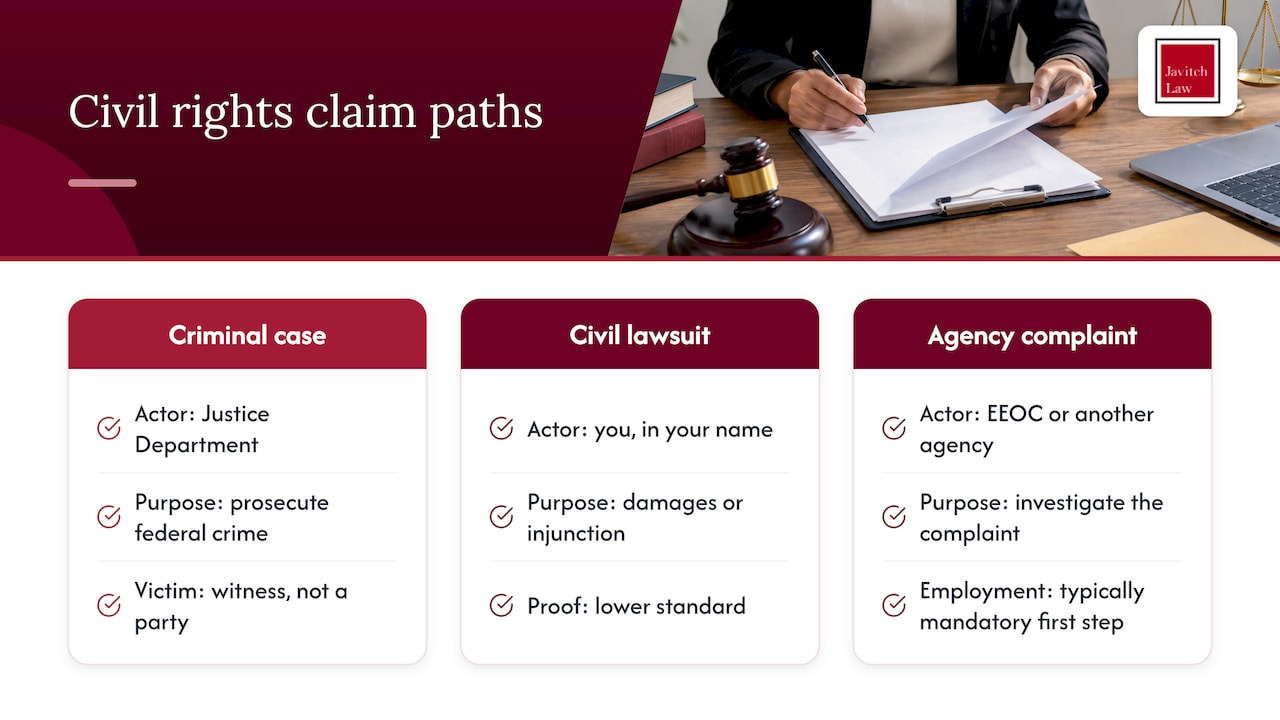
Sometimes, but the criminal case and the civil lawsuit are separate proceedings with different parties and purposes. Under Section 242 of Title 18, it is a federal crime for a person acting under color of law to willfully deprive another of a right protected by the Constitution or federal law. The Justice Department prosecutes; the victim is a witness, not a party, and cannot compel a prosecution.
A civil lawsuit is brought by you, in your name, to recover damages or obtain an injunction. It proceeds whether or not prosecutors act, and it uses a lower standard of proof. An agency complaint is a third track: it asks an agency such as the EEOC to investigate, and for employment discrimination it is typically a mandatory first step. The Justice Department’s own guidance notes that reporting a violation on its Civil Rights Portal is not the same as filing a complaint with the agencies that handle particular claims and does not protect your legal rights. A report to one office therefore does not stop a deadline running at another.
What you must prove in a § 1983 claim
California’s model jury instruction, CACI No. 3000, illustrates the elements a plaintiff must establish in a federal civil rights case against a state actor:
- The defendant intentionally, or with the applicable state of mind, committed the wrongful act.
- The defendant was acting or purporting to act in the performance of official duties.
- The conduct violated the plaintiff’s right.
- The plaintiff was harmed.
- The wrongful act was a substantial factor in causing the harm.
Each element requires a factual answer. Who is the defendant, individually and as an entity? Was that person exercising official authority? Which specific right was infringed? What was the harm, and does the record connect it to the act? Where the defendant is a municipality, the complaint must also identify the policy, custom or decisionmaker responsible.
First Amendment claims follow the same structure with additional doctrinal questions: whether the speech was protected, whether the restriction was content-based, and whether the government acted in retaliation. We discuss four common claim types and their evidence in our guide to First Amendment lawsuits.
Deadlines that decide whether a claim survives
Procedure eliminates more civil rights claims than the merits do. The deadlines below apply to employment discrimination under federal law; other claim types have their own periods.
| Step | Rule | Source |
|---|---|---|
| File an EEOC charge | 180 calendar days from the discriminatory act, extended to 300 days where a state or local agency enforces a law prohibiting discrimination on the same basis | EEOC |
| Sue after Notice of Right to Sue | 90 days to file in federal or state court | EEOC |
| Age discrimination (ADEA) | Charge required, but no Notice of Right to Sue; suit may be filed 60 days after the charge | EEOC |
| Equal Pay Act | May go directly to court within two years, or three if the violation was willful | EEOC |
For age discrimination, the 300-day extension applies only where a state law and a state agency, not merely a local one, cover age discrimination. The EEOC also explains that it litigates only a small percentage of charges, weighing the strength of the evidence and the wider impact, while Congress separately gave individuals the right to sue. A charge therefore does not guarantee that the agency will take your case to court; the Notice of Right to Sue is what opens your own path.
A § 1983 claim has no charge requirement, but it borrows a limitations period from state law. One federal district’s prisoner litigation guide, for instance, states a six-year period for Minnesota, and the period differs from state to state. Our civil rights lawsuit timeline walks through the sequence from charge to complaint.
Evidence to preserve
A court will not accept an account of what happened without support. The Western District of Virginia’s pro se handbook states that a plaintiff must be able to provide evidence of the alleged facts, including the plaintiff’s own testimony, witnesses who observed the incident, and physical evidence such as photographs, letters, emails, police reports and medical records. It also requires the complaint to identify who each defendant is, what each did or failed to do, when and where it occurred, and how each defendant’s conduct caused the harm.
Translated into a working routine:
- Write a dated chronology the same day, naming every person present and every statement attributed to them.
- Keep originals of emails, text messages, letters, notices, voicemails and policy documents. Do not edit or forward selectively; keep the complete thread.
- Capture screenshots with visible dates and URLs for web pages, social media posts, advertised prices and checkout screens.
- Identify witnesses with contact details while recollections are fresh.
- Record the harm: lost wages, medical or counseling records, expenses, and any suspension, termination or denial of access.
- Request public records early where a government entity holds the documents that prove the policy or decision. Records held by public bodies are often the best proof of a custom or policy.
Our guides on documenting discrimination within the 180-day window and on what a civil rights representation involves set out these steps in more detail.
When the problem is a consumer claim
Many readers who search for a civil rights violation claim are actually dealing with deceptive commerce: a prerecorded call to a cell phone, an AI-generated voice pitching a product, repeated calls intended for the previous holder of your number, a discount measured against a price never charged, or a subscription that renewed without clear disclosure. These are not claims against state actors. They arise under consumer-protection statutes.
The American Bar Association’s consumer-protection overview describes Section 5 of the FTC Act, which prohibits unfair or deceptive acts or practices, as the foundation of the field, with FTC rules and state unfair and deceptive practices statutes in all 50 states and the District of Columbia forming the layered enforcement structure. State statutes vary widely in scope and covered industries.
Robocalls, AI voices and wrong-number calls
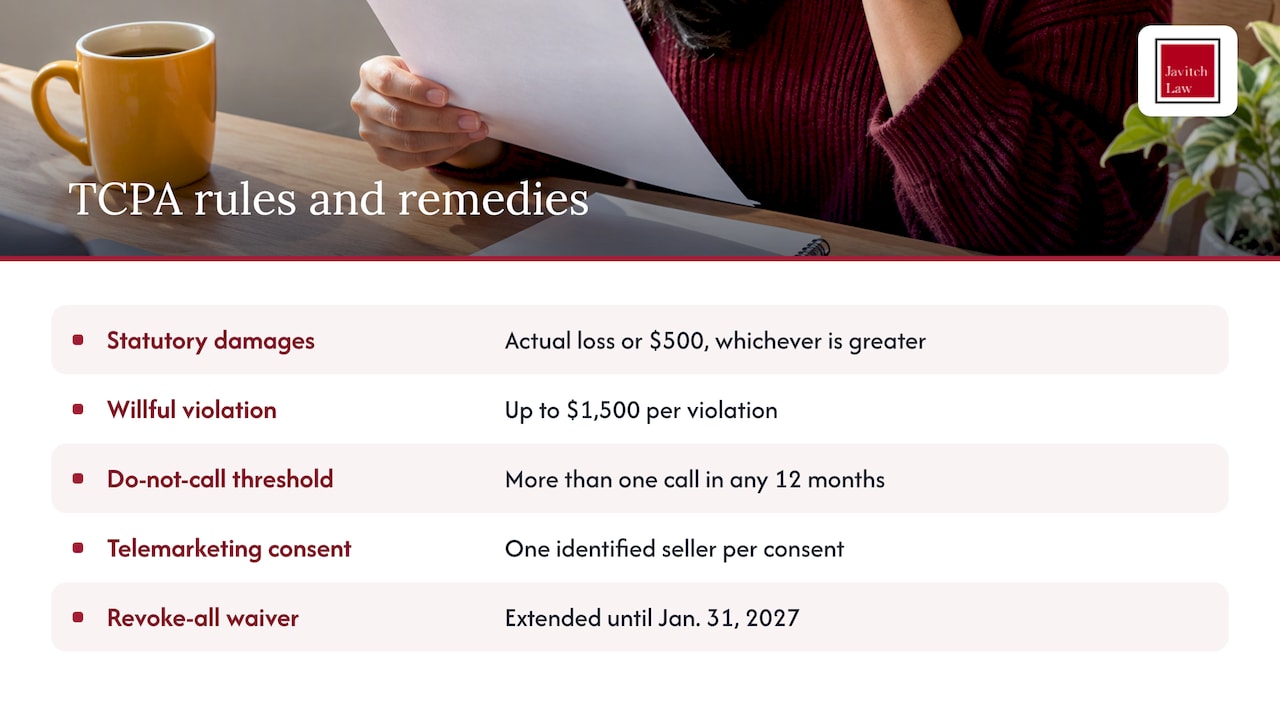
The Telephone Consumer Protection Act (TCPA) restricts autodialed and artificial or prerecorded voice calls to cell phones without prior express consent, and it gives individuals a private right of action. As quoted by the Sixth Circuit in Charvat v. NMP, LLC, a person may sue to enjoin a violation or to recover actual monetary loss or $500 in statutory damages per violation, whichever is greater, and a court may increase the award up to three times, to $1,500 per violation, where the violation was willful or knowing (47 U.S.C. § 227(b)(3)).
Do-not-call claims have a separate threshold. As quoted in Charvat v. GVN Michigan, Inc., 47 U.S.C. § 227©(5) requires more than one call within any 12-month period by or on behalf of the same entity, and a defendant has an affirmative defense if it established and implemented reasonable practices to prevent such violations.
Two recent developments matter to callers’ targets. Under the FCC’s robocall order effective January 27, 2025, prior express written consent for prerecorded telemarketing calls must be given to one identified seller at a time, and a single click on a lead generator’s site cannot authorize calls from multiple sellers. On January 6, 2026, the FCC extended its waiver of the “revoke-all” rule at 47 C.F.R. § 64.1200(a)(10) until January 31, 2027 while it reviews the requirement. Both are summarized by the National Consumer Law Center. These rules change by order, so confirm the current text before relying on a date.
What to preserve is specific to the call: the number that called, the date and time of each call, whether a prerecorded or synthetic voice spoke, what was said, whether you ever gave consent, and any request to stop and the date you made it. A wrong-number caller who continues after you explain that the person they want no longer holds the number presents a distinct fact pattern, which we address on our wrong number calls page.
Fake discounts, junk fees and surprise renewals
Deceptive pricing and renewal practices are pleaded under state consumer statutes, and the rules differ by state. Evidence here is largely documentary: screenshots of the advertised reference price and the sale price on specific dates, the checkout total against the advertised total, the sign-up flow showing what was disclosed about renewal, and billing statements showing each charge. Because many such practices affect thousands of buyers identically, they are frequently brought as class actions, in which one named plaintiff represents the others.
Choosing the right route
The table below matches common situations to the legal basis most likely to apply. It is a starting map, not a conclusion about any particular case.
| Situation | Likely legal basis | First procedural step |
|---|---|---|
| Public school or city punishes protected speech | First Amendment through § 1983 | Preserve records; identify the policy or decisionmaker |
| Employer discriminates on race, religion or disability | Title VII, ADA or state law | EEOC charge within 180 or 300 days |
| Student faces discrimination at a school district | Federal and state civil rights statutes | Document incidents; review district complaint procedures |
| Prerecorded or AI-voice marketing calls | TCPA | Log calls and consent history |
| Fake sale prices, junk fees, surprise renewals | State consumer protection law | Capture screenshots and billing records |
| Government withholds records | FOIA or state public records law | Submit a written request, then evaluate litigation |
First Amendment and public-records problems often arrive together: a government body takes the action and also holds the documents that explain it. Our FOIA and public records practice addresses requests and litigation when an agency does not produce them.
Perspective
Civil rights and consumer cases share a feature that is easy to overlook: the person harmed rarely holds the leverage. The institution controls the documents, the policy and the schedule, and the individual controls only the clock and the quality of the record. For that reason we treat early documentation as the single most valuable step a prospective client can take, ahead of any decision about forum.
We take cases that larger firms avoid and pursue legal battles that others abandon. Clients have direct contact with their attorney, and the firm is admitted in federal courts nationwide, which allows a matter that begins in one state to be brought where the defendant can properly be sued. We also use public records requests to obtain the policies and communications that establish liability, which is how a claim against a public body moves from allegation to proof.
Most of our class action and discrimination matters proceed on a contingency-fee basis, so the client pays nothing unless there is a recovery. That arrangement lets a consumer with a $500-per-call statutory claim, or an employee facing a well-resourced employer, bring the case without financing it personally.
Mark
How Javitch Law Office can help
We offer a free case consultation in which an attorney reviews your facts, identifies whether the claim sounds in civil rights, discrimination or consumer protection, and calculates the deadlines that apply. Our practice areas include discrimination, including student and religious discrimination, First Amendment matters, and TCPA claims arising from robocalls and artificial-voice calls. Bring your chronology and any documents you have preserved; the firm’s landing page lists the ways to reach us.
We represent clients in California, Colorado, the District of Columbia, Delaware, Maryland, Massachusetts, Nebraska and New Jersey, and in federal courts nationwide.
FAQ
How long do I have to file a civil rights violation claim?
The period depends on the claim. For employment discrimination under federal law, an EEOC charge is due within 180 calendar days, extended to 300 days where a state or local agency enforces a law on the same basis, and suit must follow within 90 days of a Notice of Right to Sue. Section 1983 claims borrow a state limitations period. Because the clocks differ and run concurrently, calculate them from the date of the first act.
Can I sue a private company for violating my civil rights?
Under the Constitution, generally not, because constitutional protections reach state action, although courts apply tests such as public function and joint action to treat some private parties as state actors. Federal statutes, however, prohibit discrimination by private employers, landlords and businesses open to the public. Consumer statutes such as the TCPA also apply directly to private callers and sellers.
What evidence is most useful in a civil rights lawsuit?
A court looks for your own testimony, witness accounts, and physical evidence such as photographs, letters, emails, police reports and medical records. The complaint must identify each defendant, what each did, when and where, and how it caused harm. A dated chronology prepared close to the events ties these items together.
Do unwanted AI-voice or prerecorded calls count as a civil rights violation?
They are ordinarily a consumer-protection matter rather than a civil rights one. The TCPA restricts artificial and prerecorded voice calls to cell phones without prior express consent and permits statutory damages of $500 per violation, with up to $1,500 for willful or knowing violations. Keep a log of each call and any request to stop.
Is a civil rights lawsuit the same as reporting a violation to the Justice Department?
No. A report to the Justice Department’s Civil Rights Division does not file a charge with the EEOC and does not protect your legal rights or deadlines. A lawsuit is brought by you in court, while criminal prosecution under 18 U.S.C. § 242 is decided by federal prosecutors.
Sources
- Section 1983 Outline, Ninth Circuit Office of Staff Attorneys (2024)
- Guide to Disability Rights Laws, ADA.gov
- Deprivation of Rights Under Color of Law, U.S. Department of Justice
- How to File a Discrimination or Retaliation Complaint, DOJ Civil Rights Division
- CACI No. 3000, Violation of Federal Civil Rights
- How to File a Charge of Employment Discrimination, EEOC
- Filing a Lawsuit, EEOC
- Prisoner Civil Rights Litigation Guide, U.S. District Court for the District of Minnesota
- Pro Se Handbook, U.S. District Court for the Western District of Virginia
- Everything a First-Year Attorney Should Know About U.S. Consumer Protection, American Bar Association
- Charvat v. NMP, LLC, Sixth Circuit (2011)
- Charvat v. GVN Michigan, Inc., Sixth Circuit (2009)
- New Consumer Law Rights Taking Effect in 2025, National Consumer Law Center