
If you were fired because of your race, age, disability, religion, sex, or because you reported illegal conduct, that firing is likely wrongful under California law. The California Fair Employment and Housing Act (FEHA) and federal statutes including Title VII, the ADA, and the ADEA all prohibit employers from using protected characteristics or protected activities as the basis for termination. The single most critical fact: EEOC filing deadlines are typically 180 or 300 days from the discriminatory act, depending on your jurisdiction. Miss that window and you may lose your right to sue under federal law entirely.
Immediate action checklist:
- Save every email, performance review, and written communication related to your termination right now, before accounts are deactivated
- Write down exact dates, names, and what was said in any relevant conversations
- Note whether any coworkers witnessed key events or received different treatment
- File an internal HR complaint in writing if you have not already done so (this creates a paper trail and may trigger whistleblower protections)
- Contact the California Civil Rights Department (formerly DFEH) or the EEOC to begin the intake process
- Consult an attorney promptly — Javitchlawoffice offers case evaluations for discrimination and retaliation claims
Deadline alert: The EEOC generally requires you to file a charge within 180 or 300 days of the discriminatory act. California’s Civil Rights Department has its own deadlines. Do not wait.
This article is general legal information, not legal advice for your specific situation. Confirm current rules and deadlines with the relevant agency or a qualified attorney.
Table of Contents
- What does “wrongful termination” actually mean under California law?
- Red flags that suggest your firing was discriminatory or retaliatory
- Which laws protect you in California: FEHA, Title VII, ADA, ADEA, and the Labor Code
- How courts and agencies evaluate your discrimination or retaliation claim
- What remedies can you seek, and how does the process work?
- Practical steps to preserve your claim right now
- How Javitchlawoffice can help you fight back
- Key Takeaways
- Why early legal counsel matters more than most people think
- Primary sources to bookmark and consult directly
What does “wrongful termination” actually mean under California law?
California is an at-will employment state. That means your employer can fire you for almost any reason, or no reason at all, without legal liability. But “almost any reason” has hard limits, and those limits are where wrongful termination claims live.
A firing becomes legally wrongful when it violates a statute, breaches an employment contract, or contradicts clear public policy. Feeling that a firing was unfair, arbitrary, or even cruel is not enough on its own. Courts examine whether the termination crossed one of three specific legal lines.
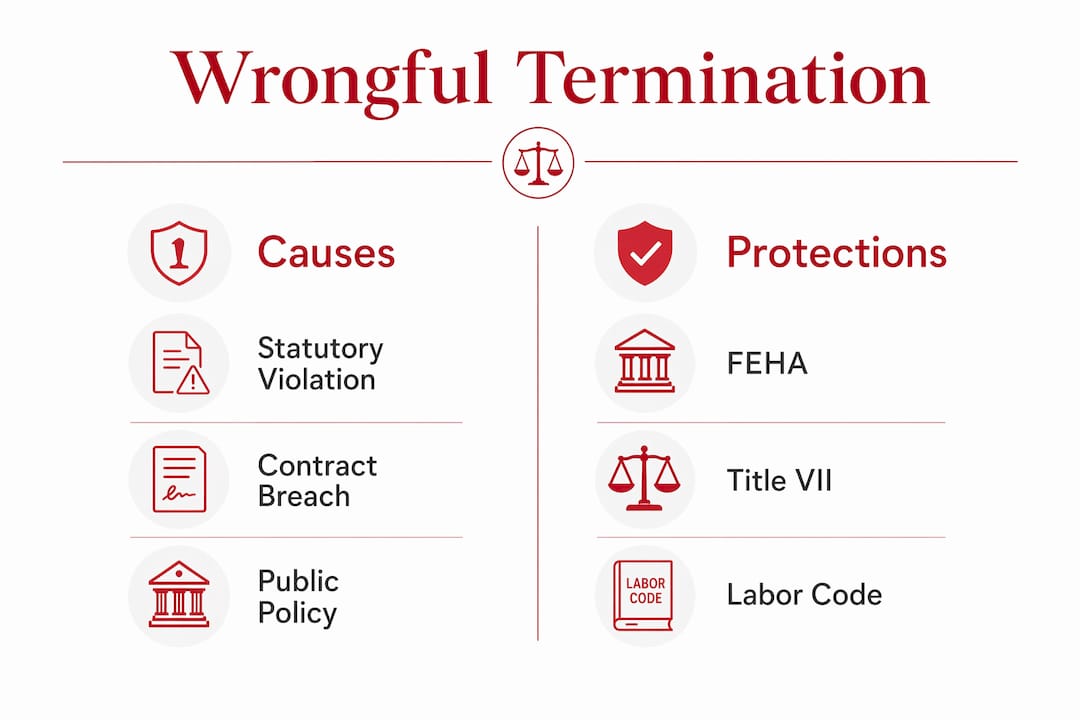
| Basis for claim | What it means | Example |
|---|---|---|
| Statutory violation | Firing violates FEHA, Title VII, ADA, ADEA, or Labor Code | Fired after disclosing a disability |
| Contract breach | Written or implied contract promised termination only for cause | Handbook states progressive discipline before discharge |
| Public policy exception | Firing punishes an employee for doing something the law encourages | Fired for reporting wage theft to the Labor Commissioner |
The at-will rule gives employers wide latitude. What it does not give them is the right to fire someone because of a protected characteristic or because that person exercised a legal right.
Pro Tip: Check your employee handbook carefully. Language like “we follow progressive discipline” or “employees will be terminated only for cause” can create an implied contract that limits at-will firing. Courts have found those phrases binding even without a signed agreement.
Red flags that suggest your firing was discriminatory or retaliatory
Courts and agencies do not expect a signed confession. They look for patterns. The following situations consistently appear in successful discrimination and retaliation claims.
Common discriminatory firing scenarios:
- Terminated shortly after disclosing a pregnancy, disability, or medical condition
- Fired after requesting a religious accommodation or FMLA leave
- Let go following a complaint about racial slurs, harassment, or unequal pay
- Dismissed after reporting a safety violation to OSHA or a wage violation to the Labor Commissioner
- Fired after participating in an internal discrimination investigation
- Terminated after engaging in First Amendment-protected speech that your employer opposed
Red-flag checklist:
- The timing is suspicious: termination came within days or weeks of a protected event
- Your employer’s stated reason keeps changing or contradicts prior performance reviews
- Coworkers in similar situations but outside your protected class were treated differently
- A supervisor made comments about your age, race, religion, or disability before or during the termination
- You were the only person in your department fired during a “restructuring” that otherwise left your demographic group untouched
Consider two short examples. An employee with a clean record is fired two weeks after filing an internal complaint about racial slurs from a supervisor. No written warning, no performance plan. That timing and sequence is exactly what agencies flag as retaliation. Separately, a 58-year-old manager is replaced by a 32-year-old after a new director comments that the team needs “fresh energy.” That comment, combined with the age gap, gives an age discrimination claim real traction.
Pro Tip: Write a contemporaneous memo to yourself the same day any significant event happens: who said what, who was present, what time it was. Courts give significant weight to notes created at the time of the event rather than reconstructed months later.

Which laws protect you in California: FEHA, Title VII, ADA, ADEA, and the Labor Code
California employees benefit from overlapping state and federal protections, and in most cases the state law is broader.
FEHA: California’s primary shield
The Fair Employment and Housing Act is the controlling state statute for most employment discrimination issues in California. FEHA covers employers with five or more employees and prohibits discrimination based on race, color, religion, sex, gender identity, sexual orientation, national origin, ancestry, disability, medical condition, marital status, age (40+), and pregnancy, among other categories. It also prohibits retaliation against employees who oppose discrimination or participate in FEHA proceedings.
Federal counterparts
Federal law adds another layer. Title VII of the Civil Rights Act covers race, color, religion, sex, and national origin for employers with 15 or more employees. The ADA covers disability discrimination for the same employer size. The ADEA protects workers 40 and older from age-based adverse employment actions. These federal statutes are enforced by the EEOC and generally apply alongside FEHA, not instead of it.
Labor Code retaliation provisions
California’s Labor Code covers retaliation for reporting wage theft, unsafe working conditions, or other Labor Code violations. The Labor Commissioner’s Office enforces these provisions and handles retaliation complaints separately from discrimination charges. If your firing followed a wage complaint or a safety report, a Labor Code claim may run parallel to a FEHA or Title VII claim.
| Statute | Primary coverage | Key remedies | Enforcement agency |
|---|---|---|---|
| FEHA | Race, sex, age, disability, religion, pregnancy, and more (CA employers, 5+ employees) | Back pay, front pay, emotional distress, punitive damages, attorneys’ fees | CA Civil Rights Department |
| Title VII | Race, color, religion, sex, national origin (15+ employees) | Back pay, reinstatement, compensatory and punitive damages | EEOC |
| ADA | Disability discrimination and failure to accommodate (15+ employees) | Back pay, reinstatement, compensatory and punitive damages | EEOC |
| ADEA | Age 40+ discrimination (15+ employees) | Back pay, liquidated damages | EEOC |
| CA Labor Code | Wage, safety, and whistleblower retaliation | Reinstatement, back pay, civil penalties | CA Labor Commissioner |
Dual-filing note: California is a Fair Employment Practices Agency (FEPA) state. When you file a charge with the California Civil Rights Department, it is typically cross-filed with the EEOC automatically. You generally do not need to file both separately.
How courts and agencies evaluate your discrimination or retaliation claim
Proving an unlawful termination claim does not require a smoking gun. Most cases are built on circumstantial evidence, and agencies are trained to recognize it.
Direct vs. circumstantial evidence
Direct evidence is a supervisor saying “we don’t promote women” or “you’re too old for this role.” It is rare. Circumstantial evidence is far more common: suspicious timing, inconsistent explanations, statistical patterns, and comparator employees who were treated differently. Both types are legally valid.
The burden-shifting framework
Under the standard framework courts apply, you first establish a prima facie case: you belong to a protected class, you were qualified for your job, you suffered an adverse action (the firing), and the circumstances suggest discrimination. The burden then shifts to your employer to articulate a legitimate, non-discriminatory reason. If they do, you must show that reason is a pretext — meaning it is false, inconsistent, or not the real explanation.
Pretext often shows up in the details. An employer who claims you were fired for poor performance but cannot produce a single written warning, while a similarly situated employee outside your protected class received three warnings before any discipline, has a credibility problem. That gap is where discrimination cases are won.
Building your evidence file
Gather these before you lose access:
- Emails and messages showing your performance was satisfactory, or showing discriminatory comments
- Performance reviews from the past two to three years
- Comparator evidence: how were employees outside your protected class treated for the same conduct?
- Witness names and contact information while memories are fresh
- The employee handbook and any written policies on discipline and termination
- Documentation of any internal complaints you made and the employer’s response
Pro Tip: Take screenshots of relevant messages on your personal device before your work accounts are shut down. Note the metadata: sender, recipient, date, and time. A screenshot without context is less useful than one you can place in a clear timeline.
“Discrimination need not be the sole motive for a discharge or disciplinary action. If discrimination played any part in the decision to discharge or discipline the charging party, a violation of Title VII has occurred.” — EEOC Compliance Manual, CM-612
What remedies can you seek, and how does the process work?
A successful wrongful dismissal lawsuit or agency finding can produce several categories of relief.
Available remedies under FEHA and federal law:
- Back pay: wages and benefits lost from the date of termination to the date of judgment
- Front pay: projected future earnings if reinstatement is not practical
- Reinstatement: return to your former position (less common in practice)
- Emotional distress damages: compensation for psychological harm caused by the discrimination
- Punitive damages: available under FEHA and Title VII when the employer acted with malice or reckless indifference
- Attorneys’ fees: prevailing plaintiffs can recover legal fees under FEHA and Title VII
Punitive damages and emotional distress damages generally require a civil lawsuit, not just an administrative agency finding. An agency investigation can result in mediation, a settlement, or a right-to-sue letter, but the larger damage awards come through litigation.
The two-step path to a lawsuit
Step one is filing an administrative charge. For federal claims, that means the EEOC. For California FEHA claims, that means the California Civil Rights Department (formerly DFEH). Filing with one agency typically cross-files with the other automatically. Step two is receiving a right-to-sue notice and filing a civil lawsuit within the time limit stated in that notice.
| Filing stage | Agency | Deadline | Notes |
|---|---|---|---|
| Federal charge | EEOC | 180 or 300 days from discriminatory act | 300 days applies in states with a FEPA like California |
| State charge | CA Civil Rights Department | Check current CRD deadlines | Cross-filed with EEOC in most cases |
| Federal lawsuit | Federal court | 90 days from EEOC right-to-sue letter | Missing this deadline bars the federal claim |
| FEHA lawsuit | CA Superior Court | Consult an attorney for current FEHA deadlines | Tolling rules may apply |
Tolling note: Certain circumstances, including ongoing agency investigations and some equitable tolling doctrines, can extend these deadlines. Do not rely on tolling as a safety net — consult an attorney before the standard deadline passes.
If the EEOC or a Fair Employment Practices Agency completes its investigation without resolving the charge, it issues a Notice of Right to Sue. That letter starts the 90-day clock for filing a federal lawsuit. Missing it ends the federal case.
Practical steps to preserve your claim right now
Time is the enemy of a discrimination claim. Evidence disappears, witnesses move on, and deadlines pass. Here is what to do in the order it matters.
- Preserve all digital evidence today. Forward relevant work emails to a personal account if your company policy permits it, or take dated screenshots. Save any performance reviews, commendations, or disciplinary notices you have access to.
- Write a detailed timeline. List every relevant event in chronological order: the protected activity (complaint, leave request, disclosure), any change in treatment that followed, and the termination itself. Include names, dates, and exact words where you remember them.
- Identify witnesses. Note coworkers who observed discriminatory comments, differential treatment, or the circumstances of your firing. Contact them while the events are fresh.
- File an internal HR complaint in writing if you have not already. State clearly that you believe the termination was discriminatory or retaliatory. This creates a record and may trigger additional legal protections.
- Contact the California Civil Rights Department or the EEOC to begin the intake process. Both agencies offer online intake portals. Filing a charge preserves your rights under the applicable statute while the agency investigates.
- Consult an attorney before the agency deadline. An attorney can assess whether early injunctive relief is appropriate (for example, if retaliation is ongoing), help you frame the charge effectively, and advise on whether to request an immediate right-to-sue letter rather than waiting for an agency investigation.
For guidance on when to hire a racial discrimination lawyer, the timing of counsel matters more than most people realize. Early involvement often means better evidence preservation and stronger negotiating leverage before a lawsuit is even filed.
Knowing how employers use pre-employment screening questions can also help you recognize when a hiring or firing decision was built on pretextual reasoning from the start.
How Javitchlawoffice can help you fight back
When the facts suggest discrimination or retaliation, the difference between a preserved claim and a lost one often comes down to how quickly you act and who is in your corner.
Javitchlawoffice is a California civil rights firm that handles employment discrimination claims with the depth and focus these cases require. The firm’s practice covers antisemitic and racial discrimination, First Amendment retaliation, age and disability discrimination, and employment cases where institutional power is being used against an individual employee. That means case evaluation, help framing an agency charge, full litigation when necessary, and evidence preservation strategy from day one.
The firm works on a contingency basis for qualifying discrimination cases, so cost is not a reason to delay getting a professional assessment of your situation. Outcomes cannot be guaranteed, but acting before a filing deadline closes is something you can control. Contact Javitchlawoffice now for a case evaluation and get a clear picture of where your claim stands before the clock runs out.
Key Takeaways
A discriminatory or retaliatory firing is legally wrongful under California law when it violates FEHA, Title VII, the ADA, the ADEA, or a public-policy exception, and the EEOC filing deadline of 180 or 300 days from the discriminatory act is the single most critical deadline to protect.
| Point | Details |
|---|---|
| At-will has hard limits | Employers can fire freely, but not for discriminatory reasons or protected activity. |
| FEHA is California’s broadest protection | FEHA covers more categories and smaller employers than federal law; file with the CA Civil Rights Department. |
| Federal deadline is 180 or 300 days | The EEOC requires a charge within 180 or 300 days of the discriminatory act; missing it bars federal claims. |
| Circumstantial evidence wins cases | Timing, inconsistent reasons, and comparator treatment are the building blocks of most successful claims. |
| Javitchlawoffice handles these claims | The firm offers case evaluations for discrimination and retaliation matters and litigates when necessary. |
Why early legal counsel matters more than most people think
The conventional wisdom says “wait and see if the agency resolves it.” In my view, that advice costs people real money and real leverage.
Agency investigations move slowly, and during that time evidence degrades, witnesses become harder to reach, and employers quietly build their paper trail. The employees who come out best in these situations are usually the ones who got counsel early, not after the agency process stalled. An attorney can help you frame the charge in a way that preserves the strongest claims, advise on whether to request an immediate right-to-sue letter, and identify whether early injunctive relief is worth pursuing if retaliation is ongoing.
There is also a practical cost argument for early involvement that people underestimate. A well-framed charge filed with strong supporting documentation often produces a faster settlement offer than a poorly framed one that drags through a full investigation. Employers respond to specificity and preparation. Showing up with organized evidence and legal representation signals that you are serious, and that changes the negotiation dynamic.
The cases that genuinely justify waiting for the agency process to play out are those where the damages are modest and the primary goal is a policy change or a record of the violation. For anyone facing significant lost wages, emotional harm, or ongoing retaliation, early counsel is not a luxury. Consulting a discrimination attorney before the first deadline passes is the single highest-leverage action available to you.
Primary sources to bookmark and consult directly
These are the official agency pages where you file charges, find forms, and confirm current deadlines. Save them now.
| Source | What it covers | Start here if… |
|---|---|---|
| EEOC — Filing a Charge | Federal charge filing, deadlines, dual-filing with state FEPAs | You want to file a federal discrimination or retaliation charge |
| EEOC — Know Your Rights | Summary of federal protected categories and prohibited practices | You want to confirm which federal law covers your situation |
| USAGov — Wrongful Termination | Plain-language overview of wrongful termination and agency process | You want a plain-English starting point before contacting an agency |
| LII / Cornell — Wrongful Termination | Legal definition, at-will rule, statutory and contract exceptions | You want to understand the legal framework before consulting counsel |
| EEOC — CM-612 Discharge/Discipline | EEOC investigator guidance on discriminatory discharge, pretext, comparators | You want to understand how investigators evaluate your type of claim |
| CA Civil Rights Department (CRD) | California FEHA charges, state filing deadlines, intake portal | You are a California employee filing under state law |
The EEOC filing page is the right first stop for federal claims. For California FEHA claims, go directly to the California Civil Rights Department website to confirm current filing windows and use their online intake form. Print or save the pages that list your specific deadline, because agency websites update their guidance periodically.
Recommended
- Antisemitic & Racial Discrimination Attorneys | Javitch Law Office
- Fighting Antisemitic and Racial Discrimination in the Workplace | Javitch Law Office
- When to Hire a Racial Discrimination Lawyer: Protecting Your Workplace Rights | Javitch Law Office
- Jewish Discrimination in the Workplace: Know Your Rights and Legal Options | Javitch Law Office