
Workplace retaliation in California is defined as any adverse action an employer takes against an employee for engaging in a legally protected activity. California law, through Labor Code §§ 98.6, 1102.5, and 1197.5, prohibits this conduct across nearly every industry and employer size. The California Civil Rights Department and the Labor Commissioner both enforce these protections. Senate Bill 497, signed into law in 2023 and fully effective in 2024, strengthened employee rights by creating a 90-day rebuttable presumption of retaliation and imposing civil penalties of up to $10,000 per violation. If your employer punished you for speaking up, you have real legal tools available right now.
What counts as workplace retaliation in California?
Workplace retaliation in California covers a wide range of employer conduct, not just termination. The law protects employees who take specific actions, and it prohibits employers from responding with any negative employment decision as a result.
Protected activities under California law
California law shields employees who engage in the following activities:
- Filing or threatening to file a wage claim with the Labor Commissioner
- Reporting workplace safety violations to Cal/OSHA or a supervisor
- Complaining about discrimination or harassment under the Fair Employment and Housing Act (FEHA)
- Discussing wages with coworkers under Labor Code § 1197.5
- Taking protected leave under the California Family Rights Act (CFRA) or FMLA
- Reporting suspected illegal activity as a whistleblower under Labor Code § 1102.5
- Participating in a government investigation or legal proceeding
One detail that surprises many employees: you do not need to be right about the underlying violation. Good faith reports are protected even if no violation is found after investigation. A reasonable belief that something illegal occurred is enough to trigger protection.
What actions qualify as adverse?
Adverse actions include termination, demotion, pay cuts, negative performance reviews, exclusion from meetings, and shift reassignments. California courts define the standard broadly. Any action that would discourage a reasonable employee from exercising a protected right qualifies as retaliatory. That includes subtle moves like suddenly assigning an employee to undesirable shifts, removing them from key projects, or creating a hostile work environment after a complaint.

Pro Tip: Keep a written log of every change in your job duties, schedule, or treatment that occurs after you engage in a protected activity. Dates and specifics matter far more than general impressions when building a retaliation case.
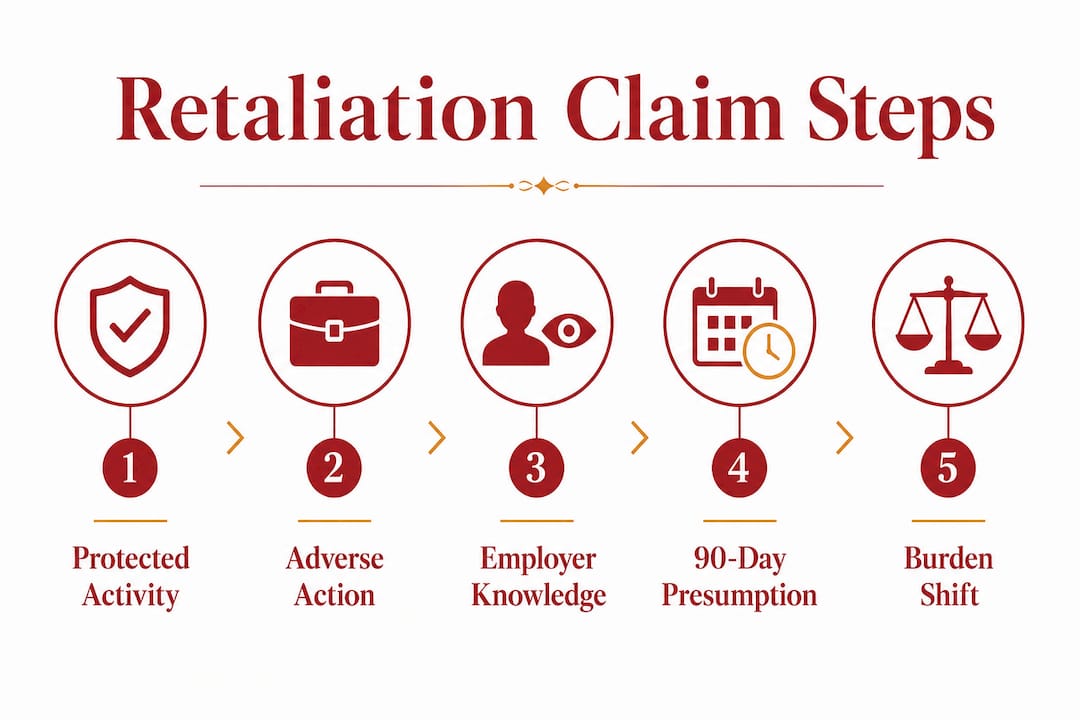
The employer must also have known about the protected activity before taking the adverse action. An employer who acts without that knowledge generally avoids retaliation liability, even if the timing looks suspicious. This makes documenting who knew what, and when, a critical part of any claim.
How does SB 497 shift the burden of proof in retaliation cases?
SB 497 changed the evidentiary rules in a way that significantly favors employees. Before this law, employees carried the full burden of proving that retaliation motivated the employer’s decision. Now, timing alone can create a legal presumption in your favor.
The 90-day presumption explained
The mechanics work like this:
- You engage in a protected activity, such as filing a wage complaint.
- Your employer takes an adverse action within 90 days of that activity.
- A rebuttable presumption of retaliation automatically arises in your favor.
- The burden shifts to your employer, who must produce clear, independent documentation proving a legitimate, non-retaliatory reason for the action.
- Without that documented evidence, judgment favors the employee.
This is a major departure from the old standard. Previously, an employee had to build the entire causal case from scratch. Now, the employer must explain itself with actual records, not just testimony.
Penalties and scope
Civil penalties under SB 497 reach up to $10,000 per violation, paid directly to the employee. That figure applies per retaliatory act, meaning multiple adverse actions can generate multiple penalties. The financial exposure for employers is real, which gives employees meaningful leverage during negotiations and litigation.
One critical clarification: the 90-day window is a presumptive tool, not a filing deadline. The 90-day presumption applies to the evidentiary standard, while the statute of limitations for filing a claim remains separate. Missing the presumption window does not kill your case. It simply means you must prove causation through other evidence.
Filing a retaliation complaint also triggers its own protection. Any adverse action after filing a complaint may generate a separate retaliation claim with its own 90-day presumption. This means your legal protection extends throughout the investigation and any proceedings that follow.
What evidence do you need to prove retaliation?
Proving a California employment retaliation claim requires establishing three elements: a protected activity, an adverse action, and a causal connection between the two. Courts evaluate all three using a combination of direct and circumstantial evidence.
Building your evidentiary record
The three elements of retaliation are straightforward to state but require careful documentation to prove. The following types of evidence carry the most weight:
- Temporal proximity: A short gap between your protected activity and the adverse action is the most common starting point for proving causation.
- Comparator treatment: Evidence that similarly situated employees who did not engage in protected activity were treated better under the same circumstances.
- Documentation of performance: Prior positive reviews followed by sudden negative evaluations after a complaint signal pretext.
- Employer admissions: Emails, texts, or recorded statements where a manager references your complaint or protected activity in connection with a job decision.
- Policy deviations: Proof that the employer skipped its own disciplinary procedures or applied rules inconsistently against you.
Pro Tip: Request copies of your personnel file, performance reviews, and any written policies as soon as possible after the adverse action. California Labor Code § 1198.5 gives you the right to inspect your personnel records within 30 days of a written request.
Courts apply the McDonnell Douglas burden-shifting framework to evaluate retaliation claims. You establish a prima facie case, the employer offers a legitimate reason, and then you must show that reason is pretextual. Proving pretext depends heavily on credible timelines, documentation, and comparing your treatment to similarly situated employees. Circumstantial evidence is not a weakness. California courts regularly find retaliation based entirely on timing and inconsistent employer behavior.
| Evidence type | What it proves |
|---|---|
| Temporal proximity | Suggests causal link between protected activity and adverse action |
| Comparator treatment | Shows disparate treatment tied to protected activity |
| Prior positive reviews | Undermines employer’s claim of legitimate performance issues |
| Employer communications | May reveal direct knowledge of protected activity |
| Policy deviations | Demonstrates pretextual application of workplace rules |
Detailed documentation of all relevant events, communications, and actions immediately after the protected activity is the single most important step you can take. Memory fades. Records do not.
How do you file a retaliation claim in California?
California employees have multiple filing options, and the right path depends on the statute your claim falls under. Each agency handles different types of retaliation claims, and each has its own deadlines.
Step-by-step filing process
- Identify the correct agency. FEHA retaliation claims go to the California Civil Rights Department (CRD). Wage-related retaliation claims under Labor Code § 98.6 go to the Division of Labor Standards Enforcement (DLSE). Workers’ compensation retaliation claims go to the Workers’ Compensation Appeals Board.
- File within the deadline. FEHA retaliation claims must be filed with the CRD within 3 years of the retaliatory act. Labor Code § 98.6 claims carry a 1-year administrative deadline. Missing either deadline forfeits your right to pursue that claim.
- Request a right-to-sue notice. Employees can request an immediate right-to-sue notice from the CRD to bypass the agency investigation and go directly to court. This is often the faster path when evidence is strong.
- File in civil court if needed. Private lawsuits allow you to pursue the full range of remedies, including reinstatement, back pay, front pay, emotional distress damages, punitive damages, and civil penalties under SB 497.
- Preserve all evidence before filing. Screenshot communications, save emails to a personal account, and write a detailed timeline before submitting any complaint. Agencies and courts rely on what you can produce, not what you remember.
Retaliation claims under different statutes carry varying deadlines, and timely filing is the single most critical step to preserving your rights. A strong case with missed deadlines is no case at all. Consulting an attorney before the deadline passes is the most effective way to protect your options.
Key Takeaways
California employees facing retaliation have strong legal protections, and SB 497’s 90-day rebuttable presumption gives them a concrete evidentiary advantage when adverse action follows protected activity quickly.
| Point | Details |
|---|---|
| SB 497 presumption | Adverse action within 90 days of protected activity creates a legal presumption of retaliation in your favor. |
| Penalty per violation | Employers face civil penalties up to $10,000 per retaliatory act paid directly to the employee. |
| Filing deadlines | FEHA claims must be filed within 3 years; Labor Code § 98.6 claims have a 1-year administrative deadline. |
| Evidence priority | Temporal proximity, comparator treatment, and documentation of pretext are the strongest tools for proving causation. |
| Good faith protection | You do not need to prove the underlying violation was real. A reasonable belief is enough to trigger legal protection. |
What I’ve learned from watching retaliation cases succeed and fail
Most employees who lose retaliation cases do not lose because the law failed them. They lose because they waited too long to document, or they assumed the facts would speak for themselves without a paper trail.
The single biggest shift I’ve seen since SB 497 took effect is how early the legal conversation needs to start. The 90-day presumption window is powerful, but it requires you to act while the clock is still running. Employees who contact an attorney within the first few weeks of an adverse action are in a fundamentally different position than those who wait months.
The other pattern worth naming: employers have gotten better at creating paper trails that look legitimate. A sudden performance improvement plan issued three days after you file a wage complaint is not a coincidence. It is a pretext. Courts know this, and so should you. The causal link between protected activity and adverse action is often buried in the timing and the sequence of events, not in a single smoking-gun document.
My honest advice is this: do not evaluate your case based on how your employer is treating you right now. Evaluate it based on what happened in the 90 days after you spoke up. That window is where retaliation cases are won or lost.
— Mark
Javitchlawoffice and California retaliation claims
Javitchlawoffice is a California civil rights firm that handles workplace retaliation and employment discrimination claims with a focus on holding employers accountable under state and federal law. The firm evaluates retaliation cases from the initial protected activity through filing, litigation, and recovery of damages.
If you experienced adverse action after reporting discrimination, filing a wage complaint, or exercising any protected right, Javitchlawoffice offers case assessments to help you understand your options before deadlines pass. The firm’s attorneys understand how to apply SB 497’s presumption to strengthen claims and pursue the full range of remedies available under California law, including civil penalties, back pay, and reinstatement.
FAQ
What is workplace retaliation under California law?
Workplace retaliation in California is any adverse employment action an employer takes because an employee engaged in a legally protected activity, such as filing a wage claim, reporting discrimination, or whistleblowing. California Labor Code §§ 98.6 and 1102.5 prohibit this conduct across virtually all employers.
How long do I have to file a retaliation claim in California?
FEHA retaliation claims must be filed with the California Civil Rights Department within 3 years of the retaliatory act. Labor Code § 98.6 claims carry a 1-year administrative deadline, so acting quickly is critical to preserving your rights.
What does the SB 497 90-day presumption mean for my case?
If your employer takes an adverse action within 90 days of your protected activity, California law presumes retaliation occurred. The employer must then produce clear, documented evidence of a legitimate reason, or the presumption stands in your favor.
Do I need proof that my employer’s stated reason was false?
Yes. After an employer offers a legitimate reason for the adverse action, you must show that reason is pretextual. Evidence like prior positive reviews, inconsistent policy enforcement, and suspicious timing all help establish pretext in California courts.
Can I be retaliated against for filing a retaliation complaint?
Any adverse action taken after you file a retaliation complaint may itself constitute a separate retaliation claim with its own 90-day presumption under SB 497. This protection extends throughout the investigation and any legal proceedings that follow.
Recommended
- Jewish Discrimination in the Workplace: Know Your Rights and Legal Options | Javitch Law Office
- When to Hire a Racial Discrimination Lawyer: Protecting Your Workplace Rights | Javitch Law Office
- Antisemitic & Racial Discrimination Attorneys | Javitch Law Office
- First Amendment Violations: When Free Speech Leads to Retaliation | Javitch Law Office