
Title VII of the Civil Rights Act of 1964 prohibits employment discrimination based on five protected classes: race, color, religion, sex, and national origin. The Equal Employment Opportunity Commission (EEOC) enforces this federal anti-discrimination law across hiring, firing, pay, promotions, and workplace conditions. If you work in California, state law often adds broader protections on top of what Title VII provides. Understanding both layers is the first step toward protecting yourself.
What types of employment discrimination does Title VII prohibit?
Title VII discrimination covers far more than an outright refusal to hire someone. The law targets two distinct patterns: disparate treatment and disparate impact.
Disparate treatment means an employer intentionally treats you worse because of a protected characteristic. A manager who passes over a qualified Black applicant in favor of a less qualified white one is a clear example. Disparate impact is subtler. It occurs when a neutral policy produces unequal outcomes for a protected group, even without any intent to discriminate. A hiring test that screens out a disproportionate share of women, with no proven connection to job performance, can qualify.
The five protected classes under Title VII cover a wide range of workplace discrimination issues:
- Race and color. Race discrimination accounts for 33.7% of all EEOC charges, making it the most common individual basis for a claim. Color discrimination, which targets skin tone rather than racial identity, is a separate but related category.
- Religion. Employers must make reasonable accommodations for religious practices unless doing so causes substantial hardship. The 2023 Supreme Court ruling in Groff v. DeJoy raised the hardship standard, requiring employers to show significant increased costs before they can deny an accommodation request.
- Sex. This category includes pregnancy discrimination, sexual harassment, and, since the 2020 Bostock v. Clayton County decision, protections for LGBTQ+ workers based on gender identity and sexual orientation.
- National origin. Discrimination based on where you were born, your accent, or your ethnicity falls here.
Title VII harassment is a specific form of sex or race discrimination. Two types exist: quid pro quo harassment, where a supervisor ties job benefits to sexual favors, and hostile work environment harassment, where pervasive offensive conduct makes the workplace unbearable.
Pro Tip: Document every incident of harassment with the date, location, what was said or done, and who witnessed it. Courts look for patterns, not isolated moments.
How does retaliation under Title VII work and why is it critical?
Retaliation claims represent more than 50% of all charges filed with the EEOC in recent years. That figure tells you something important: many workers who speak up about discrimination face punishment for doing so, and the law treats that punishment as a separate, provable wrong.
To prove title vii retaliation, you must establish three elements:
- Protected activity. You engaged in a legally protected act. This includes filing an EEOC charge, reporting discrimination internally, participating in an investigation, or testifying in a proceeding.
- Adverse action. Your employer took a negative step against you. Firing and demotion are obvious examples. Subtler forms include unwarranted negative performance reviews, exclusion from meetings, or a sudden shift to less desirable assignments.
- Causal connection. The adverse action happened because of your protected activity. Timing matters here. If you were fired two weeks after filing a complaint, that sequence is evidence of a connection.
Retaliation can be easier to prove than the underlying discrimination claim, because the sequence of events is often clear. A worker who loses a promotion the day after reporting harassment has a strong factual record to work with.
Pro Tip: Save every email, text, and performance review from before and after you reported discrimination. The contrast between your record before and after the complaint is often the most persuasive evidence you have.

One critical limit: protected activity does not shield you from consequences if you neglect your job duties or make violent threats. Filing a complaint is not a license to stop performing. Courts have consistently held that employers can take legitimate disciplinary action even against employees who have filed charges, as long as the discipline is unrelated to the complaint.
What is the process for filing a Title VII discrimination charge?
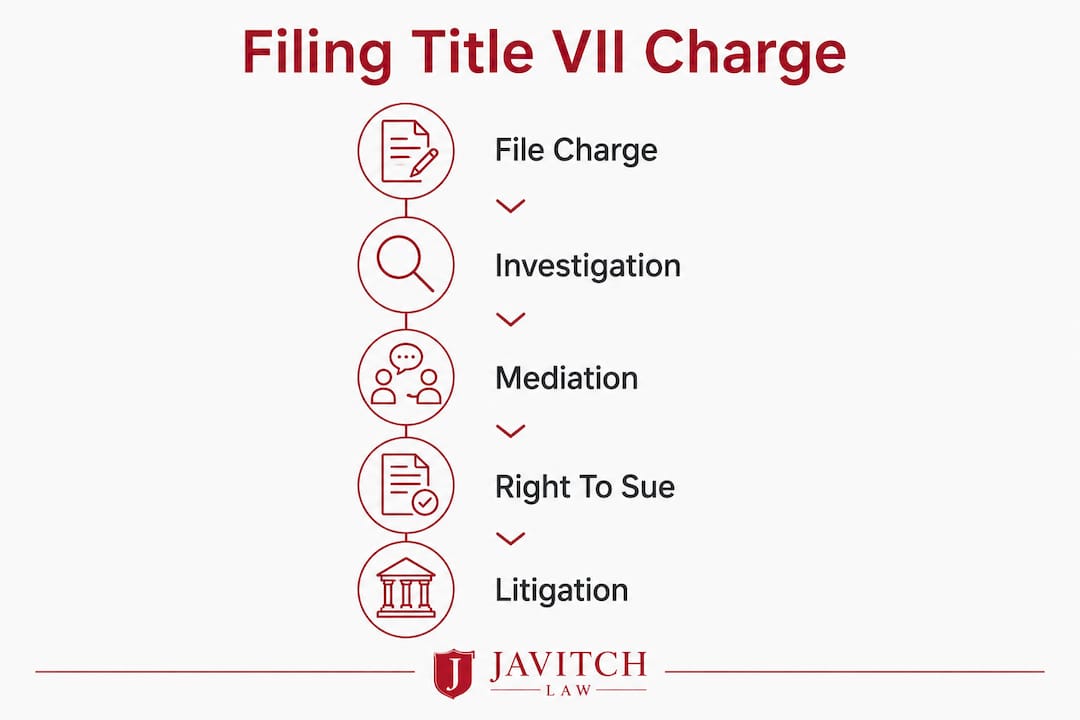
Filing a charge with the EEOC is the required first step before you can sue in federal court. The process has specific deadlines, and missing them ends your case before it begins.
Key deadlines and filing steps
- 180-day rule. You generally have 180 days to file a charge after the discriminatory act.
- 300-day extension. If your state or local agency also enforces anti-discrimination laws, the deadline extends to 300 days. California has the Department of Fair Employment and Housing (now the Civil Rights Department), so most California workers have the full 300 days.
- What to include. Your charge should describe the discriminatory acts, identify the dates, name the individuals involved, and explain the harm you suffered.
- EEOC investigation. After you file, the EEOC notifies your employer and may investigate. The agency can attempt conciliation, bringing both sides together to reach a settlement.
- Right to sue letter. If conciliation fails or the EEOC closes its investigation, it issues a “right to sue” letter. You then have 90 days to file a lawsuit in federal court.
Employer size and individual liability
Title VII applies only to employers with 15 or more employees. If your employer is smaller, you may still have options under California’s Fair Employment and Housing Act, which covers employers with five or more employees.
Federal courts hold that Title VII liability attaches to employers, not individual supervisors or coworkers. You cannot sue your harassing manager personally under Title VII. Some California state laws do allow individual liability, which is one reason consulting a California-based civil rights attorney matters.
| Step | What happens |
|---|---|
| File EEOC charge | Triggers formal investigation; employer is notified |
| EEOC investigation | Agency reviews evidence, may interview witnesses |
| Conciliation attempt | EEOC tries to broker a settlement between parties |
| Right to sue letter | Issued if no resolution; starts 90-day lawsuit window |
| Federal court filing | Lawsuit filed; discovery and litigation begin |
How have recent legal developments shaped Title VII enforcement?
Three major legal shifts have changed how Title VII protections work in practice, and all three matter if you are building a claim in 2026.
The 2020 Supreme Court ruling in Bostock v. Clayton County settled a long-running debate. The Court held that firing someone for being gay or transgender constitutes sex discrimination under Title VII. That ruling extended federal civil rights employment discrimination protections to millions of LGBTQ+ workers who previously had no clear federal remedy.
The 2023 Groff v. DeJoy decision reshaped religious accommodation law. Before Groff, employers could deny religious accommodations by showing even a minor burden. After Groff, they must demonstrate substantial increased costs. That is a meaningfully higher bar, and it strengthens claims for workers whose religious practices conflict with scheduling, dress codes, or workplace policies.
The most recent shift came from a June 2026 DOJ opinion. Plaintiffs pursuing disparate-impact claims must now identify the specific hiring practice causing unequal outcomes and propose a feasible, less discriminatory alternative. That requirement makes disparate-impact cases harder to bring but also more focused. Workers with strong statistical evidence and a clear alternative policy are better positioned than those relying on broad outcome data alone.
California’s Fair Employment and Housing Act frequently provides broader protections than federal law, covering more employers, more protected categories, and longer filing windows. Federal and state law work together, and knowing which standard applies to your situation can significantly affect your options.
What practical steps can you take if you face workplace discrimination?
Acting quickly and methodically protects your legal rights. Discrimination cases are won or lost on documentation, timing, and the quality of the evidence you gather before filing.
- Record every incident. Write down the date, time, location, what was said or done, and the names of any witnesses. Do this the same day the incident occurs, while details are fresh.
- Preserve communications. Save emails, texts, voicemails, and any written performance reviews. Forward work emails to a personal account if your employer’s policy allows it.
- Report internally. Use your employer’s complaint procedure. This creates a formal record and may be required before you can claim certain remedies. Keep a copy of your written complaint and any response.
- Know your deadlines. California workers typically have 300 days to file with the EEOC. Missing that window forecloses your federal claim entirely.
- Consult an attorney early. An attorney can assess whether your facts meet the legal standard, advise on state versus federal claims, and help you avoid procedural mistakes that sink otherwise strong cases.
Pro Tip: If you report discrimination and your employer retaliates, that retaliation is a separate legal claim. Document the change in your treatment immediately after you report, because the contrast in how you were treated before and after is powerful evidence.
Javitchlawoffice handles racial and antisemitic discrimination cases across California and has experience navigating both federal Title VII claims and California state law protections. If you are unsure whether your situation qualifies, a consultation can clarify your options without committing you to a course of action.
Key Takeaways
Title VII discrimination is most effectively challenged when workers document incidents immediately, file EEOC charges within the applicable deadline, and understand that retaliation claims often succeed independently of the underlying discrimination claim.
| Point | Details |
|---|---|
| Five protected classes | Race, color, religion, sex, and national origin are the core categories Title VII covers. |
| Retaliation is the top claim | Over 50% of EEOC charges involve retaliation, and it can succeed even if the original discrimination claim does not. |
| Filing deadlines are strict | California workers have 300 days to file with the EEOC; missing this deadline ends the federal claim. |
| Employers, not individuals, are liable | Title VII suits target employers; individual supervisors are generally not personally liable under federal law. |
| Recent rulings changed the rules | Bostock, Groff v. DeJoy, and the 2026 DOJ opinion all shifted how courts evaluate Title VII claims. |
What I have learned after years of watching these cases unfold
One pattern stands out above all others in discrimination law: workers who wait too long lose cases they should have won. The evidence fades, witnesses move on, and deadlines pass. The workers who succeed are the ones who treat documentation as a daily habit from the moment something feels wrong, not after they have already decided to file a claim.
The second pattern is the individual liability mistake. Workers often want to sue the supervisor who harassed them directly. Under Title VII, that is not how it works. The employer is the defendant. That distinction matters because it shapes your entire legal strategy, including who you negotiate with and what remedies are available. Some California state laws do allow individual claims, which is one reason local counsel matters more than people realize.
Retaliation claims are also frequently misunderstood. Workers assume they need to win the underlying discrimination claim first. They do not. Causation between protected activity and adverse action is the hinge point, and a well-documented timeline of events before and after a complaint is often enough to carry a retaliation case on its own.
The 2026 DOJ opinion on disparate impact is worth watching closely. It narrows one avenue for discrimination claims, but it does not close the door. Workers with specific, documented evidence of a biased policy and a clear alternative approach are still in a strong position. The law rewards precision, and that is exactly what good legal counsel helps you build.
— Mark
How Javitchlawoffice can help with your discrimination claim
Facing workplace discrimination is serious, and the legal process has real deadlines and procedural requirements that can determine whether your claim succeeds.
Javitchlawoffice is a California-based civil rights firm with experience in Title VII discrimination claims, including race, religion, sex, and national origin cases. The firm handles retaliation and harassment claims and understands how California state law interacts with federal protections to give workers the strongest possible case. If you believe your employer has violated your civil rights, speaking with an attorney who knows both federal and California employment discrimination laws can make a significant difference in the outcome. Contact Javitchlawoffice to discuss your situation and understand your options.
FAQ
What does Title VII discrimination cover?
Title VII prohibits employment discrimination based on race, color, religion, sex, and national origin. It covers hiring, firing, pay, promotions, job assignments, and workplace harassment.
How long do I have to file a Title VII charge?
Most workers have 180 days to file with the EEOC, extended to 300 days if a state agency also enforces anti-discrimination law. California workers generally have the full 300-day window.
Can I sue my supervisor personally under Title VII?
Federal courts hold that Title VII liability applies to employers, not individual supervisors. Some California state laws permit individual liability, so consulting a local attorney is worth doing.
What qualifies as Title VII retaliation?
Retaliation occurs when an employer punishes you for filing a charge, reporting discrimination, or participating in an investigation. Common examples include termination, demotion, and unwarranted negative performance reviews.
Does Title VII protect LGBTQ+ workers?
Yes. The Supreme Court’s 2020 Bostock v. Clayton County ruling held that sex discrimination includes discrimination based on sexual orientation and gender identity, extending federal protections to LGBTQ+ employees.
Recommended
- When to Hire a Racial Discrimination Lawyer: Protecting Your Workplace Rights | Javitch Law Office
- Jewish Discrimination in the Workplace: Know Your Rights and Legal Options | Javitch Law Office
- School Discrimination Lawyer: Protecting Your Child’s Right to Equal Education | Javitch Law Office
- Fighting Antisemitic and Racial Discrimination in the Workplace | Javitch Law Office