
Text messages are admissible in California courts. The short answer is yes, but only if you authenticate them properly and clear the hearsay hurdle. Before you do anything else, stop using the device that holds the messages, put it in airplane mode, and export the full thread right now. Courts have excluded otherwise solid evidence simply because someone kept texting on the same phone and overwrote the data.
Here is a quick checklist to confirm your evidence is worth presenting:
- Contact name and phone number visible in the thread header
- Per-message timestamps showing date and time
- Continuous thread context, not isolated screenshots
- Source files preserved on the original device or a secure backup
- A brief note logging who handled the device and when
Pro Tip: Screenshots alone are the weakest form of mobile text evidence. Capture a native export or a full-screen recording, and keep the original device intact. A screenshot with no metadata is easy to attack.
Table of Contents
- Does California law require you to authenticate text messages?
- When are text messages hearsay, and what exceptions apply?
- Screenshots vs. exports: what counts as the “original”?
- How to collect and preserve text messages for court
- How to present text messages as court exhibits
- What can you get from carriers and third-party platforms?
- Spoliation: what happens if messages are deleted?
- Common objections to text messages and how to answer them
- When do you need a lawyer or a forensic expert?
- Key Takeaways
- Why authentication is the argument that actually matters
- Javitchlawoffice can help you build a defensible evidence record
- Useful sources and authorities
Does California law require you to authenticate text messages?
Yes, and authentication is where most text-message cases are won or lost. California Evidence Code § 250 defines a “writing” broadly enough to include electronic messages, and California courts apply authentication principles consistent with Federal Rule of Evidence 901 when evaluating digital communications. The core question is simple: can you show the court that this message is what you claim it is?

Courts look for “confirming circumstances” that connect the displayed messages to a real device and a real person. A name on a contact card is not enough. Judges want corroborating evidence such as phone numbers, consistent writing style, referenced events, metadata, or a forensic device export.
Common authentication routes in California practice:
- Witness with knowledge: The sender, recipient, or someone who saw the exchange testifies that the exhibit is an accurate copy of the conversation.
- Distinctive characteristics: The messages reference facts only the claimed sender would know, use a consistent writing style, or come from a number tied to that person’s carrier account.
- Certified carrier or platform records: Business-record certificates from the carrier confirm the number, timestamps, and account holder, often without requiring live testimony.
- Forensic extraction with hash verification: A certified examiner images the device, generates hash values for each file, and produces a signed report. This is the strongest path when authenticity is contested.
The route you choose depends on the stakes. In a civil harassment restraining order, witness testimony plus overlapping screenshots usually satisfies the court. In a contested criminal matter or a high-value civil dispute, a forensic extraction with examiner testimony is the safer play. Judges in family court routinely accept authenticated PDF exports; criminal courts in California increasingly expect something more than a screenshot when the defendant disputes authorship.
Pro Tip: Cite California Evidence Code § 1552 (printed representation of computer information) and § 1553 (printed representation of images stored on a video or digital medium) when laying foundation for digital exhibits. These statutes explicitly address electronic records and give you a California-specific hook beyond federal persuasive authority.
When are text messages hearsay, and what exceptions apply?
Authentication and hearsay are separate questions. Authentication asks whether the exhibit is genuine. Hearsay asks whether the content can be offered for the truth of what it says. You can have an authenticated message that is still inadmissible hearsay, so run both analyses.
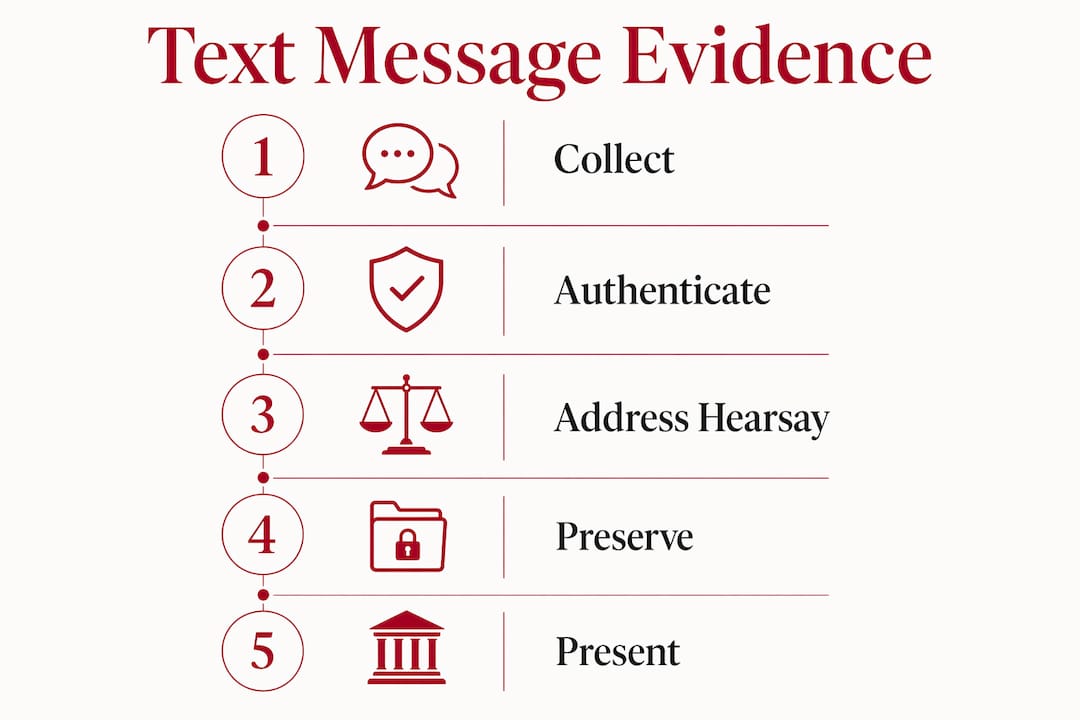
The good news: many texts are not hearsay at all, or they fall squarely within a recognized exception.
Hearsay analysis checklist:
- Is the message offered for the truth of its content, or for a different purpose (effect on the listener, notice, verbal act)?
- If offered for truth, is it a statement by a party-opponent? Under Federal Rule of Evidence 801, party admissions are excluded from the hearsay definition entirely, and California courts apply the same logic under Evidence Code § 1220.
- Does it show the sender’s state of mind at the time? Evidence Code § 1250 covers then-existing mental or emotional condition.
- Is it a present-sense impression or excited utterance? Evidence Code §§ 1240 and 1241 cover spontaneous statements.
- Does it qualify as a business record? Carrier logs and platform-generated records often meet Evidence Code § 1271.
- Is it offered only to show that the communication happened, not for its truth?
Practical examples: In a domestic-violence protective-order case, threatening texts from the respondent are party-opponent admissions and come in without a hearsay exception. In a custody dispute, a parent’s text saying “I’m too drunk to drive the kids tonight” is a state-of-mind statement admissible under § 1250. In a contract dispute, a text confirming delivery terms is an admission by a party-opponent. Carrier logs showing message volume and timing are business records, admissible under § 1271 with a proper custodian certificate.
The most common mistake is treating every text as automatically admissible once it is authenticated. Run the hearsay checklist every time, because opposing counsel will.
Screenshots vs. exports: what counts as the “original”?
California courts, following the logic of Federal Rule of Evidence 1001, treat an accurate output of electronically stored information as an “original.” That means a properly documented export, not just the physical device, can satisfy the best-evidence rule. The real fight is almost never about best evidence. It is about authentication.
Hierarchy of formats, strongest to weakest:
- Forensic device extraction: Full file-system or physical image with hash values. Captures deleted content, raw database files, and metadata. Strongest for contested cases.
- Encrypted backup parsing: iTunes or Finder backup parsed by forensic software. Captures active messages and some metadata; limited deleted-message recovery.
- Native export or paginated PDF with metadata: Sufficient for most civil matters. Timestamps and contact identifiers are preserved if the export is done correctly.
- Screenshots or screen recordings: Admitted regularly, but vulnerable to attack because they lack underlying metadata. Use overlapping sequential screenshots that show the full thread, the contact header, and per-message timestamps.
If screenshots are all you have, mitigate the risk: capture the entire thread in overlapping frames, show the phone number in the header of every frame, and preserve the screenshots with a contemporaneous note of when and how you took them.
Pro Tip: Add a cover sheet and index to any flattened PDF export. Each page should carry the exhibit number, device identifier, export date, and a one-line custody note. A judge who can trace every page back to a specific device and export event is far less likely to sustain an authentication objection.
How to collect and preserve text messages for court
The single biggest preservation mistake is waiting. Carrier SMS metadata has a short retention window, and continued device use can overwrite deleted content. Start the moment litigation is reasonably foreseeable.
Immediate steps:
- Stop using the device for new messages if possible.
- Put the device in airplane mode to prevent remote wipes or sync changes.
- Take screenshots or a screen recording of the relevant threads as a quick backup.
- Perform a native export (iMessage: use a third-party app like iMazing; Android: use the built-in backup or a forensic-grade app).
- Create an encrypted iTunes or Finder backup for iPhones.
- Log every action: who handled the device, when, and what was done.
Extraction method comparison:
| Method | What it captures | Deleted messages | Typical use |
|---|---|---|---|
| Native export / PDF | Active messages, timestamps, contact info | No | Most civil matters |
| Encrypted backup + parsing | Active messages, some metadata | Rarely | Mid-stakes civil disputes |
| Forensic extraction (logical) | Active messages, full metadata | No | Contested civil, family court |
| Forensic extraction (file-system / physical) | Full database, deleted content, raw artifacts | Yes | Criminal, high-stakes civil |
Logical backups capture active messages but rarely recover deleted items. File-system or physical extractions are needed when deleted messages matter or when you need raw database files with message IDs and metadata.
iMessage and iCloud considerations: iMessage syncs across devices sharing an Apple ID, which creates both an opportunity and a complication. Multiple devices may hold copies of the same thread, but iMessage sync also means authentication requires identifying which specific device sent each message. Preserve all devices on the account, and document the Apple ID and device list.
Evidence storage: Hash every exported file using SHA-256, save originals off-device in at least two locations, and log every access or transfer. A court-admissibility checklist that prioritizes hashing and chain-of-custody documentation will hold up far better under cross-examination than a folder of unlabeled screenshots.
Pro Tip: Send a written preservation demand to the opposing party or their counsel as soon as litigation is anticipated. This letter triggers their preservation obligation and protects you if they later delete messages. For carrier records, send a preservation request to the carrier immediately, because SMS metadata retention windows can be as short as 90 days at some providers.
How to present text messages as court exhibits
Getting texts into evidence requires more than handing the judge a printout. You need a foundation, a proper exhibit format, and either a live witness or a certified record.
Exhibit formatting checklist:
- Paginated PDF with per-message timestamps on every line
- Cover sheet identifying the device, phone number, export method, and export date
- Exhibit number on every page
- Index page listing each message by page number, date, and sender
Foundation elements for direct examination or a sworn declaration:
- Identify the declarant and their relationship to the device.
- Describe how the export was obtained (app used, date, method).
- Confirm the exhibit is an accurate and complete output of the thread.
- Establish the contact’s identity (phone number, name, prior communications).
- State the chain-of-custody facts: who handled the device, when, and what was done.
When certified carrier records are available, a Rule 902(11)-style business-record certificate can make the exhibit self-authenticating, removing the need for a live custodian. This is particularly useful when the carrier is a third party and scheduling a witness is impractical.
Sample declaration language (adapt for your case):
For courtroom presentation, use a paginated PDF with line numbers, prepare your authenticating witness to explain the export process, and be ready to produce the original device if the court or opposing counsel requests it under subpoena.
What can you get from carriers and third-party platforms?
Carrier records are useful but limited. SMS carriers typically retain metadata, including sender number, recipient number, and timestamp, but not the message content itself, and only for a short period. Subpoenaing a carrier will get you a log that confirms a message was sent at a specific time, which can corroborate a screenshot or contradict a denial, but it will not give you the text of the message.
What carriers typically provide:
- Sender and recipient phone numbers
- Date and time of each message
- Message type (SMS vs. MMS)
- In some cases, cell tower location data
What carriers cannot provide: The content of SMS messages is generally not retained after a short window. iMessage, WhatsApp, and Signal content is encrypted end-to-end and is not available from carriers at all. For these platforms, the only source of content is the devices themselves or cloud backups.
When you need carrier records, serve a preservation letter immediately and follow up with a subpoena through counsel. Carriers respond to legal process on narrow timelines, and production can take weeks. If you wait until discovery is well underway, the data may already be gone.
When content is unavailable from carriers: Rely on exports from other devices in the thread, screenshots preserved close to the event, or forensic recovery from iCloud backups and synced devices. A third party who received forwarded messages can also be a witness or a source of corroborating records.
Spoliation: what happens if messages are deleted?
A duty to preserve evidence arises the moment litigation is reasonably foreseeable, not when a lawsuit is filed. In California, courts have broad authority to sanction parties who destroy relevant evidence after that trigger point.
Consequences of spoliation:
- Evidentiary sanctions (exclusion of related evidence)
- Adverse inference instruction (the jury is told to assume the deleted messages were harmful to the spoliating party)
- Monetary sanctions and attorney’s fees
- Contempt of court in extreme cases
Steps to avoid spoliation liability:
- Disable auto-delete settings on messaging apps immediately.
- Export and back up all relevant threads.
- Send a litigation hold notice to anyone in your organization who may have relevant messages.
- Document every preservation action with a date and the name of the person who took it.
- Notify your attorney before making any changes to devices or accounts.
If the opposing party deletes messages after litigation is foreseeable, preserve whatever evidence of that deletion you can find, notify the court promptly, and consult counsel about filing a sanctions motion. Courts take spoliation seriously, and an adverse inference instruction can be more powerful than the messages themselves.
Common objections to text messages and how to answer them
Opposing counsel will object. Here are the four most common attacks and the standard responses.
Objections and rebuttals:
- Lack of foundation / authentication: Counter with witness testimony, phone number records, carrier metadata, or a forensic extraction report. Show the court the confirming circumstances that tie the message to the claimed sender.
- Hearsay: Identify the applicable exception (party-opponent admission, state of mind, business record) or argue the message is not offered for truth.
- Incomplete thread / cherry-picking: Produce the full conversation as a paginated export with an index. Overlapping sequential screenshots that cover the entire thread neutralize this objection.
- Risk of digital alteration: Present hash values for exported files, chain-of-custody documentation, and the original device for inspection. A forgery defense attorney will tell you that proving alteration requires showing the file was modified after capture, which is very difficult when hash values match.
Pro Tip: The authentication objection is the one most likely to succeed if you have not documented your collection method. Before trial, prepare a one-page summary of how the messages were collected, who handled the device, and what steps were taken to preserve integrity. Hand it to opposing counsel during meet-and-confer. It signals that you are prepared and often ends the objection before it is made.
When do you need a lawyer or a forensic expert?
Self-collection with a native export and a sworn declaration works in many civil matters. But some situations call for professional help.
Red flags that warrant professional assistance:
- The opposing party denies sending the messages or claims the thread was fabricated.
- Messages have been deleted and you need recovery.
- The case involves criminal exposure for any party.
- The dispute involves significant money, custody of children, or a civil-rights claim.
- Chain of custody will be contested at trial.
- Multiple devices share an account and sender identity is ambiguous.
A digital-forensics expert provides file-system or physical extraction, deleted-message recovery, hash-verified chain-of-custody documentation, and expert testimony explaining the methodology to the court. For criminal defense matters in California, forensic testimony on authentication is often the difference between a conviction and an acquittal.
When evaluating whether forensic costs are justified, weigh the value of the case against the centrality of the messages and the likelihood of a contested authenticity fight. A $500 forensic extraction is easy to justify in a six-figure dispute where the opposing party is already disputing authorship. In a small-claims matter where both sides agree the messages are genuine, a native export and a declaration are sufficient.
When choosing a forensic vendor, ask about certifications (EnCE, GCFE, or equivalent), the specific methodology they use, what deliverables they provide, and how they document chain of custody. Get a written engagement letter before handing over any device.
Key Takeaways
Text messages are admissible in California courts when properly authenticated, hearsay objections are addressed, and the collection method is documented from the start.
| Point | Details |
|---|---|
| Preserve immediately | Stop device use, enable airplane mode, and export threads before data is overwritten or deleted. |
| Authentication is the main fight | Courts require confirming circumstances: phone numbers, metadata, witness testimony, or forensic extraction. |
| Hearsay has common exceptions | Party-opponent admissions (Evid. Code § 1220) and state-of-mind statements (§ 1250) cover most civil and family-court texts. |
| Format your exhibits properly | Use paginated PDFs with per-message timestamps, a cover sheet, and a chain-of-custody index. |
| Javitchlawoffice | For high-stakes California cases, Javitchlawoffice provides civil-rights and consumer litigation support, including evidence preservation strategy and subpoena coordination. |
Why authentication is the argument that actually matters
Most people who come to us with text-message evidence have already made the same mistake: they saved screenshots, assumed the court would accept them, and did not think about authentication until opposing counsel objected. By then, the original device had been traded in, the carrier’s retention window had closed, and the only thing left was a folder of JPEGs with no metadata.
The conventional wisdom is that digital evidence is easy to use because everyone texts. The reality is the opposite. Digital evidence is easy to attack precisely because it is so easy to fabricate a screenshot. Courts know this. Judges in California have seen enough manipulated exhibits that they scrutinize authentication foundations carefully, especially in family court and civil harassment matters where the stakes are personal and the parties are motivated.
What actually works is treating preservation like it is part of the legal strategy, not an afterthought. The cases where text-message evidence lands cleanly are the ones where someone documented the collection process from day one, hashed the files, kept the original device, and prepared a clear declaration before the first hearing. The cases where it fails are the ones where the evidence was collected informally and the foundation was built backward from a pile of screenshots.
The other thing people underestimate is the hearsay analysis. Authentication gets all the attention, but a message that clears authentication can still be excluded if you have not identified the right exception. Running both analyses before you build your exhibit list is not optional. It is the work.
Javitchlawoffice can help you build a defensible evidence record
When text messages are central to your California civil-rights, discrimination, or consumer-protection case, the evidence strategy matters as much as the legal theory.
Javitchlawoffice handles civil-rights and consumer litigation across California, including cases where text-message proof is the core of the claim. The firm coordinates with forensic vendors, drafts preservation letters, and manages subpoenas to carriers and platforms so your evidence record is court-ready before the first hearing. For clients facing TCPA or consumer-protection claims where message records are the primary proof, early preservation and authenticated exhibits are what separate a strong case from a dismissed one. Request a case evaluation to discuss your evidence and what steps need to happen now.
Useful sources and authorities
The following primary authorities and practice resources are worth saving before you draft declarations, subpoenas, or preservation letters.
Primary authorities:
- California Evidence Code § 250 (definition of “writing,” covers electronic messages)
- California Evidence Code §§ 1220, 1240, 1241, 1250, 1271, 1552, 1553 (hearsay exceptions and electronic-record foundations)
- Federal Rule of Evidence 801 (party-opponent admissions; persuasive authority in California)
- Federal Rule of Evidence 1001 (ESI output as “original”; best-evidence framework)
Practice resources:
- Safety Net Project: Messaging Evidence (survivor-focused guide covering collection, corroboration, and carrier records)
- Mass Legal Services: Text Messages as Evidence (practical how-to on authentication and screenshots)
- Court-Admissibility Checklist for Digital Evidence (hashing, chain-of-custody, and 902-style certificate guidance)
- Burgess Forensics: Text Messages as Evidence (forensic practitioner perspective on extraction methods)
- TextPort: For Legal Evidence (export options and civil-matter standards)
Print or bookmark these before drafting any declaration or subpoena. The California Evidence Code sections are the controlling authority; the federal rules and practice guides are persuasive support that courts regularly cite.
This article is general legal information, not legal advice. Rules and retention policies change. Confirm current requirements with the California courts or a qualified attorney for your specific situation.
Recommended
- Receiving Someone Else’s Prerecorded Voice Messages? Your Legal Rights | Javitch Law Office
- Wrong Number Robocalls: Your Rights When Calls for Someone Else Won’t Stop | Javitch Law Office
- Did You Recently Switch Phone Numbers? Watch Out for These Illegal Calls | Javitch Law Office
- TCPA Violations: Your Rights Against Unwanted Robocalls and Text Messages | Javitch Law Office