
What is the TCPA statute of limitations?
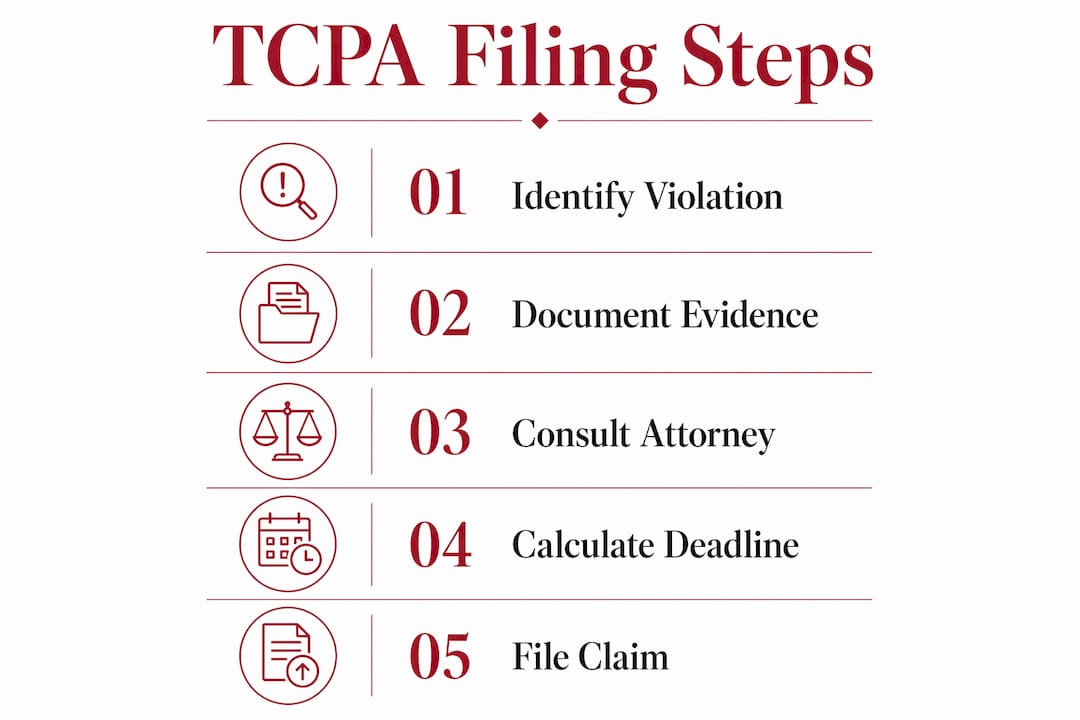
The TCPA statute of limitations is generally governed by a federal catch-all period. Under 28 U.S.C. § 1658(a), private lawsuits arising from federal statutes enacted after December 1, 1990 typically must be filed within a period specified by this statute, which has been interpreted as four years for TCPA claims. The TCPA was enacted in 1991, so the federal catch-all period applies directly to robocall and illegal telemarketing claims.
Key points to know before you file:
-
The four-year clock starts on the date of each individual violation, not when you first learned about it.
-
The TCPA itself, codified at 47 U.S.C. § 227, does not specify its own limitations period, which is why courts rely on the federal catch-all rule.
-
In many states, the federal catch-all period often applies unless a state has a specific shorter statute expressly covering the same type of claim.
-
An exception applies when a state has enacted a specific statute with a shorter limitations period addressing the same cause of action, such as statutes covering unsolicited fax transmissions; in such cases, that state statute may apply.
-
Missing the deadline almost always means losing your right to sue, regardless of how clear the violation was.
Table of Contents
- What does the TCPA actually cover?
- How California courts handle TCPA filing deadlines
- What penalties and remedies can you recover?
- How to file a TCPA claim and document violations
- Javitchlawoffice: California’s TCPA litigation team
- How to calculate your TCPA filing deadline
- What to do immediately after a TCPA violation
- How courts have interpreted TCPA filing timelines
- Key Takeaways
- Javitchlawoffice handles your TCPA claim from day one
What does the TCPA actually cover?
The Telephone Consumer Protection Act prohibits unsolicited calls and texts made with an automatic telephone dialing system (ATDS), prerecorded voice messages to cell phones without prior express written consent, and calls to numbers on the National Do Not Call Registry. The private right of action under 47 U.S.C. § 227(b)(3) lets individuals sue in either state or federal court.

One phrase in that statute has generated years of litigation: claims may be brought “if otherwise permitted by the laws or rules of court of a State.” Courts have debated whether that language lets states substitute their own, shorter limitations periods. The majority view, confirmed by multiple appellate courts, is that the phrase refers to procedural court rules and state opt-out authority, not to statutes of limitations. The federal four-year period fills the gap Congress left.
The FCC enforces the TCPA separately through forfeiture penalties, which carry their own timeframes: one year for certain violations and four years for others. Private lawsuits and FCC enforcement run on parallel tracks, and winning one does not automatically resolve the other.
How California courts handle TCPA filing deadlines
California courts generally apply the federal catch-all statute of limitations for TCPA claims because the state has not enacted a specific shorter limitations period for such claims. California courts have also recognized that the state’s own consumer protection framework, including the California Consumer Privacy Act and the Unfair Competition Law, can layer additional remedies on top of a TCPA claim without displacing the federal filing deadline.

Where California differs is in procedure. State court filings in California involve different discovery rules, class certification standards, and fee-shifting provisions than federal district court. Choosing between the U.S. District Court for the Central or Northern District of California versus a California Superior Court is a strategic decision that can affect both timeline and outcome. Javitchlawoffice handles both venues and evaluates which forum gives California clients the strongest position given the facts of each case.
Pro Tip: If you received unwanted fax advertisements rather than robocalls or texts, check whether a state-specific fax statute with a shorter period applies. In Giovanniello v. ALM Media, LLC, the Second Circuit held that Connecticut’s two-year fax-specific statute controlled over the federal four-year period because the state had expressly created that cause of action. California has not enacted a comparable fax-specific statute, but the principle is worth confirming with an attorney before you assume four years.
What penalties and remedies can you recover?
The TCPA’s damages structure is one of the most plaintiff-friendly in consumer law. Statutory damages run $500 per violation, and a court can triple that amount to $1,500 per violation if the defendant acted willfully or knowingly. You can also recover actual monetary losses if they exceed the statutory floor.
Remedies available in a TCPA lawsuit:
- $500 per call or text in statutory damages, with no need to prove actual harm.
- Up to $1,500 per violation when the caller knew the calls were unlawful or continued after being told to stop.
- Injunctive relief to stop the illegal contact going forward.
- Actual damages if your documented financial losses exceed the statutory amount.
- Class action recovery, where a single campaign reaching thousands of people can generate millions in aggregate liability.
A predictive dialer campaign contacting a large number of people without valid consent can generate substantial potential statutory damages under the TCPA, often amounting to millions of dollars depending on the number of violations. That math is why TCPA class actions are common and why defendants settle quickly when liability is clear.
How to file a TCPA claim and document violations
Filing a TCPA lawsuit starts well before you walk into a courthouse. The strength of your case depends almost entirely on the records you preserve from the moment the calls begin.
Steps to take when preparing to file:
- Log every call or text with the exact date, time, caller ID number, and what was said or sent.
- Save voicemails and screenshots of text messages without deleting them from your device.
- Note whether you ever gave consent to that company or a related entity, and document any opt-out requests you made.
- Request your call records from your carrier to corroborate your log with independent data.
- Consult an attorney early, ideally within the first year, to assess whether the technology used qualifies as an ATDS under the post-Facebook v. Duguid standard.
Thorough documentation is what separates a claim that survives a motion to dismiss from one that gets thrown out. Defendants routinely challenge both the timeliness of a filing and the authenticity of the alleged calls. A contemporaneous log with corroborating carrier records is far harder to attack than memory alone.
Javitchlawoffice: California’s TCPA litigation team
Javitchlawoffice is a California civil rights and consumer protection firm that handles TCPA claims for individuals who have received illegal robocalls, spam texts, and unsolicited telemarketing. The firm litigates in both California state courts and federal district courts, and its attorneys understand the procedural differences that affect how and where to file for maximum recovery.
The firm offers free case consultations, which means you can get a direct assessment of your claim’s viability and timing without any upfront cost. Javitchlawoffice also handles TCPA cases as class actions when a single caller has targeted many people with the same illegal campaign, which can dramatically increase the total recovery available to each class member. Their practice covers the full range of consumer protection violations, from robocalls to auto-renewal billing fraud, and they bring the same accountability-focused approach to every case.
How to calculate your TCPA filing deadline
The calculation is straightforward in most cases. Identify the date of each individual violation, then count forward four years. If a caller sent you 15 unauthorized texts over three months, each text generates its own $500 claim, and each has its own four-year window running from the date that specific text was sent. You do not need to file within four years of the first text to preserve claims on the later ones.
Where it gets complicated is tolling. The limitations clock can pause under certain conditions:
- Class action tolling: Under American Pipe & Construction Co. v. Utah, filing a class action tolls the statute of limitations for all putative class members while the class action is pending. If a class action covering your calls was filed and later dismissed, your individual clock may have been paused during that period.
- Discovery rule: In limited circumstances, courts have allowed the clock to start when the plaintiff discovered or reasonably should have discovered the violation, rather than the date it occurred.
- Fraudulent concealment: If a caller deliberately hid its identity, a court may toll the period until you could reasonably identify the defendant.
What to do immediately after a TCPA violation
Speed matters less than accuracy in the first days after an illegal call, but both matter. The worst thing you can do is delete the evidence before you document it.
Right after receiving an unwanted robocall or spam text, take these steps:
- Do not delete the call log entry or text message. Screenshot it immediately with the timestamp visible.
- Write down what happened while it is fresh: the content of any message, whether a live agent came on the line, and any company name mentioned.
- Do not call back on the number that contacted you without first noting it in your records.
- Send a written opt-out request by text reply or email if a contact address was provided, and save proof that you sent it.
- Contact a TCPA attorney to evaluate whether the technology used triggers ATDS liability under the current Facebook v. Duguid standard.
Acting quickly also helps if you want to pursue a class action. Attorneys evaluating whether to certify a class need to identify other recipients of the same campaign, and early investigation makes that process faster.
How courts have interpreted TCPA filing timelines
Judicial decisions have consistently reinforced the four-year federal period, though a few courts have carved out exceptions for specific fact patterns. The Illinois Appellate Court, in a decision applying the federal catch-all statute, held that the four-year period governed TCPA claims filed in Illinois state courts, rejecting the state’s two-year penalty statute as a substitute. The Maryland Court of Special Appeals reached the same conclusion in Worsham v. Fairfield Resorts, finding that the Supreme Court’s analysis in Jones v. R.R. Donnelley & Sons Co. compelled application of the federal period to any claim made possible by a post-1990 Act of Congress.
The outlier is Giovanniello v. ALM Media, where the Second Circuit applied Connecticut’s two-year fax statute because that state had enacted a specific cause of action for unsolicited fax transmissions with an express time limit. The court read the TCPA’s “otherwise permitted” language as giving states genuine authority to define the scope of the right they recognize, including its duration. That reasoning has not been adopted in California, and it applies only where a state has created a parallel, fax-specific cause of action with a clearly defined shorter period.
The practical takeaway: in California, plan on four years, but verify with an attorney whether any tolling event or state-specific exception applies to your particular facts.
Key Takeaways
The TCPA statute of limitations is four years from each violation date under 28 U.S.C. § 1658(a), and California courts apply that federal period with no shorter state substitute currently in force.
| Point | Details |
|---|---|
| Federal four-year rule | Under 28 U.S.C. § 1658(a), private TCPA claims must be filed within four years of each violation date. |
| California alignment | California follows the federal four-year period; no state statute currently shortens it for standard TCPA claims. |
| Per-violation damages | Each illegal call or text carries $500 in statutory damages, tripling to $1,500 for willful violations. |
| Tolling can extend the clock | Class action tolling, the discovery rule, and fraudulent concealment can all pause the four-year period in specific circumstances. |
| Javitchlawoffice | The firm offers free TCPA case evaluations and litigates in both California state and federal courts to maximize recovery. |
Javitchlawoffice handles your TCPA claim from day one
When the calls keep coming and the company ignores your opt-out requests, you need attorneys who know exactly how to build a TCPA case in California courts. Javitchlawoffice represents individuals and class members against illegal robocallers, spam texters, and telemarketers who ignore federal law. The firm’s attorneys evaluate your documentation, identify the right court, and pursue the full range of statutory damages available under the TCPA.
You pay nothing upfront for a case evaluation. Javitchlawoffice takes TCPA and consumer class action cases on contingency, meaning the firm only gets paid when you recover. If you have received illegal calls or texts within the past four years, contact Javitchlawoffice today to find out what your claim is worth before the deadline runs.
Recommended
- TCPA Lawyer | Sue for Robocalls & Illegal Telemarketing
- TCPA Violations: Your Rights Against Unwanted Robocalls and Text Messages | Javitch Law Office
- Can You Sue for Robocalls to a Reassigned Phone Number? Yes—Here’s How | Javitch Law Office
- California Public Records Act Lawyer: Enforcing Your Right to Government Transparency | Javitch Law Office