Yes, you can sue for robocalls. Under the Telephone Consumer Protection Act (TCPA, 47 U.S.C. § 227), every illegal call is a separate violation worth $500, and if the caller knew what they were doing, that jumps to $1,500 per call. Multiple calls from the same company can lead to substantial statutory damages, and you don’t need to prove you lost a single dollar. The TCPA gives you a private right of action to sue directly, without waiting for the FCC or FTC to act on your behalf.
Start right now with three things:
- Log every call. Write down the date, time, and caller ID number for each robocall you receive. A simple spreadsheet works fine.
- Save everything. Don’t delete voicemails, screenshots of call logs, or any texts. Back them up to cloud storage before you do anything else.
- Register and report. If you haven’t already, add your number to the National Do Not Call Registry at donotcall.gov. Then file complaints with the FCC and FTC to create a paper trail that can support your lawsuit later.
Javitchlawoffice handles TCPA and consumer class action cases and offers free case evaluations for people in your situation.
This article is general legal information, not legal advice for your specific situation. Consult a qualified attorney to evaluate your individual claim.
Table of Contents
- What makes a robocall illegal under the TCPA?
- Common defenses robocallers raise and how to counter them
- How to document robocalls — the evidence you must collect
- How to sue for robocalls — your options and the filing process
- How much can you recover, and how are damages calculated?
- Report robocalls to the FCC, FTC, and state agencies
- DIY vs. hiring a TCPA attorney — when does each make sense?
- A step-by-step checklist you can follow today
- Key Takeaways
- Why private TCPA enforcement matters more than most people realize
- Javitchlawoffice can evaluate your robocall claim for free
- Primary sources and further reading
What makes a robocall illegal under the TCPA?
The TCPA targets three types of calls: those made with an automatic telephone dialing system (ATDS), those using a prerecorded or artificial voice, and text messages sent by autodialer. The law covers calls to cell phones, residential landlines, and fax machines, but the cell-phone rules are the most frequently litigated because that’s where most robocalls land.
The critical trigger is consent. For telemarketing or advertising calls to a cell phone using an autodialer or prerecorded voice, prior express written consent is required. Verbal consent isn’t enough for marketing. That means a checkbox you clicked on a website, a signed paper form, or a recorded verbal agreement that specifically authorizes autodialed marketing calls. A company that got your number from a third-party list and never asked for consent has almost certainly violated the TCPA.
Two scenarios trip people up. First, reassigned numbers: if a company had consent from the prior owner of your phone number and keeps calling you, that consent doesn’t transfer. You can still have a claim. Second, wrong-number robocalls: even if the caller intended to reach someone else, the violation runs against the person who actually received the call. Javitchlawoffice has written specifically about wrong-number robocall rights if that’s your situation.
Common examples that fit squarely within TCPA coverage:
- A prerecorded pitch offering a lower mortgage rate, sent to your cell phone without your written consent
- An automated debt-collection call using a prerecorded voice to a number you never gave the creditor
- A marketing text sent by autodialer from a company you’ve never done business with
Common defenses robocallers raise and how to counter them
Knowing the defenses in advance lets you build evidence that defeats them. Here are the ones that come up most often.
Prior express consent. This is the most common defense. The company claims you gave permission somewhere, usually a fine-print checkbox on a website, a sweepstakes entry, or a lead-generation form you filled out. Pull up any forms or contracts you signed with the company. If you never gave written consent for autodialed marketing calls, that defense fails. If you did give consent but later revoked it, that matters too: under FCC rules effective April 2025, consumers can revoke consent by any reasonable means, and companies have 10 business days to comply. Calls after that window can qualify as willful violations worth $1,500 each.
Established business relationship. This defense applies to certain informational calls but does not override the written-consent requirement for telemarketing. A company you once bought something from still needs written consent to send you autodialed marketing calls.
Statutory exceptions. Emergency calls, certain healthcare calls, and calls made for non-commercial purposes (political campaigns, charities, surveys) have narrower consent requirements or outright exemptions. If the calls you received fall into one of these categories, your claim may be weaker, though not necessarily gone.
Spoofing and third-party dialers. Defendants sometimes argue they didn’t make the call because a vendor dialed on their behalf, or that the caller ID was spoofed by someone else entirely. Experienced TCPA attorneys focus on the entity “on whose behalf” the call was made, which can be the product seller or the lead buyer rather than the dialing vendor. Discovery and subpoenas are often required to trace liability to the right party.
Mistaken identity. The defendant claims the call records don’t match their systems. Carrier records and STIR/SHAKEN authentication data can rebut this, which is why preserving your own call logs and requesting trace data early matters.
How to document robocalls — the evidence you must collect
Courts don’t take your word for it. Here’s what you need to preserve, in priority order:
- Call log with timestamps. Date, time, and the number that appeared on your caller ID for every call. Your phone’s native call history is a start, but export or screenshot it regularly so it doesn’t roll off.
- Voicemails. Save every voicemail from a suspected robocaller. Back them up to a separate device or cloud storage immediately. A prerecorded message is direct proof of a prerecorded-voice violation.
- Screenshots of texts. If the robocall came as a text, screenshot the message thread, including the sender’s number and the timestamp.
- Opt-out documentation. If you replied STOP, sent a written revocation, or called to opt out, save that record. Under the FCC’s consent-revocation rules, documented opt-outs are what push a company’s continued calls into willful-violation territory.
- Do Not Call Registry confirmation. Print or save your DNC registration confirmation. Registration is a prerequisite for certain DNC-based claims.
- Any company communications. Contracts, emails, or website screenshots showing what consent (if any) you gave, or showing the company’s identity.
For tracing the caller, STIR/SHAKEN caller ID authentication and carrier trace data are increasingly useful in litigation. Your attorney can subpoena call-detail records from your carrier and request trace data through the Industry Traceback Group, which helps identify the originating provider behind spoofed numbers.
Pro Tip: Answer the call. Speaking to a live agent and asking for the company’s name, website, or mailing address is often more effective than any reverse-lookup app. Jot down exactly what the agent says. That information can be the key to identifying the defendant.

Don’t replace your phone or factory-reset it before your claim period ends. Original device data can be subpoenaed, and deleting logs, even accidentally, can hurt your case.
How to sue for robocalls — your options and the filing process
You have three realistic paths, and the right one depends on how many calls you received, whether you can identify the defendant, and how much you want to handle yourself.
Small claims court
For straightforward cases where the caller is identifiable and your total damages are modest, small claims is often the fastest and cheapest route. State caps typically range from $2,500 to $25,000, so if you have five calls at $500 each ($2,500 total), most states can accommodate that. Filing fees are low, procedures are simplified, and you don’t need an attorney. The tradeoff: discovery is limited, so if the defendant disputes identity or consent, you may not be able to compel records.
Federal or state civil court
For larger claims, willful violations, or cases where you need subpoenas to identify the defendant, a federal district court action under the TCPA is the standard path. You get full discovery, including the ability to subpoena carrier records and third-party dialers. The downside is cost and time. A federal case can take a significant amount of time to resolve, and unless you’re working with an attorney on contingency, out-of-pocket costs add up.
Class action
If the same company called thousands of people with the same illegal campaign, a robocall class action may be the right vehicle. Individual damages under the TCPA are capped per call, but class actions aggregate violations across all affected consumers and can produce settlements in the millions. Class actions require an attorney and are not a DIY option.
The basic process, step by step
- Calculate your damages. Count the calls, identify whether they were willful, and multiply.
- Send a demand letter. A clear demand listing dates, dollar math, and documentation, sent by certified mail, frequently prompts settlement before you ever file. Give the company a reasonable response deadline.
- File your complaint. In small claims, use your state’s standard form. In federal court, draft a complaint citing 47 U.S.C. § 227 and the specific subsections violated.
- Serve the defendant. Follow your court’s service rules precisely. Improper service is a common reason cases stall early.
- Use discovery. In civil or federal court, subpoena carrier records, request the defendant’s dialing records, and depose the person responsible for the calling campaign.
- Negotiate or go to trial. Most TCPA cases settle. If the defendant won’t move, a judge or jury decides.
Statute of limitations: The TCPA has a four-year limitations period applied by most courts, running from each violating call. Don’t wait. The clock starts ticking the day the call hits your phone.
How much can you recover, and how are damages calculated?
The TCPA’s damages structure is intentionally simple. You don’t need to prove financial loss. You prove the violation, and the statute sets the number.
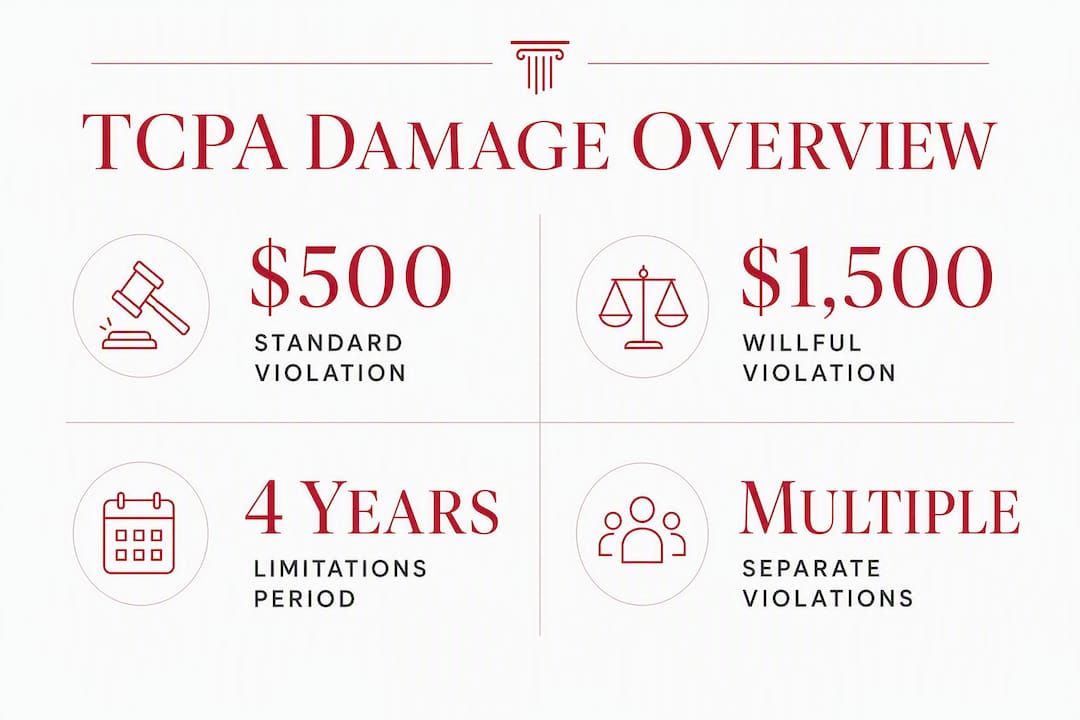
| Violation type | Statutory damages per call |
|---|---|
| Standard TCPA violation | $500 |
| Willful or knowing violation | $1,500 |
| Statute of limitations | Four years per violation |
The baseline is $500 per violation, and courts can treble that to $1,500 when the defendant acted willfully or knowingly. Violations stack. A single call can generate multiple violations if it hits a DNC-registered number, uses a prerecorded voice without consent, and ignores a prior opt-out request. Each of those is a separate count.
A concrete example: a company sends you 10 prerecorded telemarketing calls after you registered on the Do Not Call Registry and sent a written opt-out. You can argue willfulness on each call. That’s substantial potential statutory damages in total, before any negotiation.
What actually influences settlement amounts? Volume of calls matters most. So does documentation of willfulness: prior complaints to the FCC, your DNC registration date, and records of opt-out requests you sent. A company that kept calling after receiving your written revocation has a much harder time arguing it acted in good faith. Defendants also weigh litigation cost, reputational risk, and whether a class action is lurking behind your individual claim.
One thing many people don’t realize: you don’t need to show that the calls cost you money, caused you stress, or disrupted your day. Proving the violation is usually enough to collect.
Report robocalls to the FCC, FTC, and state agencies
Filing government complaints won’t put money in your pocket directly. Agencies don’t pay out individual damages. But filing with the FCC and FTC creates a public record that can strengthen a private lawsuit by showing a pattern of noncompliance, which supports a willfulness finding.
Where to report:
- FCC: File at fcc.gov/consumers/guides/filing-informal-complaint. Include the caller’s number, date, time, and a description of the call.
- FTC: File at ReportFraud.ftc.gov. The FTC feeds complaints into the Consumer Sentinel Network, which law enforcement agencies use to identify repeat offenders.
- Do Not Call Registry violations: File a specific DNC complaint at complaints.donotcall.gov. Note: your number must have been on the registry for at least 31 days before the call for a DNC violation to apply.
- State attorney general: Most states have consumer protection divisions that accept robocall complaints. California, Florida, and Texas have been particularly active in robocall enforcement.
What to include in every complaint:
- The exact date and time of each call
- The number that appeared on your caller ID
- The company name or product pitched, if you know it
- A brief description of the call content (prerecorded, live agent, text)
- Any recording snippet or screenshot you have
- Whether you were on the Do Not Call Registry at the time
Complaints filed before you sue also demonstrate that you took reasonable steps to stop the calls, which undercuts any argument that you welcomed them.
DIY vs. hiring a TCPA attorney — when does each make sense?
The honest answer: it depends on how much you can recover and how hard it is to identify the defendant.
DIY makes sense when the caller is clearly identifiable (a company name appears in the voicemail or the agent told you who they work for), your total damages fit within your state’s small-claims cap, and the consent question is straightforward. Filing a small-claims case yourself is genuinely feasible for a handful of calls from a known company. The TCPA was designed with individual private enforcement in mind.
Hire an attorney when the caller is hard to identify, you’re dealing with spoofed numbers, the calls are high-volume and potentially worth more than small-claims limits, or you want to pursue a class action. Attorneys can subpoena carrier records, depose the dialing vendor, and trace liability to the company that actually authorized the campaign. That’s not something you can do effectively on your own.
What experienced TCPA attorneys actually do: they identify the right defendant (often the product seller, not the dialing vendor), draft complaints that allege specific statutory violations, prove willfulness through prior complaints and opt-out records, and negotiate settlements. Many take high-volume TCPA cases on contingency, meaning you pay nothing unless you recover.
Javitchlawoffice handles TCPA violations and consumer class actions, including cases involving prerecorded voice messages, autodialed calls, and illegal telemarketing. To request a free case evaluation, bring your call log, saved voicemails, your DNC registration confirmation, and any FCC or FTC complaint receipts you’ve already filed. That’s the intake package that lets an attorney assess your claim quickly.
A step-by-step checklist you can follow today
If you think you have a claim, here’s the order that matters:
- Register on the Do Not Call Registry at donotcall.gov if you haven’t already. Your registration date establishes when DNC protections kicked in.
- Start a call log. Date, time, caller ID number, and a one-line description of each call. Keep it in a spreadsheet or notes app you back up regularly.
- Save voicemails and screenshots. Back up to cloud storage now, before you accidentally delete or upgrade your phone.
- Send an opt-out and document it. Reply STOP to texts, call the company’s opt-out line, or send a written revocation. Save proof of every opt-out attempt.
- Run a reverse lookup. Search the number on Google and sites like 800notes.com or the FTC’s complaint database to see if others have reported the same caller.
- File FCC and FTC complaints. Use the portals listed above. Save your confirmation numbers.
- Draft a demand letter. List the dates, the statutory math, and your documentation. Send it by certified mail with return receipt. Give the company 30 days to respond.
- Evaluate your forum. If damages fit your state’s small-claims cap and the caller is identified, file yourself. If not, consult a TCPA attorney.
Evidence preservation note: Keep your original device. Don’t factory-reset it, don’t delete call logs, and don’t discard any written communications from the robocaller during the four-year limitations period. If your case goes to discovery, original device data can be subpoenaed, and spoliation of evidence can damage your credibility in court.
Key Takeaways
Under the TCPA, every illegal robocall is a separate statutory violation subject to statutory damages, and you can sue the caller directly without waiting for a government agency to act.
| Point | Details |
|---|---|
| Statutory damages per call | Statutory damages are $500 per violation, and increase to $1,500 per call for willful or knowing violations. |
| No financial loss required | Proving the TCPA violation is enough; you don’t need to show actual monetary harm. |
| Four-year statute of limitations | The clock starts on each call, so preserve evidence and act before time runs out. |
| Evidence essentials | Call logs, saved voicemails, opt-out records, and DNC registration are the core of any claim. |
| Javitchlawoffice | Offers free case evaluations for TCPA and consumer class action claims; bring your call log and voicemails. |
Why private TCPA enforcement matters more than most people realize
The conventional wisdom is that robocalls are a nuisance problem, something to block with an app and forget. That framing undersells what the TCPA actually does. Private enforcement is the mechanism Congress built into the statute precisely because government agencies can’t pursue every individual violation. When you sue a robocaller, you’re not just recovering damages for yourself. You’re creating a record that makes the next lawsuit easier, raising the cost of illegal calling campaigns, and doing the enforcement work that the FCC and FTC simply don’t have the bandwidth to do at scale.
What most guides miss is the willfulness angle. Documenting that a company kept calling after you revoked consent, or after you filed an FCC complaint, is what separates a $500-per-call case from a $1,500-per-call case. That’s not a technicality. On 20 calls, it’s the difference between $10,000 and $30,000. The evidence work you do before you ever contact an attorney is what determines which number you’re negotiating from.
The other thing worth saying plainly: identifying the right defendant is genuinely hard. Companies structure their calling operations specifically to obscure who authorized the campaign. The dialing vendor, the lead buyer, and the product seller can all be different entities, and only one of them is the right target. That’s the part of TCPA litigation where experienced counsel earns its keep.
Javitchlawoffice can evaluate your robocall claim for free
Recovering TCPA damages is straightforward when the evidence is solid and the defendant is identified. Getting there, especially when calls are high-volume, the caller is spoofed, or a class action is the right vehicle, is where having experienced counsel changes the outcome.
Javitchlawoffice is a California-based civil rights and consumer protection firm with a nationwide practice. The firm handles TCPA violations and robocall claims, including individual suits, prerecorded-voice cases, and consumer class actions against companies running large-scale illegal calling campaigns. If your situation involves a pattern of calls, a company that ignored your opt-out, or a caller you can’t identify on your own, a case evaluation can clarify whether you have a viable claim and what it might be worth.
To request a free evaluation, bring your call log, saved voicemails, your Do Not Call Registry confirmation, and any FCC or FTC complaint receipts. The more documentation you have at intake, the faster an attorney can assess the strength of your claim and advise on the right forum.
Primary sources and further reading
- 47 U.S.C. § 227 (TCPA) — The statute itself. Read the subsections on autodialed calls, prerecorded voices, and the private right of action to understand exactly what conduct is prohibited.
- National Do Not Call Registry — Register your number and verify your registration status. Required before you can bring a DNC-based claim.
- DNC complaint portal — File a specific Do Not Call Registry violation complaint here.
- FCC consumer complaint portal — File robocall and TCPA complaints with the Federal Communications Commission.
- FTC ReportFraud portal — Report robocalls and telemarketing violations to the Federal Trade Commission; complaints feed into the Consumer Sentinel Network used by law enforcement.
- Nolo — TCPA Laws: Stop Robocalls & Telemarketing Calls — Accessible plain-language explanation of TCPA consent standards, damages, and how the law applies to cell phones.
- Lakelaw — Fight Back Against Robocallers: A Lawyer’s Guide to Suing Under the TCPA — Practitioner-level breakdown of TCPA litigation strategy, consent revocation rules, and STIR/SHAKEN tracing.
- LegalClarity — Can You Sue Robocallers? Your Rights Under the TCPA — Covers the four-year statute of limitations, demand letter strategy, small-claims options, and identification tactics.
Recommended
- Can You Sue for Robocalls to a Reassigned Phone Number? Yes—Here’s How | Javitch Law Office
- Wrong Number Robocalls: Your Rights When Calls for Someone Else Won’t Stop | Javitch Law Office
- TCPA Violations: Your Rights Against Unwanted Robocalls and Text Messages | Javitch Law Office
- Receiving Someone Else’s Prerecorded Voice Messages? Your Legal Rights | Javitch Law Office