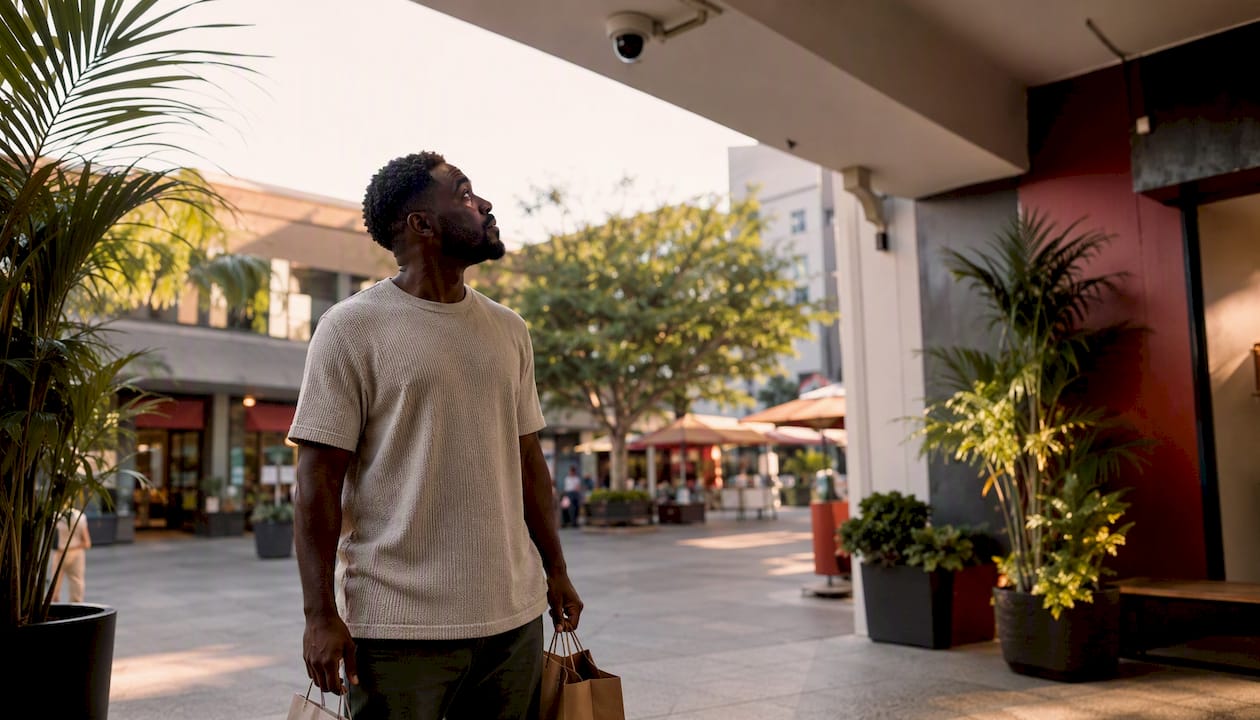
“Shopping while black” is the lived experience of being racially profiled as a criminal suspect in a retail setting simply because of your race. Scholars Shaun Gabbidon and George Higgins, who literally wrote the book on the subject, call it consumer racial profiling. The ACLU frames it as a civil-rights harm that extends well beyond any single incident. Gallup polling has tracked it for more than two decades, consistently finding that shopping ranks among the settings where Black Americans most often report unfair treatment.
If it happens to you right now, here is what to do:
- Stay calm and prioritize your safety. De-escalate, and leave the store if you feel threatened.
- Document everything immediately. Note the time, store name and address, employee names or descriptions, and what was said or done.
- Keep your receipt. Hold onto any proof of purchase and ask for a printed receipt if one was not offered.
- Get witness information. If other shoppers saw the incident, ask for their names and contact details.
- File a complaint. Options include store management, corporate customer service, your state’s civil-rights agency, or the ACLU.
- Consult an attorney. A civil-rights lawyer can assess whether you have a claim under public-accommodation law or state anti-discrimination statutes.
Key Takeaways
Retail racial profiling is a documented, persistent civil-rights harm with legal remedies available under U.S. public-accommodation law and state civil-rights statutes.
| Point | Details |
|---|---|
| Profiling is widespread | Gallup’s 2018 data found nearly two-thirds of Black Americans reported less-fair treatment while shopping compared with white Americans. |
| Document everything immediately | Record time, location, employee descriptions, witness contacts, and request security footage in writing within hours. |
| Keep your receipt | Receipts are your first line of defense; an audit study found Black shoppers are denied returns more often even when receipts are presented. |
| Legal options exist | Section 1981, state public-accommodation laws, and disparate-impact doctrine all apply to retail discrimination in the U.S. |
| Javitchlawoffice can help | The firm handles racial discrimination and consumer class action cases nationwide, with contingency arrangements available. |
Table of Contents
- What does shopping while black actually look like?
- Where the phrase comes from and how scholars frame it
- High-profile incidents and the data behind them
- Why does profiling happen in stores?
- The real costs of being profiled while shopping
- What to do if you are profiled in a store
- Legal options and when to contact an attorney
- How retailers, regulators, and advocates have responded
- Why retail profiling deserves the same legal urgency as workplace discrimination
- Javitchlawoffice can help if you have been profiled while shopping
- Sources
What does shopping while black actually look like?
Consumer racial profiling in stores takes many forms, and not all of them are as obvious as being stopped at the door. The most common experiences Black shoppers report include:
- Being followed through aisles by staff or loss-prevention personnel
- Asked for extra identification that white shoppers nearby are not asked to provide
- Denied returns or refunds under policies that are selectively enforced by race
- Placed under heightened surveillance, including having staff hover nearby or watch from a distance
- Ignored or refused service while white customers receive prompt attention
- Locked display cases opened reluctantly or not at all
The disparities show up across store types. A Black shopper in a luxury boutique may be trailed by staff who assume they cannot afford the merchandise. At a big-box retailer, the same shopper may find that a locked display case stays locked longer than it would for a white customer standing next to them. At a grocery store, a return may be questioned in ways that a white shopper’s identical return is not.
What separates profiling from an ordinary security check is the trigger: race, not behavior. A security protocol applied consistently to everyone is a policy. One applied to Black shoppers while white shoppers in the same circumstances are waved through is discrimination. A qualitative study with 55 Black respondents found that 80% reported at least one shopping-related microaggression, and 59% had been labeled as shoplifters at some point. Those numbers reflect a pattern, not a series of isolated misunderstandings.
Where the phrase comes from and how scholars frame it
The phrase “shopping while black” is a direct descendant of “driving while black,” the sardonic shorthand for racial profiling by police during traffic stops. Both phrases follow the same grammatical logic: an activity that is entirely ordinary becomes a source of suspicion when the person doing it is Black. The construction entered mainstream usage in the 1990s as civil-rights advocates and journalists began documenting retail profiling alongside police profiling.
Academically, the preferred term is consumer racial profiling, and the scholars who have done the most to define and study it are criminologist Shaun Gabbidon and George Higgins. Their book, Shopping While Black: Consumer Racial Profiling in America, synthesizes decades of research and case documentation, arguing that the harms range from immediate emotional trauma to long-term social and financial costs. They also note a significant gap in the research infrastructure: there is no national database of retail discrimination incidents, which makes the problem harder to quantify and easier for retailers to minimize.
The sociological framing matters for legal purposes. When scholars document that profiling is a pattern rather than a series of individual employee mistakes, it supports arguments about systemic discriminatory intent and disparate impact, both of which are relevant to civil-rights claims under U.S. law.
High-profile incidents and the data behind them
The public record on retail racial profiling is long. A few incidents that drew national attention and prompted corporate responses:
- Barneys New York / Macy’s (2013–2014): Multiple Black shoppers, including recording artist Jay-Z’s collaborator Trayon Christian and others, reported being detained by police after making purchases at Barneys and Macy’s flagship stores. New York Attorney General Eric Schneiderman launched investigations into both retailers, resulting in settlement agreements that included anti-profiling training and independent monitoring.
- Sephora (2019): Singer SZA publicly described being followed by a Sephora employee who called security on her at a Sephora store in Calabasas, California. Sephora responded by closing all U.S. stores for a day of diversity and inclusion training, a move that drew both praise for its speed and criticism for its symbolic rather than structural nature.
- Nordstrom Rack (2018): Three Black teenagers in St. Louis were accused of shoplifting by staff and police while shopping for prom attire. They had not stolen anything. Nordstrom Rack issued a public apology.
These incidents are not outliers. Gallup’s 2018 data showed that nearly two-thirds of Black Americans reported receiving less-fair treatment while shopping compared with white Americans in downtown or mall settings. Gallup has tracked this pattern for more than two decades, and shopping consistently ranks as one of the settings where Black Americans most frequently report discrimination.
The ACLU has documented that these incidents cause harms extending well beyond the immediate encounter, affecting mental health, economic participation, and community trust in institutions. An audit study published in the Northwestern University Law Review found that Black testers were denied returns and refunds more often than white testers at stores that officially required receipts, with the disparity actually growing when testers asked to speak to a manager.
Why does profiling happen in stores?
Three overlapping forces drive retail racial profiling: individual bias, institutional policy, and technology.
Implicit bias is the most studied driver. Staff and loss-prevention personnel make split-second judgments about who looks like a shoplifter, and research consistently shows those judgments are shaped by racial stereotypes that link Black people with criminality. The bias is often unconscious, which is part of why diversity training alone rarely eliminates it.
Discretionary policy enforcement turns individual bias into institutional harm. A return policy that says “receipt required” sounds neutral on paper. But when staff apply it strictly to Black shoppers and waive it for white shoppers, the policy becomes a vehicle for discrimination. The Northwestern University Law Review audit study documented exactly this pattern: matched testers attempting identical returns faced different outcomes based on race, with the gap widening at the management level. Courts sometimes treat this kind of inconsistent discretionary enforcement as evidence of discriminatory intent or disparate impact under state civil-rights laws.
Surveillance technology can amplify existing bias. Investigative reporting by Reuters documented how some retailers have deployed facial recognition and loss-prevention software in ways that disproportionately flag people of color. When a system trained on biased data generates alerts, staff act on those alerts, and the technology provides a veneer of objectivity to what is still a racially skewed outcome.
Additional structural factors include:
- Locked display cases concentrated in stores serving predominantly Black neighborhoods
- Suspicious-customer protocols that give individual employees broad discretion
- Loss-prevention incentive structures that reward stops and detentions, creating pressure to act on stereotypes
Pro Tip: If you are being followed or watched in a store, calmly and clearly stating “I am shopping and I have my receipt” can reduce escalation without admitting wrongdoing. Keep your hands visible and avoid sudden movements. Your safety comes before any evidence you might collect.
The real costs of being profiled while shopping
The harm from a single profiling incident is real and immediate: the humiliation of being treated as a suspect in public, the anxiety of not knowing whether a confrontation will escalate, and the practical cost of a denied return or a purchase abandoned under duress. But the ACLU’s analysis is right that the harms go deeper than any one encounter.
Psychologically, repeated profiling produces what researchers describe as racial battle fatigue: a chronic stress response from navigating environments where you are presumed guilty. Shoppers who have been profiled often report avoiding certain stores, neighborhoods, or types of retail entirely, which restricts their access to goods, services, and economic participation.
Financially, the costs include denied refunds, time spent filing complaints, and in some cases legal fees. Some Black shoppers have adopted coping strategies like keeping receipts visible or stapling them to bags to preempt suspicion. These tactics can reduce confrontations, but they also place the burden of proof on the shopper rather than on the retailer to behave lawfully.
The community-level impact is harder to quantify but no less real. When Black consumers avoid certain stores or neighborhoods because of profiling, local economic participation shifts, and the social fabric of retail spaces becomes racially stratified in ways that reinforce broader inequalities.
What to do if you are profiled in a store
Your first priority is your physical safety, not evidence collection. Once you are safe, a clear record of what happened becomes your most important asset.
In the moment:
- Stay calm. Avoid arguing, raising your voice, or making physical contact with staff.
- State clearly that you are a customer and that you have your receipt.
- If you feel unsafe, leave the store. You are not required to stay.
- Do not consent to a bag search unless law enforcement with a warrant is present.
- If police are called, remain calm, do not resist, and ask whether you are being detained or are free to go.
Immediately after:
- Write down the time, date, store name, and full address.
- Describe every employee involved: name tag, physical description, job title if visible.
- Note exactly what was said and done, in sequence.
- List any witnesses and collect their contact information if possible.
- Keep your receipt and any other proof of purchase.
- Take photos of the store exterior and interior if you can do so safely.
- Request security footage in writing as soon as possible, before it is overwritten.
Where to file a complaint:
- Store management and corporate customer service (create a paper trail)
- Your state’s civil-rights agency or human-rights commission
- The U.S. Department of Justice Civil Rights Division
- The ACLU, which accepts reports and sometimes takes cases
- A civil-rights attorney for a legal assessment
Pro Tip: Some Black shoppers carry a small notepad or use their phone’s voice memo app to record details immediately after leaving a store. A timestamped note made within minutes of an incident is far more credible than a recollection made days later.
Legal options and when to contact an attorney
U.S. law offers several potential avenues for Black shoppers who have been discriminated against, though the strength of any claim depends heavily on documentation and jurisdiction.
Possible legal theories:
- Public-accommodation laws: Most states have statutes prohibiting discrimination in places of public accommodation, which include retail stores. These laws vary by state in scope and remedies.
- Section 1981 of the Civil Rights Act of 1866: Prohibits racial discrimination in the making and enforcement of contracts, which courts have applied to retail transactions.
- State consumer-protection statutes: Some states allow claims based on discriminatory business practices.
- Disparate-impact claims: Where a neutral policy is applied in a racially disparate way, as documented in the Northwestern University Law Review return-refusal study, a disparate-impact theory may apply.
Evidence that strengthens a claim:
| Evidence Type | What to Preserve | Why It Matters |
|---|---|---|
| Receipt / proof of purchase | Original receipt, digital confirmation | Refutes theft allegation; documents the transaction |
| Written incident account | Timestamped notes, voice memos | Establishes timeline and specific conduct |
| Witness statements | Names, contact info, written accounts | Corroborates your version of events |
| Security footage | Written request to preserve, sent promptly | Footage is often overwritten within 30–72 hours |
| Employee identification | Name tag, description, badge number | Identifies the individual responsible |
| Comparator evidence | Notes on how white shoppers were treated | Supports disparate-treatment argument |
| Prior complaints | Any previous reports to the same retailer | Shows pattern, not isolated incident |
When to contact an attorney:
- You were detained, physically restrained, or had police called on you.
- You suffered a financial loss (denied refund, damaged goods, lost wages from detention).
- You have evidence of a pattern (prior incidents at the same store or chain).
- You want to understand your rights before filing a complaint.
- A retailer has refused to respond to your complaint.
A racial discrimination attorney can evaluate your documentation, identify the strongest legal theory for your jurisdiction, and advise whether your case is better suited to an individual claim or a class action. Many civil-rights attorneys work on a contingency basis for discrimination cases, meaning you pay no fee unless you recover.
This article provides general legal information, not legal advice. Laws vary by state and individual circumstances differ. Consult a qualified attorney to evaluate your specific situation.
How retailers, regulators, and advocates have responded
Corporate responses to high-profile profiling incidents have followed a familiar pattern: a public apology, a round of diversity training, and sometimes a policy announcement. Sephora’s 2019 store closure for inclusion training was widely covered. Barneys and Macy’s entered settlement agreements with the New York Attorney General that included independent monitoring. These responses matter, but scholars and advocates note their limits.
Voluntary training programs have mixed evidence behind them. One-day implicit-bias workshops rarely produce lasting behavioral change without structural reinforcement. The more durable reforms tend to involve:
- Eliminating or auditing discretionary enforcement of return and receipt policies
- Removing loss-prevention incentive structures that reward stops regardless of outcome
- Auditing surveillance technology for racial disparities before deployment
- Creating accessible, anonymous complaint channels for shoppers
- Publishing data on security stops and detentions by race
The ACLU and allied advocacy groups push for regulatory enforcement rather than relying on corporate goodwill. At the federal level, the Department of Justice Civil Rights Division can investigate patterns of retail discrimination. At the state level, attorneys general in New York, California, and other states have used consumer-protection and civil-rights authority to pursue retailers.
Consumers and advocates can accelerate change by filing formal complaints rather than accepting informal apologies, supporting legislation that requires retailers to report security-stop data by race, and using social media to document and publicize incidents in ways that create reputational pressure.
Why retail profiling deserves the same legal urgency as workplace discrimination
The conventional framing treats retail profiling as less serious than employment or housing discrimination, because the harm seems more episodic. Walk out of a store, and the incident is over. That framing is wrong, and the evidence in this article shows why.
A single profiling incident is not just an embarrassing moment. It is a denial of equal access to a public accommodation, backed by the implicit threat of police involvement. The Northwestern audit study showed that the disparity in how Black shoppers are treated actually increases when they escalate to management, which means the system is not self-correcting. The Gallup data shows the problem has persisted for more than two decades without meaningful reduction.
The legal tools exist. Section 1981, state public-accommodation statutes, and disparate-impact doctrine under state civil-rights law all apply to retail settings. What has been missing is consistent enforcement and a critical mass of documented, litigated cases that create real deterrence for retailers.
Every shopper who documents an incident, files a formal complaint, and consults an attorney is contributing to that critical mass. The firms and regulators who take these cases seriously are the ones building the record that eventually changes corporate behavior, not because retailers develop a conscience, but because the legal and financial risk of profiling becomes higher than the perceived benefit.
Javitchlawoffice can help if you have been profiled while shopping
Retail racial profiling is a civil-rights violation, and you deserve representation from attorneys who treat it that way. Javitchlawoffice is a nationwide civil-rights firm with deep experience in racial discrimination cases, including discrimination in public accommodations like retail stores. The firm handles cases involving denied service, wrongful detention, and discriminatory enforcement of store policies, and works with clients to build the documented record that gives a claim its best chance.
Unlike a general-practice attorney who handles discrimination as a side matter, Javitchlawoffice focuses on civil-rights and consumer-protection litigation, including consumer class actions where a retailer’s discriminatory practices affect a broader group of shoppers. Many cases are handled on a contingency basis, so cost is not a barrier to getting a professional evaluation. Bring your incident notes, your receipt, any witness information, and any written correspondence with the retailer. Contact Javitchlawoffice through the firm’s website at Javitchlawoffice to request a consultation and find out whether your experience supports a legal claim.
Sources
- Racial Discrimination in Retailers’ Willingness to Accept Returns: A Field Study - Northwestern University Law Review
- Shopping While Black: Consumer Racial Profiling in America - Routledge
- Shopping While Black: Harms Go Deeper Than You Think - ACLU
- As Black buying power grows, racial profiling by retailers remains a problem - CNBC
- “Shopping while Black”: Black consumers’ management of racial stigma and racial profiling in retail settings - SAGE Journals
- The Role of Receipts In Shopping While Black - Green America
This article is general information, not a substitute for advice from a qualified lawyer. Consult a qualified legal professional about your own circumstances before acting on anything here.