
If a police officer used excessive force against you, a jail official denied you medical care, or a government employee retaliated against you for speaking out, you may have grounds for a federal civil rights lawsuit under 42 U.S.C. § 1983. This statute gives private citizens a direct path to federal court to hold state and local officials accountable for constitutional violations. Section 1983 claims do not require you to exhaust state administrative remedies first, which makes them one of the most powerful tools available to individuals whose rights have been violated by government actors.
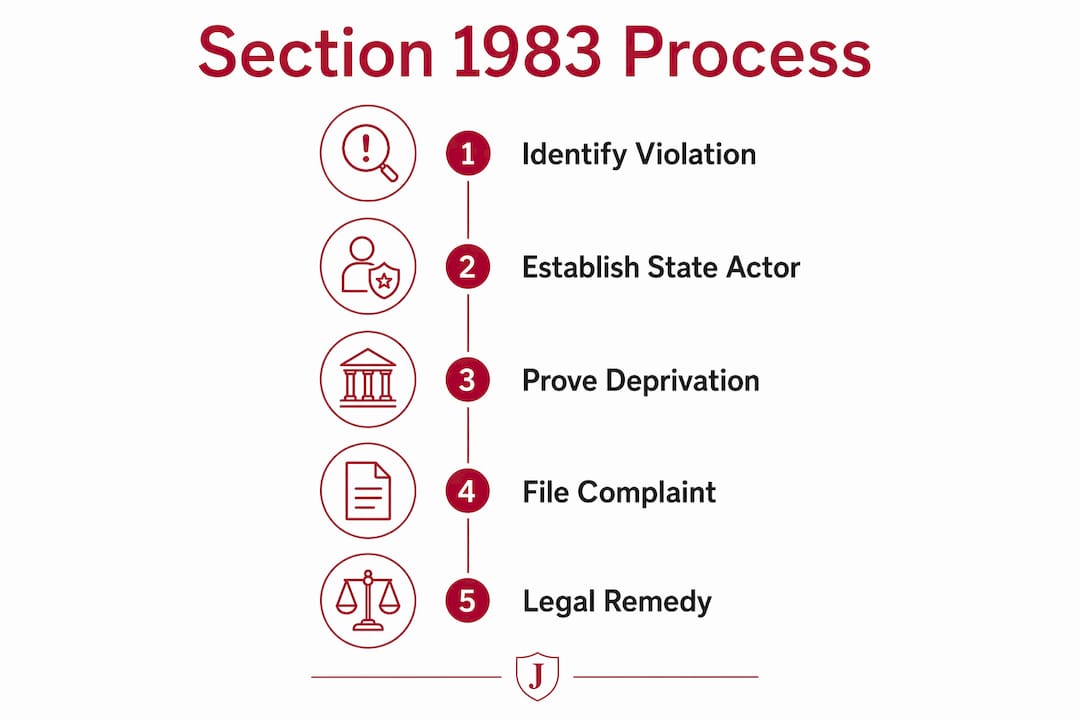
A valid claim requires two things: the defendant acted under color of state or local law, and that conduct deprived you of a right protected by the U.S. Constitution or federal statute. Here is what that means in practice:
- Color of state law: The defendant used authority granted by the government, even if they abused or misused it.
- Deprivation of a federal right: The violation must be constitutional or statutory, not just a state law wrong.
- A “person” as defendant: States themselves are immune under the Eleventh Amendment; valid defendants are individual officials, local governments, and municipalities.
- Causation: The defendant’s conduct must have directly caused your injury.
Table of Contents
- What you must prove to win a Section 1983 claim
- Common types of Section 1983 claims you can bring
- How the statute of limitations affects your Section 1983 case
- What damages and relief you can recover in a Section 1983 lawsuit
- Navigating qualified immunity and other legal hurdles
- How to pursue your claim and find the right legal representation
- Javitchlawoffice is ready to fight for your constitutional rights
- Key Takeaways
What you must prove to win a Section 1983 claim
A successful Section 1983 claim requires proving two essential elements: the defendant acted under color of state or local law, and that action caused a deprivation of your constitutional or federal statutory rights. Courts frame it simply: “(1) a person deprived him of a federal right; and (2) the person who deprived him of that right acted under color of state or territorial law” (Gomez v. Toledo, 446 U.S. 635, 1980).
Beyond those two core elements, here is what plaintiffs must establish:
- Color of law: The defendant was using or misusing state-granted authority, even if the specific act violated state law.
- Actionable conduct by a “person”: States are not persons under § 1983; individual officials and local governments are.
- Proximate causation: The constitutional violation must have directly caused your damages, not merely preceded them.
- Municipal liability (Monell claims): Suing a city or county requires showing the violation resulted from an official policy or custom, not just a rogue employee’s act. Vicarious liability alone is insufficient.
- Pleading sufficiency: Under Ashcroft v. Iqbal and Bell Atlantic Corp. v. Twombly, your complaint must allege specific, plausible facts, not conclusory statements.
Common types of Section 1983 claims you can bring
Common Section 1983 claims involve police misconduct, jail abuse, denial of free speech, and due process violations. In California, these claims arise regularly across all major urban counties. The most frequently litigated categories include:
- Excessive force: Officers using force beyond what the situation reasonably required, including shootings, chokeholds, and taser deployments that exceed reasonable force.
- False arrest and unlawful detention: Arrests without probable cause or detentions that violate the Fourth Amendment.
- Cruel and unusual punishment: Jail or prison officials denying adequate medical care, subjecting inmates to dangerous conditions, or using excessive force on incarcerated people.
- First Amendment retaliation: Government officials punishing individuals for protected speech, protest activity, or First Amendment retaliation claims.
- Due process violations: Deprivation of liberty or property without fair procedures, including wrongful termination of public employment or denial of benefits.
- Equal protection violations: Discrimination based on race, religion, national origin, or other protected characteristics by government actors.
- Antisemitic and racial discrimination: Targeted harassment or unequal treatment by law enforcement or public institutions based on identity.
California’s large public sector and active law enforcement agencies make these claims quite common in major urban areas, particularly in cities like Los Angeles, San Francisco, and Oakland.
How the statute of limitations affects your Section 1983 case

Timing can kill an otherwise strong case. The statute of limitations for Section 1983 claims generally aligns with the state’s personal injury period applicable in California. Miss that window and your claim is almost certainly gone, regardless of how clear the constitutional violation was.
Key timing rules to know:
- Accrual date: The clock typically starts when you knew or should have known about the injury and its cause, not necessarily the date of the incident itself.
- Two-year deadline in California: You have two years from the date of accrual to file in federal court.
- Tolling exceptions: The limitations period may be paused for minors, individuals with mental disabilities, or in cases where the defendant fraudulently concealed the violation.
- Government claims act: For claims against California public entities, you may also need to file a government tort claim within six months of the incident before filing suit, though federal § 1983 claims do not require exhaustion of state remedies.
- Act quickly: Evidence disappears, witnesses move on, and official records get harder to obtain. Consulting a civil rights attorney within weeks of an incident, not months, is the practical standard.
What damages and relief you can recover in a Section 1983 lawsuit
Compensatory, nominal, punitive damages, and injunctive relief are recoverable in Section 1983 cases depending on the circumstances. Damages aim to compensate for injuries caused by constitutional deprivation and can include medical bills, lost wages, and emotional distress.
Here is the full picture of what you can seek:
- Compensatory damages: Economic losses (medical expenses, lost income, property damage) and non-economic losses (pain and suffering, emotional distress, loss of enjoyment of life).
- Nominal damages: When a constitutional violation is proven but no actual injury is demonstrated, courts may award $1 in nominal damages. This matters because punitive damages can still follow.
- Punitive damages: Available when an official acted with malice or callous disregard for your federally protected rights. These are meant to punish and deter, not just compensate.
- Injunctive relief: A court order requiring the government to stop an unconstitutional practice or implement a policy change. This is often the goal in systemic cases.
- Declaratory relief: A court declaration that the defendant’s conduct violated the Constitution, useful for establishing rights without necessarily seeking money.
- Attorneys’ fees: Under 42 U.S.C. § 1988, prevailing plaintiffs can recover reasonable attorneys’ fees from the defendant, which makes civil rights litigation financially viable even for plaintiffs with limited resources.
For context on how settlements in civil rights class actions typically shake out, class action settlement ranges vary widely based on the number of plaintiffs, the severity of the violation, and the defendant’s resources.
Navigating qualified immunity and other legal hurdles
Qualified immunity is the single biggest obstacle most plaintiffs face. It protects officials from liability unless they violated clearly established rights that a reasonable person would have known about at the time. Courts often dismiss cases at the pleading stage when plaintiffs cannot point to a prior case with nearly identical facts.
Other significant challenges include:
- Pleading standards: Twombly and Iqbal require factually specific complaints. Vague allegations that an officer “violated your rights” will not survive a motion to dismiss.
- Municipal liability proof: Establishing that a city’s policy or custom caused the violation, rather than an individual officer’s isolated decision, requires evidence of patterns, prior incidents, or deliberate indifference in training.
- Eleventh Amendment immunity: States themselves cannot be sued under § 1983. Claims must target individual officials or local governmental units.
- Absolute immunity: Judges, prosecutors acting within their prosecutorial role, and state legislators acting in their legislative capacity have complete immunity from § 1983 damages claims.
Pro Tip: To overcome qualified immunity, your attorney should research prior Ninth Circuit or Supreme Court decisions involving nearly identical conduct. The more specific the factual parallel, the stronger the argument that the right was “clearly established.” California federal courts, particularly the Ninth Circuit, have a substantial body of civil rights precedent that can support this analysis.
How to pursue your claim and find the right legal representation
Getting the right attorney is not optional in § 1983 litigation. These cases are technically demanding, procedurally complex, and heavily defended by government lawyers. Experienced civil rights firms handle constitutional litigation including employment discrimination, police misconduct, and whistleblower claims. In California, firms like Haddad & Sherwin LLP and The Chandra Law Firm have established records in this area. Javitchlawoffice also offers free case consultations to evaluate Section 1983 and related civil rights claims.
Practical steps to take:
- Document everything immediately: Photographs, medical records, witness names, body camera footage requests, and a written timeline of events.
- Request public records: Police reports, use-of-force records, and disciplinary histories are often obtainable through FOIA requests or California Public Records Act requests.
- Consult a civil rights attorney: Look for someone with federal court experience and a track record in constitutional litigation, not just general personal injury work.
- File in federal court: Most § 1983 claims belong in U.S. District Court. In California, that means the Central, Northern, Eastern, or Southern District depending on where the violation occurred.
- Consider venue carefully: Where you file affects which judges and precedents apply. An attorney familiar with local federal courts can advise on the strategic implications.
Pro Tip: Ask any prospective attorney how many § 1983 cases they have taken past the motion to dismiss stage. Settling early is common, but an attorney who has never litigated through discovery or trial may not be equipped to handle a case where the government refuses to settle.
Javitchlawoffice is ready to fight for your constitutional rights
When your constitutional rights have been violated by a government official, you need more than general legal advice. Javitchlawoffice is a California-based civil rights firm that handles exactly these cases: police misconduct, racial and antisemitic discrimination, First Amendment retaliation, and government transparency failures. The firm combines local California knowledge with the kind of federal litigation experience these cases demand.
Unlike firms that treat civil rights cases as a sideline, Javitchlawoffice focuses on holding powerful institutions accountable, whether that means a single officer, a city department, or a public university. The firm offers free initial consultations, so you can get a direct assessment of your situation without financial risk. If you believe a government actor violated your constitutional rights, contact Javitchlawoffice today to discuss your options.
Key Takeaways
A Section 1983 claim succeeds when you prove a government actor, operating under color of state law, deprived you of a constitutionally protected right and caused you actual harm.
| Point | Details |
|---|---|
| Two required elements | Defendant acted under color of state law AND deprived you of a federal constitutional or statutory right. |
| California filing deadline | Two years from the date you knew or should have known about the injury; act sooner to preserve evidence. |
| Recoverable damages | Compensatory, nominal, and punitive damages, plus injunctive relief and attorneys’ fees under 42 U.S.C. § 1988. |
| Qualified immunity hurdle | Officials are shielded unless they violated a clearly established right; prior case law with similar facts is critical to overcoming this defense. |
| Javitchlawoffice | Offers free consultations for Section 1983 and civil rights claims, with focused experience in discrimination, First Amendment, and police misconduct cases in California. |
Recommended
- Javitch Law Office | Civil Rights & Consumer Protection Attorneys
- How to Sue for Public Records: A Guide to FOIA and State Records Litigation | Javitch Law Office
- California Public Records Act Lawyer: Enforcing Your Right to Government Transparency | Javitch Law Office
- FOIA Requests: Accessing Government Records in California and Federal Agencies | Javitch Law Office