
Religious discrimination at work occurs when an employer treats an employee or job applicant unfairly because of their religious beliefs, practices, or observances. Federal law under Title VII of the Civil Rights Act prohibits this conduct for any employer with 15 or more employees. California’s Fair Employment and Housing Act, enforced by the California Civil Rights Department, extends those protections further, covering employers with five or more workers. Both laws require reasonable accommodation for sincerely held religious beliefs unless doing so causes substantial undue hardship. The 2023 Supreme Court decision in Groff v. DeJoy raised that hardship threshold significantly, giving California employees stronger grounds to demand accommodation.
What does religious discrimination at work look like?
Religious discrimination takes many forms, and most employees do not recognize it until the pattern is clear. The California Civil Rights Department has secured over 80 settlements since 2020 protecting workers from conduct ranging from scheduling retaliation to outright mockery. That volume signals how common these violations are, even in workplaces with written anti-discrimination policies.

Disparate treatment is the most direct form. An employer who passes over a Sikh applicant wearing a turban, demotes a Muslim employee after she starts wearing a hijab, or fires a Jewish worker shortly after he requests time off for Yom Kippur has likely committed religious discrimination. The causal link between the religious practice and the adverse action is what courts examine.
Religious harassment at work is a separate but related violation. It includes:
- Mocking an employee during prayer or religious observance
- Making offensive jokes about a person’s faith, denomination, or religious customs
- Ridiculing dietary restrictions tied to religious practice
- Displaying hostile symbols or imagery targeting a specific religion
- Stereotyping employees based on religion, such as assuming a Catholic woman will take extended leave for family reasons and denying her a promotion on that basis
Dress code and grooming policies create another common flashpoint. An employer who enforces a uniform policy without offering any religious accommodation for a Rastafarian employee’s locs or a Sikh employee’s beard has likely violated Title VII. Federal protections cover dress, grooming, worship, prayer, sabbath observance, holidays, and proselytizing within limits. That scope is broader than most employees realize.
Pro Tip: Keep a written log of every incident, including dates, what was said or done, and who witnessed it. Courts and the EEOC treat documented patterns far more seriously than undocumented complaints.
What is religious accommodation at work, and how does the process work?
Reasonable accommodation under Title VII means any adjustment to a job, work environment, or schedule that allows an employee to practice their religion without causing the employer substantial hardship. The law does not require the employer to grant the employee’s preferred solution. It requires a genuine, good-faith effort to find a workable one.
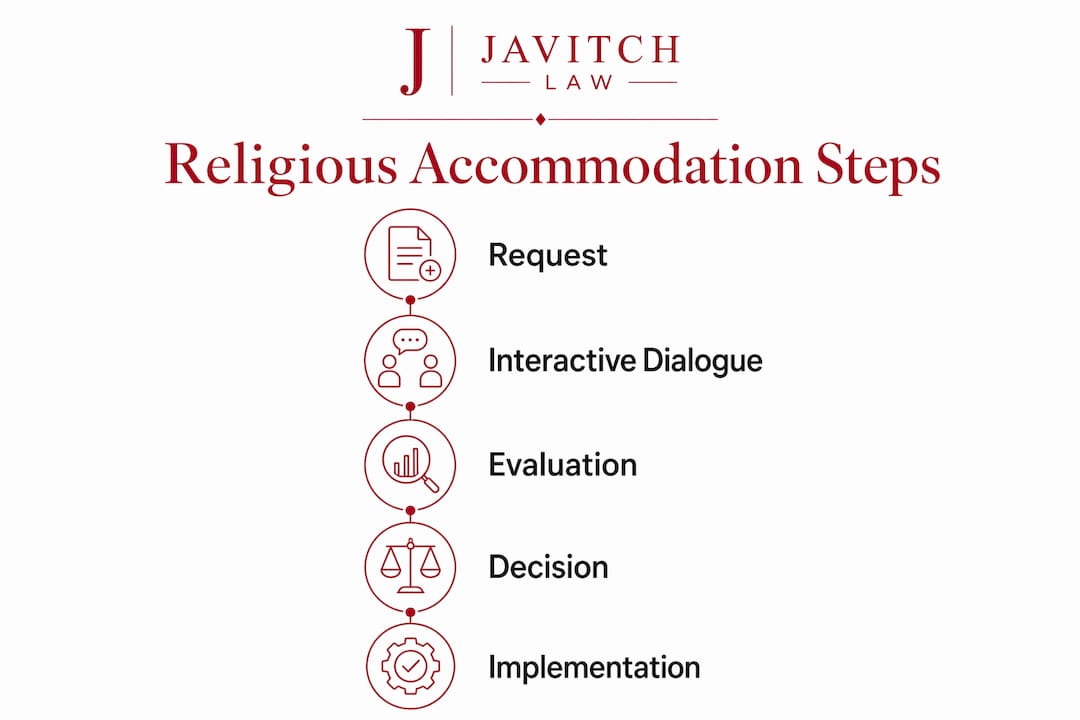
Common religious accommodation examples include schedule swaps, flexible start and end times, prayer breaks, dress code exceptions, and reassignment to a role that does not conflict with religious obligations. The EEOC’s june 2026 guidance confirms that employers must consider all reasonable alternatives before refusing a request.
The interactive process is the formal mechanism for reaching that solution. Here is how it works:
- The employee submits a written request. State the religious belief or practice, explain the conflict with the current work requirement, and propose at least one possible accommodation.
- The employer acknowledges and engages. The employer must respond in good faith, not simply deny the request without exploring options.
- Both parties discuss alternatives. If the proposed accommodation does not work, the employer must offer a counter-proposal rather than a flat refusal.
- A solution is documented. Any agreed accommodation should be confirmed in writing to protect both parties.
- The arrangement is reviewed periodically. Business needs change, and accommodations may need adjustment over time.
Failure to accommodate religion occurs when an employer skips this process entirely or refuses without demonstrating substantial hardship. That failure exposes the employer to EEOC complaints, state agency claims, and civil litigation.
Pro Tip: If your employer ignores your written accommodation request for more than two weeks, send a follow-up email referencing your original request and the date you submitted it. That paper trail matters if you later file a complaint.
How did Groff v. DeJoy change the undue hardship standard?
The Groff v. DeJoy ruling in 2023 is the most significant shift in religious accommodation law in decades. Before the decision, employers could deny accommodation by showing only a “de minimis” cost, a standard so low that almost any inconvenience qualified. The Supreme Court rejected that standard unanimously.
Under the new rule, employers must show substantial increased costs in the context of their overall business operations. A large company cannot claim hardship because one shift needs minor rescheduling. Courts now weigh the size of the business, the nature of its operations, the cost of the accommodation, and whether the employer genuinely explored alternatives.
| Factor courts examine | What it means in practice |
|---|---|
| Employer size | Larger employers face a higher burden to prove hardship |
| Nature of operations | Safety-critical roles may justify denial; office roles rarely do |
| Cost of accommodation | Minor scheduling costs do not meet the substantial threshold |
| Alternatives explored | Failure to consider alternatives weakens the employer’s case |
| Impact on other employees | Inconvenience alone is not hardship under the new standard |
This shift matters for California employees specifically. California’s FEHA already imposed a stricter standard than the old federal rule, so the Groff decision brings federal law closer to what California workers already enjoyed. The practical result is that granting accommodation is now cheaper and less legally risky for most employers than denying it without solid justification.
What protections exist against retaliation after a religious discrimination claim?
Retaliation is illegal the moment an employee requests a religious accommodation or files a discrimination complaint. The law prohibits any adverse action taken in response, including termination, demotion, reduced hours, hostile reassignment, or a sudden increase in negative performance reviews.
The EEOC’s enforcement record makes the financial stakes clear. In march 2026, the EEOC secured a $100,200 settlement against an employer who denied a religious accommodation and then retaliated against the employee who requested it. That settlement required both financial payment and policy changes. One case, one request, six figures in liability.
Retaliation often looks subtle at first. Watch for these warning signs after you submit an accommodation request:
- A sudden shift in performance evaluations with no change in your actual work
- Exclusion from meetings, projects, or communications you previously received
- Reassignment to less desirable shifts, locations, or duties
- Increased scrutiny or micromanagement that did not exist before
- Comments from supervisors suggesting your request was “disruptive” or “inconvenient”
Documentation is your strongest defense. Save every email, note every conversation with a date and witness, and keep copies of your original accommodation request and any employer responses.
Retaliation claims are often stronger than the underlying discrimination claim because the employer’s response is direct evidence of intent. If you were passed over for a promotion two weeks after filing an accommodation request, that timeline tells a story that is very hard for an employer to explain away.
For employees who also face First Amendment concerns in public-sector roles, retaliation after protected activity follows a parallel legal framework with its own remedies.
How can employees identify and respond to religious discrimination?
Recognizing workplace religion bias early gives you more options. The clearest signs are adverse employment actions that follow closely after a religious practice becomes visible to management. A promotion denied the week after you disclosed your faith, a schedule change that targets your sabbath, or a sudden dress code enforcement that only applies to you are all red flags.
Once you identify a problem, act in this order:
- Document everything immediately. Write down what happened, when it happened, who was present, and what was said. Do this the same day.
- Submit your accommodation request in writing. Email is sufficient. State your religious belief, identify the specific conflict, and propose a workable solution.
- Engage the interactive process in good faith. Be flexible. The law requires a reasonable accommodation, not your preferred one.
- Report internally if the conduct continues. File a written complaint with HR or your employer’s designated EEO officer. Keep a copy.
- File with the EEOC or the California Civil Rights Department. In California, you generally have one year from the date of the violation to file with the CRD. Federal EEOC deadlines are 180 or 300 days depending on the situation.
- Consult an employment attorney. An attorney can assess whether your employer met its obligations under Title VII and California’s FEHA, and whether retaliation occurred.
Effective documentation and active participation in the interactive process strengthen your legal position significantly. Employees who can show they acted in good faith and the employer did not tend to fare better in both agency proceedings and civil litigation.
One important limitation applies to employees at religious organizations. The ministerial exception can block discrimination claims where a role involves religious teaching or leadership functions. This exception is not limited to ordained clergy. If your job at a faith-based organization requires you to convey religious doctrine, your legal options may be narrower, and consulting an attorney early is critical.
For employees facing antisemitic conduct specifically, Javitchlawoffice has published a detailed guide on Jewish workplace discrimination rights that covers both federal and California-specific protections.
Key Takeaways
Religious discrimination at work is illegal under Title VII and California’s FEHA, and the 2023 Groff v. DeJoy ruling makes it harder than ever for employers to justify denying a religious accommodation request.
| Point | Details |
|---|---|
| Legal coverage | Title VII covers employers with 15+ employees; California’s FEHA covers employers with 5+ workers. |
| Accommodation obligation | Employers must engage the interactive process in good faith before denying any accommodation request. |
| Groff v. DeJoy impact | Employers must now show substantial increased costs, not just minor inconvenience, to deny accommodation. |
| Retaliation is illegal | Any adverse action after an accommodation request or complaint is independently actionable. |
| Document everything | Written records of requests, responses, and incidents are the foundation of any successful claim. |
What I have seen employees get wrong about religious accommodation
After working on civil rights cases, the pattern I see most often is employees who assume their employer will do the right thing without being pushed. They mention their religious conflict verbally, get a vague response, and then wait. Weeks pass. Nothing changes. By the time they realize the employer has no intention of accommodating them, the window for some remedies has narrowed.
The Groff decision genuinely shifted leverage toward employees, but only for employees who know how to use it. Most people do not realize that an employer’s failure to engage the interactive process is itself a legal violation, separate from the underlying discrimination. That procedural failure is often the clearest evidence in a case.
The other mistake I see is employees who accept the first “no” as final. An employer saying “we can’t do that” is not a legal determination of undue hardship. It is a starting position. Push back in writing, ask what alternatives the employer considered, and request documentation of the hardship analysis. That request alone often changes the conversation.
EEOC enforcement activity in recent years reflects a clear agency focus on religious discrimination, including vaccine mandate disputes and harassment claims. The agency is paying attention. You should too. If your employer is not engaging seriously with your accommodation request, the EEOC and California CRD are real options, not last resorts.
— Mark
Javitchlawoffice and your religious discrimination case
Religious discrimination cases require attorneys who understand both the federal framework and California’s stronger state protections. Javitchlawoffice is a California-based civil rights firm that handles employment discrimination claims involving religious bias, accommodation denials, and retaliation, with a track record of holding employers accountable under Title VII and the FEHA.
If your employer has ignored your accommodation request, retaliated after you raised a religious concern, or subjected you to harassment because of your faith, Javitchlawoffice offers personalized legal representation focused on your specific situation. The firm combines California-specific knowledge with national civil rights experience to build the strongest possible case. Understanding how federal courts handle settlements in discrimination matters can also help you set realistic expectations before you file. Contact Javitchlawoffice to discuss your case and understand your options.
FAQ
What qualifies as religious discrimination at work?
Religious discrimination at work occurs when an employer takes an adverse action, such as firing, demotion, or harassment, because of an employee’s religious beliefs, practices, or observances. Title VII protects all sincerely held religious beliefs, including non-traditional beliefs that function like religion, not only major organized faiths.
What are common religious accommodation examples?
Common accommodations include schedule swaps to avoid working on a religious day of rest, dress code exceptions for religious garments, flexible hours for prayer, and reassignment to roles without religious conflicts. Employers must offer a reasonable accommodation, though not necessarily the employee’s preferred solution.
How do I report religious discrimination in California?
File a complaint with the California Civil Rights Department or the EEOC. California employees generally have one year from the date of the violation to file with the CRD, while federal EEOC deadlines are 180 or 300 days depending on whether a state agency also covers the claim.
Can my employer fire me for requesting a religious accommodation?
No. Firing, demoting, or harassing an employee for requesting a religious accommodation is illegal retaliation under Title VII. The EEOC secured a $100,200 settlement in march 2026 against an employer who did exactly that.
Does the ministerial exception affect my religious discrimination claim?
The ministerial exception can limit legal recourse for employees at religious organizations whose roles involve conveying religious doctrine or providing religious leadership. This exception extends beyond ordained clergy to any role with significant religious teaching or leadership functions, so consulting an attorney early is critical if you work for a faith-based employer.
Recommended
- Jewish Discrimination in the Workplace: Know Your Rights and Legal Options | Javitch Law Office
- When to Hire a Racial Discrimination Lawyer: Protecting Your Workplace Rights | Javitch Law Office
- Fighting Antisemitic and Racial Discrimination in the Workplace | Javitch Law Office
- School Discrimination Lawyer: Protecting Your Child’s Right to Equal Education | Javitch Law Office